Page
293
AUGLAIZE
COUNTY
was formed in 1848 from portions of Allen, Logan, Darke,
Shelby, Mercer and Van Wert counties. It is at the southern termination
of the Black
Swamp district, and occupies the great dividing ridge between the head
waters
of Lake Erie and Ohio river. Only the
northwestern
part possesses the peculiar characteristics of the “Black Swamp;” by
ditching
the greater part has been brought tinder cultivation. The Mercer county
reservoir, a great artificial lake of 17,500 acres and an average of
ten feet
in depth, is partly in this county; it abounds with fish, ducks and
geese. The
population is largely of German origin. It contains 400 square miles.
In 1885
the acres cultivated were 131,205; in pasture, 14,997; woodland,
60,842; lying
waste, 1,346; produced in wheat, 594,538 bushels; in corn, 1,330,471;
barley,
18,795; tobacco, 7,600 pounds. School census in
1886, 9,566;
teachers, 140. It has 39 miles of railroad.
|
Township And
Census |
1840 |
1880 |
|
Township And
Census |
1880 |
1880 |
|
Clay, |
840 |
1,346 |
|
Noble, |
309 |
1,303 |
|
Duchouquet, |
905 |
4,971 |
|
Pusheta, |
1,008 |
1,456 |
|
German, |
1,470 |
2,239 |
|
Saint Mary’s, |
693 |
3,147 |
|
Goshen, |
336 |
796 |
|
Salem, |
400 |
1,160 |
|
Jackson, |
|
1,991 |
|
Union, |
1,008 |
1,590 |
|
Logan, |
336 |
1,206 |
|
Washington, |
688 |
1,515 |
|
Moulton, |
450 |
1,436 |
|
Wayne, |
672 |
1,288 |
Population in 1850 was 11,341; in 1860,
17,187; in
1880, 25,444, of whom 21,040 were Ohio-born.
In this county three specimens of the
mastodon have
been discovered as stated in historical sketch in the County
Atlas—first in
1870 in Clay township; second, in 1874 also in Clay; third, in 1878 in
Washington. The mastodon differed from the elephant in being somewhat
larger
and thicker though in general not unlike it. Cuvier
called it mastodon from the form of its teeth; the name is from two
Greek words
signifying “nipple teeth.” The bones of the mastodon have been
discovered over
a large part of the United States and Canada; the bones of a hundred
have been
discovered at Big Bone Lick, Ky., and probably as many in different
parts of
this State.
The parts of skeleton No. 1 show it to
have been an
animal about fourteen feet high, eighteen feet long and with tusks
probably
twenty-seven feet. It was found while excavating a ditch through Muchinippi swamp eight feet from the surface,
which for the
first third was peat and the rest marly
clay. The bones were discovered in a posture natural to an animal
sinking in
the mire. It is supposed it lost its life within 500 or 1,000 years
after the
deposition of the drift in which the marsh deposits rest. The remains
of No. 2 were
found in the same swamp. Only a few relics of No. 3 have been
discovered. The
ground being boggy there it is supposed that all the remainder of the
skeleton
awaits only search for its recovery, and in good preservation.
After the remnant of the powerful and
noble tribe
of Shawnee Indians were driven from Piqua, by General George Rogers
CLARK,
which was in 1780, they settled a town here, which they called Wapaghkonetta, and
the site of the now county-seat. Early in the century there was at the
place a
fine orchard, which from its being planted in regular order was
supposed to
have been the work of Frenchmen settled among the Indians. By the
treaty at the
Maumee rapids, in 1817, the Shawnees were given a reservation of ten
miles
square in this county, within which was their council-house at
Wapakoneta, and
also a tract of twenty-five square miles, which included their
settlement on
Hog creek; by the treaty of
Page 294
the succeeding year, made at St. Mary’s,
12,800 acres
adjoining the east line of the Wapakoneta reserve were added.
From the year 1796 till the formation
of the State
constitution, Judge BURNET, of Cincinnati, attended court regularly at
Marietta
and Detroit, the last of which was then the seat of justice for Wayne county.
The jaunts between these remote places,
through a
wilderness, were attended with exposure, fatigue and hazard, and were
usually
performed on horseback, in parties of two or three or more. On one of
these
occasions, while halting at Wapakoneta, he witnessed a game of ball
among the
people, of which he has given this interesting narrative:
BLUE JACKET, the
war-chief, who
commanded the Shawnees in the battle of 1794, at Maumee, resided in the
village,
but was absent. We were, however, received with kindness by the old
village
chief, BUCKINGELAS.
When we went to his
lodge he was
giving audience to a deputation of chiefs from some western tribes. We
took
seats at his request till the conference was finished, and the strings
of
wampum were disposed of. He gave us no intimation of the subject-matter
of the
conference, and of course we could not, with propriety, ask for it.
Indians
playing Football.—In a little time
he called in some of his young men, and requested them to get up a game
of
football for our amusement. A purse of trinkets was soon made up, and
the whole
village, male and female, were on the lawn. At these games the men
played
against the women, and it was a rule that the former were not to touch
the ball
with their hands on penalty of forfeiting the purse; while the latter
had the
privilege of picking it up, running with, and throwing it as far as
they could.
When a squaw had the ball the men were allowed to catch and shake her,
and even
throw her on the ground, if necessary to extricate the ball from her
hand, but
they were not allowed to touch or move it, except by their feet. All
the
opposite extremes of the lawn, which was a beautiful plain, thickly set
with
blue grass stakes were erected, about six feet apart—the contending
parties
arrayed themselves in front of these stakes; the men on the one side,
and the
women on the other. The party which succeeded in driving the ball
through the
stakes, at the goal of their opponents, were
proclaimed
victors, and received the purse. All thing
being the
old chief went to the centre of the lawn and threw up the ball, making
an
exclamation, in the Shawnee language, which we did not understand. He
immediately retired, and the contest began. The parties seemed to be
fairly matched as to numbers, having about a
hundred
on a side.
The game lasted more
than an hour
with great animation, but was finally decided in favor of the ladies,
by
the power of an herculean squaw, who got
the ball and
in spite of the men who seized her to shake it from her uplifted hand,
held it
firmly, dragging them along, till she was sufficiently near the goal to
throw
it through the stakes. The young squaws were the most active of their
party,
and, of course, most frequently caught the ball. When they did so it
was
amusing to see the strife between them and the young Indians, who
immediately
seized them, and always succeeded in rescuing the ball, though
sometimes they
could not effect their object till their
female
competitors were thrown on the grass. When the contending parties had
retired
from the field of strife it was pleasant to see the feelings of
exultation
depicted in the faces of the victors whose joy was manifestly enhanced
by the
fact, that their victory was won in the presence of white men, whom
they
supposed to be highly distinguished, and of great power in their
nation. This
was a natural conclusion for them to draw, as they knew we were
journeying to
Detroit for the purpose of holding the general court; which, they
supposed,
controlled and governed the nation. We spent the night very pleasantly
among
them, and in the morning resumed our journey.
In August, 1831, treaties were made
with the Senecas of Lewiston and the
Shawnees of Wapakoneta, by
James GARDINER, Esq., and Col. John M’ELVAIN, special commissioners
appointed
for this purpose, by which the Indians consented to give up their land
and
remove beyond the Mississippi. The Shawnees had at this time about
66,000 acres
in this county, and in conjunction with the Senecas
about 40,300 acres at Lewiston. The Indians were removed to the Indian
Territory on Kansas river, in the Far West,
in
September, 1832, D. M. WORKMAN and David ROBB being the agents for
their
removal. The removal of the Indians opened the country to the
settlement of the
whites. Therefore in 1833 the present town of Wapakoneta was platted;
the
original proprietors were Robert J. SKINNER, Thomas B. VAN HORNE,
Joseph
BARNETT, Jonathan. K. WILDS and Peter
Page 295
AUGENBAUGH. Up to this time from early in the
century the
Friends had a mission here among the Indians.
WAPAKONETA,
the county-seat; seventy-five
miles northwest of
Columbus, is on the C. H. & D. R. R. It is situated within the oil
and gas
belt, both of which have been struck in considerable quantities. The
surrounding country is, a rich agricultural district, and there is much
manufacturing done in wooden articles. More churns, it is claimed, are
made
here than in any other place in the country. County officers in 1888:
Probate
Judge, John McLAIN; Clerk of Court, James
A. NICHOLS;
Sheriff, Wm. SCHULENBERG; Prosecuting Attorney, Cyrenius
A. LAYTON; Auditor, Wm. F. TORRANCE; Treasurer, Colby C. PEPPLE;
Recorder, John
J. CONNAUGHTON; Surveyor, John B. WALSH; Coroner, F. C. Hunter;
Commissioners,
Henry KOOP, George VAN OSS John REICHELDERER.
Newspapers: Auglaize
Republican, Republican, W. J. McMURRAY,
editor; Auglaize County Democrat, Democrat,
Fred. B. KAMPF, editor. Churches: 1 English Lutheran, 1 Evangelist
German Protestant,
1 Methodist, 1 Presbyterian, l Catholic, 1 German Lutheran. Banks:
First
National, L. N. BLUME, president; C. F. HERBST, cashier; People’s
National, F.
FRITCH, president, F. J. McFARLAND,
cashier.
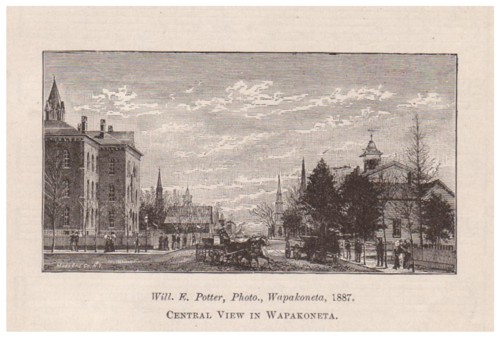
Will E. Potter, Photo,
Wapakoneta, 1887.
CENTRAL VIEW IN
WAPAKONETA.
Manufactures
and Employees—Stenger
& Frank, flour, etc.; Wapakoneta
Bending Co., spokes and rims, 50 hands; J. Gately,
lumber; Theodore Dickman, builders’
wood-work; Rupp
& Winemiller, limber; Wapakoneta Churn
&
Handle Co., churns and handles, 47; M. Brown & Co., washing
machines, etc.,
29; Swink Bros. & Co., furniture,
etc., 17; C.
Fisher, flour, etc., 7; Wapakoneta Spoke & Wheel Co., wheels and
spokes, 50.--State Report 1887.
Population in 1880
2,765.
School census in 1886, 1,291; J. T. CARSON, superintendent.
TRAVELLING NOTES.
A pleasant, name for a
place is
desirable. Every inhabitant unconsciously derives from it a benefit; it
is a
happy association. This is proved by the reverse. What interest could
we take
in a people who lived in “Hard Scrabble” or “swineville?”
Wapakoneta enjoys the distinction of having, with possibly a single
exception—”Pataskala”—the most original and musical name in the State.
The word
has the flavor of antiquity; this enhances the charm, carries the mind
back to
the red man and the wilderness.
Col. John JOHNSTON,
agent among
the
Page 296

|
THE HILLS OF OHIO From “The Key of the West” by Alex. Auld. 1. The hills
of Ohio, how sweetly they rise,
In the beauty of nature to blend with the skies;
When fair azure outline, and tall ancient trees,
Ohio, my country, I love thee for these. 2. The homes of Ohio, free fortuned, and fair,
Full many hearts treasure a sister’s love there;
E’en more than they hill-sides
or streamlets they please,
Ohio, my country, I love thee for these. 3. God shield thee, Ohio, dear land of my birth,
And thy children that wander afar o’re
the earth;
My country thou art, where’er
my lot’s cast,
Take thou to they bosom my ashes at last. |
Page 297
Indians, appointed by
Jefferson,
thus wrote me in 1846: “Wapagh-ko-netta—this is the true Indian
orthography. It was named after an
Indian chief long since dead, but who survived years after my
intercourse
commenced with the Shawanoese. The chief
was somewhat
club-footed, and the word has reference, I think, to that circumstance,
although its full import I never could discover. For many years prior
to 1829 I
had my Indian headquarters at Wapagh-ko-netta.
The business of the agency of the Shawanoese,
Wyandots. Senecas, and Delawares was transacted there.”
Speaking of the
benefit of a good name, let me pursue- the
matter a little further. The people
of the whole State in this respect have been specially favored. The
name of but
one other equals it in the merit of brevity. Regardful of the English
alphabet,
it makes three letters do the business— “O” “H,” “I”—these letters
only,
inasmuch as the last is only a second appearing of the first. It is the
only
State the name of which suggests the idea of “elevation;” does this no
intemperate sense. The name drops in with song so nicely that, away
back early
in the century, multitudes sang its praises who had never seen Ohio,
living, as
they did, by the ocean side; sang them while feasting their eyes with
the broad
expanse of the rolling blue and breathing in the grateful odors of the
salt
meadows.
Poetry and song ever
appeal to the
imagination, and so helped its quick settlement. Great things always
require
them—as war and religion. All soldiers, even savages, have their war
songs, and
the only religionists among us who have not song are those calm,
sweet-tempered
people, “the Friends,” and they are fast melting; soon will vanish
entirely,
when the “thees” and “thous”
will be heard no more in the land. A
single verse drops in here as a matter of history. It is from one of
the songs
that was sung at the East at the end of some game where kissing-never
to be a
lost art-was going on between young people, who later largely became
fathers
and mothers out here in the Ohio-land
|
“Arise, my
true love, and present me your
hand, And we’ll
march in procession for a far distant
land: Where the
girls will card and spin, And the boys
will plough and sow, And we’ll
settle on the banks of the pleasant
Ohio.” |
Suppose an unsavory
name had been
given to the great river, and then applied to the State. It might have
retarded
its settlement for years. Say the name of a certain river now in
Vermont—“Onion.”
Who would have sung its praises? What kind of emigrants would have been
attracted, and by what name after they got here would they have been
called? As
it was, the pioneers were the brightest, bravest, most cheery young
people of
the East, and their children inheriting their exuberance and pluck,
fill the
land with hope and song.
A song most widely
sung is that
entitled “The Hills of Ohio” (p. 296), by Alexander AULD
published in his
“Key of the West.” He was born in Milton, Pa., and came to Ohio in 1822, when a
child of six years, and at the age of
fifteen began
teaching music. He taught music for fifty years, and is still living in
Deersville, Harrison county,
enjoying a happy, healthy old age. In a letter recently written by
himself, he
says he first taught by the old four-note system, but that on Christmas
eve,
1835, he added to our
present musical scale the first, second, and seventh
syllables, thereby increasing the popularity and simplicity of his own
patent-note system. He is the author of four books, viz.: “The Ohio
Harmonist,”
“The Key of the West,” The Farmers’ and Mechanics’ Minstrel,” and “The
Golden
Trumpet.” It is said he sold 600,000 copies of the “Ohio Harmonist,”
and about
700,000 of the other three, making in all 7,300,000 of Auld’s
singing-book—and these went largely into Ohio homes-hence he is widely
known.
The words are not original with Mr. AULD, but were set to music and
largely
sung by emigrants in the early years of this century.
Indian
Characteristics and Customs.—Mr. David ROBB, one of the agents for
the removal
of the Indians, had great experience among them, and has left this
record of
their peculiar traits:
Intemperance to a
great extent
prevailed among the Indians; there was, however, as wide a contrast in
this
respect as with the whites, and some of the more virtuous refused to
associate
with the others. This class also cultivated their little farms with a
degree of
taste and judgment: some of these could cook a comfortable meal, and I
have
eaten both butter and a kind of cheese made by them. Many of them were
quite
ingenious and natural mechanics, with a considerable knowledge of and
an
inclination to use tools. One chief had an assortment of carpenters’
tools
which he kept in neat order. He made plows, harrows, wagons, bedsteads,
tables,
bureaus, etc. He was frank, liberal and conscientious. On my asking him
who
taught him the use of tools, He replied, no one; then pointing up to
the sky,
he said, “the Great Spirit taught me.”
Fascinations
of Indian Character.—With
all their foibles and vices there is something fascinating in the
Indian
character, and one cannot long associate with them without having a
perceptible
growing attachment. The Indian is emphatically the natural man, and it
is an
easy thing to make an Indian out of a white person, but very difficult
to
civilize or Christianize an Indian. I have known a number of whites who
had
been taken pris-
Page 298
oners by the Indians when
young, and with out exception they formed such
attachment; that after being with them some time, they could not be
induced to
return to their own people. There was a woman among the Shawnees,
supposed to
be near an hundred years of age, who was taken prisoner, when young, in
Eastern
Pennsylvania. Some year; after, her friends, through the agency of
traders,
endeavored to induce her to return but in vain. She became, if
possible, more
of a squaw in her habits and appearance than any female in the nation.
Indian Punctuality.—A sample
of their punctuality in performing their
contracts, I would state that I have often loaned them money, which was
always
returned in due season, with a single exception. This was a loan to a
young man
who promised to pay me when they received their annuity. After the
appointed
time he shunned me, and the matter remained unsettled until just prior
to our
departure for their new homes. I then stated the circumstance to one of
the
chiefs more from curiosity to see how he would receive the intelligence
than
with the expectation of its being the means of bringing the money. He,
thereupon, talked with the lad upon the subject, but, being
unsuccessful, he
called a council of his brother chiefs, who formed a circle, with the
young man
in the centre. After talking to him a while in a low tone, they broke
out and
vociferously reprimanded him for his dishonest conduct but all proved
unavailing. Finally, the chiefs in a most generous and noble spirit, made up the amount from their own purses, and
pleasantly
tendered it to me.
Belief in
Witchcraft.—The Indians being
firm believers
in witchcraft, generally attributed sickness and other misfortunes to
this
cause, and were in the habit of murdering those whom they suspected of practising it. They have been known to travel
all the way from the
Mississippi to Wapakoneta, and shoot down a person in his cabin merely
on
suspicion of his being a wizard, and return unmolested. When a person
became so
sick as to lead them to think he was in danger of death, it was usual for them to place him it
the woods alone, with no one to
attend except a
nurse or doctor, who generally acted as an agent in hurrying on the
dissolution, It was distressing to see one in this
situation, I have
been permitted to do this only through the courtesy of relatives, it
being
contrary to rule for any to visit them except such as had medical care
of them.
The whole nation and at liberty to attend the funerals, at which there
is
generally great lamentation. A chief, who died just previous to their
removal,
was buried in the following manner. They
bored holes in the lid of his coffin—as their custom—over his eyes and
mouth,
to let the Good Spirit pass in and out. Over the grave they laid
presents, etc.. with
provisions, which they
affirmed the Good Spirit would take him in the night. Sure enough!
–these
articles had all disappeared in the morning, by the hand of an evil spirit clothed in a human body. There were many funerals among the
Indians, and
their numbers rapidly decreased intemperance, and pulmonary and
scrofulous
diseases, made up a large share of their bills of mortality, and the
number of
deaths to the births were as one to three.
A few anecdotes will
illustrate
the wit and dishonesty of some, and the tragical
encounters of others of the Indians. Col. M’PHERSON the former
sub-agent, kept
goods for sale, for which they often got in debt. Some were slow in
making
payments, and one in particular was so tardy that M’PHERSON earnestly
urged him
to pay up. Knowing that he was in the habit of taking hides from the
tanners,
the Indian inquired if he would take hides for the debt. Wing answered
in the
affirmative, he promised to bring them in about four days. The Indian,
knowing
that M’PHERSON had at this time a flock of cattle ranging in the
forest, went
in pursuit, shot several, from which he took off the hides, and
delivered them
punctually according to promise.
Love of Whiskey—While
we were encamped,
waiting for the Indians to finish their ceremonies prior to emigration,
we were
much annoyed by an unprincipled band of whites who came to trade,
particularly
in the article of whiskey, which they secreted from us in the woods.
The
Indians all knew of this depot, and were continually going, like bees
from the
hive, day and night, and it was difficult to tell whether some who led
in the
worship passed most of the time in that employment or in drinking
whiskey.
While this state of things lasted, the officers could do nothing
satisfactorily
with them, nor were they sensible of the consequence of continuing in
such a
course. The government was bound by treaty stipulations to maintain
them one
year only, which was passing away, and winter was fast approaching,
when they
could not well travel, and if they could not arrive until spring, they
would be
unable to raise a crop, and consequently would be out of bread. We
finally
assembled the chiefs and other influential men, and presenting these
facts
vividly before them, they became alarmed and promised to reform. We
then
authorized them to tomahawk every barrel keg, jug, or bottle of whiskey
that
they could find, under the promise to hay for all and protect them from
harm in
so doing. They all agreed to this, and went to work that night to
accomplish
the task. Having lain down at a late hour to sleep, I was awakened by
one who
said he had found and brought me a jug of whiskey: I handed him a
quarter of a
dollar, set the whiskey down, and fell asleep again. The same follow
then came,
stole jug and all, and sold the contents that night to the Indians at
“a
shilling a dram—a pretty good speculation on a half gallon of “whisk ,” as the Indians call it. I suspected him
of the
trick, but he would not confess it until I was about to part with them
at the
end of the journey, when he came to me and related the cir-
Page 299
cumstances, saying that it was
too good a story to keep. One of our interpreters,
who was part Indian and had lived with them a long time, related the
following tragical occurrence. A company
of Shawnees met some time prevous to my
coming among them, had a drunken frolic and quarrelled.
One vicious fellow who
had an old grudge against several of the others, and stabbed two of the
company
successively until they fell dead, was making for the third, when his
arm was
arrested by a large athletic Indian, who, snatching the knife from him,
plunged
it into him until he fell. He attempted to rise and got on his knees,
when the
other straddled him, seized him by the hair, lifted up his head with
one hand,
while with the other he drew his knife across his throat, exclaiming—
“lie
there, my friend! I guess you not eat any more hominy.”
Religious Ceremonies.—After we had
rendezvoused, preparatory to moving,
we were detained several weeks waiting until they had got over their
tedious
round of religious ceremonies, some of which were public and others
kept
private from us. One of their first acts was to take away the fencing
from the
graves of their fathers, level them to the surrounding surface, and
cover them
so neatly with green sod, that not a trace of the graves could be seen.
Subsequently, a few of the chiefs and others visited their friends at a
distance, gave and received presents from chiefs of other nations, at
their
headquarters.
Among the ceremonies
above alluded
to was a dance, in which none participated but the warriors. They threw
off all
their clothing but their breechclouts, painted their faces and naked
bodies in
a fantastical manner, covering them with the pictures of snakes and
disagreeable insects and animals, and then, armed with war clubs,
commenced dancing,
yelling and frightfully distorting their countenances: the scene was
truly
terrific. This was followed by the dance they usually have on returning
from a
victorious battle, in which both sexes participated. It was a pleasing
contrast
to the other, and was performed in the night, in a ring, around a large
fire.
In this they sang and marched, males and females promiscuously, in
single file,
around the blaze. The leader of the band commenced singing, while all
the rest
were silent until he had sung a certain number of words, then the next
in the
row commenced with the same, and the leader began, with a new set, and
so on to
the end of their chanting. All were sin singing at once, but no two the
same
words. Twas told that part of the
words they used were
hallelujah! It was pleasing to witness the native modesty and graceful
movements of those young females in this dance.
When their ceremonies
were over,
they informed us they were now ready to leave. They then mounted their
horses,
and such as went in wagons seated themselves, and set out with their
“high
priest” in front, bearing on his shoulders “the ark of the covenant,”
which
consisted of a large gourd and the bones of a deer’s leg tied to its
neck. Just
previous to starting, the priest gave a blast of his trumpet, then moved slowly and solemnly while the others
followed in
like manner, until they were ordered to halt in the evening and cook
supper.
The same course was observed through the whole of the journey. When
they
arrived near St. Louis, they lost some of their number by cholera. The
Shawnees
who emigrated numbered about 700 souls, and the Senecas
about 350. Among them was also a detachment of Ottawas
who were conducted by Capt. HOLLISTER from the Maunice
country.
The principal speaker among the
Shawnees at the
period of their removal was
WIWELIPEA. He was an eloquent
orator—either grave or gay, humorous or
severe, as the occasion
required. At times his manner was so
fascinating, his countenance so full of varied expression, and his
voice so
musical, that surveyors and other strangers passing through the country
listened to him with delight, although the words fell upon their ears
in an
unknown language. He removed out west with his tribe. The chief
CATAHECASSA, or
BLACK HOOF, died at Wapakoneta, shortly previous to their removal, at
the age
of 110 years. The sketches annexed of BLACK
HOOF and BLUE JACKET are derived from
Drake’s
“Tecumseh.”
The Chief Black Hoof.—Among
celebrated chiefs of the Shawanoes, BLACK
HOOF is entitled
to a high rank. He was born in Florida, and at the period of the
removal of a
portion of that tribe to Ohio and Pennsylvania was old enough to
recollect
having bathed in the saltwater. He was present, with others of his
tribe, at
the defeat of Braddock, near Pittsburg, in 1755, and was engaged in all
the
wars m Ohio from that time until the treaty of Greenville, in 1795.
Such was
the sagacity of BLACK HOOF in planning his military expeditions, and
such the
energy with which he executed them, that he won the confidence of his
whole
nation, and was never at a loss for braves to fight under his banner.
He was
known far and wide as the great Shawanoe
warrior,
whose cunning, sagacity, and experience were only equalled
by the fierce and desperate bravery with which he carried into
operation his
military plans. Like the other Shawanoe
chiefs, he
was the inveterate foe of the white man, and held that no peace should
be made
nor any negotiation attempted except on the condition that the whites
should repass the mountains, and leave the
Page 300
great plains of the west to
the sole
occupancy of the native tribes.
He was the orator of
his tribe
during the greater part of his long life, and was an excellent speaker.
The venerable
Colonel JOHNSON, of Piqua, to whom we are indebted for much valuable
information, describes him as the most graceful Indian he had ever
seen, and as
possessing the most natural and happy faculty of expressing his ideas.
He was
well versed in the traditions of his people; no one understood better
their
peculiar relations to the whites, whose settlements were gradually
encroaching
on them, or could detail with more minuteness the wrongs with which his
nation
was afflicted. But although a stern and uncompromising opposition to
the whites
had marked his policy through a series of forty years, and nerved his
arm in a
hundred battles, he became at length convinced of the madness of an
ineffectual
struggle against a vastly superior and hourly increasing foe. No sooner
had he
satisfied himself of this truth, than he acted upon it with the
decision which
formed a prominent trait in his character.
The temporary success
of the
Indians in several engagements previous to the campaign of General
WAYNE had
kept alive their expiring hopes; but their signal defeat by that
gallant
officer convinced the more reflecting of their leaders of the desperate
character of the conflict. BLACK HOOF was among those who decided upon
making
terms with the victorious American commander; and having signed the
treaty of
1795, at Greenville, he continued faithful to his stipulations during
the
remainder of his life. From that day, he ceased to be the enemy of the
white
man; and as he was not one who could act a negative part, he became the
firm
ally and friend of those against whom his tomahawk had been so long
raised in
vindictive animosity. He was their friend, not from sympathy or
conviction, but
in obedience to a necessity which left no middle course, and under a
belief
that submission alone could save his tribe from destruction; and having
adopted
this policy, his sagacity and sense of honor alike forbade a recurrence
either
to open war or secret hostility. He was the principal chief of the Shawanoe nation, and possessed all the influence
and
authority which are usually attached to that office, at the period when
TECUMSEH and his brother the PROPHET commenced their hostile operations
against
the United States.
When TECUMSEH and the
PROPHET
embarked in their scheme for the recovery of the lands as far south as
the Ohio
river, it became their interest as well as policy to enlist BLACK HOOF
in the
enterprise; and every effort which the genius of the one, and the
cunning of
the other, could devise, was brought to bear upon him. But BLACK HOOF
continued
faithful to the treaty which he had signed at Greenville, in 1795, and
by
prudence and influence kept the greater part of his tribe from joining
the
standard of TECUMSEH or engaging on the side of the British in the late
war
with England. In that contest he became the ally of the United States,
and
although he took no active part in it, he exerted a very salutary
influence
over his tribe. In January, 1813, he visited Gen. TUPPER’S camp, at
Fort
McArthur, and while there, about ten o’clock one night, when sitting by
the
fire in company with the General and several other officers, some one
fired a
pistol through a hole in the wall of the but, and shot BLACK HOOF in
the face:
the ball entered the cheek, glanced against the bone, and finally
lodged in his
neck: he fell, and for some time was supposed to be dead, but revived,
and
afterwards recovered from this severe wound. The most prompt and
diligent
inquiry as to the author of this cruel and dastardly act failed to lead
to his
detection. No doubt was entertained that this attempt at assassination
was made
by a white man, stimulated perhaps by no better excuse than the memory
of some
actual or ideal wrong, inflicted on some of his own race by an unknown
hand of
kindred color with that of his intended victim.
BLACK HOOF was opposed
to
polygamy, and to the practice of burning prisoners. He is reported to
have
lived forty years with one wife, and to have reared a numerous family
of
children, who both loved and esteemed him. His disposition was
cheerful, and
his conversation sprightly and agreeable. In stature he was small,
being not
more than five feet eight inches in height. He was favored with good
health,
and unimpaired eyesight to the period of his death.
Blue
Jacket or Weyapiersenwah—the campaign of
General HARMER,
in the year 1790, Blue Jacket was associated with the Miami chief,
Little
Turtle, in the command of the Indians. In the battle of the 20th of
August,
1794, when the combined army of he Indians was defeated by General
Wayne, BLUE
JACKET had the chief control. The night previous to the battle, while
the
Indians were posted at Presque Isle, a council was held, composed of
chiefs
from the Miamis, Pottawatomies,
Delawares, Shawanoes,
Chippewas, Ottawas
and Senecas—the seven nations engaged in
the action. They
decided against the proposition to attack General WAYNE at right in his
encampment. The expediency of meeting him the next day then came up or
consideration. LITTLE TURTLE was opposed so this measure, but being
warmly
supported by BLUE JACKET, it was finally agreed upon. The former was
strongly
inclined to peace, and decidedly opposed to risking a battle under the
circumstances in which the Indians were then placed. “We have beaten
the
enemy,” said he, “twice, under separate commanders. We cannot expect
the same
good fortune always to attend us. The Americans are now led by a chief
who
never sleeps. The night and the day are alike to him; and, during all
the time
that he has been marching upon our villages, notwithstanding the
watchfulness
of our young men, we have never been able to surprise him. Think well
of it.
There is something whispers
Page
301
me, it would be prudent to listen to his offers
of
peace.” The counsels of BLUE JACKET, however, prevailed over the better
judgment of LITTLE TURTLE. The battle was fought and the Indians
defeated.
In the month of October following this
defeat, BLUE
JACKET concurred in the expediency of suing for peace, and at the head
of a
deputation of” chiefs, was about to bear a flag to General Wayne, then
at
Greenville, when the mission was arrested by foreign influence.
Governor
SIMCOE, Colonel McKEE and the Mohawk
chief, Captain
John BRANT, having in charge one hundred and fifty Mohawks and Messasagoes, arrived at the rapids of the
Maumee, and
invited the chiefs of the combined army to meet them at the mouth of
the
Detroit river, on the 10th of October. To
this BLUE
JACKET assented for the purpose of hearing what the British
officers had to propose. Governor SIMCOE urged the Indians to retain
their hostile
attitude towards the United States. In referring to
the
encroachments of the people of this country on the Indian lands, he
said,
“Children: I am still of the opinion that the Ohio is your right and
title have
given orders to the commandant of Fort Miami to fire on the Americans
whenever
they make their appearance again. I will go down to Quebec, and lay
your
grievances before the great man. From thence they will be forwarded to
the king
your father. Next spring, you will know the result of everything what
you and I
will do. “He urged the Indians to obtain a cessation of hostilities,
until the
following spring, when the English would be ready to attack the
Americans, and
by driving them back across the Ohio, restore their lands to the
Indians. These
counsels delayed the conclusion of peace until the following summer.
BLUE
JACKET was present at the treaty of Greenville, in 1795, and conducted
himself
with moderation and dignity.
THE FRIENDS AT
WAPAKONETA.
Early
in this
century the Society of Friends established a mission among the Shawnees
at
Wapakoneta; this was interrupted by the war of 1812. At a very great
expense
they erected a grist-mill and saw-mill on the Auglaize; also a
residence for
Isaac HARVEY, the superintendent, and his family. Under his instruction
the
Indians acquired considerable proficiency in agriculture, the product
being
corn, pumpkins and beans. They made rapid progress in civilization and
the
acquisition of property.
Domestic
animals were introduced and the horse was brought into use to relieve
the women
the labor of ploughing and carrying their
burdens.
While willing to be educated in agriculture, they were for years averse
to
having their children taught by the whites. Eventually this overcome,
their young
people made rapid progress in study.
During
the
summer the men left their women to raise the crops and idled their
time; in
winter they engaged in hunting, but such was their scrupulous honesty
that if
one found the animal of another in his trap he removed the game,
suspended it
near by, and reset it. The missionary HARVEY greatly ingratiated
himself with
the Indians. In the early part of his mission there was living among
them a
Polly BUTLER, a half-breed, being the daughter by a Shawnee woman of
General
Richard BUTLER, an Indian trader before the American Revolution, and
who was
second in command at St. Clair’s defeat and among those killed.
She was accused of bewitching
one of the tribe, and at night fled to the house of HARVEY for
protection,
saying in broken English, “They kill-ee me ! they kill-ee
me! ‘she brought with her a. little child. A
small dog
which followed Harvey was killed, lest his noise should betray her
hiding-place. TENENSKWATAWA, the PROPHET, brother of TECUMSEH, was at
this time
living in the village, and was exorcising a sick man for witchcraft.
HARVEY,
who had visited him, carrying food and nourishment, found him at one
time lying
on his face, his back bare and his whole body so lacerated that he was
in
danger of death from loss of blood. The PROPHET was present, and being
asked by
HARVEY why .this brutal treatment, he replied that the
incisions
were made to extract the combustible matter which the witch had
deposited. The
good Quaker drove the PROPHET out of the house and dressed the sick
man’s
wounds. The Indians came next day to HAWLEY’S house in search of the
fugitive;
she was secreted between two beds, and they failed to discover her.
Later came the chief WEASECAH or CAPTIAN
WOLF. He was a friend of HARVEY. The
result of the
interview was that Harvey went with WEASECAH to the Council House. The
Indians
were dressed some of them in war paint, while WEASECAH made a brief
address to
them; but it was of no avail. Then HARVEY through the interpreter told
them
with great composure that he had come with WEASECAH to intercede for
the woman;
but seeing that they had resolved to follow their own course, he had
prepared
to offer himself in her stead; that he had no weapons and was at their
mercy;
Page
302
they might do with him as they thought best. At
this the
noble chief WEASECAH took hold of HARVEY’s
arm and
said: “Me Qua-ke-lee friend.” He begged the
chiefs
not to suffer their friend the Quaker to be harmed, but they were still
determined not to submit to the proposition. He offered his life
instead of his
friend’s. This heroic attitude of the Quaker, with the loyal and brave
act of
the noble chief checked the tide of hostile feeling, and for a minute
all were
in suspense. Then chief after chief, to the number of six or eight,
stepped up
to HARVEY, each offering his hand, and saying, “Me Qua-ka-lee friend.”
WEASECAH
then argued with then eloquently, and at last the whole council offered
their
hands in friendship, TENSKWATAWA, the PROPHET, only excepted,
who sullenly left the council house in defeat. It was hard for HARVEY
and
WEASECAH to prevail on the poor woman to leave her place of concealment
She remained in the Quaker’s house for
several days, and
then returned to her people and lived in peace.
This was the first successful effort to
arrest the
monstrous practice of destroying life on charges of witchcraft among
these
Indians. The Indians were only a little later than the whites in these
matters.
Thousands were put to death in Germany alone, in the century Columbus
discovered America, on charges of witchcraft.
In 1830 the mission schools came under the
charge of
Mr. Henry HARVEY, and when the Indians were removed to Kansas the
Friends”
mission schools were taken with then under his charge and that of his
family.
In 1842 Mr. HARVEY returned to the East. When about to leave, the Indians bade them an
affectionate
farewell. One of their number whose English name was George
WILLIAMS was
appointed to extend the farewell of the whole tribe, and in doing so he
spoke
as follows: “Mr. brother and sister, I am about to speak for all our
young men
and for all our women and children, and in their name bid you farewell.
They
could not all come, and it would be too much trouble for you to have
them all
here at once, so I have been sent with their message. I was directed to
tell
you that their hearts are full of sorrow, because you are going to
leave them
and return to your home. Ever since you have lived with us we can all
see how
the Quakers and our fathers lived in peace.
“You have treated our children well, and your
doors
have always been open to us. When we were in distress you relieved us;
and when
our people were hungry you gave them food. For your kindness we love
you. Your
children and our children lived together in peace, and at school
learned
together and loved one another. We will always remember you, and teach
our
children to never forget your children. And now, my brothers and
sisters, I bid
you farewell and Caleb and his sisters, and the little boys and their sisters farewell!” He then took Mr. HARVEY by the
hand,
saying, “Farewell, my brother,” and then taking the hand of Mrs. HARVEY
said:
“Farewell, my good sister.” He then bade the children an individual
farewell
and went away in sadness.
St.
Mary’s,
eighty miles northwest of Columbus, lies within the oil and gas belt,
In June,
1887, its daily production of gas from six wells was 25,000,000 cubic
feet. Its
daily production of oil is also quite large. St. Mary’s is on the line
of the
Erie and Miami Canal, and on the L. E. & W. R. R., at the junction of the
Minster branch.
The
town is on elevated ground, 398 feet above Lake Erie. A large canal
basin is in
the place and abundance of water-power is afforded by the Mercer County
Reservoir.
The town is supplied with light and fuel from natural gas owned by the
corporation,
Newspapers:
Argus, Democrat, D. A. CLARK, editor;
Sentinel,
Independent, V. J. WALKUP, editor. Churches: 1 Presbyterian,
l
Methodist, l Baptist, l German Protestant, 1 German Lutheran, 1
Catholic. Bank
of St. Mary’s, F. DICKER, cashier.
Manufactures and Employees.—R. B.
Gordon, flour, etc.; C. Buehler, job machinery, 14 hands; L. Bimel & Son, carriages, etc., 90; John
Ladue, oars and
handles, 20; St. Mary’s Woolen Manufacturing Company, woolen blankets,
etc.,
141; Nietert & Koop, flour, etc.—State Report.
Population in 1880, 1,745; school census in 1886, 761;
C. F.
WHEATON, superintendent.
St.
Mary’s was from early times a noted point, being a village of the
Shawnees.
Gen. Wayne on his campaign
camped here
and called the place “Girty’s town,” from
James
GIRTY, a brother of Simon, who lived here with the Indians and gave his
name to
the place; Harmar was also here prior to
Wayne. In
the war of 1812 there was a fort at St. Mary’s, which for a time was
the
headquarters of Gen. Harrison. It was called Fort Barbee by the
regiment of Col.
BARBEE which built it. Another fort was also built by Col. POGUE at the
Page 303
Ottawa towns on the Auglaize, twelve
miles from St.
Mary’s, which he named, from his wife, Fort Amanda. The regiment of
Col.
JENNINGS completed the fort, which his troops named Fort Jennings.
There were four GIRTY brothers, Thomas,
George,
James and Simon. James was adopted by the Shawnees; George by the Delawares, and Simon by the Senecas.
James was the worst renegade of them all and took delight in inflicting
the
most fiendish cruelties upon prisoners, sparing neither women nor
children.
Simon was the most conspicuous, being a leader and counsellor
among the Indians. It was while at St. Mary’s that General HARRISON
received
his commission of major-general. The old Fort Barbee stood in the
southeast
corner of the Lutheran cemetery.
St. Mary’s will long be memorable as
the last home
and final resting-place of that old hero AUGUST WILLICH. On his monument here is
this extraordinary record:” Born Nov. 19, 1810, in Braunsberg,
Prussia; died Jan. 22, 1878, at St. Mary’s, Ohio. Commanding
army of the Revolution in Germany, 1849; private 9th Regt. O. V. I.;
Colonel
32d Regt. Ind. Vol. Inf.; Brig.-Gen. U. S. Vol., July,
1862; Brevet
Maj.-Gen. U. S. Vol., Oct. 21, 1865.”
A friend in St. Mary’s who loved him as
a brother
thus outlines for these pages the story of his heroic and noble life.
General August WILLICH was born in Braunsberg, Prussia, Nov. 19, 1810. When twelve
years of
age he was appointed a cadet at the military school in Potsdam, and
three years
later he entered the military academy in Berlin, whence in 1828 he was
commissioned a lieutenant and assigned to the artillery.

GEN.
AUGUST WILLICH.
WILLICH’S MONUMENT.
Democratic sentiments were prevalent
amongst the
officers of this corps and many were transferred to other commands.
WILLICH,
then a captain, was sent to Fort Kolberg
in 1846; he
resigned his commission, which a year later was accepted. Thereafter he
became
a conspicuous leader of the revolutionary and working classes, assuming
the
trade and garb of a carpenter.
In March, 1848, he commanded the
popular assault
and capture of the Town Hall in Cologne; a mouth later the Republic was
declared in Baden, and WILLICH was tendered the command of all the
revolutionary forces; on April 20, 1848,
Page 304
this force was attacked by an overwhelming
force of the
government troops, defeating and scattering them. WILLICH, with over a
thousand
of his followers, sought and found refuge in the young and hospitable
Republic
of France.
The next year, 1849, WILLICH again
crossed the
boundary and besieged the Fortress of Landau, until it was relieved by
an army
under the Prince of Prussia, Dow Emperor of Germany. After several
other
exploits, all revolutionary forces were defeated, and on July 11th the
last
column under WILLICH crossed the border to Switzerland.
Crossing France on his way to England,
WILLICH was
arrested in Lyons by order of the then president, Louis Napoleon, to be
surrendered to Prussia, but released in consequence of public
demonstrations in
his favor.
In 1853 he came to the United States,
and found
employment on the coast survey from Hilton Head to South Carolina,
tinder
Captain MOFFITT, later commander of the
rebel cruiser
“Florida.” In 1858 he was called to Cincinnati to assume the editorial
chair of
the German
Republican, the organ
of the workingmen.
On the breaking out of the war he
joined the 9th
Regt. O. V. I. and as private, adjutant and major organized and drilled
it.
After the battle of Rich Mountain he was commissioned a colonel by
Governor
Morton of Indiana, and organized the 32d Regt. Ind. V. I., with which
he
entered the field and participated in the battle at Mumfordsville,
Ky., Dec. 16, 1861. A few days later occurred
the
brilliant fight of the regiment with the Texas Rangers at Green river,
under
Col. Terry, who was killed, and totally routed.
General WILLICH’S history thereafter is part of the history of the Army of the
Cumberland.
His memorable exploit at Shiloh was followed by a commission as
brigadier-general. At Stone River, by the unfortunate fall of his
horse, he was
taken prisoner. At the battle of Chickamauga he held the right of
Thomas’ line, and with his brigade covered
the rear of our forces on
its retreat to Rossville. At Missionary Ridge his brigade was among the
first
to storm the rebel works, resulting in the rout of the enemy. His
career in the
Atlanta campaign was cut short by serious wound in the shoulder,
received at
Resaca, Ga.
He was then placed in command of the post at Cincinnati until
March,
1865, when he assumed command of his brigade and accompanied it to
Texas, until
its return and his muster-out as brevet major-general.
In 1867 he was elected auditor of
Hamilton county; after the expiration of
his term in 1869 he
revisited Germany, and again took up the studies of his youth,
philosophy, at
the University of Berlin. His request to enter the army in the
French-German
war of 1870 was not granted, and he returned to his adopted country,
making his
home in St. Mary’s, Ohio, with his old friend, Major Charles HIPP, and
many
other pleasant and congenial friends.
In those few years he was a prominent
figure in all
social circles, hailed by every child in town, and died Jan. 23, 1878,
from
paralysis of the heart, followed to his grave in the beautiful Elmwood
Cemetery
by three companies of State militia, delegations from the 9th Ohio and
32d Ind.
Vols., the children of the schools, and a vast concourse of sorrowing
friends.
In his “Ohio in the War” Whitelaw REID
gives
WILLICH extraordinary commendation He says:
In the opening of Rosecrans’ campaign against Bragg in 1863 General
WILLICH
took Liberty Gap with his brigade, supported by two regiments from
another
command. Rosecrans characterizes this as
the finest
fighting he witnessed in the war. The maneuvering of the brigade was by
bugle
signals, and the precision of the movements was equal to a parade.
His services at Chickamauga under the
direction of
Thomas were gallant in the extreme He was finally left to cover the
retreat and
maintained his position until the whole army arrived safely at
Chattanooga. But
it was at the battle of Mission,
Page
305
305
Ridge especially that his military career was crowned with one of the
grandest
feats of the war. Says Reid:
In the action on the third day, when Sherman
had made his
unsuccessful charges and Grant gave his well-known order for the centre
to take
the enemy’s works at the foot of the Ridge and stay there, WILLICH’S
and
Hazen’s brigades were in the front with Sheridan’s and other divisions
in echelon to
the rear. The whole line moved in double-quick through woods and fields
and
carried the works WILLICH’S brigade going up under the concentrated
fire of
batteries at a point where two roads met.
At this point General WILLICH said that he
saw to obey
General Grant’s order and remain in the works at the foot of the Ridge
would be
the destruction of the centre. To fall back would have been the loss of
the
battle with the sacrifice of Sherman. In this emergency, with no time
for
consultation with the division general, or
any other
commander, he sent three of his aides to different regiments and rode
himself
to the Eighth Kansas and gave the order to storm the top of the
Ridge.
How brilliantly the order was executed the whole world knows.
NEW BREMEN, formerly called Bremen, seventy-eight miles
northwest
of Columbus, on the L. E. & W. R. R. It was first settled in
1832 by
a company organized at Cincinnati for the purpose of locating a town to
be
colonized by Germans. A committee, consisting of F. H. SCHROEDER and A.
F.
WINDELER, viewed the country north of Cincinnati and selected the
present site.
The company consisted of thirty-three members, among whom
were Christian CARMAN, J. B. MESLOH, F. STEINER, F. NEITER and Philip
REIS.
They
purchased
ten acres of land from the government at one dollar per acre. The land
was
surveyed by R.GRANT into 102 lots, each 66 by 300 feet. Each member was
entitled to one lot, the remainder being offered for sale at $25 each.
The plot
was recorded in Mercer county June 11, 1833, immediately after which
WINDELER
returned to Cincinnati, while SCHROEDER remained for the purpose of
erecting a
hut for the reception of the six members who came with WINDELER from
Cincinnati, a journey occupying fourteen days. The first hut was built
of logs
twelve by fourteen feet in dimension, and required to raise it the
assistance
of all the settlers within a radius of six miles. The latest survivors
of the
first colony were DICKMAN and MOHRMAN who died several years since.
In
those days the nearest supply station was twenty-three miles, and an
instance
is recorded of one Mr. GRAVER, making on foot a trip to Piqua,
returning the
same day carrying on his shoulder a No. 7 plow which he had procured
there.
The
first families were all Protestants; their first minister, Rev. L. H. MEYER. A building was erected (1883)
at a cost of $40, which answered the purpose of both school and church.
In 1$35
Mr. Charles BOESEL settled here; he was the pioneer business man of New
Bremen,
who established its first bank. He died April 17, 1885, aged 71 years,
leaving
many permanent monuments to mark the events of a progressive, generous
and
useful life. He was one of the most prominent Germans of Northern Ohio,
occupying many high official positions of trust and responsibility. In
1835 many
of the settlers went to Indiana and worked on the Wabash canal, while
the women
managed the home farms. During the same year a post-office was
established and the name changed to New Bremen.
The
Miami canal
being under construction in 1838 enhanced the industry and growth of
the town,
the completion of which formed the first shipping outlet; and in 1840 a
warehouse (Mr. WIEMEYER’S) and water mill were established.
In
1849 the town was scourged by cholera and 150 died out of a population
of 700.
Since then it has grown with steady prosperity and now has:
Newspapers:
Sun, C. M. SMITH,
editor and publisher; Star of Western
Ohio, Democrat, Theodore
PURPOS, editor. Churches: 3 Lutheran and 1 Catholic. Bank: Boesel
Bros & Co., Jacob BOESEL, president; Julius BOESEL, cashier.
Manufactures
and Employees.—W. Rabe,
sash, doors, blinds, etc., 12 hands; Knast
& Heinepeld, carriages,
etc.; Bakhaus & Kuenzel,
flour and feed; Bakhaus & Kuenzel,
woollen blankets, etc., 18; New Bremen
Machine Co.,
drain tile
Page 306
machines, 14; also New Bremen Oil & Gas Co.,
pork
packing, etc.-State Report
1886.
Population in 1880, 1,160. School
census
in 1886, 848; Chas. W. WILLIAMSON, superintendent.
MINSTER, seventy-five miles
west of
Columbus, on a branch of the L. E. & W. R. R., is surrounded by a
fine
farming district. Churches: 1 Catholic.
Manufactures
and Employees.—The
Metropolitan Mills, flour and feed, l1 hands; Minster Woollen Mills, woollen
blankets,
etc., 26; F. Herkhoff & Bro., staves
and
cooperage, 40; Fred. Weimann, sawing
lumber, 7;
Steinman Bros., lager beer; also 2 boot and shoe factories.—State
Report 1886.
Population in 1880, 1,123. School
census
in 1886, 603.
It was founded in 1833 like New Bremen by a stock association of Cincinnati Germans; they were Catholics. It was laid out by Francis Joseph STALLO of Mercer county as their agent, who named it Stallostown; the place still preserves its German nationality, and has one of the largest breweries in this region, founded by Frank Lang in 1870. The Catholic church is one of the finest in the State, and that religion prevails exclusively.
Additional Reading
The History of western Ohio and Auglaize County
