Page
682
Geauga
County was formed in 1805 from Trumbull, since which its original
limits have
been much reduced. It was the second county formed on the Reserve. The name Geauga, or Sheauga,
signifies the Indian language Raccoon. It was originally applied to
Grand river, thus: "Sheauga sepe,"
i.e.,
Raccoon river. The
surface is
rolling and the soil generally clay. Its area is 400 square miles. In 1885 the acres
cultivated were
62,698; in pasture, 103,077; woodland, 45,541; lying waste 2,703;
produced in
bushels, wheat, 148,178; oats, 383,891; corn 253,691; potatoes,
171,760; hay,
tons, 41,393; butter, 460,807 pounds; cheese 1,550,382.
School census, 1886,
3,984; teachers, 240.
It has
25 miles of railroad.
|
Township And Census |
1840 |
1880 |
|
Township And Census |
1840 |
1880 |
|
Auburn |
1,198 |
786 |
|
Middlefield |
|
835 |
|
Bainbridge |
988 |
683 |
|
Montville |
567 |
824 |
|
Batavia |
771 |
|
|
Munson |
1,263 |
774 |
|
Burton |
1,022 |
1,130 |
|
Newburg |
1,209 |
889 |
|
Chardon |
1,910 |
1,702 |
|
Parkman |
1,181 |
961 |
|
Chester |
962 |
748 |
|
Russell |
742 |
713 |
|
Claridon |
879 |
808 |
|
Thompson |
1,038 |
1,021 |
|
Hampden |
840 |
666 |
|
Troy |
1,208 |
901 |
|
Huntsburg |
911 |
810 |
|
|
|
|
The
population in 1820 was 7,791; in 1840, 16,299; in 1860, 15,817; in
1880,
14,251, of whom 10,380 were Ohio-born; 1,241, New York; 372,
Pennsylvania; 719,
foreign born.
This
county, being at the head-waters of Chagrin, Cuyahoga and part of Grand
rivers, is high ground,
and more subject to deep snows than
any other part of the Reserve. In its early settlement it was visited
by some
high sweeping winds or tornadoes, but perhaps no more than other
counties
around them. In August, 1804, John MINER was killed at Chester. He had
lately
moved from Burton, with part of his family, into a log-house which he
had built
at that place. A furious storm suddenly arose, and the timber commenced
falling
on all sides, when he directed his two children to go under the floor,
and
stepped to the door to see the falling timber. At that instant three
trees fell
across the house and killed him instantly. The children remained in the
house
until the next morning, when the oldest made her way to a neighbor,
about two
miles distant, and related the sad tidings.
The first settlement in
Geauga was at
Burton, in the year 1798, when three families settled there from
Connecticut.
This settlement was in the interior of the country, at a considerable
distance
from any other. The hardships and privations of the early settlers of
the
Reserve are well described in the annexed article from the pen of one
who was
familiar with them.
The
settlement of the Reserve commenced in a manner somewhat peculiar.
Instead of
beginning on one side of a county, and progressing gradually into the
interior,
as had usually been done in similar cases, the proprietors of the
Reserve,
being governed by different and separate views, began their individual
improvements
wherever their individual interests led them.
Hence we find many of the first settlers
immured in a dense forest, fifteen or twenty miles or more from the
abode of
any white inhabitants. In consequence of their scattered situation,
journeys were
sometimes to be performed of twenty or fifty miles, for the sole
purpose of
having the staple of an ox-yoke mended, or some other mechanical job,
in itself
trifling, but absolutely essential for the successful prosecution of
business. These
journeys had to be performed
through the wilderness, at a great
Page
683
expense of time, and, in many
cases, the only safe guide to
direct their course were the township lines made by surveyors.
The
want of mills to grind the first harvests was in itself a great evil.
Prior to
the year 1800 many families used a small handmill,
properly called a sweat-mill,
which took the hard labor of two hours to supply flour enough
for one
person a single day. About the year 1800 one or two grist-mills,
operating by
water power, were erected. One of these was at Newburg, now in Cuyahoga
county. But the distance
of many of the settlements from the
mills, and the want of roads, often rendered the expense of grinding a
single
bushel equal the value of two or three.
The
difficulties of procuring subsistence for a
family, in such circumstances, must be obvious. Often would a man leave
his
family in the wilderness with a stinted supply of food, and with his
team or pack-horse
go perhaps some twenty or
thirty miles for provisions.
The necessary appendages of his journey would be an axe, a pocket
compass,
fireworks, and blanket and bells. He cut and beat his way through the
woods
with his axe, and forded almost impassable streams. When the day was
spent he
stopped where he was, fastened his bells to his beasts, and set them at
liberty
to provide for themselves.
Then he would strike a
fire, not only to dissipate, in some degree, the gloom and damps of
night, but
to annoy the gnats and mosquitos,
and prevent the
approach of wolves, bears, and panthers. Thus the night passed with the
trees
for his shelter. At early dawn, or perhaps long before, he is listening
to
catch the sound of bells, to him sweet music, for often many hours of
tedious
wanderings were consumed ere he could find his team and resume his
journey. If
prospered, on reaching his place of destination, in obtaining his
expected
supply, he follows his lonely way back to his anxious and secluded
family, and
perhaps has scarce time to refresh and rest himself ere the same
journey and
errand had to be repeated.
Geauga
suffered much from the "Great Drouth"
in
the summer of 1845, the following brief description of which was
communicated
to Dr. S.P. Hildreth,
by Gov.Seabury
FORD, and published in "Silliman's
Journal."
The
district of country which suffered the most was about one hundred miles
in
length, and fifty or sixty in width, extending nearly east and west
parallel
with the lake, and in some places directly bordering on the shore of
this great
island sea. There was no rain from the last of March, or the 1st
of
April, until the 10th of June, when there fell a
little rain for one
day, but no more until the 2d of July, when there probably fell half an
inch,
as it made the roads a little muddy. From this time no more rain fell
until in
early September. This long-continued drouth
reduced
the streams of water to mere rills, and many springs and wells
heretofore
unfailing became dry, or nearly so. The grass crop entirely failed, and
through
several counties the pasture grounds in places were so dry, that in
walking
across them the dust would rise under the feet, as in highways. So dry
was the
grass in meadows, that
fires, when accidentally kindled,
would run over them as over a stubble-field, and great caution was
required to
prevent damage from them. The crop of oats and corn was nearly
destroyed. Many
fields of wheat so perished that no attempt was made to harvest them.
Scions
set in the nursery dried up for lack of sap in the stocks, and many of
the
forest trees withered, and all shed their leaves much earlier than
usual. The
health of the inhabitants was not materially affected, although much
sickness
was anticipated. Grasshoppers were multiplied exceedingly in many
places, and
destroyed every green thing that the drouth
had
spared, even to the thistles and eldertops
by the
roadside.
The
late frosts and cold drying winds of the spring months cut off nearly
all the fruit, and what
few apples remained were defective at the
core, and decayed soon after being gathered in the fall. Many of the
farmers
sowed fields of turnips in August and September, hoping to raise winter
food
for their cattle, but the seed generally failed to vegetate for lack of
moisture.
So great was the scarcity of food for the domestic animals that early
in the
autumn large droves of cattle were sent into the valley of the Scioto,
where
the crops were more abundant, to pass the winter, while others were
sent
eastward into the borders of Pennsylvania. This region of country
abounds in
grasses, and one of the staple commodities is the produce of the dairy.
Many
stocks of dairy cows were broken up and dispersed, selling for only
four or
five dollars a head, as the cost of wintering would be more than their
worth in
the spring.
Such
great losses and suffering from the effects of drouth
have not been experienced in Ohio for many years, if at all since the
settlement of the country. As the lands become more completely cleared
of the forest
trees, dry summers will doubtless be more frequent. In a region so near
a large
body of water we should expect more rain than in one at a distance. The
sky in
that district is, nevertheless, much oftener covered with clouds than
in the
southern portion of the State, where rains are more abundant; but the
dividing
ridge, or height of land between Lake Erie and the waters of the Ohio
lacks a
range of high hills to attract the moisture from the clouds and cause
it to
descend in showers of rain.
TRAVELLING NOTES
An
Amusing Old Lady. – On
leaving Painesville on this the last morning of September, my attention
was
arrested at a little
Page
684
depot on the outskirts by an old
lady, evidently a
character. She was seated on a box; an eight-year-old boy was by her
side, and
she was smoking a pipe. Changes were being made in the gauge of the
track, with
consequent confusion at the depot, with scant accomodation
for waiting passengers. She was virtuously indignant. "All
the railroad men care for is to get our money," she said;
then
puffed away. After a little the locomotive came up drawing a single
car; in a
twinkling it was filled with a merry lot of rural people, laughing and
chatting, exhilarated by the air of a perfect September morning, sunny
and
bracing.
I
object—While waiting for the start something
was said about
smoking in the car, whereupon a gentleman exclaimed: "If any person
objects we must not smoke." Instantly came from a distant corner, in
the
shrill, screaming tones of some ancient woman: "I
object." The announcement was received with a shout of
laughter, in which everybody seemed to join. It was evident that every
soul in
that car felt that "I object"
had such an abhorrence of tobacco smoke, that if the man in the moon
got out
his pipe she would know it after a few puffs; that is, if the wind was
right.
My
sympathy was excited for the old lady at the deprivation of her
pipe-smoke, and
so tried, as we started, to relieve her mind by conversation. As is not
unusual
with humanity, herself was an interesting topic. She was, she told me,
fifty-five years old; her parents born in Connecticut, she in "York
State," but from five years old had lived in Geauga county.
In turn I told her what I was doing, travelling
over
the State to make a book.
"Make money out of it?" inquired she. "Hope so." As
I said this she dropped into a brown study, evidently thinking what a
grand
thing, making money! That thought having time to soak in, she broke the
silence
with: "My husband died twelve years ago; then putting her hand on the
shoulder of the boy, as if joyed
at the thought,
added: "This is my man; took him at five months – first time seen
the kears."
As
we were passing some sheep, I inquired: "Sheep plenty in this country,
madam?" "Yes. I've got some, but no such poor scrawny things as
those," she said, smirking her nostrils and pointing so contemptuously
at
the humble nibbling creatures, scattered over a field below us, that I
felt
sorry for them. Soon after crossing a country road whereon was a flock
of
turkeys, it came my turn to point, as I said: "How bad those turkeys
would
feel if they knew Christmas was coming." "What?" said she. She had got a new idea:
Turkeys dreading Christmas when
everybody else was so glad.
Burton—
The ride over from the depot to Burton is a little over two miles
westerly.
Burton stands on a hill, and it loomed up pleasantly as I neared it,
reminding
me of the old-time New England villages. It was largely settled from
Cheshire,
Connecticut which also stands on a hill. The prospect from the village
is
beautiful and commanding in every direction, takes in a circuit of
sixty or
seventy miles, including points in Trumbull and Portage counties; north
I
discerned over a leafy expanse sprires
in Chardon,
eight miles
distant; and south the
belfry of Hiram College at Garretsville,
fourteen
miles away. As I look the one makes me think of Peter Chardon BROOKES,
its
founder; and the other of James Garfield, for there he went to school.
The
county is charmingly diversified with hills and valleys. About ten
miles from
the shore of Lake Erie and nearly parallel to it is the dividing ridge,
on
which are points nearly 800 feet above the lake, as Little Mountain and
Thompson Ledge; the mean surface of the county is about 500 feet above
the
lake.
The
New Connecticut People. —
General Garfield in a speech at Burton, September 16, 1873, before the
Historical Society of Geauga County, drew a pleasant picture
descriptive of the
character of the people, a large majority of whom are descendants of
emigrants
from Connecticut. He said: "On this Western Reserve are townships more
thoroughly New England in character and spirit than most of the towns
of New
England to-day. Cut off from the metropolitan life that has been
molding and
changing the spirit of New England, they have preserved here in the
wilderness
the characteristics of New England as it was when they left in the
beginning of
the century. This has given to the people of the Western Reserve those
strongly
marked qualities which have always distinguished them.
When the Reserve was surveyed in
1796 by Gen.
Cleveland there were but two white families of settlers on the entire
lake
shore region of Northern Ohio. One of these was at Cleveland and the
other at Sandusky.
By the close of the year 1800 there were thirty-two settlements on the
Reserve,
though no organization of government had been established. But the
pioneers
were a people who had been trained in the principles and practices of
civil
order, and these were transplanted to their new homes. In New
Connecticut there
was little of that lawlessness which so often characterizes the people
of a new
country. In many instances a township organization was completed and a
minister
chosen before the pioneers left home. Thus they planted the
instructions of old
Connecticut in their new wilderness homes.
The pioneers who first broke ground
here accomplished
a work unlike that which will fall to the lot of any succeeding
generation. The
hardships they endured, the obstacles they encountered, the life they
led, the
peculiar qualities they needed in their undertakings, and the traits of
character developed by their work, stand alone in our history.
These pioneers knew well that the
three great forces
which constitute the strength and glory of a free government are – the
family, the school and the church. These three they
Page 685
planted
here, and they nourished and cherished them with an energy and devotion
scarcely equalled in
any other quarter of the world.
The glory of our country can never be dimmed while these three lights
are kept
shining with an undimmed lustre.
Burton
is about
30 miles east of Cleveland, 8 south of Chardon, about 20 miles from
Lake Erie,
and 2 ½ miles westerly from the P. & Y. R .R.
It is a finely located village, and the
seat of the county fair grounds. Newspaper: Geauga Leader,
A.R.WOOLSEY,
editor and proprietor. Churches:
1
Methodist Episcopal and 1 Congregational. Bank: Houghton, Ford
& Co. Population
in 1880, 480.

OLD-TIME WAY
OF MAKING MAPLE SUGAR.
THE MAPLE SUGAR
INDUSTRY
The
peculiar industry of Geauga county
is the making of
maple sugar. Forty-five counties in the State make maples sugar, but
Geauga,
one of the smallest yields nearly a third of the entire product, beside
very
large amounts of syrup of excellent quality; but no other county in the
Union
equals its amount of maple sugar. The entire amount for the year 1885
was a
trifle less than 2,000,000 pounds, of which Geauga produced 631,000
pounds, and
Ashtabula county, the next largest, 253,000 pounds. Improvements in
this have
taken place as in other manufactures, and the quality here made is of
the very
best. Where poorly made its peculiarly fine flavor is lost. Our cut,
showing the
old-time way, is
Page 686
copied
from that in Peter Parley's "Recollections of a Lifetime." The
article which here follows is by Henry C. TUTTLE, of Burton, who wrote
it for
these pages:
"The
undulating and somewhat hilly character of Geauga county
seems especially adapted to the growth of the sugar maple and
productive of a
large supply of sap. Not
only does
it make the largest quantity, but also the best quality of maple sweet. From using troughs
hollowed out of split
logs in which to catch the sap and boiling it in big iron kettles in
the open
air to a thick, black, sticky compound of sugar, ashes, and
miscellaneous dirt,
which had some place in the household economy, but no market value,
sugar-makers to-day use buckets with covers to keep out the rain and
dirt, the
latest improved evaporators, metal storage tanks, and have good
sugar-houses in
which the sap is quickly reduced to syrup.
All this has been done at a large outlay of money, but the
result proves
it to have been a good investment, as the superior article made finds a
ready
market and brings annually from $80,000 to $100,000.
The
season
usually opens early in March, when the trees are tapped and a metal
spout
inserted, from which is suspended the bucket. When the flow of sap
begins it is
collected in galvanized iron gathering tanks, hauled to the sugar-house
and
emptied into the storage vats, from which it is fed by a pipe to the
evaporator. The syrup taken from the evaporator is strained, and if
sugar is to
be made, goes at once into the sugar-pan, where it is boiled to the
proper
degree, and caked in pound and one-half cakes. If syrup is to be made,
it is
allowed to cool, and is then reheated and cooled again, to precipitate
the
silica. It is then drawn off into cans and is ready for market.
The
greatest care
and cleanliness is required to make the highest grade of sugar and
syrup, and
the fragrant maple flavor is only preserved by converting the sap into
sugar or
syrup as fast as possible. If the sap stands long in the vats or is
boiled a
long time the flavor is lost and the color becomes dark.
The
groves of
"bushes" vary from 300 to 3,000 trees each, the total number of trees
tapped in 1886 being 375,000. The
industry is still growing, and there are probably enough groves not yet
worked
to make a total of 475,000, which, if tapped, would increase the output
about
one-third. The
sugar and syrup is
mostly sold at home. The
principal
market is Burton, centrally located, and from there it is shipped to
consumers
in all parts of the country, the larger proportion going to the Western
States."
TRAVELLING
NOTES
Burton is a pleasant place for a
few days' rest. It
has a ten-acre square with homes,
churches and academy
grouped around it, and on it is a band-stand where, on evenings, the
village
band gives excellent music. The place has had some noted characters.
Here
lived, at the time of my original visit, two especially such, Gov. Seabury FORD,
born in Cheshire, Connecticut, in 1801, and Judge
Peter Hitchcock, born in the same place in 1781. Mr. FORD
came here when
a child.
He was educated for the law, was
long political life,
serving as speaker of both branches of the State Legislature, and was
governor
of the State in 1849-51, and died soon after from paralysis. He was an
ardent
Whig and greatly instrumental in carrying the State for Henry Clay.
In 1820, with a companion, Mr. D.Witter,
he travelled through an
almost unbroken wilderness to
New Haven, Conn., for a four years' absence to obtain an education at
Yale
College. They both graduated, and were the very first to do so from the
young
State of Ohio. While there he was elected the college "bully." This
was an office for which the physically strongest man was generally
chosen, to
preside at class meetings and to lead in fights against the "town
boys" so called, the rougher elements of the city, with whom there were
sometimes conflicts. On one dark night, the latter, a mob of town boys,
went so
far as to draw up a cannon loaded to its mouth with missiles, in front
of the
college and applied the torch. It simply flashed, having been secretly
spiked
on the way thither. The office of "college bully" has long since
become obsolete from the absence of a low-down class of people to
cherish
enmity against students.
Seabury FORD was one of the most efficient
then known in the
legislative history of the State. He gave an excellent piece of advice
in a
letter to his son Seabury,
so characteristic of the
man and so likely to be of use to some reader, that I know nothing more
fitting
for a close here than its quotation: "Avoid pol-
Page 687
itics and public life until, by a
careful and industrious
attention to a legitimate and honorable calling, you have accumulated a
fortune
sufficiently large to entitle you to the respect and confidence of your
fellow-men
as a business man and a man of integrity, and sufficiently large to
render you
thoroughly and entirely independent of any official salary."
I walked about a mile from the
village on the Chardon
road to visit the old home of Peter HITCHCOCK, who has been defined as
"Father of the Constitution of Ohio," so largely was his advice
followed in framing it. I wished to see how this man of mark had lived,
and was
greatly pleased to find it was with full republican simplicity. It
seemed like
an old-time Connecticut farmhouse set down here in Ohio. Vines nestled
over the
attached kitchen building, and a huge milk-can, tall as a five-year-old
urchin,
was perched on the fence drying in the sun preparatory to being filled
against
to-morrow morning's visit of the man from the cheese factory. Both are
shown in
the engraving.
 Peter HITCHCOCK, in 1801, graduated
at Yale at the age
of 20, was admitted to the bar, and in 1806 moved to Ohio and took a
farm here
and divided his time between clearing the wilderness, teaching and the
law
practice. Four
years later he went
to the Legislature; in 1814 was speaker of the Senate; in 1817 a member
of
Congress; in 1819 was a Judge of the Supreme Court, and with slight
intermissions held that position until 1852, part of the time being
Chief
Justice. He was a leading member of the Constitutional Convention of
1850. In
1852, at the age of 70 years, after a public service of over forty
years, like Cincinnatus,
he retired to his farm and died in 1854.
Peter HITCHCOCK, in 1801, graduated
at Yale at the age
of 20, was admitted to the bar, and in 1806 moved to Ohio and took a
farm here
and divided his time between clearing the wilderness, teaching and the
law
practice. Four
years later he went
to the Legislature; in 1814 was speaker of the Senate; in 1817 a member
of
Congress; in 1819 was a Judge of the Supreme Court, and with slight
intermissions held that position until 1852, part of the time being
Chief
Justice. He was a leading member of the Constitutional Convention of
1850. In
1852, at the age of 70 years, after a public service of over forty
years, like Cincinnatus,
he retired to his farm and died in 1854.
He is described as having been
finely proportioned,
erect, strong-chested,
with a large head full of
solid sense; his expression sedate and Puritanic.
He
was profound in law, his judgment almost unerring, in words few but
exact to
the point. He was revered by the bar and beloved by the people, and his
decisions considered as models of sound logic. Unconscious of it
himself, he
was great as a man and a judge.
The history of Mortimer
D. Leggett, one of Ohio's efficient generals in the
rebellion, is
identified with this county. He was born in Ithaca, New York, in 1821,
and in
1836 came with his father's family on to a farm at Montville. He worked
on the
farm and studied at intervals, then went to the Teachers' Seminary at
Kirtland,
later studied law and was admitted to the bar in 1844, but did not
until six
years after begin the practice, for he became deeply interested in the
subject
of common schools and labored arduously with Dr. A. D. Lord, Lorin Andrews and M. F. Cowdry
for the establishment of Ohio's present system of public instruction.
These
three gentlemen, with young Leggett, stumped the entire State at their
own
expense in favor of free schools.
Those two warm friends of
education, Judge Worcester,
of Norwalk, and Harvey Rice, of Cleveland, fortunately were in the
Legislature,
and uniting their efforts in the fall of 1846, accomplished the passage
of a
special school law for the village of Akron, whereupon Leggett, then
but 25
years of age, went thither and organized the first system of free
graded schools
west of the Alleghenies, under what is known as the "Akron School
Law." The good
Judge
Worcester, whom I knew well—and who, by the way, was the brother of the
scholar who made the dictionary—passed away many years since. Harvey
Rice
I found at his home in Cleveland in 1886, and although born in the last
year of
the last century, he was then erect, his hearing perfect, and his
vision so
good as to enable him to read without glasses. Moreover, he was active
in
instituting measures for the erection of a monument to the memory of
the city's
founder, now accomplished. Gen. Leggett is to-day a practising
lawyer in Cleveland. His example of what a young man without
experience, but
enthused with a beneficent idea, can do for the public welfare,
is too valuable not to have a permanent record.
In Burton I made the acquaintance
of an ex-soldier of
the Union army. Mr.
E.P. Latham,
whose
history is a wonderful example of pluck and will power.
He was early in the war in the
Cumberland mountains,
under the command of Gen.
Morgan, where, while assisting in firing a salute from a cannon, both
of his
arms were blown off above the elbow.
Yet Mr. Latham feeds himself, drives a fast-going horse in
a buggy
around Burton, keeps the accounts of a cheese factory, writes letters,
manages
a farm, and superintends a Sabbath school.
At table his food is prepared for
him, and he feeds
himself with a fork or spoon strapped to his left stump, his right
stump being
paralyzed; he drives with the reins over his shoulder and back of his
neck,
guiding his horse, turning corners, etc., by movements of his body; and
writes
with his mouth.
As he wrote the specimen annexed in
my presence I
describe it. 1. He placed himself at the table, and with his stump
moved paper
and pen to the right position. 2. Picked up the pen with his mouth and
held it
in his teeth, pointing to the left. 3. Dipped it in
Page688
the ink.
4. Brought his face close to the table and wrote,
dragging the pen across the paper from left to right. He had such
control of it
that by the combined use of lips and teeth he turned the point so as to
bring
the slit to its proper bearing for the free flow of the ink. In the
engraving
it is reduced one-third in size from the original.
His right stump is useless, being
without sensation;
he cannot feel a pin prick. It
is
indeed, an inconvenience. "In winter," said he "before retiring
I am obliged to heat it by the fire, otherwise it feels like a clog of
ice—chills me. I
have not
been free from pain since my loss; I don't know what it is not to
suffer; but I
won't allow my mind to rest upon it—what is the use? I have now lived
longer without my hands than with  them, yet to-day I feel all my
fingers." Then he
bared his left stump and showed me the varied movements necessary for
picking
up and grasping things in case the remainder of his arm and hand had
been
there.
them, yet to-day I feel all my
fingers." Then he
bared his left stump and showed me the varied movements necessary for
picking
up and grasping things in case the remainder of his arm and hand had
been
there.
I
persuaded him to give me a specimen of his handwriting, saying that he
ought
not to withhold the lesson of his life from the public; that it would
be of
untold benefit to the young people as an illustration of the principle
never to
despair, but to accept the inevitable and work with what was left; that
these
seeming disasters were often of the greatest benefit. "Yes," said he,
"I know it but for this, I might to-day be in the penitentiary."
Mr.
Latham is rather tall, erect, slender,
with an
intellectual and somewhat sad expression, the result I presume of never
ceaseing pain.
I once met while travelling
a young man, a
stranger, whose every breath was in pain, one of his lungs having when
diseased
become attached to his ribs; his expression was like that of Mr.
Latham's.
E. P. LATHAM, EX-SOLDIER,
O.V.

SPECIMEN
OF WRITING WITH APEN
HELD IN THE MOUTH, BY E. P. LATHAM, AN
ARMLESS
EX-SOLDIER OF THE UNION ARMY, NOW OF BURTON,
OHIO
|
Burton, Ohio Oct. 2nd, 1886
Mr. Henry Howe,
My Dear Sir Having lost both my arms in the
war for the Union each just above
the elbow I have organized the
art of writing by holding my pen in my mouth of which this is
a sample.
Respectfully
EP. Latham
Late
of the 9th Ohio Battery |
Mr. Latham has a family and enjoys
life because his
mind is fully occupied with pleasant duties.
A French author, in writing a book
entitled "The Art of Being Happy," finally summed it in three words,
"An absorbing pursuit;" and this Mr. Latham has. Then he can pride
himself on being original; does things differently from anybody else. A
lady
said to me, " I was one day walking behind Mr. Latham, when a sudden
gust
of wind blew off his hat; with his foot he turned it over, bent down
and thrust
in his head, arose and then walked away independent, as though he felt
that was
the proper way to put on a hat." And it was for Mr. Latham.
Page 689
Chardon in 1846 – Chardon
is the
county-seat, 170 miles northeast of Columbus, and twenty-eight miles
from
Cleveland. It was laid out about the year 1808, for the county-seat,
and named
for Peter Chardon Brookes, of Boston, then
proprietor of the soil. There
are but few villages in Ohio that
stand upon such an elevated, commanding ridge as this, and it can be
seen in
some directions for several miles; although but fourteen miles from
Lake Erie,
it is computed to be 600 feet above it. The

Drawn
by Henry Howe, in 1846
VIEW OF
PUBLIC SQUARE IN CHARDON.
village is
scattered and small. In
the centre
is a handsome green of about eleven acres, on which stands the public
buildings, two of which, the court-house and Methodist church, are
shown in the
engraving. The Baptist church and a classical academy, which are on or
face the
public square, are not shown in this view.
Chardon has six stores, a newspaper
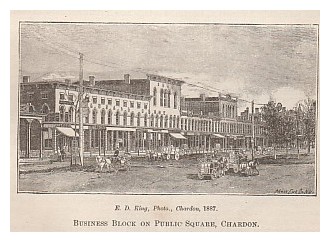
E.
D. King, Photo, Chardon, 1887
BUSINESS BLOCK ON PUBLIC SQUARE,
CHARDON.
printing
office, and in 1840 had 466 inhabitants–Old Edition.
Chardon,
the county-seat of Geauga county,
is on the P. &
Y. R. R. it is beautifully situated on a hill, and together with Bass
Lake,
three miles, and Little Mountain, seven miles distant, is somewhat of a
summer
resort. County officers
Page 600
in
1888; Auditor, Sylvester D.
HOLLENBECK; Clerk, Brainard
D. AMES; Coroner, Will J.
LAYMAN; Prosecuting Attorney, Leonard P. BARROWS; Probate Judge, Henry
K.
SMITH; Recorder, Charles A. MILLS; Sheriff, Wm. MARTIN; Surveyor,
Milton L.
MAYNARD; Treasurer, Charles J. SCOTT; Commissioners, David A. GATES,
Lester D.
TAYLOR, Joseph N. STRONG.
Newspapers: Republican, Republican,
J. O. CONVERSE, editor and
proprietor; Democratic Record, DENTON Bros. and
KING, editor and
proprietors. Churches: 1 Methodist Episcopal, 1 Congregationalist, 1
Baptist,
and 1 Disciple. Bank: Geauga Saving
and Loan
Association, B.B. WOODBURY, president, S.S. SMITH, cashier.
Population in 1880, 1,081.
School census
in 1886, 321; Chas. W. CARROLL, superintendent.
 The
term "Cheesedom,"
as applied to the Western Reserve, has led strangers to suppose that
the dairy
was the great source relied upon for the support of the farmers. This
is an
error, for in no part of the Union is mixed husbandry more prevalent,
and when
grass fails the farmers fall back upon their cultivated crops and great
variety
and abundance of fruits. It is true cheese and butter making are the
most
important industries.
The
term "Cheesedom,"
as applied to the Western Reserve, has led strangers to suppose that
the dairy
was the great source relied upon for the support of the farmers. This
is an
error, for in no part of the Union is mixed husbandry more prevalent,
and when
grass fails the farmers fall back upon their cultivated crops and great
variety
and abundance of fruits. It is true cheese and butter making are the
most
important industries.
The pioneer women
were skilled in
cheese-making in their Eastern homes, and when the settlers had
enclosed and
seeded their pastures, cheese making increased. In the Centennial year
1876,
the dairy productions of the county were butter, 672,641 pounds;
cheese,
4,136,231. Only
three counties in
Ohio made more, but those were much larger in territory. In 1885, in
this
county was made, butter, 686,207 pounds, and cheese, 1,550,832 pounds.
Ashtabula, Lorain, Portage, and Trumbull now exceed it in
cheese-making, though
none of them come up to within three-quarters of Geauga's
figures for 1876.
In
1862 began the great revolution in the manufacture of cheese, dairymen
sending
their milk to factories to be worked up by the co-operative system. In
a few
years every township had its one or more cheese factories, until they
summed up
about sixty in the county – a wonderful relief to the domestic labor of
the women. Butter and cheese is now shipped direct from this county to
Liverpool.
Process of
Cheese Manufacture. – The
milk is brought to the factory at morning and evening of each day. Here it is weighed and
strained into
large vats surrounded by running spring water. It is cooled to about
60° F.
and a sufficient quantity of rennet added to set the curd. The curd is then cut with
knives made
for the purpose, into small cubes and heated by steam to 90° F. Then
the
whey is drawn off and the curd salted,
two and a half
to three pounds of salt to 100 pounds of milk.
The curd is then put into hoops and
pressed for two hours, then the bandages of cheese cloth are put on and
the
cheese again goes to press for twenty four hours, when it is taken out
and goes
to the curing-house, where it is rubbed and turned every day for thirty
to
forty days, when it is ready for market.
TRAVELLING NOTES
Oct.5—I
came with a load of passengers early this morning in a public hack from
Chardon
to Painesville, distance ten miles, Chardon being on the high table
land, the
clouds are apt to gather there, and so we started in mists which the
sun
dispelled and warmed us up and we went through a rich country of gentle
hills
and valleys. We passed orchards and had the pleasant sight of men and
boys in
the trees gathering the many-colored apples and stowing them away in
bags
hanging from the branches. I observed some noble hickories, and was
pointed to
a tree from which at a single season four and a half bushels had been
gathered.
The maples were but just beginning to blush. Geauga
Page 691
is the favorite
home of the maple and its maple sugar industry the greatest in the
Union, and
the sugar excelling in quality.
Trout Streams.
– Geauga has, with Erie,
the distinction of being the only one of two counties that I know of in
Ohio
that has a stream of water so pure and cold as to be the native home of
the
speckled brook trout. In Erie the source is a cold spring at Castalia
gushing
forth from a prairie. In Geauga it is in the vicinity of where we are
passing
to-day, below the conglomerate rock, at the base of which the filtered
pure
water gushes forth in streams, forming the head-waters of Chagrin river.
Past and Present
on the Reserve. – Travelers
by rail see comparatively little. My ride by hack was a refreshing
change, an
eye feast. In my original journey on horseback through the Reserve I
was
continually reminded of the Connecticut of that time by the large
number of red
houses, red barns and little district school-houses by the roadside,
also
red. Gone are these
red things, and
gone mostly are the people, and gone the country taverns with their
barroom
shelves filled with liquor bottles. The boys and girls of that time now
living
are largely grand-parents. Now
the
farmhouses are white or a neutral tint, many of them ornate, the
creations of
skilled architects; all of those hereabouts have porches either upon
the main
building or upon the addition.
Labor-saving machines and implements and conveniences,
both on the farm
and in the dwelling, have saved much untold back-aching drudgery and
given
leisure for the more delicate things. Farmer's wives can any time pick
up Harper's
Weekly or Monthly and read an article on
entomology, maybe an instructive
one on the habits of the bumble-bee, and not feel as though they were
committing a sin – encroaching on valuable time that ought to be given
to
melting snow in a huge kettle hanging over backlogs, whereby to get
water and
worry through the week's washing.
The
dreadful isolation and loneliness of farm life is a thing of
the past. Good
roads have overcome this and
brought town and country together shaking hands. Most families have
representatives in some neighboring city or on farms farther west, and
they
often visit the old homestead, bringing their children, and renew the
old
ties. The cricket
still sings
somewhere around the premises, the doves still coo from the eaves; the
clover,
fragrant as ever, finds them out and steals into their noses. Books, magazines are in
every dwelling
and education general; and social intercourse has changed and broadened
their
lives. Noah Webster
lies alongside
the Family Bible with the photographic album, wherein are absent
friends and the lastest arrival by
the
"limited express" – limited by the capacities of maternity.
"Was there ever such a pretty baby?" The genus gawkey
is no more and no longer one hears uncouth speech and expressions, such
as:
"I want ter kneow!"
"Dew tell," "I kinder
reckon,"
"Stun wall!" "Pale the keow!"
etc.
Stage-Coach Talk.
– Nearing Painesville our way
over the height of land was through winding ravines with their running
streams,
and one spot was pointed out to me by a gentleman by my side, where was
nestled
in a nook a homestead that seemed as a sort of paradise. "I had rather
live there," he said, "as those people live in these surroundings
than on Euclid avenue."
He was of the law, a
large man from Chardon; reminded me of Tom Corwin, whom I knew, and
like him
had a dark complexion and run to adipose; and , as Corwin would have
done, bequiled the way
with amusing stories, and his budget was
running over.
As
we started out of the village, he said: "Some of us have been making a
sort of social census of Chardon; the result is: three bachelors, four
old
maids (that is, counting girls over 35 as such), five widowers and
seventy
widows." Thought I,
if that is
a quiz, I admire your ingenuity. If a fact, it is astounding as an
earthquake. My
courtesy led me to apparently take the shock, and so I put in, "Why
does
Chardon so run to widows? Was the town gotten up for them?"
"No," said he, "not exactly that; they all have children and
come from the country around to educate them, the schools and morals of
the
people are so excellent and it is such a healthy pretty spot, with such
abundance of everything and living so cheap."
Dropping
the widows, we launched on to other subjects; one was the false idea
that young
and inexperienced people have of men and of high station and
reputation.
"I was," he said, "bred on a farm and knew nothing of the world.
When a young man I journeyed to
Columbus and called upon the
Governor in his audience chamber in the State House.
Ushered into his
presence, I trembled as an aspen. He invited me to a seat, and I was in
the act
of sitting down in a chair, when a leg slipped out of its socket. "Hold
on," said he, "let me fix that." Then he stooped to his knees
and slipped the chair leg in its place. In a twinkling my awe vanished.
I saw
the Governor of Ohio, kneeling before me, was as other men; so when he
arose I
was as calm as a May morning. The governor was R. B. Hayes.
The
timid, sensitive boy is of all others to be admired, for he has the
first
requisition of genius and heroism—impressibility. The old Athenians, that
lovable people,
had it to a superlative degree; and how heroic and intellectual were
they and
how exquisite their art, their architecture and statuary. Those
creations of
their genius seen under the tender blue skies of that soft, delicious
climate,
amid the moving figures of the beautiful Athenians arrayed in their
simple
loose garments of white that swayed in graceful folds around their
persons,
must have completed a landscape that touched the rude Seythain
brought into their presence with a sense akin to the celestial. The
greatest,
no matter how high their station, at times may be timid.
Page 602
Nothing
is so dreadful to man as
man. It is the
world of intellect
that at times awes the strongest. Intellect is of God, and its
possession makes
man godlike. One who had been a cabinet minister, a governor of a great
State,
and a soldier of national reputation, recently to a question of mine
replied:
"Yes, to this day I at times suffer from sensitiveness, even just
before I
begin such a simple duty as questioning a witness in court." As he thus
spake, my regard for
him, which was high before, increased.
If
the young nervous boy, who shrinks on hearing his name called in
school, could
realize the grand truth, that when a sense of duty impels, that with action
timidity vanishes, and that he of all others will prove the most
capable of
heroic things, a great point would be gained for the world into which
he has
arrived for the express purpose of developing himself and helping to
make it
better. "Why do you tremble so?" said an old officer to a young
lieutenant of Wellington's army just at the opening of a battle. "Do
you
feel bad?" "Yes, sir, I do," he rejoined; "and if you felt
as bad as I do you would run away."
Middlefield is about 30 miles east of Cleveland and about 25 miles south of Lake Erie, on the P. & Y. R .R. Newspaper: Messenger, Independent, C.B. MURDOCK, editor. Churches: 1 Methodist Episcopal and 1 Wesleyan Methodist. Industries: 1 grist, 2 saw and woodworking mills, brick and tile, cheese factories, etc. Population in 1880, 325. The vicinity abounds in mineral springs. Geauga has several other small villages, as Parkman, 16 miles S. E. of Chardon; Huntsburg, 6 miles east, and Chester Cross Roads, in the northwestern corner of the county.
