Page 726
GUERNSEY
COUNTY was organized in March, 1810.
The upland is hilly and of various qualities, and the soil clay or
clayey loam. There is much
excellent land in the bottom of Wills creek and its branches, which cover about
one-third of the county. Wool is a
staple product of the county, together with beef cattle, horses and swine. Its area is 460 square miles. In 1885 the acres cultivated were
67,095; in pasture, 133,784; woodland, 48,407; lying waste, 1,134; produced in
wheat, 68,313 bushels; oats, 206,490; corn, 671,694; tobacco, 231,191 pounds;
wool, 685,262; sorghum, 32,069 gallons; sheep owned, 162,640; coal, 433,800
tons. School census, 1886, 9,690;
teachers, 180.
|
Townships And Census |
1840. |
1880. |
Townships And Census |
1840. |
1880. |
|
Adams, |
866 |
806 |
Millwood, |
1,722 |
1,984 |
|
Beaver, |
1,686 |
|
Monroe, |
1,098 |
1,080 |
|
Buffalo, |
1,025 |
|
Oxford, |
2,133 |
1,615 |
|
Cambridge, |
2,033 |
4,665 |
Richland, |
1,772 |
1,439 |
|
Center, |
976 |
1,233 |
Seneca, |
1,356 |
|
|
Jackson, |
1,155 |
1,140 |
Spencer, |
1,669 |
1,552 |
|
Jefferson, |
755 |
931 |
Valley, |
|
999 |
|
Knox, |
538 |
964 |
Washington, |
1,008 |
742 |
|
Liberty, |
835 |
1,503 |
Westland, |
1,077 |
925 |
|
Londonderry, |
1,629 |
1,320 |
Wills, |
1,887 |
1,855 |
|
Madison, |
1,569 |
1,160 |
Wheeling, |
769 |
1,284 |
Population
in 1820 was 9,292; in 1830, 18,636; 1840, 27,729; 1860, 24,474; 1880, 27,107,
of whom 23,554 were Ohio-born, 1,499 Pennsylvania, 608 Virginia, 47 New York,
and 578 from Europe.
Previous
to the first settlement of the county there was a party of whites attacked by
Indians on Wills creek, near the site of Cambridge. The particulars which follow are from
the pen of Col. John M’DONALD, author of the “Biographical
Sketches.”
In the year 1791 or ’92, the Indians having made
frequent incursions into the settlements along the Ohio river, between Wheeling
and the Mingo bottom, sometimes killing or capturing whole families, at other
times stealing all the horses belonging to a station or fort, a company
consisting of seven men rendezvoused at a place called the Beech bottom, on the
Ohio river, a few miles below where Wellsburg has been erected. This company were John WHETZEL, William
M’COLLOUGH, John HOUGH, Thomas BIGGS, Joseph HEDGES, Kinzie DICKERSON,
and a Mr. LINN. Their avowed object
was to go to the Indian towns to steal horses. This was then considered a legal,
honorable business, as we were then at open war with the Indians. It would only be retaliating upon them
in their own way. These seven men
were all trained to Indian warfare and a life in the woods from their
youth. Perhaps the western frontier
at no time could furnish seven men whose souls were better fitted, and whose
nerves and sinews were better strung to perform any enterprise which required
resolution and firmness. They
crossed the Ohio, and proceeded with cautious steps and vigilant glances on
their way through the cheerless, dark and almost impervious forest, in the Indian
country, till they came to an Indian town, near where the head waters of the
Sandusky and Muskingum rivers interlock.
Here they made a fine haul, and set off homeward with fifteen horses. They travelled rapidly, only making
short halts to let their horses graze and breathe a short time to recruit their
strength and activity. In the
evening of the second day of their rapid retreat they arrived at Wills creek,
not far from where the town of Cambridge has been erected. Here Mr. LINN was taken violently sick,
and they must stop their march or leave him alone to perish in the dark and
lonely woods. Our frontier men,
notwithstanding their rough and unpolished manners, had too much of my Uncle
Toby’s “sympathy for suffering humanity” to forsake a comrade
in distress. They halted, and
placed sentinels on their back
Page 727
trail, who remained there till late in the night,
without seeing any signs of being pursued.
The sentinels on the back trail returned to the camp. Mr. LINN still lying in excruciating
pain. All the simple remedies in
their power were administered to the sick man, without producing any effect. Being late in the night, they all lay
down to rest, except one who was placed as guard. Their camp was on the bank of a small
branch. Just before daybreak the
guard took a small bucket and dipped some water out of the stream; on carrying
it to the fire he discovered the water to be muddy. The muddy water waked his suspicion that
the enemy might be approaching them, and were walking down in the stream, as
their footsteps would be noiseless in the water. He waked his companions and communicated
his suspicion. They arose, examined
the branch a little distance, and listened attentively for some time; but
neither saw nor heard anything, and then concluded it must have been raccoons,
or some other animals, puddling in the stream. After this conclusion the company all
lay down to rest, except the sentinel, who was stationed just outside of the
light. Happily for them the fire
was burned down, and only a few coals afforded a dim light to point out where
they lay. The enemy had come
silently down the creek, as the sentinel suspected, to within ten or twelve
feet of the place where they lay, and fired several guns over the bank. Mr. LINN, the sick man, was lying with
his side towards the bank, and received nearly all the balls which were at
first fired. The Indians then, with
tremendous yells, mounted the bank with loaded rifles, war-clubs and tomahawks,
rushed upon our men, who fled barefooted and without arms. Mr. LINN, Thomas BIGGS and Joseph Hedges
were killed in and near the camp.
William M’COLLOUGH had run but a short distance when he was fired
at by the enemy. At the instant the
fire was given he jumped into a quagmire and fell; the Indians, supposing that
they killed him, ran past in pursuit of the others. He soon extricated himself out of the
mire, and so made his escape. He
fell in with John Hough, and came into Wheeling. John WHETZEL and Kinzie DICKERSON met in
their retreat, and returned together.
Those who made their escape were without arms, without clothing or
provisions. Their sufferings were
great; but this they bore with stoical indifference, as it was the fortune of
war. Whether the Indians who
defeated our heroes followed in pursuit from their towns, or were a party of
warriors who accidentally happened to fall in with them, has never been
ascertained. From the place they
had stolen the horses they had travelled two nights and almost two entire days,
without halting, except just a few minutes at a time, to let the horses
graze. From the circumstance of
their rapid retreat with the horses it was supposed that no pursuit could
possibly have overtaken them, but that fate had decreed that this party of
Indians should meet and defeat them.
As soon as the stragglers arrived at Wheeling, Capt. John
M’COLLOUGH collected a party of men, and went to Wills creek and buried
the unfortunate men who fell in and near the camp. The Indians had mangled the dead bodies
at a most barbarous rate. Thus was
closed the horse-stealing tragedy.
Of
the four who survived this tragedy none are now living to tell the story of
their suffering. They continued to
hunt and to fight as long as the war lasted. John WHETZEL and Dickerson died in the
country near Wheeling. John Hough
died a few years since, near Columbia, Hamilton county, Ohio. The brave Capt. William M’COLLOUGH
fell in 1812, in the battle of Brownstown, in the campaign with Gen. HULL.
Hon.
William M. FARRAR has given us the following interesting items concerning the
early history of the county:
The streams of this county come somewhat curiously by
their names, as Leatherwood, from a bush having a tough leathery bark used by
the pioneers for many useful purposes; Yoker, from the yoker brush that grows
along its banks; Wills creek, from Wills river, Maryland; Crooked creek, from
its winding course; Little and Big Skull Forks, from the fact that in early
times the Indians, having made one of their raids into the white settlements
east of the Ohio river, were returning with their prisoners, among whom were a
mother and infant child; being pursued they first killed the infant and left
the body to be devoured by the wolves, who left no remains but the little
skull; farther on the mother was killed and in like manner devoured by the
wolves, leaving only the skull.
These skulls were found by the pursuing whites on the banks of the
streams which thus received their respective names. Another stream is named Indian Camp from
one of their camping grounds.
The
settlement of the county was curious in that settlers from so many different
districts met here. The Virginians
and Guernseymen met at Wills creek; the Yankees from Massachusetts and Western
Pennsylvanians in the southwest; Quakers from North Carolina and Chester
county, Pa., in the southeast; the Irish in northern and western
townships. A settlement from New
Jersey extends into two townships, while there are families, descendants of the
Hessians, in the southern part of the county that came in through Virginia and
Maryland settlements. The youngest
daughter of Gen. STARK, of the Revolution, died in this county, aged
ninety-nine years.
The
man who wields the second oar in the painting of Perry’s Victory, in the
rotunda of the Ohio State House, was a Guernsey
Page 728
county man known as “Fighting Bill”
Reed. He was of Virginia and
Pennsylvania stock, who learned the blacksmith trade with William McCRACKEN, of
Cambridge.
Gen.
BROADHEAD’S trail on his Coshocton campaign in 1781 against the Indians
is distinctly marked through the county.
There were no Indian villages in this region, it being the hunting
ground of parties that hunted and fished along the principal streams.
In
1798 “Zane’s Trace” was cut through the county. When ZANE’S party arrived at Wills
Creek Crossing they found the government surveyors busy surveying the United
States Military lands. They had a
camp on its banks. At this time the
only dwelling between Wheeling and Lancaster was at Zanesville. The ZANES were from the South Branch of
the Potomac, near wills river, Maryland, and hence gave the name Wills creek to
the stream. So far as known,
Ebenezer ZANE’S party consisted of himself, his brother Jonathan ZANE,
John McINTIRE, Joseph WORLEY, Levi WILLIAMS, and an Indian guide named Tomepomehala.
Wills
creek is a sluggish stream with clay bottom, and choked up as it was at that
day with drift wood and rubbish, was a difficult crossing; and the ZANES, in
compliance with the requirements of the act to establish and maintain ferries
at the principal crossings, probably induced a man of the name of Graham to
establish one there. It was the
first stream west of Wheeling on the “Trace” over which they placed
a ferry. Who this first ferryman
was or where from is not known. He
remained about two years, and was succeeded by George BEYMER, from Somerset,
Pennsylvania, a brother-in-law of John McINTIRE, of ZANE’S party. McIntire was a brother-in-law of
Ebenezer ZANE. Both of these
persons kept a house of entertainment and a ferry for travellers on their way
to Kentucky and other parts of the West.
Mr. BEYMER, in April, 1803, gave up his tavern to Mr. John BEATTY, who
moved in from Loudon county, Virginia.
BEATTY’S family consisted of eleven persons. Among these was Wyatt HUTCHINSON, who
later kept a tavern in the town.
The Indians then hunted in this vicinity, and often encamped on the
creek. In June, 1806, Cambridge was
laid out; and on the day the lots were first offered for sale, several families
from the British isle of Guernsey, near the coast of France, stopped here and
purchase lands. These were followed
by other families, amounting in all to some fifteen or twenty, from the same
island; all of whom, settling in the county, gave origin to its present
name. Among the heads of these
families were William OGIER, Thomas NAFTEL, Thomas LANFISTY, James BISHARD,
Charles and John MARQUAND, John ROBBINS, Daniel FERBRACHE, Peter, THOMAS and
John SARCHET, and Daniel HUBERT.
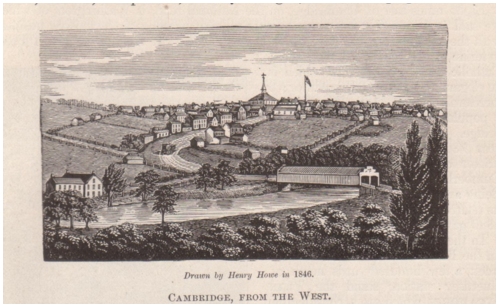
CAMBRIDGE
IN 1846.—Cambridge, the county-seat, is on the National road, 77 miles
east of Columbus and 24 east of Zanesville. It is a flourishing village, and
contains 1 Presbyterian, 1 Seceder, 1 Methodist Episcopal and 1 Reformed
Methodist church, an academy, 9 mercantile stores, 2 carding machines, 1
flouring and 2 fulling mills, 1 newspaper printing office and about 1,000
inhabitants. The view represents
the town as it appears from a hill on the west, about 300 yards north of the
National road. The bridge across
Wills creek is sown on the right and the town on the hill in the
distance.—Old Edition.
The
bridge above spoken of is shown also in the new picture. Although built in 1828 it still does
good service. It is on the plan of
Ithiel Town, a noted architect who, at the same date, was building the
Connecticut State-House after the model of the Greek temple, and is now
standing on the New Haven Green, though no longer used as a State-House, while
the bridge, started as a bridge, remains still on duty as a bridge.
Cambridge
is 77 miles east of Columbus, at the intersection of the C. & M. and B.
& O. railroads. It is the
centre of a fine agricultural district and the county-seat of Guernsey county. County officers in 1888: Probate Judge,
Lot P. HOSICK; Clerks of Court, James R. BARR, Alfred WEEDON; Sheriff, Hugh F.
McDONALD; Prosecuting Attorney, Justus H. MACKEY; Auditor, Thomas SMITH;
Treasurer, Milton TURNER; Recorder, John K. CASEY; Surveyor, William J. HES-
Page 729
TOR; Coroner, John H. SARCHET; Commissioners,
John SHIPMAN, James B. HARTLEY, George WATSON. Newspapers: Jeffersonian, Democrat, John M. AMOS, editor and proprietor; Guernsey Times, Republican, D. D.
TAYLOR, editor and proprietor; Herald,
Independent, MEHAFFY & OGIER, editors and proprietors; Peo-
Drawn by
Henry Howe in 1846.
CAMBRIDGE, FROM THE WEST.
ple’s
Press, Republican, C. W.
DUNNIFER, editor; Eastern Ohio Teacher,
Educational, Prof. John McBURNEY, editor and proprietor. Churches: 1 Methodist Episcopal, 1
Presbyterian, 1 United Presbyterian, 1 Baptist, 1 Episcopalian, 1 Colored
Baptist and 1 African Methodist Episcopal.
Banks: Central National,

J. P. Brown,
Photo, Cambridge, 1887.
CAMBRIDGE FROM THE WEST.
A. J. HUTCHINSON, president, W. E. BODEN,
cashier; Guernsey National, J. D. TAYLOR, president, A. A. TAYLOR, cashier; Old
National, S. J. McMAHON, president, A. R. MURRAY, cashier.
Industries and Employees.—C. &
M. R. R. shops, 50 hands; Cambridge Chair Factory, 75 hands; Cambridge Roofing
Co., iron roofing, 27 hands; Hoyle &
Page 730
Scott, doors and sash; Simons Bros., foundry;
E. M. Collum, buggies, City Mills.—State
Report for 1887. Natural gas is
used here for manufacturing and domestic purposes. Population in 1880, 2,883. School census in 1886, 1,280; E.
Burgess, superintendent.
Eight
miles east of Cambridge, on the National road, is Washington, of which we said
in 1846: “It is a very thriving village, and does an extensive business
with the surrounding country, which is very fertile. It has 1 Lutheran, 1 Presbyterian, 1
Methodist, 1 Union and 1 Catholic church, the last of which is an elegant and
costly Gothic edifice; 6 mercantile stores, 1 woollen factory, a population
nearly equal to Cambridge. It was
laid out about the year 1805 by Simon BEYMER, proprietor of the soil, and a
native of Cumberland county, Pennsylvania.” Being away from railways, it has lost
its relative importance. The census
of 1880 gave it exactly 600 inhabitants.
In
the northern part of this county, on the line of the C. & M. railroad
track, a few hundred yards north of Guernsey station, stand the TWIN SYCAMORES,
which are a considerable curiosity in the way of trees. These are the measurements, as obtained
for us by Mr. William M. FARRAR: Twelve inches above ground the largest is in
girth 14 feet by 6 inches, and the smaller, 10 feet and 4 inches. The arm or connection is 22 feet 2
inches from the ground, and its girth 5 feet 5 inches. The girth of the larger tree above the
arm is 10 feet 5 inches; of the smaller tree, 7 feet 9 inches. The growing of a limb of one tree into
the body of another is occasionally seen in the forests. This, however, is an unusual
specimen. Sometimes one limb grows
into another; an example of this is on the New Haven Green, where a lower limb
about five feet in length has grown into the one above and serves as a brace as
completely as any brace put in by human hands.

I. N.
KNOWLTON, Photo
THE TWO SYCAMORES.
THE
LEATHERWOOD GOD.
At
the village of Salesville there was built by the early settlers a hewed
log-church called the Temple and for the use of all denominations. In August, 1828, about two and a half
miles northwest of the Temple, was held a camp-meeting under the auspices of
the United Brethren Church. It
began on Wednesday and continued over Sunday.
On
Sunday afternoon a large assemblage was addressed by the Rev. John Crum,
P.E. He was about half way through a
sermon of great eloquence, which had produced a profound impression, when he
paused that the truths he had spoken might sink into the minds of his
hearers. At this moment the solemn
silence was broken by a tremendous voice, bursting forth like a clap of thunder
upon the congregation, giving utterance to but one word,
“SALVATION,” followed by a shout and snort, which filled the people
with awe and dread; one of those present said: “They carried with them,
right through you, a thrill like that felt when greatly scared in the dark and
a dread similar to that experienced when we think of dying instantly.”
Page 731
Men
jumped to their feet, women screamed aloud and every cheek blanched. All eyes were turned in the direction
from whence the sounds came, and there, seated in the midst of the
congregation, was a stranger with solemn countenance, totally unmoved, dressed
in a suit of broadcloth, frock coat, white cravat and yellow beaver hat.
How
or when he had come there no one knew, although dressed in a garb differently
from any seen in this community at that time.
After
several moments the clergyman proceeded with his sermon, but the people gave no
heed to it, for every eye and mind was centred upon the mysterious and solemn
stranger in their midst. His large
black flashing eyes, pale face, low broad forehead, from which the long black
locks were brushed back, reaching half way to his waist, and his melancholy,
solemn aspect seemed to inspire the people with awe.
After
the meeting, he went about representing himself to be God Almighty, who had
come down into the midst of the assembled people in his spiritual body and then
assumed the corporeal one with the name of Joseph C. DYLKS; that he could
appear and disappear at will, perform miracles, and, finally, that he had come
to establish the millennium, and that whosoever followed him should never die
in their natural bodies. He found
many believers and followers. At first
he was very cautious in his statements, but, as converts became more numerous,
he grew more bold, claimed that his body could not be touched without his
permission and that with a shout and snort he could destroy the universe. His following increased and converts
were made throughout parts of Belmont, Guernsey and Noble counties. Three men from the vicinity of
Salesville, Michael BRILL, Robert McCORMICK, and John BRILL, also a young
minister named DAVIS, who had come to Salesville during his visitation, were
appointed disciples. He preached in
the Temple at Salesville and made many converts.
He
addressed them as follows: “I
am God and there is none else. I am
God and the Christ united. In me
Father, Son and Holy Ghost are met.
There is now no salvation for men except by faith in me. All who put their trust in me shall
never taste death, but shall be translated into the New Jerusalem, which I am
about to bring down from heaven.”
Then the brothers yelled “We shall never die,” the sisters
screamed, DYLKS snorted and spectators muttered their indignation at the
blasphemy. When DYLKS descended
from the pulpit McCormick exclaimed, “Behold our God,’ and the
believers fell on their knees and worshipped him.
The
indignation of those who had not been drawn into the delusion of the Dylksites
finally resulted in organized opposition, and DYLKS was called upon to prove
his professions by the performance of a miracle. Thereupon he agreed to make a seamless
garment if the cloth were furnished him.
The
cloth was forthcoming but the miracle was not accomplished. DYLKS was arrested and brought before a
magistrate, but there being no law provided for such offences he was
discharged. His accusers were not
satisfied with this, and DYLKS was obliged to flee to the woods pursued by a
mob. After this his conversions
ceased, but those who had accepted him still believed in his divinity, and
among these he found a refuge from the unbelievers who sought to drive him from
the country. He remained several
weeks in hiding, and then assembled his converts and announced that he must go
to Philadelphia and set up his “New Jerusalem.” This was in the latter part of October,
and taking three of his disciples with him, they proceeded on foot to
Philadelphia. When about to enter
the city, DYLKS and Davis separated from McCormick and Michael Brill, “to
meet again,” said DYLKS, “where the light from heaven shall shine
brightest within the city, for there will New Jerusalem begin to expand to fill
the earth.” They searched the
city over and never found the “Light” nor DYLKS and Davis, and
after many days wanderings, footsore and moneyless, with sorrow and weeping,
McCormick and Brill turned their steps homeward.
Page 732
Notwithstanding
that death removed the Dylksites one by one, the survivors still believed in
the divinity of the Leatherwood God, and that he would some day return and set
up his New Jerusalem. Seven years
later the Rev. Davis reappeared and preached a sermon in which he declared he
had seen DYLKS ascend into heaven, and that he would return and set up his
kingdom. Davis then left and
neither he nor DYLKS was ever heard of again.
The
mystery surrounding the method by which DYLKS reached the centre of that
congregation was never divulged.
When it is considered that his appearance was such a peculiar one, his
attire differing from any ever seen in that community at that time, it is not
surprising that many believed him to be a supernatural being, to have suddenly
appeared in the midst of that large body of people without observation from any
one.

A PENNYROYAL DISTILLERY.
The
title, “The Leatherwood God,” was given this imposter from the
meeting where he first appeared having been held on the bank of Leatherwood
creek. Leatherwood, which gives
name to the creek, is a peculiarly soft and pliable wood with a tough bark that
can be tied into knots. It was used
by the pioneers for tying the meat of wild hogs, venison and bear upon pack
saddles for conveyance to market at Wheeling. When green it is so soft and spongy that
it can be dented by the pressure of the fingers.
PENNYROYALDOM
is the name of a district of uncertain boundaries of which Oxford township is
the centre and to which it is principally applicable. This is the central of the three
easternmost townships bordering on Belmont county. It is so called from the peculiar
industry of pennyroyal raising and distilling within its limits. It is not a great industry, because the
demand for the article is light, but it is a peculiar and rare industry, and as
such is worthy of notice. The
following is a description of the process of its distillation.
The
pennyroyal, after being gathered, is allowed to wilt until it will pack well,
is then tramped down carefully in the steam-chest until it is full. The oil is in the leaf, and at times can
be seen with a magnifying glass in small globules on the under side of the
leaf. Set free by the steam it
passes into the condenser, into which a stream of cold water is conducted until
condensed, and poured into an oil vat filled with water up nearly to the
top. The oil, being lighter than
the water, runs into the vessel and passes out into a receiver.
The
still-houses are of rude construction, as shown in the engraving. Four forks are set in the ground with
connecting poles, upon which the roof of rough
Page 733
boards is placed, extending from a ridge-pole
to the eaves. The business is not
of enough importance to justify any large expenditure for complete works.
The
origin of the industry is as follows:
The
first settlers of Oxford township found after plowing up the ground that a
spontaneous growth of pennyroyal sprang up. Benjamin BORTON, who came from New
Jersey in 1804 and settled on the line of the old Wheeling road, having learned
the art in his native State, commenced its distillation, and the industry has
since been continued by his sons, grandsons and great-grandsons and became
identified with the history of this region.
It
is said that in the early days when all other resources for raising ready money
with which to pay taxes had been exhausted, the farmers would go out and gather
pennyroyal, distil it and in this way raise the cash, which was a scarce
article in those times.
The
medicinal qualities of the American pennyroyal are superior to that of foreign
production, and the oil found a ready sale in the Eastern markets.
The
industry has been productive of benefit as it has given rise, indirectly, to
social reunions among the people, and as the outcome of these has been
narratives of pioneer experience, it comes within our province to go into some
little detail in regard to them.
At a banquet given in Cambridge on the retirement of
Jonathan ROSE as County Commissioner and the incoming of Peter LOCHARY, it was
proposed to hold annual reunions of those born or bred in Pennyroyaldom, and
the proposition acted upon. The
first was held, August, 1880, at Gardiner’s Grove in Oxford township, and
the records of that and succeeding meetings have been preserved by Mr. John
KIRKPATRICK in pamphlet form from which we quote.
Rev.
John ABLES, of Jackson township, and his brother Bethuel (since deceased), the
oldest living people born in Oxford township, were present at the first
reunion, and from the speech of Bethuel (the first white child born in Oxford township),
we extract the following:
“I was born in 1806, within a mile
of this spot, amongst the wolves, Indians and snakes. My father died when I was six years old,
and left me the oldest of the family upon my mother’s hands. John, who has just spoken, was the next
eldest. One night he and I, as the
wolves were troublesome, penned the sheep right up against the cabin. In the night the wolves came and howled
and pushed around the house. The
sheep were killed and wounded. It
made our little hearts quake at the danger. Once I went for my uncle, Reuben BORTON,
through a wheat patch for water. I
was terribly afraid of snakes. I
stepped in my bare feet on two copperheads while going, and also an old hoop
which flew up and struck me. I
jumped so high each time that I brought no water back. My uncle found and killed the snakes.
“There
were no near neighbors; for miles around there was nothing but paths. One day I was riding on an errand
through the woods on ‘Kate,’ and suddenly a man’s hand came
from behind a tree on my thigh. I
told of it and was informed that it was a robber looking for land buyers who
had money. I escaped because I was
a boy. In a few days we heard of a
murder on the Maginnis farm. The
hand of Providence was around us or we could not have lived. We suffered. I was out after the cows one day, and in
crossing a creek walked on a log out into the stream and jumped to get over. I lit in the mud and went down and down,
and could not get out; the more I stepped the more I became fastened. Some chips floated near me and little by
little I was enabled to reach a slim branch above me.
“I
learned the blacksmith business. I
made the tools to clear this country.
I made the hoes, the axes and the mattocks for the settlers. I was here when there were not thirty
people in the township. I know all
of Pennyroyal, and how to make the oil, too. In the early days we boiled it in
kettles, now a four-horse load is needed to fill a ‘gum.’ It was hard work to gather
pennyroyal. It grows by
‘grasshopper springs.’
The springs near it are generally filled with grasshoppers, and the
fields with weeds, etc.”
From
the address of Geo. PLATTENBURG (since deceased) we give:
“In
1805 my father and family moved out.
We did not have a load of furniture, and put some salt in the bottom of
the wagon and sold it at Washington, Pa., for $6 a sack or $30 a barrel. It took one-and-a-half bushels of wheat
to buy a pound of coffee then.
Flour sold at New Orleans for $1.50 a barrel. It was plenty and money scarce. I made a coat for a man that cost him
twenty-seven barrels of flour, or one hundred and thirty-five bushels of
wheat. Timber sold at $12 a
thousand feet, and whiskey at fifteen cents a gallon, but where were the
fifteen cents?”
From
William MORTON’S remarks we quote:
“There
were not more than fifteen persons in the township when we came to the goodly
land of Ohio, in 1814 and 1815. The
early settlers who followed were from New Jersey,
Page 734
New York, Delaware, Maryland, Pennsylvania and
Virginia. I was then ten years
old. The boys had to hunt the cows
from ridge to ridge through the wood sometimes for half a day, and then come
home without them. They braved
dangers, too. The hogs in the
woods, wild as they were, were more dangerous than the bears. When cow-hunting the dogs would scare up
the hogs, the hogs would charge, in battle array, upon the dogs, who would fall
back upon the boys and they would have to stand the battle from great fallen
trees or from the saplings. One day
when my brothers and myself were out, we heard on a ridge above us howlings
like those of a wolf. We howled
similarly in return, and the dogs joined us in the howling. A boy on the ridge took to flight,
thinking a pack of wolves was in reality near. This was the fun of those times.”
Hon.
Joseph FERRELL said that when Oxford township was organized there were not
enough men in it to fill the offices.
It was soon settled by soldiers from the war of 1812, two of whom,
William BERNARD and William RICHARDS, were still living. The Second Regiment of Ohio in the war
of 1812 was made up in this region; the Second Regiment in the war of 1846 was
filled from here, and the Second Regiment in the last war had many from this
neighborhood.
From
Hon. Newell KENNON’S reminiscences of Fairview we extract:
“About
1818, in the woods south of Fairview, was seen by all the passers-by a
speaker’s stand with benches in front sufficient to seat a large
audience. This place was occupied
for preaching by the Reformed Associate Presbyterian Church for five or six
years by the Rev. Samuel FINDLEY, their chosen pastor. In fair weather very large and
appreciative audiences would assemble to hear the teachings of the learned doctor. The church increased rapidly, large numbers
of families settling in the neighborhood who were members of that persuasion,
besides others joining who had never been members of any church. They then built what was called a large
and comfortable stone church. The
chief architect was a sort of stone mason—but not a Free Mason, or he
would have used the plumb, square and level more than he did, thus preventing
the intolerant law of gravitation from pushing it down in the process of
time. It was strange that the
architect, who had the entire control of the building, would have a jug of
whiskey placed in the corner-stone as a memento. When the workmen took down the building,
the jug and the whiskey were found in a high state of preservation; they drank
the whiskey and I don’t know what became of the jug.”
In
the early settlement of the West the borders were infested by desperadoes
flying from justice, suspected or convicted felons escaped from the grasp of
law, who sought safety in the depths of the wilderness. The counterfeiter and robber found there
a secure retreat and a new theatre for crime.
During
the early settlement of the wild hill country of Southeastern Ohio the
scattered, struggling, honest pioneers suffered much from the depredations of
this class who found hiding-places among the caves and rocks and thick tangled
undergrowth of the ravines. Much
loss was inflicted by horse-thieves and counterfeiting of coin was carried on
at times quite extensively. In some
instances the early settlers executed summary justice upon the depredators and
hung or shot them without ceremony.
The outside public learned not of these events, as they took place
before the advent of newspapers and communication with the older settled
communities infrequent; we now learn of them mainly by tradition.
For
several years prior to 1834 a large number of horses had been stolen from
Guernsey and the surrounding counties, and so completely were all traces of the
thieves covered up that the settlers were forced to the conclusion that an
organized band of horse thieves must have been formed in their midst. From the scant evidence at hand, it
appeared that these marauders had a line of communication from the Muskingum
Valley to Lake Erie. So that horses
stolen in Guernsey county would be passed along the line and disposed of at a
point far distance from the place of theft. All efforts toward the discovery of the
thieves were without avail, until finally suspicion fastened upon one Walter G.
PERRY, who resided some five miles east of Cumberland, in Guernsey county, near
what is now called Blue Bell.
On
the night of October 15, 1833, a horse had been stolen from Wm. KNAPPENBURGER,
of Tuscarawas county, who offered a reward for the capture of the thief, and
described him as “a short stout-made man, with black piercing eyes and of
a rather quiet disposition.”
PERRY answered to this description and measures were taken for his
arrest, but he could not be found.
At
this time a school-teacher in the McELROY district, named Adonijah PARRISH, was
boarding with Anthony JONES, and during the night, January 5, 1834, he
Page 735
heard some one cautiously admitted to the
JONES dwelling; his suspicions were aroused and still further excited when,
toward morning, he heard the stealthy departure of the person admitted during
the night. By questioning the young
son of JONES, Parrish learned that the cautious guest of the night was
“uncle Perry.” Instead
of attending to his school that day he hastened to an adjoining district, now
called Harmony, and securing the assistance of Robert MARSHALL, Thomas RANNELS,
James C. BAY, E. BURT and Robert KELLS, started in pursuit of PERRY. Armed with rifles, they proceeded to the
dwelling of JONES and from there

L. M.
Rodecker, Photo., Cumberland.
PERRY’S DEN.
took up the trail, which was easily followed,
owing to a light snow having fallen during the night. After following it for some distance,
they perceived that an effort had been made to cover the tracks and baffle pursuit.
About
a mile and a half from JONES’S the trail led into a deep ravine, on
either side of which were high projecting rocks and deep, dark recesses,
causing the pursuers some trepidation through fear that they might fall victims
to an ambushed enemy. They moved
cautiously forward, speaking only in whispers, every faculty on the alert. Suddenly one of the party called out,
“There he is, by the rocks.”
Seeing that he was discovered, PERRY assumed a defiant attitude, and
pistol in hand, cried out with an oath that he would shoot the first one who
came near. His pursuers having
satisfied themselves that he was alone, began closing in on him, when he
started to run. MARSHALL and
RANNELS threw up their rifles, firing simultaneously, and PERRY fell, wounded
in the right leg. His captors
carried him to the cabin of Clark WILLIAMS, where his wound was dressed, and on
the evening of the same day he was taken to Cambridge.
PERRY
was tried and convicted at the April term of court in Tuscarawas county, and on
the 19th of April was sentenced to five years’ imprisonment in
the penitentiary. His wound refused
to heal and near the end of the first year’s imprisonment he was pardoned
by the governor and set at liberty.
He returned to his family, who still resided in Guernsey county, but,
after a short time, they all left and were heard of no more. PERRY had preserved the rifle-ball which
had shattered his leg, swearing he would be glad to “plant it in each of
his captors.”
After
PERRY’S departure evidences came to light of his having been connected
with a gang of counterfeiters. For
several months preceding his arrest, numerous
Page 736
spurious notes and coins were put in
circulation, and PERRY on one occasion had remarked to Martin ROBBINS that he
had a lot of coins that would “go just as well as any.” About two hundred yards east of his
dwelling, in a ravine, was discovered a slot cut in a tree, and near it a long
lever, which was used to make imprints of coins in short blocks of seasoned
wood; from these primitive molds casts were made in the same manner that the
early pioneers cast their rifle-balls.
These
discoveries furnished an explanation of the stealthy visits of strangers to the
cabin of Perry during all hours of the night. In 1883, in a field near this spot,
Newton HICKLE plowed up some 130 or more counterfeit coins, evidently made in
this manner.
The
place of his capture has ever since been called PERRY’S Den, and is a
resort for picnic parties and lovers of the romantic in nature. It is in Spencer township, three miles
east of Cumberland, in a deep glen in the highlands, dividing the waters of
Wills and Duck creeks.
In
its native wildness it afforded remarkable facilities for secreting stolen
property. Its distance from roads
and the difficulties of access, together with the dense underbrush and its
peculiar openings in the rocks, made its discovery extremely unlikely.
Two
waterfalls of from twenty to thirty feet descent and about one hundred yards
apart add to the romantic beauty of the glen. Horse Shoe Falls, with its ledge of rock
projecting out over the depths below, forms a cavern in which twenty horses
could be stabled at one time, undiscoverable except by the closest inspection,
and early settlers say that unmistakable evidences that it had been put to such
uses were plainly discernible. The
second waterfall is a gem of beauty; in summer it is bordered with ferns and
flowers, intermingled with laurels and evergreens, and in winter, stately
columns of glittering ice and fantastic shapes and forms of filagree and
frosted work arrest and please the eye.
THE
GUERNSEY COUNTY METEOR.
On
of May, 1860 about half an hour after noon, an aerolite exploded over the
western border of this county a little east of the village of New Concord. As it approached the earth its
brilliance was almost equal to the sun.
A great number of distinct detonations were heard like the firing of
cannon, after which the sounds became blended together and were compared to the
roar of a railway train. This meteor
was one of the most remarkable on record from the large quantity of stones
which fell to the earth. Prof.
Elias LOOMIS, of Yale College, in Harper’s Magazine for June, 1868, in an
article entitled “Shooting Stars, Detonating Meteors and
Aerolites,” thus gives the main items connected with this very notable
aerolite.
“Several
stones were seen to fall to the ground and they penetrated the earth from two
to three feet. The largest weighed
103 pounds, and is preserved in the cabinet of Marietta College. Another was found which weighed
fifty-three pounds, a third fifty-one pounds, a fourth was estimated to weigh
forty to fifty pounds and a fifth weighed thirty-six pounds. A small one, weighing fifteen pounds, is
preserved in the cabinet of Yale College. . . . About thirty stones were found, and the
entire weight of all the fragments was estimated at 700 pounds.
“All
these stones have the same general appearance. They are irregular blocks, and are
covered with a very thin black crust, which looks as if it had been fused. Their specific gravity was 3.54, and
their composition very similar to that of the Weston meteor. This meteor fell in the southwestern
part of Connecticut on the morning of December 14, 1807, and was nearly
one-half silex, about one-third oxide of iron, and one-eighth magnesia, with a
little nickel and sulphur.
“Owing
to the cloudy state of the atmosphere, the time was unfavorable for accurate
observation of the meteor’s position in the heavens. It has been computed, however, that the
meteor moved toward the northwest, that its path was nearly horizontal, and
elevated about forty miles above the earth’s surface. . . . The velocity of the Weston meteor
relative to the earth was about fifteen miles per second. . . . There are eighteen
Page 737
well-authenticated cases in which aerolites have
fallen in the United States during the last sixty years and their aggregate
weight is 1,250 pounds.
“While
aerolites contain no elements but such as are found in terrestrial minerals,
their appearance is quite peculiar, and the grouping of the elements, that is,
the compound formed by them, is so peculiar as to enable us by chemical
analysis to distinguish an aerolite from any terrestrial substance.
“All
aerolites without exception contain a substance called Schreibersite, though often in very small quantities. This substance is a compound of iron,
nickel and phosphorus, and has never been found except in aerolites.”
Another
writer upon meteors says:
“Records
of the fall of aerolites is as old as history. One is recorded by Pliny, 467 B.C.,
which was the size of a wagon.
KEPLER affirmed his belief that there were more comets and smaller
bodies flying through space in number than fish in the ocean.
“In
regard to the chemical composition of these stones it must be observed that in
passing through our atmosphere they undergo some change, as they always take
fire in the upper regions by friction against our atmosphere, and arrive at the
ground hot, sometimes making a deep hole.
Combustible substances in their composition, and perhaps an atmosphere
of combustible gases surrounding them, combined with the immense velocity with
which they enter our atmosphere, cause, on the sudden diminution of that
motion, a most intense rise in temperature, ignition, and very often one or
more violent explosions. It is not
surprising that they all present the appearance of having been subject to great
heat. Chemists have proved that
aerolites are not of volcanic origin, and astronomers that their velocity is
far too great to be accounted for by terrestrial attraction.”
CUMBERLAND,
about seventy miles east of Columbus, at the junction of B. Z. & C. and C.
W. & N. Y. railroads, is surrounded by a fine farming country. Newspaper: News, Independent, W. A. Reedle, editor and publisher. Churches: 1 Methodist Episcopal, 1
Cumberland Presbyterian and 1 Presbyterian. Population in 1880, 519. School census in 1886, 200; A. R.
McCulloch, superintendent.
QUAKER
CITY, about ninety miles east of Columbus, on the O. C. R. R., is in the midst
of a fine agricultural and stock-raising district. Newspaper: Independent, Independent, J. W. & A. B. Hill. Churches: 1 Disciples, 1 Methodist
Episcopal and 1 Friends.
Manufactures and Employees.—Manufacturing
builders’ materials; sheep-shearers’ benches; 1 foundry and machine
shop; cigar factories; Quaker City Window Glass Co., employing 70 hands; 2 good
gas wells; coal mining, etc. Bank:
Quaker City National, John R. Hall, president, I. P. Steele, cashier. Population in 1880, 594.
BYESVILLE,
five miles south of Cumberland, on the C. & M. R. R. Newspaper: Transcript, Independent, V. D. Browne, editor and proprietor. Population in 1880, 210. The following are names of villages,
with their population in 1880:
SENECAVILLE, 402; SALESVILLE, 266; FAIRVIEW, 152
