PREBLE COUNTY
Page 446
PREBLE COUNTY was formed from Montgomery and Butler, March 1, 1808, it was named from Capt. Edward PREBLE, who was born at Portland, Maine, August 15, 1761, and distinguished himself as a naval commander in the war of the Revolution, and particularly in the Tripolitan war, and died on the 25th of August 1806. The soil is various; the southern part is a light rich soil, and is interspersed by numerous streams; the remainder of the county is upland, in places wet, but fertile when brought under cultivation. There is an abundance of water power for milling purposes, and large quantities of flour are manufactured.
Area about 440 square miles. In 1887 the acres cultivated were 186,275; in pasture, 35,426; woodland, 33,294; lying waste, 5,873; produced in wheat, 529,637 bushels; rye, 1,136; buckwheat, 85; oats, 464,627; barley, 13,563; corn, 1,522,636; broom-corn, 17,100 pounds brush meadow hay, 8,814 tons; clover hay, 4,096; flax, 81,500 pounds, fibre; potatoes, 30,830 bushels; tobacco, 1,044,210 pounds; butter, 611,300; cheese, 300; sorghum, 6,668 gallons; maple syrup, 9,169; honey, 11,137 pounds; eggs, 549,135 dozen; grapes, 30,870 pounds; wine, 149 gallons; sweet potatoes, 3,242 bushels; apples, 1,643; peaches, 61; pears, 749; wool, 28,183 pounds; milch cows owned, 5,959. Ohio Mining Statistics, 1888: Limestone, 64,500 tons burned for lime; 3,000 tons burned for fluxing; 23,750 cubic feet of dimension stone; 10,397 cubic yards building stone; 30,000 square feet of flagging; 12,460 square feet of paving; 8,571 lineal feet of curbing; 3,492 cubic yards of ballast or macadam. School census, 1888, 7,139; teachers, 183; miles of railroad track, 75.
|
Township And Census |
1840 |
1880 |
|
Township And census |
1840 |
1880 |
|
Dixon, |
1,281 |
1,162 |
|
Jefferson, |
2,165 |
2,244 |
|
Gasper, |
836 |
836 |
|
Lanier, |
1,624 |
1,909 |
|
Gratis, |
1,950 |
2,186 |
|
Monroe, |
1,176 |
1,986 |
|
Harrison, |
1,696 |
2,663 |
|
Somers, |
1,823 |
2,233 |
|
Israel, |
1,538 |
1,807 |
|
Twin, |
1,676 |
1,973 |
|
Jackson, |
1,257 |
1,398 |
|
Washington, |
2,459 |
4,118 |
Population of Preble in 1820 was 10,237; 1830,16,296; 1840,19,481; 1860, 21,820; 1880, 24,533; of whom 19,293 were born in Ohio; 1,042, Indiana; 768, Virginia; 722, Pennsylvania; 322, Kentucky; 87, New York; 478, German Empire; 425, Ireland; 51, British America; 44, England and Wales; 10, France, and 6, Scotland. Census, 1890, 23,421.
Page 447
LIMESTONE
QUARRIES.
The quarrying of limestone is an important industry
in
this county. The limestones
principally
quarried belong to the Niagara group; these in Ohio are very often
called cliff
limestones, because they stand in the bluffs along the river valleys. The quarries in the vicinity of
Eaton turn out
a number of grades of stone; suitable for flaggings and copings as well
as for
fine and rough constructions. It
is
stated in Orton’s Geological Report, that a stone 10 x 12
feet in superficial
dimensions has been taken out and that very much larger stones can be
obtained.
The Clintonlimestone has not been so extensively quarried, but is very
much in
demand for chimney backs and has been found especially desirable for
those
constructions which are exposed to fire or heat.
Old
Block House.—On
what is known as the Wolf farm, Harrison township, stood one of a
series of
block houses built and manned by citizen-soldiers in the fall of 1813.
Dr. J.
W. MILLER, of West Baltimore, has given us the following facts
concerning it.
This block-house was built by a
party
of drafted men, belonging to a company of riflemen which formed a part
of the
Old Battalion under the command of Major Alexander C. Lanier. This
company
occupied the block-house during the winter of 1813-14 to protect the
settlements on Miller’s Fork.
It was one of a series of
block-houses, built and manned by citizen-soldiers, in communication
with the
settlements and line of forts between Cincinnati and the Lakes. The
following
is a true copy of a discharge which is in my possession.
I do certify that ______
_______,
a sargeant of my company of Ohio Riflemen, in the Old Battalion, under
the
command of Alexander C. Lanier, has served a regular tour of duty, and
is
hereby honorably discharged.
Given under my hand this 5th day of
April, 1814,
SIMON
PHILLIPS, Capt.
The members of this company have
been
left out of the roster of Ohio’s soldiers in the war of 1812,
as least so far
as Ohio’s record is concerned. The LOCKS, HAPNERS, McNULTS
and others of
Lewisburg, and the TILLMANS, LOYS, RICES, ABBOTS, PHILLIPES, MYERSES and others on
Miller’s Fork, were
prominent in the settlements referred to.
TRAVELLING NOTES.
A Caboose
Ride.—On
Tuesday at noon, April 13, I
took the caboose at Hamilton, and rode to Eaton, distant some 25 miles.
The
caboose was at the end of a very long freight train, perhaps a quarter
of a mile
in length. In the roof of the caboose was a lookout.
I took advantage of it, ascended by a few steps, seated
myself in a
chair on a little platform, when perhaps half of my body was outside
and above
everything, there being a scuttle-hole in the roof for this purpose.
Our progress was very slow, about 6 or 8 miles an
hour, which gave ample opportunity if one passed anything particularly
attractive, to fully take it all in; I especially appreciated this as
we slowly
went by a scattered village, with a quaint-appearing church, with deep
red
roof, and red roofs here and there upturned to the sky, which showed
that the
people whose homes I was gazing upon came to Ohio from the Rhineland. The ride was a delight, and also
historically
interesting, up the gentle valley in which, in the days of the savage
and the
wilderness, the armies of St. Clair and Wayne had marched—the
one to defeat and
massacre; the other to victory and peace.
I looked down as from the upper
deck
of a steamer upon our long train, which was twisting and winding under
my eyes,
with its little black pony ahead (at least seeming little from its
distance
from me) sending out its black smoke and doing his work so nicely and
honestly,
as to fill me with a sense of gratitude for his marvellous performance.
If I
don’t give the black pony credit, I must those who first
thought him out, and
then made him to go (the little creatures generally known as human
beings), and
this without a crack of a whip, nor a quart of oats, but simply with
fire, wood
and plenty of water, and a strong, brave manly fellow to drive him.
The fields in broad areas were
green
with the deep verdure of the winter wheat, on which the snow had lain
and
nurtured, and then the sun came out warm and smiling and it was exhaled
to the
skies. Thus the bright green wheat, with the black and as yet leafless
woods,
the scattered white houses of the farmers, and now and then a red one,
the
windings of the Seven Mile or St. Clair’s Creek, indicated
from my lookout by
the un-
Page 448
dulating course of our train which was
going up it, the tall
windmills by the farm houses, called wind pumps, because used for
supply of
water; the gentle undulations of the country largely open to the view,
together
with the clear overarching sky, were all pleasing, peace-filling
objects for my
contemplation. I had no cares and so drank to my fill from the varied
objects
of the changing landscape. Ordinary
railroad travelling
gives one but a faint idea of the
beauties of natural objects, and so I felt favored.
Aunt
Sally
and her Pet.—In my
original visit to Eaton, the landlady at the village tavern was a
comical,
good-natured creature, whom, if I rightly remember, the young men of
the
village (who largely boarded with her) addressed as “Aunt
Sally.”
In those days the pigs had the
liberty of the streets
in the small towns; yea, even in Cincinnati they roamed abroad, doing
good
scavenger work, while sending forth their notes loud and strong.
Whether Aunt Sally was unwedded or
wedded I know not,
but she evidently felt the want of some object to pet.
Woman’s heart has many
tendrils and sometimes these fasten queerly; hence Aunt
Sally’s especial
attentions to a pig, which were gratefully returned, all to the daily
amusement
of her boarders.
Piggie was not over cleanly, had only one
ear some dog
having appropriated the other, and once, to my astonished eyes, during
my stay,
dashed into and through the house with the freedom of one of the
family. I was
told he had once even appeared in the dining-room. I doubted this; it
was
altogether too premature. Odd
characters
in the olden time diversified
village
life. There are few such anywhere in our time—a
great loss in the line of what
Barnum might term “moral entertainment.”
At Eaton I was pleased to find my
old friend Judge
John V. CAMBELL, a large, heavy man of sweet and gentle spirit, who
had aided
me on my original visit and all through a long life
has been doing good. He took me toward evening on a ride in his buggy
to the
Preble County Children’s Home, about a mile southwest from the town, of which institution
he was the principal trustee.
The
Judge’s Crust.—In a few minutes after starting my attention was arrested by an old
mill and tool shop in ruins on the
margin of “Seven Mile Creek” and near an old bridge.
“What
a fine picture,” I said,” that would, make
if it only had some big, old trees
around it.”
“Yes,” replied
the Judge, “and I must tell you a
story.
“When
I was a boy about fifteen years old, a missionary, one Sunday morning,
preached
a charity discourse in our church. His eloquence so moved me that I
felt it my
duty to contribute. I had a
quarter in my pocket. I
hated to part with it; it was all the money I had in the world, and money was hard for me to get; but I
dropped
it in the box all the same. That afternoon I was wandering about
that old
tool shop, when my eye was attracted by
something shiny; stooping down I picked it up; when,
rubbing off the
dirt, I found it to be half-a-dollar.”
Thus the Judge’s crust
cast upon the waters went ahead
of the Scripture promise, it being doubly returned, and that too before
sundown.
The Children’s Home has
about forty children. This
place contains about twenty-five acres. The
Home building was originally a hotel, a health resort called St.
Clair’s Springs.
Here are several flowing mineral springs, said to
be good for many diseases. It is on the line of St. Ciair’s
Military Trace, and near the site of old Fort St. Clair. There are six
springs
at the Home and more can be made anywhere there by driving gas pipes
down a few
feet.
These Children’s Homes
are one of the most commendable
features of the State. They originated in Washington county, under
which
heading is given a sketch and portrait of Mrs. EWING, the noble woman
who
originated them.
As we drove out to the gate to
leave, a little midget
in the form of a four-year-old boy stood in waiting.
He looked up at the Judge with a
reverential
air, thumb in mouth, “Well,
Tommy,” asked the
Judge, “what do you want?”
“Some
new shoes,” timidly replied he. We looked down at his feet;
he seemed well, but
coarsely shod, the toes well protected with shining, metallic
tips.
“You shall have a new
pair soon, Tommy,” rejoined the
Judge. Then as we drove along he told me this incident:
“A group of the children
were chatting among themselves about their
mothers, saying
how much they would like to have visits from their
mothers, when one little fellow, who had
been
silent, added, ‘I don’t
care’ ever to see my mother no more, since she
has forsaken me and left me alone in this place.’ “
About a year after this ride with
me, the Judge
illustrated in his history the text that points to the finale for each of us in turn, “We
have here no continuing city.”
Eaton in 1846.—Eaton, the county-seat, is twenty-four miles west of Dayton, ninety-four west of Columbus, and nine east of the State line. It was laid out in 1806 by William BRUCE, then proprietor of the soil. It was named from Gen. William Eaton, who was born in Woodstock, Ct., in 1764, served in the war of the revolution, was graduated at Dartmouth in 1790, was appointed a captain under Wayne, in 1792, also consul at Tunis in 1798; in April, 1804, he was appointed navy agent of the United States with the Barbary powers, to co-operate
Page 449
with Hamet, bashaw, in the war against Tripoli, in which he evinced great energy of character: he died in 1811. He was brave, patriotic and generous.
The
turnpike from Dayton west leads through Eaton, and one also connects
the place
with Hamilton. The village contains 1 Presbyterian, 1 Methodist and 1
Public
church, 1 book, 2 grocery and 4 dry-goods stores, 1 or 2 newspaper
printing
offices, 1 woollen
factory, 1 saw mill and about
1,000 inhabitants. Near the town is an overflowing well of strong sulphur water, possessing
medicinal properties. About two
miles south is Halderman’s
quarry, from which is
obtained a beautiful grey clouded stone: at the village is a limestone
quarry,
and the county abounds in fine building stone.—Old Edition.
Among the earlier settlers of the town were: Samuel HAWKINS, Cornelius VANASUSDAL, David E. HENDRICKS, Alexander Mitchell, Alexander C. LANIER and Paul LARSH. Cornelius VANAUSDAL kept the first store and David E. HENDERICKS the first tavern.
EATON, county-seat of Preble, is fifty-three miles north of Cincinnati, on the C. R. & C. R. R. It is the centre of a great tobacco and grain-growing section. Cigar manufacturing is a large industry.
County officers, 1888: Auditor, Hiram L. ROBBINS; Clerk, Leander D. LESH; Commissioners, William MILLS, John C. RINER, Werter D. PUGH; Coroner, Philip M. SMALL; Infirmary Directors, Frank RIDENOUR, Nathaniel B. STEPHENS, Joseph W. COFFMAN; Probate Judge, William A. NEAL; Prosecuting Attorney, John RISINGER; Recorder, Peter S. EIKENBERRY; Sheriff, William ATTERS; Surveyor, Robert E. LOWRY; Treasurer, Silas LAIRD. City officers, 1888: W. B. MARSH, Mayor; J. N. SLIVER, Clerk; Geo. W. NELSON, Treasurer; Court Marshal. Newspapers: Democrat, Democratic, L. G. GOULD, editor and publisher; Register, Republican, W. F. ALBRIGHT & Sons, editors and publishers. Churches: 1 Lutheran, 2 Methodist, 1 Presbyterian, 1 Catholic, 1 Baptist, and 1 Disciples. Banks: Farmers’ and Citizens’, Abner DUNLAP, president, C. F. BROOKE, Jr., cashier; Preble County, H. C. Hiestand & Co.
Manufactures and Employees.—F.
P.
Filbert, cigars, 35 hands; Coovert & Cooper,
cigars, 29; G. A. & J. F. Lugar,
builders’ wood-work, 11; Frank Rhinehart,
builders’
wood-work, 4; H. Sanders, flour, etc., 3; W. F. Jones, cigars, 13;
Straw Bros.,
cigar boxes, 5.—State Report, 1887.
Population in 1880, 2,143. School census, 1888, 730; J. P. SHARKEY, school superintendent. Capital invested in industrial establishments, $51,000. Value of annual product, $100,000.—0hio Labor Statistics, 1887. Census, 1890, 2,996.
“At Eaton are mineral springs and flowing wells,” writes Dr. F. M. Michael. “Artesian Wells are obtained in the north part of the town by boring thirty or thirty-five feet in the earth. The waters are strongly impregnated with iron, bicarbonate of sodium, potassium, with traces of lithium; very little lime salts enter into the composition; in fact, the water is much softer than the surface wells.
“One of these wells has been flowing for many years. Several new wells have been flowing for eight years; the water rises several feet above the ground.
“A well at the court-house, over one hundred feet in depth, affords white sulphur waters. Has been in use many years for its medicinal qualities.”
Eaton is a healthy town, but in 1849 few places in the State suffered so severely from Asiatic Cholera; about one hundred and twenty deaths in the course of the summer out of a population of about six hundred who remained behind, while of the other half of the population who fled, not one died.
The first male person born in this
country was Col.
George D. HENDRICKS. This was on the site of Camden, October 3, 1805. He had a varied
experience; was a soldier
under Sam Houston, in the war between Texas and Mexico, and then
returned and
settled at Eaton, where he became a most useful citizen; served in the
Legislature; was County Auditor, County Sheriff and Village Postmaster. This child of the
wilderness remembered
many
interesting things.
Page 450
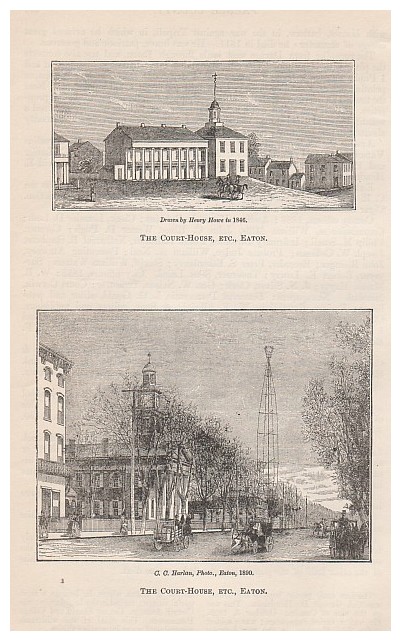
Top
Picture
Drawn
by Henry Howe
in 1846.
THE COURT-HOUSE, ETC., EASTON.
Bottom
Picture
C. C. Harlan,
Photo., Eaton,
18890.
THE
COURT-HOUSE, ETC., EATON
THE
ONE-EYED OX.
This was an animal that roamed
through the woods when
he was a boy. This historic ox was a noble animal, with large and
stately horns
of a dark brindle color, and a grand type of the bovine race, whom the
first
settlers found hereon their arrival. It
was supposed he had strayed from
Wayne’s army on
his march into the Indian country. They caught him and
reduced him to
their service. When a boy Hendricks rode
“One-Eyed”
to mill on several occasions,
and his father harnessed
him and employed him to haul logs in the clearing. He was quite
celebrated
among the early settlers and lived for several years among them as
common
property, and when he died they largely turned out to his funeral and
buried
him in honor on Garrison Branch.
NETTLE
SHIRTS.
Another of Mr. Hendrick’s
experiences was the wearing a nettle shirt. Nettles were found wild in
the
woods, and before they could break up the country and grow flag for linen, the settlers resorted to it
as a
material for underclothing. This shirt so irritated his back, he was
frequently
compelled to lean against the trees and rub it to allay the irritation.
Scott,
in his History of Fairfield County,
says :
“The
pioneers in some parts manufactured fine linen from the fibre
of wild nettles, but it was not known to all even of them. It grew in
great
abundance in some sections and always on the low and richest soil. It resembled boneset or ague weed,
and grew about four feet in
height. Its fibre was fine
as the finest flag and was treated in the same
way, by rotting, breaking, scutching
and spinning;
but unlike flag, it was mowed down
and
not pulled up by the root. The
nettle has
entirely disappeared from the country and is never seen except in
remote and
wild spots. It has on its stem a prickly beard that, upon touching with
the
hands, inserts itself into the skin, producing a most intolerable
itching,
almost unendurable; hence, everybody soon learned to go round
‘the nettle
patch.’ ”
GIRLS STOLEN
BY INDIANS.
A year or two before the war of 1812, two little girls were stolen from Harrison township by Indians. One was named THARP and the other HARPER. The incidents connected with this affair were related by Mr. G. D. HENDRICKS, January 18, 1885, at which time he was a resident of Hiawatha, Kansas.
Mr.
Harper
Finds His Child.—When the
children were first missed, they were supposed
to. be lost; but their
captivity was assured by the
discovery of Indian tracks. All efforts to find their whereabouts were
of no
avail, until many years after the close of the war, when Mr. HARPER
learned
from an Indian that a white woman was at Kaskaskia,
Illinois, whence the father sought and found his long-lost
child, but so changed by time and association that she was past
recognition. But through the kind offices of a French interpreter, it became self-evident as to her identity. Notwithstanding this, she seemed
unable to
realize that she was other than one of the tribe, and refused to
converse with
her father, or return with him to civilization.
Wife of
an Indian Chief.—Years rolled on
without any tidings of the daughter of Mr. THARP, until about the year
1837 or
1838, when he received word from a friend and Indian trader, that the
wife of
an Indian chief, named CAPTAIN DIXON,
was
a white woman. DIXON was a
younger
brother of the Miami chief SHINGLEMACY, whose Indian name was METO-SINA. This
tribe were
on their Reservation, a few miles below where Marion, Grant county,
Indiana, is
located. The fond father sped his way to the vicinity of the village,
and
called on my brother, William E. HENDRICK, who had a traditional
knowledge of
the abduction of the THARP and HARPER
children. As his farm was
adjoining the
Reservation, and he knew personally CAPTAIN DIXON and the tribe generally,
the
meeting of father and daughter was at my brother’s house.
Refused to Leave.—The result
of the conference
was disheartening to the father; for this child of
misfortune persistently refused to leave her Indian home, arguing that
with the
whites she would be an object of sport or ridicule, on account of her
Indian
habits and training, and was too old to learn the habits
and customs of civilized life; and in fact, she had but a
faint
recollection of her childhood home and kindred. The meeting and
parting, as
described by my nephew, were heartrending to the bereaved father; and
the more
so, because of the cold indifference of his alienated daughter, who, in
a few
years after, committed suicide, by
drowning, at “Hog-back,”
“in the Mississinewa,
four miles below the
village, because her liege lord returned home from a drunken spree with
another
wife. CAPTAIN
DIXON, though a fair scholar, and speaking good English, was a drunken
desperado, as were two of his brothers, who
were
killed at an Indian pow-wow, by a Pottawatomie brave; his
oldest
brother, METO-SINA, was
temperate.
VANASUDAL’S STORE.
When the county of Preble was
organized there was not
a store in the county. The necessity for
one
induced Cornelius VANAUSDAL, a young man of 25, to leave
his father’s
Page 452
farm and start
the enterprise at
Eaton. He and his store soon became known throughout the surrounding
country,
and his venture proved a profitable one. Started in 1808, he conducted
it
either alone or in partnership with others until 1863. Among his
familiar
acquaintances were TECUMSEH, his brother the PROPHET, HONEST JOHN,
INDIAN JOHN,
and others.
It is
related of Indian John,
that he brought furs to the store to swap for salt. The old-fashioned
steelyards with long and short, or light and heavy slides,
were used in weighing the articles involved in the trade. John had
never seen
steelyards before, and watched the weighing closely. The light side was
used in
weighing the furs. W hen the salt was to be weighed the steelyards were turned over so as to use the
heavy side. John watched this
operation
with
suspicion,
and when he saw the
yard fly up when the pea was not so far from the fulcrum as when his
furs were
weighed, he was convinced that there was something wrong, and seizing
the
steelyards with an exclamation pronouncing them a lie, ran to the door
and
threw them as far as he could into the weeds and brush. Mr. VANAUSDAL,
in his
dealings with Indians, would never give them credit, although he freely
trusted
white men. Mr. VANAUSDAL was born in Virginia, October 2, 1783; in 1805
came
with his father to what is now Lanier township, Preble county.
In 1810 he took the first census of Preble county.
During the war of 1812, he was assistant paymaster in the United States
army,
and engaged in furnishing supplies to the army operating between the
Ohio river and Lake
Erie. In 1819 he represented Preble county
in the Legislature. His death occurred in 1870.
About a mile west of Eaton is the
site of
Fort
St. Clair, erected in the severe winter of 1791-2. At
this time Fort Jefferson was the farthest-advanced post, being
forty-four miles
from Fort Hamilton. This spot was chosen. as a place of security, and to guard the communication between
them.
Gen. Wilkinson sent Major John S. Gano,
belonging to
the militia of
the
Territory, with
a party
to build the work.
Gen. Harrison, then an ensign, commanded a guard every other night for
about
three weeks, during the building of the fort. They had neither
fire nor covering of
any
kind, and suffered much from the intense cold. It was a
stockade, and had about twenty acres cleared around it. The outline can
yet be
distinctly traced.
On the 6th of November, 1792, a
severe battle was fought almost under cover of the guns of Fort
St. Clair, between a corps of riflemen and a body of Indians. Judge Joel COLLINS,
of Oxford, who was in the
action, gives the following facts respecting it
in a letter to James McBRIDE,
dated June 20, 1843:
Indians
Led
by Little Turtle.—The
parties engaged were a band of 250 Mingo and Wyandot warriors, under
the
command of the celebrated chief LITTLE TURTLE, and an escort of 100
mounted
riflemen of the Kentucky militia, commanded by Capt. John Adair,
subsequently
governor of Kentucky. These men had been called out to escort a brigade
of pack-horses,
under an order from Gen. Wilkinson. They could then make a trip from
Fort
Washington, past Fort St. Clair, to Fort Jefferson, and return in six
days,
encamping each night under the walls of one of the military posts for
protection. The Indians being elated by the check they had given our
army the
previous year, in defeating St. Clair, determined to make a descent
upon a
settlement then forming at Columbia, at the
mouth of the Little
Miami. Some time in September 250 warriors struck
the war pole, and took
up their line of march.
Fortunately for the infant settlement, in passing
Fort Hamilton they discovered a fatigue party, with a small guard,
chopping
firewood, east of the
fort. While the men were gone to
dinner the Indians formed an ambuscade, and on their return captured
two of the
men. The prisoners informed the Indians that on the morning
previous-which must
have been on Friday—a brigade of some fifty or 100
pack-horses, loaded with
supplies for the two military posts in advance, had left Fort Hamilton,
escorted by a company of riflemen, mounted on fine horses, and that if
they
made their trip in the usual time, they would be at Fort Hamilton, on
their
return, Monday night.
Ambuscade.—Upon this
information, Little Turtle
abandoned his design of breaking~ up the settlement above Cincinnati,
and fell
back some twelve or fifteen miles, with a view of intercepting the
brigade on
its return. He formed an ambuscade on the trace, at a well-selected
position,
which he occupied through the day that he expected the return of the
escort.
But as Capt. Adair arrived at Fort Jefferson on Saturday night, he
permitted
his men and horses to rest themselves over Sunday, and thus escaped the
ambuscade. On Monday night, when on their return, they encamped within
a short
distance of Fort St. Clair. The judge says:
“The
chief of the band of Indians
being informed of our position by his runners,
concluded that by a night attack he could drive us out of our
encampment.
Accordingly, he left his ambush and a short time before daybreak, on
Tuesday
morning, the Indians, by a discharge of rifles and raising the hideous
yells
for which they were distinguished, made
Page 453
a simultaneous attack on three aides
of the encampment,
leaving that open next to the fort. The horses became frightened, and
numbers
of them broke from their fastenings. The camp, in consequence of this,
being
thrown into some confusion, Capt. Adair retired with his men and formed
them in
three divisions, just beyond the shine of the fires, on
the aide next the
fort; and while the enemy were endeavoring to secure the horses and
plunder the
camp—which seemed to be their main object—they were
in turn attacked by us, on
their right, by the captain and his division; on the left by Lieut.
George
MADISON, and in the centre by Lieut. Job HALE, with their respective
divisions.
The enemy, however, were sufficiently strong to detail a fighting
party, double
our numbers, to protect those plundering the camp and driving off the
horses,
and as we had left the side from the fort open to them they soon began
to move
off, taking all with them.
“Close
Fighting.—As soon as the day-dawn afforded light
sufficient to
distinguish a white man from an Indian, there ensued some pretty sharp
fighting, so close in some instances as to bring in use the war-club
and
tomahawk. Here Lieut. Hale was killed and Lieut. Madison wounded. As
soon as
the Indians retreated the white men hung on their rear but when we
pressed them
too close, they would turn and drive us back. In this way a kind of
running
fight was kept up until after sun-rising, when we lost sight of the
enemy and
nearly all our horses, somewhere about where the town of Eaton now
stands. On
returning from the pursuit our, camp presented rather a discouraging
appearance. Not more than six or eight horses were saved; some twenty
or thirty
lay dead on the ground. The loss of the enemy remains unknown; the
bodies of
two Indians were found among the dead horses. We gathered up our
wounded, six
in number, took them to the fort, where a room was assigned them as a
hospital,
and their wounds dressed by Surgeon Boyd of the regular army. The wound
of one
man John JAMES,
consisted of little more than the loss
of his scalp. It appeared from his statement that in the heat of the
action he
received a blow on the side of his head with a war-club, which stunned
so as to
barely knock him down, when two or three Indians fell to skinning his
head, and
in a very short time took from him an unusually large scalp, and in the
hurry
of the operation a piece of one of his ears. He recovered, and I
understood
some years afterwards that he was then living.
Another of the wounded, Luke VORES,
was a few years
since living in Preble county.
“Melancholy
Duty.—By
sunset on the day of the action we had some kind of rough
coffins prepared for the slain. For the satisfaction of surviving
friends I
will name them, and state that in one grave, some fifty paces west of
the site
of Fort St. Clair; are the remains of Lieut. Job HALE; next to him, on
his
left, we laid our orderly sergeant, Matthew ENGLISH; then followed the
four
privates, Robert BOWLING, Joseph CLINTON, Isaac JETT and John WILLIAMS.
Dejection and even sorrow hung on the countenances of every member of
the
escort as we stood around or assisted in the interment of these our
fellow-comrades. Hale was a noble and brave man, fascinating in his
appearance
and deportment as an officer. It was dusk in the evening before we
completed
the performance of this melancholy duty. What a change
!
The evening before nothing within the encampment was to be seen or
heard but
life and animation. Of those not on
duty, some were
measuring their strength and dexterity at athletic exercises; some
nursing,
rubbing and feeding their horses; others cooking, etc. But look at us
now, and
behold he ways, chances
and uncertainties of war. I
saw and felt the contrast then, and feel it still, but am unable
further to
describe it here!”
Between the site of Fort St. Clair and Eaton is the village graveyard. This cemetery is adorned with several beautiful monuments. Among them is one to the memory of Fergus HOLDERMAN, who died in 1838. Upon it are some exquisitely beautiful devices, carved by “the lamented CLEVENGER,” which are among his first attempts at sculpture. The principal object of attraction, however, is the monument to the memory of Lieut. LOWRY and others who fell with him in an engagement with a party of Indians commanded by LITTLE TURTLE, at Ludlow’s Spring, near the Forty-foot Pitch, in this county, on the 17th of October, 1793. This monument has recently been constructed by La Dow & Hamilton, of Dayton, at an expense of about $300, contributed by public-spirited individuals of this vicinity. It is composed of the elegant Rutland marble, is about twelve feet in height, and stands upon one of those small artificial mounds common in this region. The view was taken from the east, beyond which, in the extreme distance, in the forest on the left, is the site of Fort St. Clair. This Lieut. LOWRY was a brave man. His last words were: “My brave boys, all you that can fight, now display your activity and let your balls fly!” The slain in the engagement were buried at the fort. On the 4th of July, 1822, the remains of LOWRY were taken up and reinterred with the honors of war in this
Page 454
graveyard, twelve military officers acting as pall-bearers, followed by the orator, chaplain and physicians, under whose direction the removal was made, with a large concourse of citizens and two military companies. The remains of the slain commander and soldiers have been recently removed to the mound, which, with the monument, will “mark their resting-place, and be a memento of their glory for ages to come.”
E. D. Mansfield, in his Personal Memoirs, published by Robert Clarke & Co., in 1879, speaks of meeting LITTLE TURTLE at his father’s house, then Ludlow’s Station, now Cumminsville, Cincinnati.
One day a dark man, with swarthy
countenance, riding a
very fine horse, dismounted at our house and went into my
father’s office. I
wanted to go in and see him, but for some reason or other was not
allowed to.
After some time—it was in the forenoon, I think—I
saw him come out, mount his
horse and ride rapidly away. I was struck by the man, and asked,
“Who is that,
Ma?” She said it was “LITTLE
TURTLE,” the
great Indian chief.
The last Indian Confederacy had
been founded by
Brandt, but the figure which stands out on the historical canvas in
bold relief
is that of MECHE CUNNAQUA,
the LITTLE
TURTLE, chief of the Miamis.
This most acute and
sagacious of Indian statesmen, was, it is said, even a polished
gentleman. He
had wit, humor and intelligence.
Thirty years after the treaty of
Greenville he die at
Fort Wayne, of the gout (!), which
would seem a marvellous
fact, did we not remember
that the LITTLE TURTLE was a high liver and a gentleman; equally
remarkable was
it that his body was borne to the grave with the highest honors by his
great
enemy, the white man.
The muffled drum, the funeral
salute, announced that a
great soldier had fallen, and even enemies paid their mournful tribute
to his
memory. The sun of Indian glory set with him; and the clouds and
shadows, which
for two hundred years had gathered around their destiny, now closed in
the
starless night of death.
We give a letter narrating an account of this action, written by Gen. Wayne to the Secretary of War, and dated “Camp, southwest branch of the Miami, six miles advanced of Fort Jefferson, October 23, 1793.”
The greatest difficulty which at
present presents, is
that of furnishing a sufficient escort to secure our convoy of
provisions and
other supplies from insult and disaster, and at the same time retain a
sufficient force in camp to sustain and repel the attacks of the enemy,
who
appear desperate and determined. We have recently experienced a little
check to
our convoys, which may probably be exaggerated into something serious
by the
tongue of fame, before this reaches you. The following, however, is the
fact,
viz.: Lieut. LOWRY, of the 2d sub-legion, and Ensign BOYD, of the lst, with a command consisting
of ninety non-commissioned
officers and privates, having in charge twenty wagons belonging to the
Quartermaster-General’s department, loaded with grain, and
one of the
contractor’s [wagons], loaded with stores, were attacked
early on the morning
of the 17th inst., about seven miles advanced of-Fort St. Clair, by a
party of
Indians. Those gallant young gentlemen—who
promised at a
future day to be ornaments to their profession—together
with thirteen
non-commissioned officers and privates, bravely fell, after an
obstinate
resistance against superior numbers, being abandoned by the greater
part of the
escort upon the first discharge. The savages killed or carried off
about
seventy horses leaving the wagons and stores standing in the
road, which have
all been brought to this camp without any other loss or damage, except some trifling articles.
LITTLE TURTLE,
who name has been mentioned in the preceding pages, was a
distinguished
chief and counsellor of
the Miamis,
by whom he was called Meshekenoghqua. He commanded the Indians at St.
Clair’s
defeat. We annex a sketch of him from Drake’s Indian
Biography.
A Chief
who Never Sleeps.—It has
been generally said, that had the advice of this chief been taken at
the
disastrous fight afterwards with General Wayne, there is but little
doubt but
he had met as ill-success as General St. Clair. He was not for fighting
General
Wayne at Preaque Isle,
and inclined rather to peace
than fighting him at all. In a council held the night before the
battle, he
argued as follows: “We have beaten the enemy twice, under
separate commanders.
We cannot expect the same good fortune always to attend us. The
Americans are
now led by a chief who never sleeps; the night and the day are alike to
him.
And during all the time that he has been marching upon
Page 455
our villages,
notwithstanding the
watchfulness of our young men, we have never been able to
surprise him. Think
well of it. There is something whispers me, it would be prudent to
listen to
his offers of peace.” For using this language he was
reproached by another
chief with cowardice, which put an end to all further discourse.
Nothing wounds
the feelings of a warrior like the reproach of cowardice, but
he stifled his
resentment, did his duty in the battle, and its issue proved him a
truer prophet
than his accuser believed.
A Wise and
Humane Indian Chief.—LITTLE
TURTLE lived some years after the war in great
esteem among men of high standing. He was alike courageous and humane,
possessing great wisdom. “And”
says Schoolcraft, ‘there have
been few individuals among aborigines who have done so much to abolish
the
rites of human sacrifice. The grave of this noted warrior
is shown to
visitors, near Fort Wayne. It is frequently visited by the Indians in
that part
of the country, by whom his memory is cherished with the greatest
respect and
veneration.”
When the
philosopher and famous traveller,
Volney, was in
America, in the winter of 1797, LITTLE TURTLE came to Philadelphia,
where he
then was, and he sought immediate acquaintance with the celebrated
chief, for
highly valuable purposes, which in some measure he effected.
He made a vocabulary of his language, which he printed in the appendix
to his
travels. A copy in manuscript, more extensive than the printed one, is
in the
library of the Philosophical Society of Pennsylvania.
Having
become convinced that all
resistance to the whites was vain, he brought his nation to consent to
peace
and to adopt agricultural pursuits. And it was with the view of
soliciting
Congress and the benevolent Society of Friends for assistance to effect this latter purpose that
he now visited Philadelphia.
While here he was inoculated for the small pox, and was afflicted with
the gout
and rheumatism.
Indians
Descendants of Tartars.—At
the time of Mr. Volney’s
interview with him for information, he took no notice of the
conversation while
the interpreter was communicating with Mr. Volney,
for he did not understand English, but walked about, plucking out his
beard and
eye-brows. He was dressed now in English clothes. His skin, where not
exposed,
Mr. Volney says, was as
white as his; and on speaking
upon the subject, LITTLE TURLE said: “I have seen Spaniards
in Louisiana, and
found no difference of color between them and me. And why should there
be any?
In them, as in us, it is the work of the father
of colors, the sun that burns
us. You white people
compare the color of your face with that of your bodies.” Mr.
Volney explained to him
the notion of many, that his race
was descended from the Tartars, and by a map showed him the supposed
communication between Asia and America. To this LITTLE TURTLE replied: “Why
should not these Tartars, who
resemble us, have
come from America? Are
there any reasons
to the contrary? Or why
should we not both have
been in our own country?” It is a fact that the Indians give
themselves a name
which is equivalent to our word indiqine, that is, one sprung from the soil, or
natural to it.
An Indian out of Place.—When
Mr. Volney asked LITTLE
TURTLE what prevented him
from living among the whites, and if he were not more comfortable in
Philadelphia than upon the banks of the Wabash, he said:
“Taking all things
together you have the advantage over us; but here I am deaf and dumb. I
do not
talk your language; I can neither hear, nor make myself heard. When I
walk
through the streets I see every person in his shop employed about
something:
one makes shoes, another hats, a third sells cloth, and every one lives
by his labor.I say to myself, Which of
all these things can you do? Not one. I can make a bow or an arrow,
catch fish,
kill game, and go to war; but none of these is of any use here. To
learn what
is done here would require a long time. Old age comes on. I should be a
useless
piece of furniture, useless to my nation, useless to the whites, and
useless to
myself. I must return to my own country.”
Col. John Johnston has given
in his “Recollections,”
published in Cist’s
Advertiser, some anecdotes of Little
Turtle.
A Companionable
Indian.—LITTLE TURTLE was a man
of great wit, humor and
vivacity, fond of the company of gentlemen, and delighted in good
eating. When
I knew him he had two wives living with him under the same roof in the greatest
harmony; one, an old woman, about his
own age—fifty—the choice of his youth, who
performed the drudgery of the house;
the other, a young and beautiful creature of eighteen, who was his
favorite;
yet it was never discovered by any one that
the least unkind feeling existed between them. This distinguished chief
died at
Fort Wayne, about twenty-five years ago, of a confirmed case of the
gout,
brought on by high living, and was buried with military honors by the
troops of
the United States. The LITTLE TURTLE used to entertain us with many of
his war
adventures, and would laugh immoderately at the recital of the
following:
A Tricky Prisoner.—A white man, a
prisoner of many years in the tribe, had
often solicited permission to go on a war party to Kentucky, and had
been
refused. It never was the practice with the Indians to ask or encourage
white
prisoners among them to go to war against their countrymen. This man,
Page 456
however, had so far acquired the
confidence of the
Indians, and being very importunate to go to war, the TURTLE at last
consented,
and took him on an expedition into Kentucky. As was their practice they
had reconnoitred during
the day, and had fixed on a house,
recently built and occupied, as the object to be attacked neat morning
a little
before the dawn of day. The house was surrounded by a clearing, there
being
much brush and fallen timber on the ground. At the appointed time, the
Indians,
with the white man, began to move to the attack. At all such times no
talking
or noise is to be made. They crawl along the ground on hands and feet;
all is
done by signs from the leader. The white man all the time was striving
to be
foremost, the Indians beckoning him to keep back. In spite of all their
efforts
he would keep foremost, and having at length got within running
distance of the
house, he jumped to his feet and went with all his speed, shouting at
the top
of his voice, Indians ! Indians !
The TURTLE and his party
had to make a
precipitate retreat, losing forever their white companion and
disappointed in
their fancied conquest of the unsuspecting victims of the log cabin.
From that
day forth this chief would never trust a white man to accompany him
again to
war.
Kosciusko
and
Little Turtle.—During
the presidency
of Washington the LITTLE TURTLE visited that great and just man at
Philadelphia, and during his whole life after often spoke of the
pleasure which
that visit afforded him. KOSCIUAKO, the Polish chief, was at the time
in
Philadelphia confined by sickness to his lodgings, and hearing of the
Indians
being in the city, he sent for them, and after an interview of some
length, he
had his favorite brace of pistols brought forth, and addressing the
chief,
Turtle, said—I have carried and used these in many a
hard-fought battle, in defence
of the oppressed, the weak and the wronged of my
own race, and I now present them to you with this injunction, that with
them
you shoot dead the first man that ever comes to subjugate you or
despoil you of
your country. These pistols were of the best quality and finest
manufacture,
silver mounted, with gold touch-holes.
FATHER
FINLEY, THE ITINERANT.
On entering the Old Mound Cemetery, at Eaton, I was surprised to find there the monument to my old friend, Father FINLEY. I had not until then known the spot of his burial. To copy the inscription was a labor of love. On the north side it was: “Rev. Jas. B. FINLEY, died September 6, 1857, aged 76 years, 1 month and 20 days;” on the south side,” To the memory of Hannah, his wife, born in 1783; died in 1861.”On the west side is an open Bible with the words: “There is rest in Heaven.” The monument is a single shaft mounted on a pedestal and about twelve feet in height., The young of this generation may ask, “Who was Father FINLEY? “We reply,” One of the greatest of the itinerant Methodist ministers.” He began his itinerant ministry in 1809, when 28 years of age. The scene of his labors was the then wilderness of eastern and northern Ohio, western Pennsylvania and western New York; and during his over forty years of service he personally received 5,000 members into the service of the Methodist Episcopal church. Daniels, in his “History of Methodism,” thus sums up his life-work: “Finley was eight times elected a member of the General Conference. He also served three years as chaplain of the Ohio Penitentiary. He was a man of great energy of character, of burning zeal, a powerful preacher, a popular manager of camp meetings and other great assemblies, at which, by the power of his eloquence as well as his tact and knowledge of human nature, he swayed the masses, and calmed the rage of mobs and ruffians.
“To his other labors he added, from his own experiences, those of an author. ‘An Account of the Wyandot Mission,’ ‘Sketches of Western Methodism,’ ‘Life Among the Indians,’ ‘Memorials of Prison Life,’ and his own ‘Biography,’—book abounding in wild adventure, hair-breadth escapes, backwoods wanderings, and such other wild experiences as appertained to the Western itinerants of that day.”
I said Father FINLEY was an old friend. Yes, I was in prison and he comforted me. In 1846 he was chaplain of the Ohio Penitentiary, when he took me under his wing. I had arrived with a severe cold, and he cured me after the manner of the Wyandots, those simple people of the woods, among whom he had lived, prayed and sung. He brought out a heavy buffalo robe, and spreading it.
Page 457

Top
Picture
FATHER
FINLEY
Indian Missionary and Itinerant.
Bottom
Picture
Drawn
by Henry Howe in
1846.
THE LOWRY MONUMENT.
In the Mound Cemetery, Eaton.
Page 458
before the fire of
his room, I laid on
my back and toasted my feet for about two days; thus
the cure was effected, and so well
that scarcely a single other has since invaded my premises. Those two days
with the hunter were a
rare social treat.
Wrote Donn Piatt: “A
mean sinner makes a mean saint;” this was more than forty
years ago, but Donn
never put in any claim for it as an original
discovery. Father FINLEY was formed on a generous scale, and when he
threw that
strong, sympathetic spirit of his into the service of Christianity,
there was
enough of him to make one of the biggest sort
of
Christians. He was
short, but strongly
built, with a heavy, sonorous voice that went to the utmost verge of
many a
camp-meeting, stirring the emotions of multitudes to their inmost
depths. He
was frank, simple as a child, outspoken, fearless in denunciation of
wrong, and
when rowdies disturbed any meeting where he was, he was quick and
effective in
muscular demonstrations.
His autobiography is
a valuable
contribution to the knowledge of
Western life in the
beginning of this
century, and gives an experience nowhere else
so well
told. From it we derive the
following:
The FINLEYS
were Presbyterians of
Pennsylvania. James’ father, Robert W. FINLEY, was graduated
at Princeton,
studied for the ministry, and then sent as a missionary into the
settlements of
North Carolina, South Carolina and Georgia, preaching and planting
churches in
destitute places. Here he married Miss Rebecca BRADLEY, whose father
had lately
removed from Pennsylvania to North Carolina, and the year after, in
1781, James
was born at his father’s home in North Carolina.
Horrors of Civil War.—James
was cradled and reared in
war until well advanced in life. At the time of his birth the horrors
of civil
war raged with great fury; neighbor was massacred by neighbor. The
Tories urged
by the British, tried to exterminate the Whigs.
All of his mother’s
brothers, says FINLEY, were killed in this deadly strife. One fell at
Gates’
defeat; another was murdered by four Tories near his own
door—was shot with his
own rifle; another died on a prison ship. His father and congregation
were
waylaid and shot at on their way to church; one member was killed by a
shot
through a window of his house while at prayer. His father received a
ball
through the clothes of his breast, just as he stepped out of his own
door.
A Tory Major of the
neighborhood by stratagem
collected all the wives of the Whigs in one house, and hanged them by
the neck
until almost dead, in the vain attempt to extort from them the places
of their
husbands’ concealment. At the close of the war he returned to
the neighborhood,
when their sons took him out one night to a swamp, and gave him twenty
lashes
for each of their mothers whom he had hanged. Then they tarred and
feathered
him, ducked him in the swamp and threatened if he did not leave the
country in
a month they would draw every drop of Tory blood out of his body.
Kentucky
Experiences.—In 1786 the
FINLEY family removed to the Redstone
country, near the headwaters of the Potomac, Virginia, where his father
preached for two years; but Kentucky was the land of promise, and in
the fall
of 1788 they embarked with a party of others on the Ohio, and arrived
at
Maysville, when Mr. FINLEY removed his family to Washington, Ky., for
the
winter. James was then a lad of 7 years, and saw for the first time
that great
adventurer. Simon Kenton, a child of Providence, raised
for the protection of the scattered families in the
wilderness.”
That winter
the Indians made
great depredations and stole almost all the horses, so that the farmers
were
scarcely able to carry on their business. It was only a few years
before that
Kenton, going in pursuit with a party, was taken prisoner, and but for
the
intervention of Simon Girty,
would have been burned
at the stake.
The Finleys Help to Found Chillicothe.—The
depredations of the Indians were so great that the
family again removed, and to Cane Ridge, in Bourbon
county. Mr. Finley
bought part of an unbroken canebrake, cleared it, and opened up a farm,
which
he cultivated with the work of his slaves. He preached to two
congregations—Cane Ridge and Concord—and started a
high-school, the first of
the kind in Kentucky, in which the dead languages were taught. Several
of his
pupils became Presbyterian ministers. In the spring of 1796 Mr. FINLEY
emigrated with a large part of his two congregations to the Scioto
valley, and
was a great factor in laying the foundations of Chillicothe (see Ross
County),
and James was thenceforth “ an Ohio boy.” He says
in his early days they had to
depend for their daily living upon the hunters and what they could kill
themselves of the wild game. This gave him an early love for the chase,
so that
before the age of 16 he had almost become an Indian in his habits and
feelings.
In his
father’s academy he had
studied the Greek, Latin and mathematics, and finally, by his request,
studied
medicine, and in the fall of 1800 took his degree, but with no design
to
practise it. “My recreations,” said he,
“were with the gun in the woods, and I
passed several months in the forest
Page 459
surveying Congress lands for Thomas
Worthington, afterwards
Governor of the State. “
FINLEY ADOPTS THE PROFESSION OF A
HUN-
TER, AND SEEKS FOR A WIFE
A WOMAN
ADAPTED TO THAT SITUATION.
Having
passed
the winter of 1800-1801 in hunting, he was so enamored with its
peaceful
enjoyments that he resolved on adopting a hunter’s life, and
by the adviee of his
mother chose a wife suited to that mode of
living. The happy woman was Hannah STANE, and she proved a prize in
that
perilous venture which may rum or save a man—marriage !
“On the 3d day of March 1801,” he says,
“I was accordingly married.”
How Not on
he thus
relates:
My father having bought the land in
what is now
Highland county, I resolved to move and take possession. This
section of the country was then a dense wilderness, with only here and
there a
human” habitation. My father-in-law, being
dissatisfied with his
daughter’s choice, did not even allow her to take her
clothes, so we started
out without any patrimony, on our simple matrimonial stock, to make our
fortune
in the woods.
Builds a Cabin.—With the aid
of my brother John I built a cabin in the forest, my nearest neighbor
being
three miles off. Into this we moved without horse or cow, bed or
bedding, bag
or baggage. We gathered up leaves and dried them in the sun; then,
picking out
all the sticks, we put them into a bed-tick. For a bedstead, we drove
forks
into the ground, and laid sticks across, over which we placed elm bark.
On this
we placed our bed of leaves and had comfortable lodging.
The next thing was to procure
something to eat. Of
meat we had an abundance,
supplied by my rifle, but we
wanted some bread flied and split one hundred rails for a bushel of
potatoes,
which I carried home on my back, a distance of six miles. At the same place I worked
a day for a hen
and three chickens, which I put into my hunting shirt-bosom and carried
home as
a great prize. Our cabin was covered with bark, and lined and floored
with the
same material. One end of the cabin was left open for a fireplace. In
this we
lived comfortably all summer. Having no horse or plough, I went into a
plum
bottom near the house, and, with my age, grubbed and cleared off an
acre and a
half, in which I dug holes with my hoe, and planted my corn without any
fence
around it.
I cultivated this patch as well as
I could with my
hoe, and Providence blessed my labor with a good crop of over one
hundred
bushels. Besides, during the summer, with the help of my wife, I put up
a neat
cabin, and finished it for our winter’s lodgings. For the
purpose of making the
cabin warm, I put my corn in the loft, and now, if we could not get
bread, we
had always, as a good substitute, plenty of hominy. We had also plenty
of bear
meat and venison, and no couple on earth lived happier or more
contented. Our
Indian friends often called and stayed all night, and I paid them, in
return,
occasional visits.
During the season several families
settled in the
neighborhood, and, when we were together, we enjoyed life without
gossip and
those often fatal bickerings
and backbitings
which destroy the peace ace of whole communities. Though we had but
little, our
wants were few, and we enjoyed our simple and homely possessions with a
relish
the purse-proud aristocrat never enjoyed. A generous hospitality
characterized
every neighbor, and what we had we divided to the last with each other.
When
any one wanted help all were ready to aid. I spent the greater part of
the
winter in hunting and laying up a store of provisions for the summer,
so that I
might give my undivided attention to farming. As we had no stock to
kill, and
could not conveniently raise hogs; on account of the wild animals,
which would
carry them off, we were obliged to depend upon the product of the
woods. As the
bear was the most valuable, we always hunted for this animal. This fall
there
was a good mast, and bears were so plentiful that it was not necessary
to go
from home to hunt them. About Christmas we made our turkey-hunt. At
that season
of the year they are very fat, and we killed them in great abundance.
To
preserve them, we cleaned them, cut them in two, and after salting them
in
troughs, we hung them up to dry. They served a valuable purpose to
cook, in the
spring and summer, with our bear, bacon, and venison hams. Being dry,
we would
stew them in bear’s oil, and they answered a good substitute
for bread, which,
in those days, was hard to be obtained, the nearest mill being thirty
miles
distant. Another great difficulty was to procure salt, which sold
enormously
high—at the rate of four dollars for fifty pounds. In
backwoods currency, it
would require four buckskins, or a large bear skin, or sixteen coon
skins, to
make the purchase. Often it could not be had at any price, and the only
way we
had to procure it was by packing a load of kettles on our horses to the
Scioto
salt lick, now the site of Jackson Court-house, and boiling the water
ourselves. Otherwise we had to dispense with it entirely. I have known
meat
cured with strong hickory ashes.
Happy Times.—I imagine I
hear the reader saying this
was hard living and hard times. So they would have been to the present
race of
men; but those who lived at that time enjoyed life with a greater zest,
and
were more healthy and happy than the present race. We had not then
sickly,
hysterical wives, with poor, puny, sickly, dying children, and
no dyspeptic
men constantly swallowing the nostrums of quacks. When we became sick
unto
death we died at once, and did not keep the neighborhood in a constant
state of
alarm for several weeks by daily bulletins of our dying. Our young
women were
beautiful without rouge, color de rose, meen
fun, or
any other cosmetic, and blithesome
Page 460
without wine and fruit-cake. There was
then no curvature of
the spine, but the lasses were straight and fine-looking, without
corsets or
whalebone. They were neat in their appearance and fresh as the morning.
When the spring opened I was better
prepared to go to
farming than I was the last season, having procured horses and plough.
Instead
of the laborious and tedious process of working the land with a hoe; I
now
commenced ploughing.
Providence crowned my labors
with abundant success, and we had plenty to eat and wear. Of course, our wants were few and
exceedingly
simple, and the products of the soil and hunting yielded a rich supply.
Thus
we lived within ourselves on our own industry, our only dependence
being upon
the favor of an over-ruling bountiful Benefactor. We spun and wove our
own
fabrics for clothing, and had no tag, no muster, no court, no justices,
no
lawyers, no constables, and no doctors, and, consequently had no
exorbitant
fees to pay to professional gentlemen. The law of kindness governed our
social
walks; and if such a disastrous thing as a quarrel should break out,
the only
way to settle the difficulty was by a strong dish of fisticuffs. No man
was
permitted to insult another without resentment; and if an insult was
permitted
to pass unrevenged, the
insulted party lost his standing and caste
in society any a muss or
spree was gotten up, in which the beat of friends quarrelled
and fought, through the sole influence of the brown jug.
It was seldom we had any preaching,
but if a travelling
minister should come along and make an
appointment, all would go out to preaching. If the preaching was on a
week day,
the men would go in their hunting-shirts,
with their guns. On Sabbath, the gun was left at home, but the belt and
knife
were never forgotten.
Misfortune Met Philosophically.—After
two or three seasons had passed he met with a great misfortune; lost
all his
property, one hundred acres of good military land, with all the
improvements,
by going security for a man who had run away.
He
took it philosophically. “I
consoled my wife,”
says he, “as well as I could, and told her we
were young, and had begun the
world with nothing,
and would do it again. I requested her to stay at home and keep house,
and I
would take to the woods and hunt.” Bear-skins commanded a
good price; from
three to seven dollars, according to size and quality. I spent the
winter
mostly in the woods, and suffered much from lying out at night without
bedclothes or bed only as I could make one
out of dry bark. I wrapped
skins about me and laid by the
fire. It was a prosperous
winter, and
success the most sanguine, crowned my days
and
nights of toil and privation.
From the
proceeds of my winter campaign, I was enabled to purchase as good a
home as
that from which the law had ejected me.
Thus I passed seven years, farming
in the summer and hunting in the winter,
and adding
to my resources till I had a comfortable home, with
everything necessary to make the backwoodsman happy.
The
Grand Old
Woods.—But my neighbors
became too numerous, and my hunting-grounds
were broken in upon by the hard of
civilization;
game became scarce and hard to take; my ranges were broken up, and I
had about
come to the conclusion to go to a new country. It seemed as though my
happiness
depended upon a life in the woods,”
the
grand old woods, “where
Nature had
erected her throne, and where she swayed her sceptre.
Alone in the deep solitude of the
wilderness man can
commune with himself and Nature and her God, and realize emotions and
thoughts
that the crowded city never can produce. To be sure, one has said,
“A great
city is a great desert,” but it is a desert of depraved
humanity, where every
one is wrapped up in selfishness, and guards himself against his
neighbor while
his heart rankles with envy at his
prosperity,
or his wild unbridled ambition urges him on the reckless
course of
outstripping all his competitors. Not so in the woods. There pride,
envy,
selfishness, and ambition have no abode. The only evil spirit that
haunts the
woods is Melancholy. This
will often
steal upon the heart of those who have not found the satisfying portion
that
religion imparts.
Mr. FINLEY’S account of his conversion and final entrance into the ministry of the Methodist Church is vividly told. “He was,” he says, “raised by Presbyterian parents, and taught the catechism.” From this he learned that God from all eternity had elected some men and angels to everlasting life and passed by the remainder, ordaining them to eternal death. This doctrine seemed to him unjust. There was no use in prayer. That would not convert him unless he was one of the elect, and if so, he would be saved anyway. “This doctrine,” he says, “well nigh ruined me. I thought if God had brought me into the world without my consent for his own purposes, it was no concern of mine, and all I had to do was to be honest, enjoy life, and perform the errand of my destiny.” So he entered freely into pleasure, took a hand at cards, but never gambled; was passionately fond of dancing; sometimes went on a spree; would swear when angry, and fight when insulted. “Backwoods boys were brought up to the trade of knock down and drag out.” The people called him the “New Market Devil,” so wild was he.
Page 461
In the midst of all this mirth and
revelry he dare not
think of death and eternity. About this time a great revival of
religion broke
out in Kentucky, accompanied by that
alarming phenomena
called the jerks. In August, 1801, learning there was to be a great
meeting at
Cane Ridge, Kentucky, in his father’s old congregation, he
left, with some
companions, his woody retreat in Highland county, near what is now New
Market,
and went down to visit the scenes of his boyhood.
CAMP MEETING SCENES.
When he arrived on the camp-ground
he found an awful
scene. A vast crowd was collected, estimated at 25,000. The noise was like
the roar of
Niagara. The vast sea
of human beings were agitated as if by a storm. He counted
seven
ministers all preaching at once from stumps, fallen trees, and wagons.
Some
were singing, others praying; some
piteously
crying for mercy and others shouting most vociferously. He became weak as a kitten at the sight and fled to the woods.”After
some
time,” he says, “I returned to the scene of
excitement, the waves of which, if
possible, had risen still higher. The same awfulness of feeling came
over me. I
stepped up on to a log, where I could have a better view of the surging
sea of
humanity. The scene that presented itself to my mind
was indescribable. At
one
time I saw at least five hundred swept down in a moment, as if a
battery of a
thousand guns had been opened upon them; and then immediately followed
shrieks
and shouts that rent the very heavens. My
hair rose up on my head; my whole frame trembled; the blood ran cold in my veins; and I
fled for
the woods a second time, and wished I had stayed at home. While I
remained here
my feelings became intense and insupportable.
A
sense of suffocation and blindness seemed to come over me, and I
thought I was
going to die.
A
Drunken Revelry.—There being
a tavern about
half a mile off, I concluded to go and get some brandy,
and see if it
would not strengthen my nerves. When I arrived there I was disgusted
with the
sight that met my eyes. Here I saw about one hundred men engaged in a
drunken
revelry, playing cards, trading horses, quarrelling, and fighting.
After some
time I got to the bar, and took a dram and left; feeling that I was as
near
hell as I wished to be, either in this or the world to come. The brandy had no effect in allaying
my
feelings, but, if anything, made me worse.
Convicted
of Sin.—Night
at length came on, and I was afraid to see any of my companions. I
cautiously
avoided them, fearing lest they should discover something the matter
with me. In this state I
wandered about from place to
place, in and around the encampment. At
times it seemed as if all the sins I had ever committed in my life were
vividly
brought up in array before my terrified
imagination; and under their awful pressure I felt that I
must die if I
did not get relief. Then it
was that I
saw clearly through the thin vail
of Universaliam, and
this refuge of lies was swept away by the
Spirit of God. Then fell the scales from my sin-blinded eyes, and I
realized,
in all its force and power, the awful truth; and that if I died in my
sins, I
was a lost man forever.
Notwithstanding all this, my heart
was so proud and
hard that I would not have fallen to the ground for the whole State of
Kentucky. I felt that such an
event would have
been an everlasting disgrace, and put a final quietus on my boasted
manhood and
courage. At night I went to a barn in the
neighborhood, and, creeping under the hay spent amost
dismal night. I resolved in
the morning to start for
home, for I felt that I
was a ruined man. Finding one of the friends who came
over with me, I said, “Captain, let us be
off; I wilt stay no longer.” He assented, and
getting our horses’ we
started for home.
A
Struggle—Conversion—Joy.—The next night they reached the Blue Lick
Knobs, when, says
FINLEY, “I broke the silence which reigned
mutually between us, and exclaimed to my companion, Captain, if you and I don’t stop
our wickedness, the devil will
get us both.” Then both commenced crying and weeping. The next morning he
went
into the woods to pray. His
shouts
attracted the neighbors, who gathered around, and among them a Swiss
German who
had experienced religion. He understood his case; had him carried to
his house,
and put on his bed. The old Dutch saint directed me
to look
right away to the Saviour. He then kneeled at the bedside, and
prayed for my salvation most
fervently in Dutch and broken English. He
then rose and sung in the same manner, and continued singing and
praying
alternately till nine o’clock, when suddenly my load was
gone, my guilt
removed, and presently the direct witness from heaven
shone full upon my soul. Then
there flowed such copious streams of love into the hitherto waste and
desolate
places of my soul, that I thought I should die with excess of joy. I cried, I laughed, I shouted; and
so
strangely did I appear to all but my Dutch brother that they thought me
deranged. After a time I returned to my companion, and we started on our journey. O what a day it was to my soul!
I told the captain how happy I was,
and was often
interrupted, in a recital of my experience by involuntary shouts of
praise. I
felt a love for all mankind, and reproached myself for having been such
a fool
as to live so long in sin and misery when there was so much mercy for
me.
Becomes
a Circuit Rider.—Soon after his
arrival at home, FINLEY joined the Methodists, developed extraordinary eloquence, and eventually was appointed to the
wills creek circuit. He sent for his family, put them into a cabin; their
entire
earthly possessions being nothing but a bed and some wearing apparel,
and then he says, “My funds
being all exhausted,
I sold my
boots off my feet to pur-
Page 462
chase provisions with.
Then he started on his circuit, to be absent four weeks.
Wills
Creek
Circuit
was computed to be 475 miles
round. Its route was as follows: Beginning at Zanesville and running
east, it
embraced all the settlements on each side of the Wheeling road, on to
Salt
creek and the Buffalo fork of Wills creek; thence down to Cambridge and Leatherwood, on Stillwater; thence to Barnesville and Morristown;
thence down
Stillwater, including all the branches on.
which
[there] were settlements, to the mouth; thence up the
Tuscarawas,
through New Philadelphia, to One-leg Nimishilling thence up Sandy to Canton, and on to
Carter’s; thence to
Sugar creek, and down said creek to the mouth; thence down the
Tuscarawas to
William Butt’s, and thence down to
the mouth of Whitewoman; thence, after crossing
the river, including all the settlements of
the Wapatomica, down to Zanesville,
the
place of beginning.
Many
were his
difficulties and perils. The
country was
wild; the people generally ignorant and inexperienced.
They often interrupted him in his preaching by mookings
and curses and threats’
of punishment,
and sometimes he felt it his duty to
“go in” on
his muscle; and he was strong as an ox.
They
used to tell a story of his thrashing a notorious bully, and then
bringing him
within the fold.
While on the Wills circuit one man, whose wife had been in great distress of mind from the sense of sin, declared FINLEY was a wizard and had bewitched her. He loaded his rifle with a charmed bullet, and went two miles into the woods to waylay him. Soon his mind was filled with dreadful thoughts; horrid visions floated in the air; demon faces gibbered before his vision, when he took to his heels for his home in as much distress as his poor wife. In the result both became converts.
As he journeyed his place of study was the forest and his text-books the Bible, Discipline, doctrinal tracts, and the works of Wesley and Fletcher. The influence of the circuit riders in that day in saving the people of the wilderness from degenerating into savagery was beyond all computation. Such a body of self-denying moral heroes as they were have seldom been known. Generally poverty loomed up to them drearily in the distance. They lived poor and died poor, and left their families in poverty. “Some I know,” said FINLEY, “have spent a fortune for the privilege of travelling circuits, at a salary of twenty-five dollars a year, while their wives lived in log cabins and rocked their children in sugar-troughs.”
Eventually FINLEY was put in charge of the “Ohio district,” which included eight circuits, ten travelling preachers, and over 4,000 members. It embraced all Eastern and Northern Ohio, part of Western New York and all Western Pennsylvania; and he rode through the woods all around it four times a year, holding quarterly meetings. We close with an anecdote related by him as having occurred at St. Clairsville, wherein the later eminent Charles HAMMOND illustrated his muse:
“I was,” writes Finley, “called on by brother YOUNG to exhort. Being much blessed, I suppose I raised my voice to the highest pitch and struck the book-board with my hand. At this a young lawyer, Charles HAMMOND, who had a considerable reputation for talents, became alarmed, and, urging his way through the crowd to the door, fled for his life. On my next round, the sexton found in the pulpit a very neatly turned maul, with a slip of paper wrapped around the handle, which was directed to me. After meeting it was presented, and on the paper were the following verses:
|
“ ‘Thus saith the Lord, the preacher now
Must warn the people all,
And if you cannot make the hear,
I’d have your use this maul. |
|
“ ‘Your hand,
dear sir, is for too soft
To batter on the
wood ;
Just take this maul, it is but small,
And
thunder on the board. |
|
“ ‘Lift up your
voice, and loudly call
On sinners all around,
And if you cannot make them here
Take up this maul and POUND
!’ ” |
CAMDEN is eight miles south of Eaton, on the C. R. & C. R. R. Newspapers:
Page 493
Gazette,
Independent, C. M. HANE,
editor and publisher. Churches:
1 Methodist, 1 Presbyterian, and 1 Universalist.
It
is quite a purchasing and shipping-point for grain and stock. Population, 1880, 800. School census,
1888, 220.
WEST ALEXANDRIA
is six miles east of Eaton, on the C. J. & M. R. R., and in the
heart of
the beautiful Twin Valley. Newspaper: Twin
Valley Times, Independent, Chas. J. WILSON, editor. Churches:
1 Episcopal
Methodist, 1 Lutheran, 1 Reformed. This is said to be one of the
wealthiest
villages, per head of population, in this part of the State, and
remarkable for
its number of fine residences. The main industries are furniture,
Coffman &
Burtner; washing
machines, Adolph Schlingman;
woollen goods, as yarns
and blankets, flour, saddlery,
harness, wagons, etc. Population,
1880, 796. School
census, 1888,186. E. P. VAUGHN,
superintendent of schools.
WINCHESTER, P. O. Gratis; is
nine miles southeast
of Eaton. Population, 1880, 502.
School
census, 1888, 203.
WEST ELKTON is fourteen miles
southeast of Eaton. Population, 1880,
247. School census,
1888, 115.
LEWISBURG is nine miles
northeast of Eaton, on the
C. J. & M. R. R. Population, 1880, 409. School
census,
1888, 161.
NEW
PARIS 19
twelve miles northwest of Eaton, on the P. C. & St. L. R. R.,
six miles
east of New Richmond, Ind., on and in the valley of the Whitewater.
Newspapers:
Mirror, Independent, C. W. BLOOM, editor and publisher. Churches:
1
Methodist Episcopal, 1 colored Methodist Episcopal, 1 Presbyterian, 1
Christian, 1 Universalist,
1 United Brethren, and 1
Catholic. Population,
1880, 835. School
census, 1888, 300. F.
S. ALLEY, superintendent of
schools. New Paris is noted
for its mineral springs,
called Cedar Springs, which are quite a summer
resort
for invalids. The manufacture
of linen is extensively carried on.
ELDORADO is twelve miles northwest of Eaton, on the P. C. & St. L. R. R. Population, 1880, 337. School census, 1888, 112.
