RICHLAND COUNTY
Page 474
RICHLAND COUNTY was organized March 1, 1813, and named from the character of its soil. About one-half of the county is level, inclining to clay, and adapted to grass. The remainder is rolling, adapted to wheat, and some parts to corn, and well watered. Area, about 490 square miles. In 1887 the acres cultivated were 165,970; in pasture 71,752; woodland, 63,143; laying waste, 4,986; produced in wheat, 520,776 bushels; rye, 6,699; buckwheat, 905; oats, 783,314; barley, 8,100; corn, 712, 143; meadow hay, 30,636 tons; clover hay, 13,470; flax 6,600 lbs. fibre; potatoes, 93,054 bushels; butter, 682,564 lbs.; cheese, 11,240; sorghum, 902 gallons; maple syrup, 27,577; honey, 6,332 lbs.; eggs, 503,168 dozen; grapes, 12,295 lbs.; apples, 14,257 bushels; peaches, 7,953; pears, 1,709; wool, 251,873 lbs.; milch cows owned, 7,289.
School census, 1888, 11,189; teachers, 343. Miles of railroad track, 155.
|
Townships And Census |
1840. |
1880. |
|
Townships And Census |
1840. |
1880. |
|
Auburn, |
1,020 |
|
|
Monroe, |
1,627 |
1,888 |
|
Bloomfield, |
1,294 |
1,181 |
|
Montgomery, |
2,445 |
|
|
Blooming Grove, |
1,495 |
|
|
Orange, |
1,840 |
|
|
Butler, |
|
789 |
|
Perry, |
1,852 |
656 |
|
Cass, |
|
1,614 |
|
Plymouth, |
1,934 |
1,700 |
|
Clear Creek, |
1,653 |
|
|
Sandusky, |
1,465 |
723 |
|
Congress, |
1,248 |
|
|
Sharon, |
1,675 |
2,981 |
|
Franklin, |
1,668 |
967 |
|
Springfield, |
1,685 |
1,617 |
|
Green, |
2,007 |
|
|
Troy, |
1,939 |
1,424 |
|
Hanover, |
1,485 |
|
|
Vermilion |
2,402 |
|
|
Jackson, |
|
977 |
|
Vernon, |
1,040 |
|
|
Jefferson, |
2,325 |
2,449 |
|
Washington, |
1,915 |
1,599 |
|
Madison, |
3,206 |
11,675 |
|
Weller, |
|
1,076 |
|
Mifflin, |
1,800 |
930 |
|
Worthington, |
1,942 |
2,060 |
|
Milton, |
1,861 |
|
|
|
|
|
Population of Richland in 1820 was 9,186; 1830, 24,007; 1840, 44,823; 1860, 31,158; 1880, 36,306; of whom 27,251 were born in Ohio; 3,931, Pennsylvania; 602, New York; 254, Virginia; 228, Indiana; 28, Kentucky; 1,563, German Empire; 446, Ireland; 387, England and Wales; 81, British America; 60, Scotland; 51, France, and 10, Sweden and Norway. Census, 1890, 38,072.
A large proportion of the early settlers of Richland emigrated from Pennsylvania, many of whom were of German origin, and many Scotch-Irish Presbyterians. It was first settled, about the year 1809, on branches of the Mohiccan. The names of the first settlers, as far as recollected, are Henry M’CART, Andrew CRAIG, James CUNNINGHAM, Abm. BAUGHMAN, Henry NAIL, Samuel LEWIS, Peter
Page 475
KINNEY, Calvin HILL, John MURPHY, Thomas COULTER, Melzer TANNEHILL, Isaac MARTIN, Stephen VAN SCHOICK, Archibald GARDNER and James M’CLURE.
In September, 1812, shortly after the breaking out of the war with Great Britain, two block-houses were built in Mansfield. One stood about six rods west of the site of the court-house, and the other a rod or two north. The first was built by a company commanded by Capt. SHAEFFER, from Fairfield county, and the other by the company of Col. Chas. WILLIAMS, of Coshocton. A garrison was stationed at the place, until after the battle of the Thames.
At the commencement of hostilities,
there was a
settlement of friendly Indians, of the Delaware tribe, at a place
called
Greentown, about 12 miles southeast of Mansfield, within the present
township
of Green, now in Ashland county. It was a village
consisting of some 60
cabins, with a council-house about 60 feet long, 25 wide, one-story in
height,
and built of posts and clapboarded.
The
village contained several hundred persons.
As a measure of safety, they were collected, in August,
1812, and sent
to some place in the western part of the State, under protection of the
government. They
were first brought to
Mansfield, and placed under guard, near where the tan-yard now is, on
the
run. While there, a
young Indian and
squaw came up to the block-house, with a request to the chaplain, Rev.
James
SMITH, of Mount Vernon, to marry them after the manner of the whites. In the absence of the
guard, who had come up
to witness the ceremony, an old Indian and his daughter, aged about 12
years,
who were from Indiana, took advantage of the circumstance and escaped. Two spies from Coshocton,
named MORRISON and
M’CULLOCH, met them near the run, about a mile northwest of
Mansfield, on what
is now the farm of E. P. STURGES.
As the
commanding officer, Col. KRATZER, had given orders to shoot all Indians
found out
of the bounds of the place, under an impression that all such must be
hostile,
MORRISON, on discovering them, shot the father through the breast. He fell mortally wounded,
then springing up,
ran about 200 yards, and fell to rise no more. The girl escaped. The men returned and gave
the
information. A
party of 12 men were
ordered out, half of whom were under Serjeant
John C.
GILKISON, now (1846) of Mansfield.
The
men flanked on each side of the run.
As
GILKISON came up, he found the fallen Indian on the north side of the
run, and
at every breath he drew, blood flowed through the bullet-hole in his
chest. MORRISON next
came up, and called to M’CULLOCH to come and take revenge. GILKISON then asked the
Indian who he was: he
replied, “A friend.”
M’CULLOCH, who had
by this time joined them, exclaimed as he drew his tomahawk,
“D–n you! I’ll
make a friend of you!” and aimed a blow
at his head; but it glanced, and was not mortal.
At this he placed one foot on the neck of the
prostrate Indian, and drawing out his tomahawk, with another blow
buried it in
his brains. The
poor fellow gave one
quiver, and then all was over.
GILKISON had in vain endeavored to
prevent this
inhuman deed, and now requested M’CULLOCH to bury the Indian. “D–n
him! No!” Was
the answer; “they killed two or three
brothers of mine, and never buried them.”
The second day following, the Indian was buried, but it
was so slightly
done that his ribs were seen projecting above ground for two or three
years
after.
This M’CULLOCH continued
an Indian fighter until his
death. He made it a
rule to kill every
Indian he met, whether friend or foe.
Mr. GILKISON saw him some time after, on his way to
Sandusky, dressed as
an Indian. To his
question, “Where are
you going?” he replied, “To get more
revenge!”
Mr. Levi JONES was shot by some
Greentown Indians in
the northern part of Mansfield, early in the war, somewhere near the
site of
Riley’s Mill. He
kept a store in
Mansfield, and when the Greentown Indians left, refused to give up some
rifles
they had left as security for debt.
He
was waylaid, and shot and scalped.
The
report of the rifles being heard in town, a party went out and found
his body
much mutilated, and buried him in the old graveyard.
After the war, some of the
Greentown Indians returned
to the county to hunt, but their town having been destroyed, they had
no fixed
residence. Two of
them, young men by the
names of SENECA JOHN and QUILIPETOXE, came to Mansfield one noon, had a
frolic
in WILLIAMS’ tavern, on the site of the North American,
hotel, and quarrelled
with some whites. About
four o’clock in the afternoon they
left, partially intoxicated. The
others,
five in number, went in pursuit, vowing revenge.
They overtook them about a mile east of town,
shot them down, and buried them at the foot of a large maple on the
edge of the
swamp, by thrusting their bodies down deep in the mud.
The place is known as “Spook
Hollow.”–Old
Edition.
In the war of 1812 occurred two
tragic events near the
county line of Ashland. These
were, the murder by the
Indians of Martin RUFFNER, Frederick
ZIMMER and family, on the Black Fork of the Mohiccan;
and the tragedy at the cabin of James COPUS.
For details see Ashland County.
Page 476
TRAVELLING NOTES.
The name MANSFIELD is with me a very old memory, that of a personal acquaintance with the eminent character, COL. JARED MANSFIELD, in whose honor the place was named. One incident is indelibly impressed in connection with his death, which occurred in his native place, New Haven, Connecticut, February 3, 1830, now more than sixty years since. On that occasion my father had involved upon him a delicate duty, to write to Mrs. Mansfield, then in Cincinnati, of the event. And as he walked the floor to and fro pondering, he turned to me and said he was troubled to think how he could the most appropriately and gently impart the sad tidings.
The MANSFIELDS have been eminent people. The late Edward Deering MANSFIELD, “the Sage of Yamoyden,” Ohio’s statistician and journalist, was his only son: while General Joseph K. F. MANSFIELD, the old army officer, who fell at Antietam, was his nephew.
COL. JARED MANSFIELD was rising of 70 years of age, a tall venerable silver-haired old gentleman, and one of the great, useful characters of his day. It was under his teachings that our famed military school at West Point got its start, in the beginning years of this century.
In giving him the position of Surveyor-General of the Northwest Territory the good judgment of Thomas JEFFERSON was illustrated. In person and qualities he resembled his own son, Edward DEERING; had the same strongly pronounced Roman nose, the same childlike simplicity of speech, and the same loud, guileless laugh. This last was one of the life troubles of Mrs. MANSFIELD; a somewhat proud, punctilious old lady, ever mindful of the proprieties. She “wished the Colonel”–she was always thus careful to give his title–she” wished the Colonel would not laugh so loud; it was so undignified.”
Mrs. Mansfield herself was one of
the strong-minded and
most elegant of the pioneer women of Ohio and deserves a notice. She was a girl-mate and
life-long friend of
my mother, and so I have the facts.
The
family came out to Ohio in 1803, and settled in Cincinnati in 1805,
when, as
her son wrote, it was “a dirty little village.”
She was a society-leader, and introduced the custom of New
Year calls; a
queenly woman withal, of high Christian principles; a close thinker and
great
reader; suave and gracious in manner, but imperious in will. True to her sex, she
looked for admiration
and respect, and, as was her due, received them.
She had come from a commanding
stock and inherited the
qualities for leadership. Her
father and
family–the PHIPPS–had largely been shipmasters.
Among them was Sir William PHIPPS, a shipmaster, an early
governor of
Massachusetts; a generous man, but imperious, “quick to go on
his muscle.” Another
is remembered, not by his name, but
for the usual manner of his “taking off.”
He was in command of a frigate.
It had just arrived, and anchored in the harbor of Halifax. Date
1740, or thereabouts.
He personally landed in a small boat, having
left orders for his ship to fire the usual salute for such an event,
and was
walking on the dock, leading a boy by the hand.
By an oversight in loading the guns for the salute, a
previous load that
was in one of them had not been withdrawn.
It had been loaded with ball while at sea.
That ball went ashore and cut him in two; the
lad was unharmed.
MANSFIELD, in his
“Personal Memories,” gives a handsome
tribute to his father, in some very interesting and instructive
paragraphs. He
says: My father’s family
came from Exeter, in England, and were among the
first settlers in New Haven, in 1639.
My
father, Jared MANSFIELD, was,
all his life, a teacher,
a professor, and a man of science.
He
began his life as a teacher in New Haven, where he taught a
mathematical
school, and afterward taught at the “Friends’
Academy,” in Philadelphia, where
he was during the great yellow-feaver
season, and
went from there to West Point, where he taught in the Military Academy,
in
1802-3 and in 1814-28. In
the meantime,
however, he was nine years in the State of Ohio, holding the position
of
Surveyor-General of the United States.
The manner of his appointment and the work he performed
will illustrate
his character, and introduce a small but interesting chapter of events.
While teaching at New Haven, he had
several pupils who
afterward became famous or rather distinguished men.
Two of these were Abraham and Henry
BALDWIN. The first
was afterward United
States Senator from Georgia, and the second, Judge of the Supreme Court
of the
United States. These
boys, as may be
inferred, had decided talents, but were full of mischief. One day they played a bad
trick upon my
father, their
Page 477
teacher, and he whipped them very severely. Their father complained,
and the case came
before a magistrate; but my father was acquitted.
It may be thought that the boys would have
become my father’s enemies.
Not so; they
were of a generous temperament, and knew their conduct had been wrong;
this
they acknowledged, and they became my father’s fast friends. Judge Henry BALDWIN told
me that nothing had
ever done him so much good as that whipping; and the brothers were warm
in
their friendship to my father, both in word and act.
While teaching in New Haven he
published a book
entitled “Essays on Mathematics.”
It was
an original work, and but a few copies were sold; for there were but
few men in
the country who could understand it.
The
book, however, established his reputation as a man of science, and
greatly
influenced his after life. Abraham
BALDWIN was at that time senator from Georgia, and brought this book to
the
notice of Mr. JEFFERSON, who was fond of science and scientific men. The consequence was that
my father became a
captain of engineers, appointed by Mr. JEFFERSON, with a view to his
becoming
one of the professors at the West Point Military Academy, then
established by
law. Accordingly,
he and Captain BARRON,
also of the engineers, were ordered to West Point, and became the first
teachers of the West Point cadets in 1802.
He was there about a year, when he received a new
appointment to a new
and more arduous field in the West.
Mr. JEFFERSON had been but a short
time in office,
when he became annoyed by the fact that the public surveys were going
wrong,
for the want of establishing meridian lines, with base lines at right
angles to
them. The surveyors
at that time,
including Gen. Rufus PUTNAM, then surveyor-general, could not do this. Mr. JEFFERSON wanted a man
who could perform
this work well; necessarily, there-fore, a scientific man. This came to the ears of
Mr. BALDWIN, who
strongly recommended my father as being, in fact, the most scientific
man of
the country. My
father did not quite
like the idea of such a work; for he was a scholar and mathematician,
fond of a
quiet and retired life.
He foresaw, clearly, that going to
Ohio, then a
frontier State, largely inhabited by Indians and wolves, to engage in
public
business involving large responsibilities, would necessarily give him
more or
less of trouble and vexation. He
was,
however, induced to go, under conditions which, I think, were never
granted to
any other officer. It
was agreed that,
while he was engaged in the public service in the West, his commission
in the
engineer corps should go on, and he be entitled to promotion, although
he
received but one salary, that of surveyor-general.
In accordance with this agreement, he received
two promotions while in Ohio; and his professorship at West Point was
(on the
recommendation of President MADISON) subsequently, by law, conformed to
the
agreement, with the rank and emoluments of lieutenant-colonel.
My father, so far as I know, was
the only man
appointed to an important public office solely on the ground of his
scientific
attainments. This
was due to Mr.
JEFFERSON, who, if not himself a man of science, was really a friend of
science.
Mansfield in 1846.–Mansfield, the county-seat, is sixty-eight miles northerly from Columbus, twenty-five from Mount Vernon, and about forty-five from Sandusky City. Its situation is beautiful, upon a commanding elevation, overlooking a country handsomely disposed in hills and valleys. The streets are narrow, and the town is compactly built, giving it a city-like appearance. The completion of the railroad through here to Sandusky City has added much to its business facilities, and it is now thriving and increasing rapidly
It was laid out in 1808 by James HEDGES, Jacob NEWMAN, and Joseph H. LARWILL. The last-named gentleman pitched his tent on the rise of ground above the Big Spring, and opened the first sale of lots on the 8th of October. The country all around was then a wilderness, with no roads through it. The first purchasers came in from the counties of Knox, Columbiana, Stark, etc. Among the first settlers were George COFFINBERRY, William WINSHIP, Rollin WELDON, J. C. GILKISON, John WALLACE, and Joseph MIDDLETON. In 1817 about twenty dwellings were in the place–all cabins, except the frame tavern of Samuel WILLIAMS, which stood on the site of the North American, and is now the private residence of Joseph HILDRETH, Esq. The only store at that time was that of E. P. STURGES, a small frame which stood on the northwest corner of the public square, on the spot where the annexed view was taken. The Methodists erected the first church.
Mansfield contains one Baptist, one Union, one Seceder, one Disciples’, one Methodist, one Presbyterian, and one Congregational church–the last of which is one of the most substantial and elegant churches in Ohio; two newspaper printing-offices, two hardware, one book and twenty dry-goods stores, and had, in 1840, 1,328 inhabitants, and in 1846, 2,330.–Old Edition.
Page 478
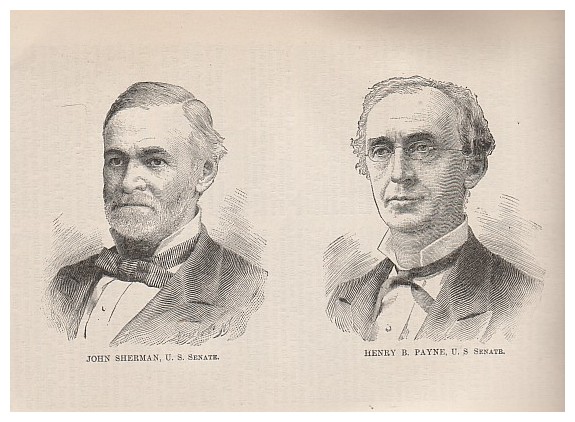
JOHN SHERMAN, U. S. SENATE. HENRY B. PAYNE, U. S.
SENTE.
Page 479
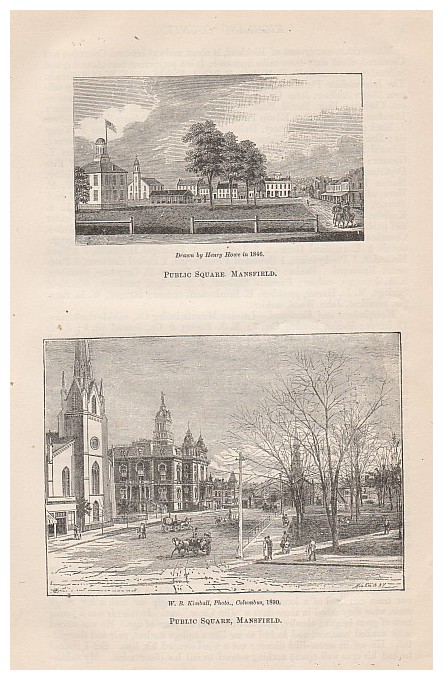
Top
Picture
Drawn
by Henry Howe in
1846.
PUBLIC
SQURE, MANSFIELD.
Bottom
Picture
W.
B. Kimball, Photo, Columbus, 1890.
PUBLIC SQUARE, MANSFIELD.
Page 480
MANSFIELD, county-seat of Richland, is about midway between Columbus and Cleveland, about sixty-three miles from each. It is a prosperous manufacturing and railroad centre; is on the P., Ft. W. & C., B. & O., L. E. & W., and N. W. O. Railroads. The Intermediate Penitentiary is now in course of erection there. County officers, 1888: Auditor, John U. NUNMAKER; Clerk, John C. BURNS; Commissioners, Christian BAER, David BOALS, John ILER; Coroner, Eli STOFER; Infirmary Directors, George BECKER, Edwin PAYNE, Joseph FISHER; Probate Judge, Andrew J. MACK; Prosecuting Attorney, Hubbert E. BELL; Recorder, William F. VOEGELE; Sheriff, Bartholomew FLANNERY; Surveyor, Orlando F. STEWART; Treasurer, Edward REMY. City officers, 1888: Mayor, R. B. McCRORY; Clerk, John Y. GESSNER; Marshal, H. W. LEMON; Civil Engineer, Jacob LAIRD; Chief of Fire Department, George KNOFFLOCK; Street Commissioner, A. C. LEWIS; Solicitor, Marion DOUGLASS. Newspapers: Herald, Republican, George U. and W. F. HARN, editors; News, Republican, CAPPELLER and HIESTAND, editors; Shield and Banner, Democratic, GAUMER and JOHNSTON, editors; Courier, German, L. S. KUEBLER, editor and publisher; Democrat, Democratic, A. J. BAUGHMAN, editor and publisher; Buckeye Farmer, agricultural, W. N. MASON, editor and publisher. Churches: 1 Baptist, 1 Believers in Christ, 1 Catholic, 1 Christian, 1 Congregational, 1 Evangelical German, 3 Lutheran, 1 Episcopal Methodist, 1 African Methodist, 1 Presbyterian, 1 Reformed Presbyterian, 1 United Brethren, 1 Protestant Episcopal. Banks: Citizens’ National, George F. CARPENTER, president, S. A. JENNINGS, cashier; Farmers’ National, J. S. HEDGES, president; Mansfield Savings, M. D. HARTER, president, R. BRINKERHOFF, cashier; Sturges’, W. M. STURGES, president, John WOOD, cashier.
Manufactures and Employees.–Larabee Manufacturing Co., vehicle chafe irons, 12 hands; BODINE Roofing Co., 7; E. J. FORNEY & Co., linseed oil, 9; Jacob CLINE, cooperage, 18; BISSMAN & Co., coffee, spices, etc., 16; Union Foundry and Machine Co., 12; GILBERT, WAUGH & Co., flour, etc., 15; HICKS-BROWN Co., flour, etc., 15; Mansfield Barrel Co., cooperage, 14; BARNETT Brass Co., bras goods, 42; AULTMAN & TAYLOR Co., engines, etc., 330; NAIL & FORD, planing mill, 25; Mansfield Plating Co., nickel-plating, 11; Buckeye Suspender Co., 84; Mansfield Steam Boiler Works, 42; Mansfield Carriage Hardware Co., 57; HUMPHREY Manufacturing Co., pumps, etc., 182; Mansfield Machine Works, 100; Mansfield Buggy Co., 97; FAUST & WAPPNER, furniture, 4; S. N. FORD & Co., sash, doors and blinds, 70; BAXTER Stove Co., 96; MILLS, ELLSWORTH & Co., bending works, 25; R. LEAN & Son, harrows, 12; Western Suspender Co., suspenders, 85; CRAWFORD & TAYLOR, crackers, etc., 80; Herald Co., printing, 21; HAUTZENROEDER & Co., cigars, 285; DANFORTH & PROCTOR, sash, doors and blinds, 25; Ohio Suspender Co., 33; Mansfield Box Manufacturing Co., paper boxes, 15; Shield and Banner Co., printing, 19; News Printing Co., printing and binding, 22.–State Report, 1888.
Mansfield is a rich agricultural centre and heavy wood market. Great attention is given to the improvement of farm stock, as horses, cattle, swine, etc. Population, 1880, 9,859. School census, 1888, 3,589; John SIMPSON, school superintendent. Capital invested in industrial establishments, $1,036,500. Value of annual product, $2,592,000.–Ohio Labor Statistics, 1887.
Census, 1890, 13,473.
Mansfield, in 1846, was reached by a railroad from Sandusky, and I came here by it, though they were not then running regular trains. Everything about it was rough and crude. The track had thin, flat bars of iron spiked on wood, and our train consisted of a locomotive, tender, and a single car with a few rough seats, what they called in those days a “Jim Crow” car. In this car was a young man of great height; slender, pale, and then just 23 years of age. He was attired with studied neatness, and looked to me like a college student, pale and thoughtful. He sat in statue-like silence; not a word escaped his lips. But I noticed he had his eyes well open; nothing seemed to fail his observation. My saddle-
Page 481
bags, containing valuable drawings and notes, had been taken in charge by the railroad man, and I knew not its whereabouts. In talking with him about it, I showed, as I felt, a nervous anxiety. The young man heard my every word, and the thought came over me, “You must think I am very fussy.” He could not realize how important to me were those saddle-bags. Since that day our country has gone through much. We, of advanced years, who have lived through its periods of deadly peril, and suffered the agonies of its sore adversities, alone can realize how much. But I know not a living man who has done such a prolonged, united to such a great, service to the United States, as the silent, reflecting youth who sat by me on that day–JOHN SHERMAN.
Sunday morning, the first day of November, 1886, arrived, and I was again in Mansfield. The town is on a hill; on its summit is the public square, containing about three acres; around it are grouped the public buildings. On it is the soldiers’ monument, a band-stand, a pyramid of cannon and a fountain, and these things appear under a canopy of overhanging trees.
After breakfast I walked thither and looked around. The day was one of the autumnal show-days; the sun bright, the air balmy, the foliage gay in softly blending hues. Standing there, enjoying the scene, a large, portly gentleman of about 60 years of age approached me. He had in his hand a book–was on his way to open Sunday-school. He was a stranger, and I stopped him to make inquiries about the surroundings. He seemed pleased, it being complimentary to his superior knowledge. A moment later I made myself known. I could not have met a better man for my queries. It was Mr. Henry C. HEDGES; he was town-born and loved the spot; and when I remarked, “It is an honor to this town to possess such a citizen as John SHERMAN,” it hit like a centre-shot. The remark was in innocence of the fact that he was the old law partner of Mr. SHERMAN, and his most intimate friend. “You had better go and see him?” said he. “Oh, no, it is Sunday, and it will be an intrusion.” “The better the day, the better the deed. He has just ended a speaking campaign, and now is the very time. He will be glad to welcome you.”
Mr. Sherman’s was near
the end of a fine avenue of
homes, on the high ground, about a mile distant.
I walked thither. The
bells were ringing for church, and I met
the people in loving family groups on their way to worship. The autumnal sun filled
the air with balm and
gladness, and the leaves glinted in its rays their hues of dying beauty. The home I found an ample
brick mansion, with
a mansard roof, on a summit, with a grand outlook to the north, east
and west. It is on
a lawn, about 200 feet from the
avenue, in the midst of evergreens and other trees.
The home place has about eight acres, with a
large farm attached, on which are orchards abounding in choicest fruits.
The last distant tones of the bells
had died on the
air, and the leaves ceased rustling under my feet as I reached the door
of the
mansion. I found
Mr. SHERMAN alone in
his library; the ladies had gone to church.
His greeting was with his characteristic calm cordiality. There is no gush about
John SHERMAN. Simplicity,
directness and integrity mark alike
his intercourse and thought. These
qualities are illustrated in those paragraphs forming the conclusion of
a
speech made in Congress, January 28, 1858:
“In conclusion, allow me
to impress the South with two
important warnings she has received in her struggle for Kansas. One is,
that though
her able and disciplined leaders on this floor, aided by executive
patronage,
may give her the power to overthrow legislative compacts, yet, while
the sturdy
integrity of the Northern masses stands in her way, she can gain no
practical
advantage by her well-laid schemes.
The
other is, that while she
may indulge with impunity the
spirit of filibusterism, or lawless and violent adventure upon a feeble
and
distracted people in Mexico and Central America, she must not come in
contact
with that cool, determined courage and resolution which forms the
striking
characteristic of the Anglo-Saxon race.
In such a contest, her hasty and impetuous violence may
succeed for a
time, but the victory will be short-lived and leave nothing but
bitterness
behind.
“Let us not war
with each other; but, with the
grasp of fellowship and friendship, regard to the full each
other’s rights, and
let us be kind to each other’s faults; let us go hand-in-hand
in securing to
every portion of our people their constitutional rights.”
I had never met Mr. SHERMAN to speak with him until ten days before, and then, but for a moment, and now I had called upon his then-given invitation. He was at leisure for conversation, and passing me a cigar we talked for a while and then he took me on a short walk around the place. The outlook
Page 482

MICHAEL
D. HARTER
COL.
JARED MANSFIELD GEN
ROELIFF BRINKERHOFF.
Page 483
was magnificent–the town in
the distance; the valley through
which runs the Mohiccan,
and the distant gently
sloping hills. The
place is 700 feet
above Lake Erie, distant in a direct line about 40 miles.
Everything about it and the mansion
within is on the
expansive, generous scale, substantial and comfortable.
CHESTERFIELD once took Dr. JOHNSON over his
place, and as the doctor concluded his rounds, he turned to
CHESTERFIELD and
said, with a sigh, “Ah! My lord, it is the possession of such
things that must
make it so hard to die.”
The mansion is spacious in its
varied apartments, and
the walls are filled with books, and by the thousands, and they are
there in
great variety, and in many lines of human interest.
The history of our country is all told, the
utterances of her most eloquent sons; the deeds of her heroes; the acts
of her
statesmen. Many of
the works are of
elegance, many out of print, and of priceless value.
He took me to the large rooms under the roof,
where is his working library, consisting largely of books appertaining
to
American legislation and to law. In
this
great collection it is said, there is not one official act of
Government since
its foundation that is not recorded, nor a report or utterance by an
official,
Congressman or Senator of any moment,
that is not
given.
Such are the equipments of a
Statesman who has made a
life-study of, and had a life-experience in behalf of a righteous
government
for this American people. I
don’t say great
American people: every reader feels the adjective.
In Mr. SHERMAN’s
safe are
over 40,000 letters: largely from noted characters, but so carefully
classified, that any one can be found in a twinkling.
Among them is the famous letter from his
brother, the General, giving the first authentic intelligence of the
discovery
of gold in California.
The greatest curiosity he produced
were two large
volumes containing perhaps a thousand letters, written by the General
to him,
from the year 1862 to 1867, embracing the period of the civil war.
From youth they had begun a
correspondence. The
General, during his most arduous military
duties–in the midst of his famous march to the
sea–took time to write long
letters to his brother, and he in like manner to him.
What a mine they will be to the future
historian, as revealing the workings of the minds of the famous
brothers, in
the light of the events in the passing panorama of that stupendous era. The lifelong affection
between them has no
other, nor to our knowledge a like example in the history of our
eminent public
men.
On the opposite side of the avenue from Mr. Sherman’s are the homes of two other gentlemen, bright lights in Ohio, upon whom he thought I ought to call. GENERAL ROELIFF BRINKERHOFF and M. D. HARTER. I took his advice. The first I had met, the other I had not, but, when I did, he pleased me by saying that he remembered “when a very little boy, lying on the floor looking at the pictures in Mr. HOWE’s Historical Collections of Ohio.” It seems to be the custom now-a-days to write of lights while yet shining, and call it “contemporaneous biography.” Our ancestors waited until their lights were glimmed and then on their tombstones told how bright had been their scintillations.
GENERAL ROELIFF BRINKERHOFF had for
his remote
ancestor Joris
DERICKSON BRINKERHOFF, who cam in
1638, from Holland to Brooklyn, N. Y., and “bringing with him
his wife,
Susannah:” certainly pleasing in name and we opine pleasing
in person. Providence
seems to have blessed the twain,
inasmuch as they were the originals of all the BRINKERHOFFS in America. Roeliff
is of the
seventh generation, and had among his ancestors some French Huguenots. He was born in Owasco,
N. Y., in 1828. At
16 he began teaching
school in his native town; at 19, was private tutor in the family of
Andrew
JACKSON, Jr., at the Hermitage, Tennessee: this was two years after the
death
of the General. At
the age of 22, he
came north and acquired the profession of the law, in the office of his
kinsman, Hon. Jacob BRINKERHOFF, in Mansfield: and when the war broke
out, was
one of the proprietors and editors of the Mansfield Herald. Going into the Union army
in 1861, he was
soon assigned to the position of Regimental Quartermaster of the 64th
Ohio, and rose very high in that department, first in the west and then
in the
east. At one time
was Post Quartermaster
at Washington City; in 1865, Colonel and Inspector of the
Quartermaster’s
Department; he was then retained on duty at the War Office, with
Secretary
STANTON; later was Chief Quartermaster at Cincinnati, and in 1866,
after five
years’ continuous service, retired with the commission of
Brigadier-General.
General BRINKERHOFF is the author
of “The Volunteer
Quartermaster,” which is still the standard guide for the
Quartermaster’s
Department. As a
member of the Board of
State Charities, and as President of the National Board of Charities,
he has
won by his executive capacity high honor and wide recognition.
He has given for years much study
on the subject of
prison reform. Largely
through his
efforts, Mansfield was selected as the site for the State Intermediate
Penitentiary. The
site is about a mile
north of the town, and the corner-stone was laid November 5, 1886.
MICHAEL D. HARTER is the head in
Mansfield of that
great manufacturing concern,
Page 484
“The
Aultman
& Taylor Co.”
He was born in Canton, in 1846; the son of a
merchant and banker. He
is a highly
respected and genial gentleman, patriotic and public-spirited; the gift
of the
handsome soldiers’ monument in the public square at Mansfield
is one of the
many illustrations of these qualities.
His religious attachment is Lutheran and his politics
Democratic,
believing in the axiom, “That government is best, which
governs the
least.” He
is prominent as the champion
in Ohio of the policy of FREE TRADE and Civil Service Reform.
One of the most hale and vigorous
old gentlemen I met
on my tour was DR. WILLIAM BUSHNELL, of Mansfield.
He was born about the year 1800.
After the surrender of Hull, he, being then
in his twelfth year, went with his father with the troops from Trumbull
County,
to the camp near Cleveland. A
battle
being imminent with the Indians, his father told him he must go back
home. He obeyed
reluctantly, for he
so wanted to take part in a fight and pop over an Indian or two. He retraced his steps
alone through the dense
wilderness, guided only by the trail left by the regiment. He said to me,
“When I got into Wayne
township, Ashtabula county, I came to a cabin, was worn out and half
starved,
and there I found the biggest people I had ever seen; and it appears to
me now,
as I think of it, I have scarcely seen any since so big. They took me in and almost
overwhelmed me
with kindness. They
were the parents of
Joshua R GIDDINGS, who was then a seventeen-year-old boy about the
place,
swinging his axe into the tall timber.
In 1878, Dr. BUSHNELL was the delegate from Ohio to the
International
Prison Reform Congress, called by the Swedish Government, and held at
Stockholm. The
portrait of a solid
strong white-bearded patriarch forms the frontispiece to GRAHAM’s
History of Richland Co., and in fac-simile
under it
is the signature of Wm. BUSHNELL, M. D.
JOHNNY APPLESEED.
 At
an early day,
there was a very eccentric character who
frequently
was in this region, well remembered by the early settlers. His name was John CHAPMAN,
but he was usually
known as Johnny Appleseed. He came originally from
New England.
At
an early day,
there was a very eccentric character who
frequently
was in this region, well remembered by the early settlers. His name was John CHAPMAN,
but he was usually
known as Johnny Appleseed. He came originally from
New England.
He had imbibed a remarkable passion for the rearing and cultivation of apple trees from the seed. He first made his appearance in western Pennsylvania, and from thence made his way into Ohio, keeping on the outskirts of the settlements, and following his favorite pursuit. He was accustomed to clear spots in the loamy lands on the banks of the streams, plant his seeds, enclose the ground, and then leave the place until the trees had in a measure grown. When the settlers began to flock in and open their “clearings,” Johnny was ready for them with his young trees, which he either gave away or sold for some trifle, as an old coat, or any article of which he could make use. Thus he proceeded for many years, until the whole country was in a measure settled and supplied with apple trees, deriving self-satisfaction amounting to almost delight, in the indulgence of his engrossing passion. About 20 years since he removed to the far west, there to enact over again the same career of humble usefulness which had been his occupation here.
His personal appearance was as singular as his character. He was quick and restless in his motions and conversation; his beard and hair were long and dark,
Page 485
and his eye black and sparkling. He lived the roughest life, and often slept in the woods. His clothing was mostly old, being generally given to him in exchange for apple trees. He went bare-footed, and often travelled miles through the snow in that way. In doctrine he was a follower of Swedenborg, leading a moral, blameless life, likening himself to the primitive Christians, literally taking no thought for the morrow. Whenever he went he circulated Swedenborgian works, and if short of them would tear a book in two and give each part to different persons. He was careful not to injure any animal, and thought hunting morally wrong. He was welcome everywhere among the settlers, and was treated with great kindness even by the Indians. We give a few anecdotes, illustrative of his character and eccentricities.
One cool autumnal night, while lying by his camp-fire in the woods, he observed that the mosquitoes flew in the blaze and were burnt. Johnny, who wore on his head a tin utensil which answered both as a cap and a mush pot, filled it with water and quenched the fire, and afterwards remarked, “God forbid that I should build a fire for my comfort, that should be the means of destroying any of His creatures.” Another time he made his camp-fire at the end of a hollow log in which he intended to pass the night, but finding it occupied by a bear and cubs, he removed his fire to the other end, and slept on the snow in the open air, rather than disturb the bear. He was one morning on a prairie, and was bitten by a rattlesnake. Some time after, a friend inquired of him about the matter. He drew a long sigh and replied, “Poor fellow! He only just touched me, when I, in an ungodly passion, put the heel of my scythe on him and went home. Some time after I went there for my scythe, and there lay the poor fellow dead.” He bought a coffee bag, made a hole in the bottom, through which he thrust his head and wore it as a cloak, saying it was as good as anything. An itinerant preacher was holding forth on the public square in Mansfield, and exclaimed, “Where is the bare-footed Christian, travelling to heaven!” Johnny, who was lying on his back on some timber, taking the question in its literal sense, raised his bare feet in the air, and vociferated “Here he is!”
The foregoing account of this philanthropic oddity is from our original edition. In the appendix to the novel, by Rev. James MCGAW, entitled “Philip SEYMOUR; or, Pioneer Life in Richland County,” is a full sketch of Johnny, by Miss Rosella PRICE, who knew him well. When the Copus monument was erected, she had his name carved upon it in honor of his memory. We annex her sketch of him in an abridged form. The portrait was drawn by an artist from her personal recollection, and published in A. A. GRAHAM’s “History of Richland County:”
Johnny Appleseed’s
Relatives.–John
CHAPMAN was born at or near Springfield, Mass.,
in the year 1775. About
the year 1801 he
came with his half-brother to Ohio, and a year or two later his
father’s family
removed to Marietta, Ohio. Soon
after
Johnny located in Pennsylvania, near Pittsburg, and began the nursery
business
and continued it on west. Johnny’s father, Nathaniel, senior,
moved from Marietta to Duck
creek, where he died.
The CHAPMAN
family was a large one, and many of Johnny’s relatives were
scattered
throughout Ohio and Indiana.
Johnny was famous throughout Ohio
as early as
1811. A pioneer of
Jefferson county said
the first time he ever saw Johnny he was going
down the river, in 1806, with two canoes lashed together, and well
laden with
apple-seeds, which he had obtained at the cider presses of Western
Pennsylvania. Sometimes
he carried a bag
or two of seeds on an old horse; but more frequently he bore them on
his back,
going from place to place on the wild frontier; clearing a little
patch,
surrounding it with a rude enclosure, and planting seeds therein. He had little nurseries
all through Ohio,
Pennsylvania and Indiana.
How Regarded by the Early Settlers.–I can remember how
Johnny looked in his queer
clothing-combination suit, as the girls of now-a-days would call it. He was such a good, kind,
generous man, that
he thought it was wrong to expend money on clothes to be worn just for
the fine
appearance; he thought if he was comfortably clad, and in attire that
suited
the weather, it was sufficient. His
head-covering was often a pasteboard hat of his own making, with one
broad side
to it, that he wore next the sunshine to protect his face. It was a very unsightly
object, to be sure,
and yet never one of us children ventured to laugh at it. We held Johnny in
Page 486
tender regard.
His
pantaloons were old, and scant and short, with some sort of a
substitute for
“gallows” or suspenders.
He never wore a
coat except in the winter-time; and his feet were knobby and horny and
frequently bare. Sometimes
he wore old
shoes; but if he had none, and the rough roads hurt his feet, he
substituted
sandals–rude soles, with thong fastenings.
The bosom of his shirt was always pulled out loosely, so
as to make a
kind of pocket or pouch, in which he carried his books.
Johnny’s Nurseries.–All the orchards in the
white settlements came from the nurseries of
Johnny’s planting. Even
now, after all
these years, and though this region of country is densely populated, I
can
count from my window no less than five orchards, or remains of
orchards, that
were once trees taken from his nurseries.
Long ago, if he was going a great
distance, and
carrying a sack of seeds on his back, he had to provide himself with a
leather
sack; for the dense underbrush, brambles and thorny thickets would have
made it
unsafe for a coffee-sack.
In 1806 he planted sixteen bushels
of seeds on an old
farm on the Walhonding river,
and he planted nurseries in Licking county, Ohio, and Richland county,
and had
other nurseries farther west. One
of his
nurseries is near us, and I often go to the secluded spot, on the quiet
banks
of the creek, never broken since the poor old man did it, and say, in a
reverent whisper, “Oh, the angels did commune with the good
old man, whose
loving heart prompted him to go about doing good!”
Matrimonial Disappointment.–On one occasion Miss PRICE’s
mother asked Johnny if he would not be a happier man, if he were
settled in a
home of his own, and had a family to love him.
He opened his eyes very wide–they were
remarkably keen, penetrating grey
eyes, almost black–and replied that all women were not what
they professed to
be; that some of them were deceivers; and a man might not marry the
amiable
woman that he thought he was getting, after all.
Now we had always heard that Johnny had loved
once upon a time, and that his lady love had proven false to him. Then he said one time he
saw a poor,
friendless little girl, who had no one to care for her, and sent her to
school,
and meant to bring her up to suit himself, and when
she was old enough he intended to marry her.
He clothed her and watched over her; but when she was
fifteen years old,
he called to see her once unexpectedly, and found her sitting beside a
young
man, with her hand in his, listening to his silly twaddle. I peeped over at Johnny
while he was telling this,
and, young as I was, I saw his eyes grow dark as
violets, and the pupils enlarge, and his voice rise up in denunciation,
while
his nostrils dilated and his thin lips worked with emotion. How angry he grew! He thought the girl was
basely
ungrateful. After
that time she was no protegé
of his.
His Power of Oratory.–On the subject of
apples he was very charmingly enthusiastic.
One would be astonished at his beautiful description
of excellent fruit. I
saw him once at
the table, when I was very small, telling about some apples that were
new to
us. His description
was poetical, the
language remarkably well-chosen; it could have
been no finer had the whole of Webster’s
“Unabridged,” with all its royal
vocabulary, been fresh upon his ready tongue.
I stood back of my mother’s chair, amazed,
delighted, bewildered, and
vaguely realizing the wonderful powers of true oratory.
I felt more than I understood.
His Sense of Justice.–He was scrupulously
honest. I
recall the last time we ever saw his sister, a very ordinary woman, the
wife of
an easy old gentleman, and the mother of a family of handsome girls. They had started to move
West in the winter
season, but could move no farther after they reached our house. To help them along and to
get rid of them, my
father made a queer little one-horse vehicle on runners, hitched their
poor
little caricature of a beast to it; helped them to pack and stow
therein their
bedding and few movables; gave them a stock of provisions and five
dollars, and
sent the whole kit on their way rejoicing; and that was the last we
ever saw of
our poor neighbors. The
next time Johnny
came to our house he very promptly laid a five-dollar bill on my
father’s knee,
and shook his head very decidedly when it was handed back; neither
could he be
prevailed upon to take it again.
He was never known to hurt any
animal or to give any
living thing pain–not even a snake.
The
Indians all liked him and treated him very kindly.
They regarded him, from his habits, as a man
above his fellows. He
could endure pain
like an Indian warrior; could thrust pins into his flesh without a
tremor. Indeed so
insensible was he to acute pain, that
his treatment of a wound or sore was to sear it
with a hot iron, and then treat it as a burn.
Mistaken Philanthropy.–He ascribed great
medicinal virtue to the fennel,
which he found, probably, in Pennsylvania.
The overwhelming desire to do good
and benefit
and bless others induced him to carry a quantity of the seed, which he
carried
in his pockets, and occasionally scattered along his path in his
journeys,
especially at the wayside near dwellings.
Poor old man! He inflicted upon the farming population a
positive evil,
when he sought to do good; for the rank fennel, with its pretty but
pungent
blossoms, lines our roadsides and borders our lanes, and steals into
our
door-yards, and is a pest only second to the daisy.
Leaves His Old Haunts.–In 1838 he resolved to
go farther on. Civilization
was making the wilderness to
blossom like the rose; villages were springing up; stage-coaches laden
with travellers were
common; schools were everywhere; mail
facilities were very good; frame and brick houses were taking the
places of the
humble cabins; and so poor Johnny went around among his friends
Page 487
and bade them farewell.
The little girls he had dandled upon his knees and
presented with beads
and gay ribbons, were now mothers and the heads of families. This must have been a sad
task for the old
man, who was then well stricken in years, and one would have thought
that he
would have preferred to die among his friends.
He came back two or three times to
see us all, in the
intervening years that he lived; the last time was in the year that he
died,
1845.
His bruised and bleeding feet now
walk the gold-paved
streets of the New Jerusalem, while we so brokenly and crudely narrate
the
sketch of his life–a life full of labor and pain and
unselfishness; humble unto
self-abnegation; his memory glowing in our hearts, while his deeds live
anew
every springtime in the fragrance of the apple-blossoms he loved so
well.
An account of the death and burial of this simple-hearted, virtuous, self-sacrificing man, whose name deserves enrolment in the calendar of the saints, is given on page 260, Vol. I.
The following extract from a poem, by Mrs. E. S. DILL, of Wyoming, Hamilton county, Ohio, written for the Christian Standard, is a pleasing tribute to the memory of Johnny Appleseed:
|
Grandpa stopped, and from the grass
at our feet, Picked up an apple, large, juicy,
and sweet; Then took out his jack-knife, and
cutting a slice, Said, as we ate it,
“Isn’t it nice To have such apples to eat and
enjoy? Well, there weren’t very
many when I was a boy, For the country was new–e’en food was scant; We had hardly enough to keep us
from want, And this good man, as he rode
around, Oft eating and sleeping upon the
ground, Always carried and planted appleseeds– Not for himself, but for
others’ needs. The appleseeds
grew, and we, to-day, Eat of the fruit planted by the way. While Johnny–bless
him–is under the sod– His body is–ah! He is
with God; For, child, though it seemed a
trifling deed, For a man just to plant an appleseed, The apple-tree’s shade,
the flowers, the fruit, Have proved a blessing to man and
to brute. Look at the orchards throughout the
land, All of them planted by old
Johnny’s hand. He will forever remembered be; I would wish to have all so think of me.” |
BIOGRAPHY.
JOHN SHERMAN was born in Lancaster, Ohio, May 10, 1823. His parents were natives of Norfolk, Conn., and a few months after their marriage removed to Ohio. Charles Robert SHERMAN (the father of John SHERMAN) was a man of eminent legal abilities, a Judge of the Supreme Court of Ohio; he died very suddenly, leaving his widow with eleven children and but meager means of support. John SHERMAN, the eighth child, was in the spring of 1831 taken to the home of his cousin, John SHERMAN, a merchant of Mount Vernon, Ohio, and placed at school. It is said that he was rather a wild and reckless boy, and that in their boyhood there seemed greater likelihood of John becoming a warrior and his brother William T. a statesman, than that they should occupy their present positions in life.
An Early Start in Life–In the spring of 1837,
although but 14 years of age,
John anxious to become self-supporting, obtained a position as junior rodsman on the Muskingum river
improvement. He was
soon advanced to a
position of much responsibility at Beverly, requiring diligence and
care in the
performance of his duties; and when, in 1839, he was removed because he
was a
Whig, he felt that the two years spent in this work, with its necessary
study
for accuracy in details, the close attention to business
Page 488
required, and the self-confidence inspired,
had given him a
better education than could have been obtained elsewhere in the same
time.
As a Lawyer.–At
21 years of age (May 11, 1844), he was admitted to the bar, having
studied law
with his brother Charles, of Mansfield, Ohio, who admitted him to
partnership. The
salient and conquering
trait in his mind and character, together with an excellent knowledge
of men
and familiarity with the ways of the world, enabled him at once to
secure a
fine practice. Keeping
his expenditures
well within his earnings, he acquired the means of investing, a few
years
later, in a manufacturing enterprise, then new to that part of Ohio
(flooring,
sash, door and blind factory), that yielded him a handsome profit for a
number
of years, and formed the nucleus of the comfortable property he has
since
acquired. (Notwithstanding
the common
impression, Senator SHERMAN is not what is called a rich man.)
Secretary of a Whig Convention.–In 1848 he was elected
a delegate to the Whig
Convention, held at Philadelphia.
When
organized, he was made secretary of the convention on the motion of
Col.
COLLYER, who said: “There is a young man here from Ohio, who
lives in a
district so strongly Democratic that he could never get an office
unless this
convention gave him one.”
Schuyler
COLFAX, being similarly situated in Indiana, was made assistant
secretary. The
convention nominated Zachary TAYLOR, and
Mr. SHERMAN canvassed part of Ohio for him.
In August, 1848, Mr. SHERMAN was
married with Miss
Cecilia STEWART, only child of Judge STEWART, of Mansfield.
A Congressman.–In
1855 he was elected to Congress. His thorough acquaintance with public affairs;
his power as a
ready, clear and forcible speaker; his firm position on the questions
then
before the people, so soon made him a recognized leader. The great questions then
were the Missouri
Compromise, the Dred
Scott decision, slavery in
Kansas, the fugitive slave law, and the national finances.
Mr. SHERMAN held clearly to the
doctrines of the
Republican party on the
slavery question. He
was appointed by N. P. BANKS, then Speaker
of the House, one of a committee of three to investigate and report on
the
border-ruffian troubles in Kansas.
The
committee visited Kansas and took testimony.
They encountered rough treatment, and on one occasion all
that saved the
lives of the committee was the presence of United States troops at Fort
Leavenworth. One
day sixty armed men,
dressed in the border style with red shirts and trousers, with
bowie-knives and
pistols in their boots, marched into the committee room for the purpose
of
intimidating the committee. It
was
necessary that Mrs. ROBINSON, the wife of one of the members of the
committee,
should secretly convey the testimony to Speaker BANKS.
Mr. HOWARD, chairman of the
committee, being unable
through sickness to prepare the report, it was prepared by Mr. SHERMAN,
and
when presented to the house created a great deal of feeling and
intensified
antagonisms; it was made the basis of the campaign of 1856.
Opposition to Monopoly–An Authority on
Finance.–During his first
session in Congress Mr. SHERMAN showed the opposition to monopolists
that he
has since consistently maintained, by saying in the debate on the
submarine
telegraph, “I cannot agree that our government should be
bound by any contract
with any private incorporated company for fifty years; and the
amendment I
desire to offer will reserve the power to Congress to determine the
proposed
contract after ten years.”
