| 1789-1850 |
1802-1890 |
Alexander Macfie and Ann Tough were married in Inveraray, on the north side of Loch Eyne in Argyleshire, Apr 21st 1823. They embarked on their journey to Canada , from Aberdeen March 29 1824. Three days out to sea their first born, a son, arrived. He was named Robert after his grandfather Robert of Langhouse , Inverkip .
It has been assumed that accompanying Alexander, his wife and newly born son were the father-in-law William Tough , his wife Jane Munro, and from what can be determined two sons and two daughters. ( Charles, William, Jane and Martha) , New information culled in 2007 from th 1825 census records has us reconsidering this assumption.
Together they set sail on the " Quebec Packet " , a vessel , owned by business associates of the Macfie family - Robert Catto and Son -. The Captain of the vessel was an Anderson . The Quebec Packet was a fairly large and new vessel at that time built in 1822 , 82.8 in length, 23.9 in beam and 15.3 in depth. She was registered at 196 gross tons (a brigadier). Good time was made sailing from Aberdeen, and the vessel arrived in Quebec on or about the 7th of May , where their newly born son Robert was baptized, sailing time 40 days. Other passengers on the vessel were Mr. & Mrs. Hardy and one Lieut. Grayson of the Royal Navy. Records show that it was 92 degrees F in the shade that particular day.
It is not known if the family left the ship in Quebec, but there are other records showing that an Alexander McPhee took passage to Three Rivers on the " Malsham " , the 3rd of June, 1824.
The " Quebec Packet " itself sailed for Montreal arriving on May 17th, where it off loaded passangers Captain Bell, Mr Pownall and Mr Adam . It is assumed that these passengers booked passage from Quebec to Montreal only, as their names did not appear with those listed at arrival in Quebec.
|
Quebec May 26th: Quebec June 5th: |
In order for Alexander and his group to get to thier final destination , Noyan, Quebec, several assumptions have to be made.
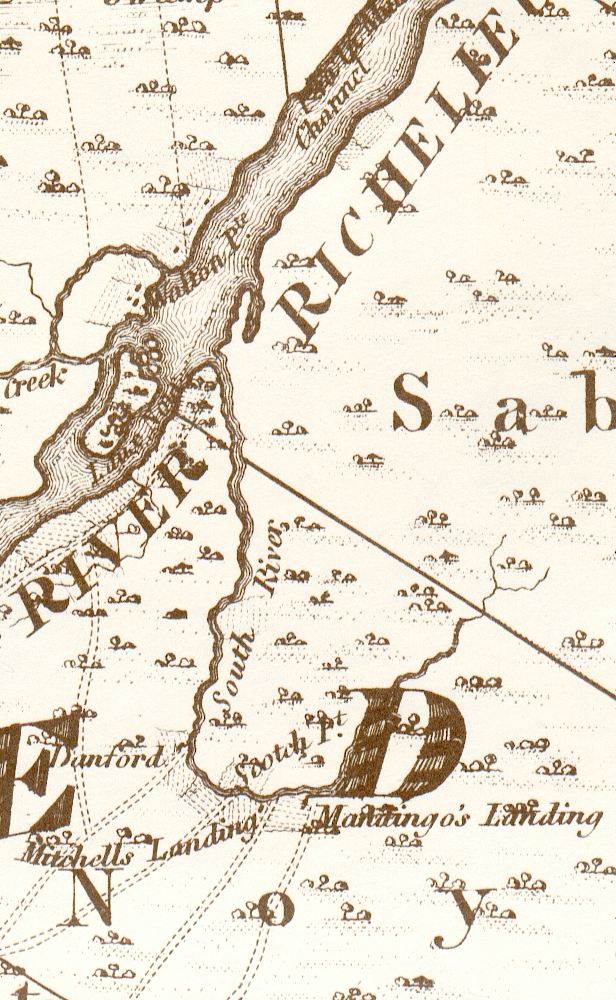
A: After arriving in Quebec City , Alexander and his family travelled to Sorel ,Quebec, a military town located at the beginning of the Richelieu river. Sorel had become a fairly large city, given its location. It was a military town, a trading town during the French reg, ( Fort Richelieu) being renamed William Henry after the English conquest. During the American Revloution, many of those loyal to England fleeing north were held in refugee camps at Sorel. Form Sorel , Alexander 's group would have boarded a small craft that would take them down river to Fort Chambly, where they would have had to change vessels as the canal was not constructed until 1831. From Chambly, they would most likley have taken another river vessel to what may have been a staging loaction on Ilse Aux Noix situated at the entranceto the South River, or perhaps had made arrangment on a private vessel taking them directly to Mandigo's Corners at the extremeity of South River. From there it they would have had to travel by land to the lot Alexander had purchased from Saul Fargo.
B: The family may have also travelled by steam boat named "Montreal " from Quebec ,to Montreal , then crossed the mighty St. Lawrence River to Laprairie,by ferry .At Laprairie they would have to had arrange for some land conveyance to (horse or oxen and wagon) to take them to Dorchester ( St John - St. Jean sur Richelieu of today), and then transfer to a barge that descended the Chamblee River (Richelieu River ) to Lac Champlain, perhaps once again stopping at Isle aux Noix where there was an established British military community. From this point a bateau could be taken down the South River into the heart of the Seiginory of Noyan, Quebec. At the bend in the South River, where the waterway became narrower there were, back then , settlements such as Scotch Point, Mitchell's Landing and Mandigo's Landing. From one of these landings Alexander and his group would have had to walk into the heavily wooded area to reach his particular plot of land, there would only have been trails, no roads.
C: Since there appears to be several records showing an Alex McPhee- Macfie- McPhie travelling between Quebec City and Trois Rivieres several times after his arrival in Canada, we could assume he was searching for a suitable location for his family to settle and may have or not obtained the lot of land he settled on at this juncture in time. So far i have found no records indication the family as a whole travelled from Quebec to Trois Riviers before embarking on thier voyage to the head of Missisquoi Baie. I have not as of Mrch 2020, located any records concerning the deed of sale to Alexander from Saul Fargo (Fargeaux) who was listed as owner of the property in question
 |
At least one of these methods of transport, if not all of them,had to be have been used to facilitate himself and his family passage to his lot of land in the Seignory of Noyan, Quebec in 1824.
|
|
In August of 2008 we were able finally to locate the site of the first bit of land Alexander obtained
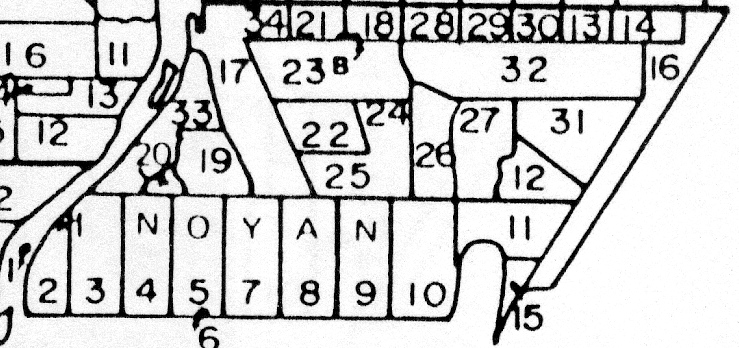
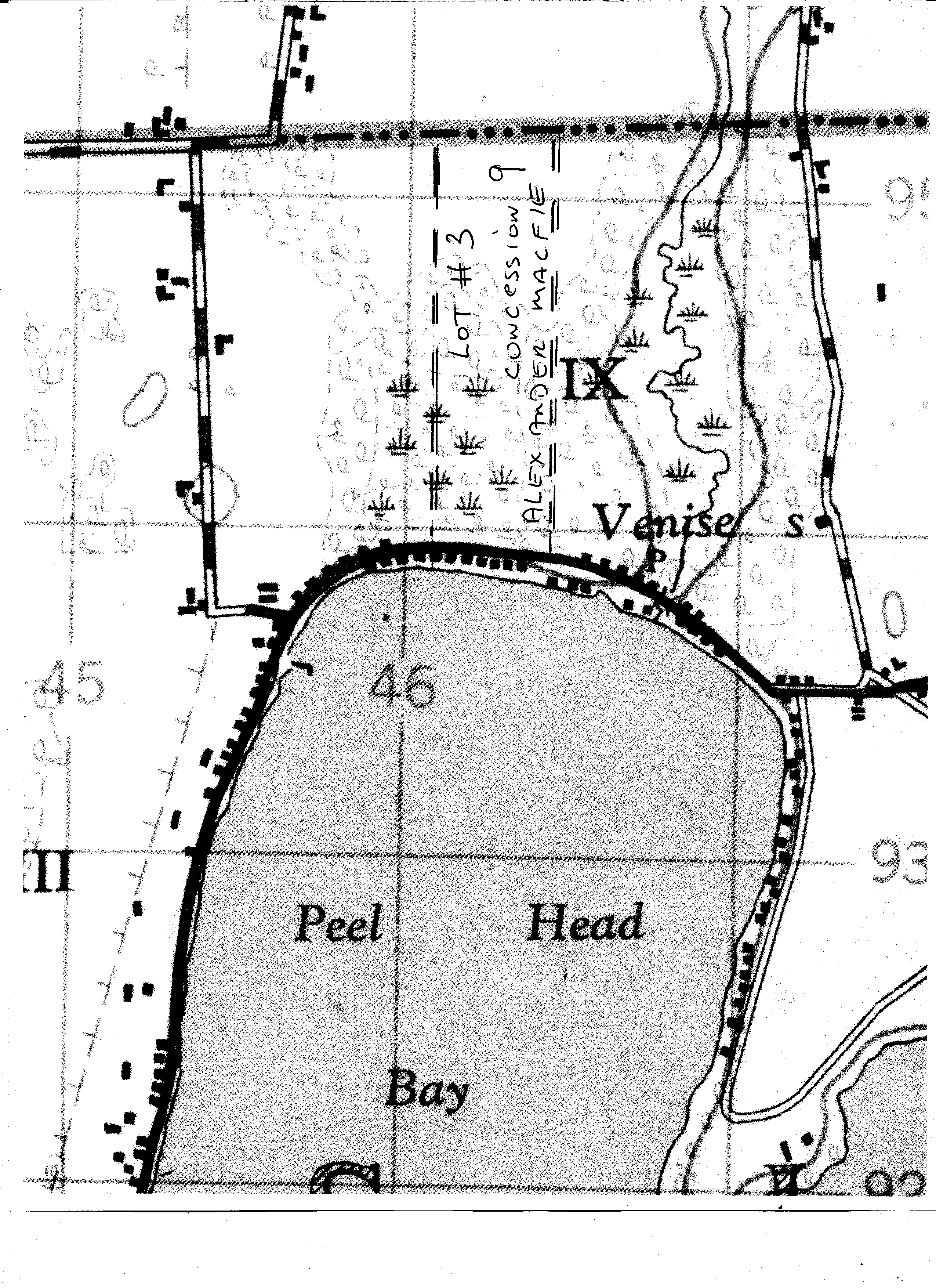
in 1823 when he arrived in the Seigeniory of Noyan . Lot number 3, concession 11, of the old survey. This piece of land 4 arpents, in breath by 23,2 in deepth
fronted by the top of Missisquoi Bay (what is genearally known as Peel's head Bay). The present site in now most likley one of the many camp grounds.
Alexander appears to have gotten the land from one Saul Fargo, who occupied lots 3, 4 and 5 since 14 March 1821 .
From the records in the Montreal Archives we have frond John Lewis on lot 2, Peter Kirk on lot 4, John Mandigo on lot 5, John McArthur on lot 6 and Ephraim Wheeler on lot 7.
(there is a cemetery named Brockville in this area in which we find a John Macfie died 1826 son of Alex Macfie and Ann).
<
 |
 |
 |
 |
| Distance between Mandigo's landing and Peel Head Bay showing very few track ways or roads circa 1831 |
Map of Concession numbers Old survery |
Position of lots Concession 11 |
More recent topographic map showing swamp like land conditions |
In Sept of 2007 , the 1825 census of the area was posted on Pam Waugh's Eastern Townships web site, courtesy of Dr. David Ellis, ( a lot of dedicated hard work on his part). We find that the first name the census takers recorded was Mathew Jameson, followed by Baptiste Mainville, Jacob Louis, Allen Wheeler, and Ephraim Wheeler. Next on the list is Alexander Macfie ( Mcphee) who then is followed by William Lewis, Levi Mandigo, Owen Hughes, Benjamin McAlister and the Partlow family of John, David and Allen.
 |
In March of 1826 we find Alexander writing home to his father old Robert of Langhouse, telling him of his woes.
The next written word we find from Alexander is July 1827 -(there is a chance that there are more letters either in the Glasgow files, or in the files in Sweden, Alex goes on to explain that all his problems are costing him money that he does not have, and asks for some kind consideration of his brother in helping him out with his financial problems.
Apparently his barn burnt, a fire had been started by a lamp that had not be turned out properly. They had been husking corn until almost 9 PM that evening and then had gone to bed,
only to be awakened by the cries of their neighbours around 3 AM. They were unable to save very much and Alexander was writing to borrow money to rebuild and cover his losses of the season.
He writes about drawing lumber for a new barn from the swamp, this work having to be done late in the season, when things were dry.
as of July 1998 not all has been verified) He writes to his brother John in Leith, I have assumed that John being closer to his age was the more receptive of the family.
Alexander explains that his has had some bad health, and that he and his wife were now the parents of a daughter, whom they named Mary, after Alexander's loving Mother.
The sickness they labeled the " ague " it sapped your energy, and caused you chills then brought on a fever. Alex was confined to bed for 5 days,
and had to hire a man to start working his land.
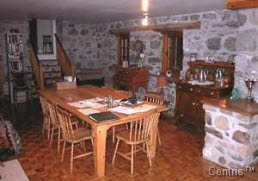
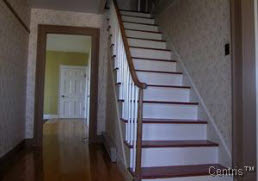
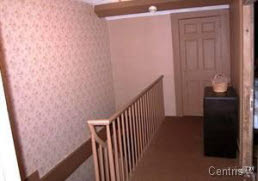
To further complicate things , some time between July and August 1827, Alexander has gotten himself into a difficult situation. This resulted in Alexander obtaining the lands of one Walter Bruce some 200 acres of farm land on the edge of Missisquoi Bay, an old stone house and the right to draw fish from the Bay itself. (Caldwell's Manor) ...
With this deal, Alexander takes possession of a stone farm house and the holdings of Walter Bruce thus assuming the position of an affluent land owner in the Seignory of Foucault -
now known as Caldwell's Manor - in the area bordering Missisquoi Bay. Alexander is an educated man, he enjoys reading and keeps up with the news of the day. This fact influences those around him,
and with this, Alexander's roll of a farmer takes on new standing and he becomes involved in the goings on in the area, both political and administrative.
 |
.
|
|
|
|
|
|
Alexander has become more agile, and his farming capabilities are on the increase, we see him winning awards for his produce and animals at the county fairs. His family is growing, another daughter Jane Munro is born in 1829 and is named after Ann's mother. During the next five years Alexander and Ann who are now 38 and 25 enjoy the fruits of this new farm land they have managed to procure. Working hard was some thing Alexander did not want to do in Scotland however since the death of his Father in Sept. of 1827, Alexander could not really count on his two brothers to take pity on him and his woes. He had received part of an inheritance from his father's estate, however as his brothers William and John were the trustees, he was not given a lump sum of money to do with as he wished. Most likley disappointed with this decision Alexander had to content himself with a pension from the money that had been allocated to him.
In 1834 another son was born and named William Marshall. Life appears more structured, more convenient, at the Rouville Agricultural Society fair (Sat Sept.21 1836) Alexander entered some of his animals to be judged and came away with First prize for his 2 year old colt, First prize for his brood sow (pig) .Second prize for his brood mare and Third prize for his 3 year old steer. This same year his third son John is born (1836). We must assume that Alexander had learned from his life experiences at Langhouse, some of the values of farming , otherwise he would not have been able to transfer any experiences to his life now unfolding at Caldwell's Manor in this Canadian wilderness. The Macfie family had now grown and additions were now following Martha born in 1838, Alexander in 1840 , Jessie Thorburn in 1842, Margaret in 1844, and finally James the last child born in 1846. >During the years 1837 - 1838 while Canada was still under the control of the British, we find that the middle and upper middle class, educated and bourgeois, were having difficulty coming to grips with the ruling parties in England, they felt were not obtaining adequate consideration nor representation in this growing Canadian colony. A similar situation had occurred in 1774- 1776 in the American Colonies the results of which had given birth the the United States of America. >The English did not want a repeat of the American situation, so in order to snip any rebellious movement in the bud, they increased the number of soldiers in Canada, and went about setting up local Militia who would be faithful servants to the Crown. In Lower Canada what is now Quebec the rebellion took on a more distinct part. The French speaking population had never really considered themselves as being assimilated by the English. Even after the Treaty of Paris 1763 in which the French Colony of Canada was seceded to England those families of French origins who had remained in the colony had been allowed to keep their laws, their language, their religion and many of their customs. >In Lower Canada the Rebellion developed into more than just a desire to have the British rethink its way of governing this new country, it created a desire to regain a country that had been lost. This uprising even though it was put down and trampled upon, remained implanted in the desire of many a citizen of Quebec right up to today, a desire to have their own country, a country free of the English influence, a country similar to what existed at the time of the signing of the Treaty of Paris in 1763. >In 1837 Alexander was appointed Captain of the 3rd Battalion of the County Rouville Militia. Alexander could read and write, he was educated, he was a large land owner having some 200+ acres and he had a horse and musket, he was 44 years of age. Whether or not Alexander saw action against the rebels we do not know. We do have a letter he sent to his sister in Sweden dated May 1838, stating that the Rebels were in possession of house 3/4 miles from their abode. They had at one time been forced to remove themselves from their home, burying the silverware in the back bush, the cattle were marched with them and the hay had to be taken as feed. He also wrote that he had a strong guard of his own company stationed just south of his house which dissuaded the Rebels from encroaching too far. >Fortunately this commotion did little to prevent Martha ,who was born during these troubled times, to become a strong young lady who produced a large family of her own. In 1837-38 , Alex had wanted to send young Robert off to school in Durham, however the rebellion was obliging his absence from the family. Robert's journey to school had to be put off for a period, as he was needed at home to help when Alex was off with the Militia. >The Macfie family were pleasently surprised with the visit of cousin William Andrew Macfie and a joyous time was spent showing him around this Canadian enterprise. A year later we find Alexander writing William Andrew to congratulate him on his up coming marriage, Alex writes in his letters that he has read of the death of his old friend John Galt and was very much saddened by it. >He went on to explain that they had had another child whom they had baptized Martha and that Robert was then off to school some 18 miles away boarding with a Mr. Campbell , a highly talented gentleman from the Paisley (Scotland) area. Alex indicated that it was his intention to send his daughter Mary off to the same school , the superior school being kept by a young man from England. Alex inquired as to who was now living in Langhouse, indicating that not much news was received from his brothers who were now very much concerned with the sugar processing in both Greenock and Leith. >He mentions that he would welcome any odd and ends that the family might consider sending, as they were missing some of the Scottish treats that they could not obtain here in Canada. >In 1845 Alexander wrote to his sister Jessie thanking her for her numerous letters, which brought back many memories of his child hood at Langhouse, all of which he read to his family so that they could share some of the wonderful childhood he had experienced. Alexander speaks of smuggling cream, riding a red stick painted for a horse, fishing on the beautiful linns of the Langhouse burn and other innocent amusements he shared with his sister back then. He tells Jessie of his latest born who was named Margaret, stating proudly that he now had a child named for every member of his family. >The letter explaining that in Canada he was doing the thrashing of the grain with one horse as compared to 8 oxen that were being used in Sweden, and that from 50 to 80 bushels of wheat were thrashed daily. There was a new process being used at this time but he had not tried it because of the cost. It was chiefly wheat that he had sowed in May and would cut in September, it was a wheat called "Black Sea " which had just been introduce in the last years, it was supposed to do well in Canada as it did not rust nor mildew. He goes on to explain that he has excellent fishing and fine land, the fishing taking a back drop to the farming as it required all of his attention. In April of 1845, Alexander had just finished making 102 ( what ever this might be - trees- or gallons - or some kind of measure) to maple sugar. " The land was then clear of snow, but wet to plow it, and the ice on the lake thawed so that a horse team could not go onto it" Alexander writes home.

1746-1827 1749- 1815 |
1774 - 1855 1777 - 1853 |
1789-1850 |
April 21 1823 Inverary Scotland |
1802-1890 |
| Robert Macfie 1824-1896 |
John Macfie 1826-1826 |
1827-1898 |
1829-1865 |
1831-1832 |
1834-1879 |
1836-1920 |
1838-1905 |
1840-1899 |
1842-1920 |
1844-1901 |
James Macfie 1846-1906 |
(the father) |
1789-1823 |
|
(the son) |
||
| Clarenceville | ||
 langhousemacfie@gmail.com langhousemacfie@gmail.com |
Index | GUESTBOOK |

1827-1898 |
23 Oct 1848 Caldwell's Manor, Que |
1824-1876 |
1829-1908 |
1852-1943 |
1852-1918 |
1855-1924 |
1859-1950 |
1862-1953 |
1834-1879 |
30 June 1862 Clarenceville, Que |
1838-1886 |
1864-1868 |
1865-1905 |
1869-1952 |


1865-1905 |
18 August 1902 Davenport, Ill |
1882-1918 |
1903-1903 |
   |
|
Ada remarried :
In his youth Latshaw took perilous trips down the Yukon River, and delivered mail by dogsled over a 500-mile Artic Route. His first job in the north was with the Grand Trunk Railway in British Columbia in 1909.
He is a cameraman himself and served as a flying photographer with the Air Corps branch of the U.S. Signal Corps during World War I.
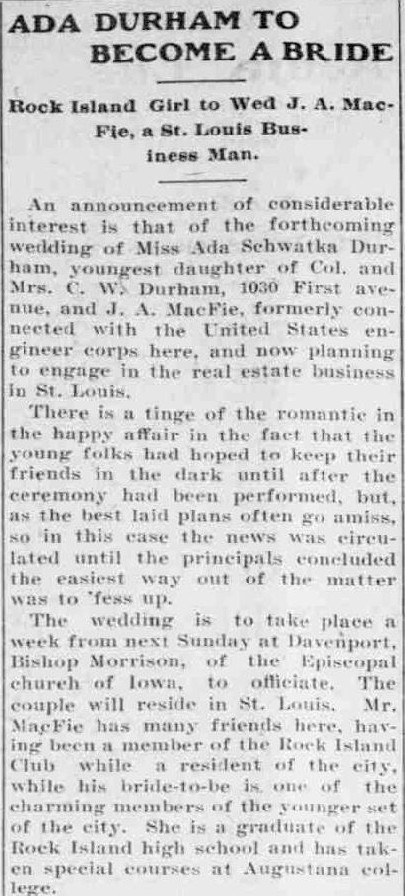
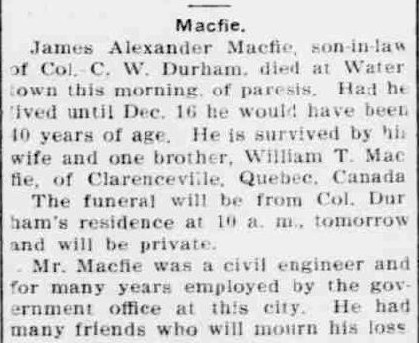
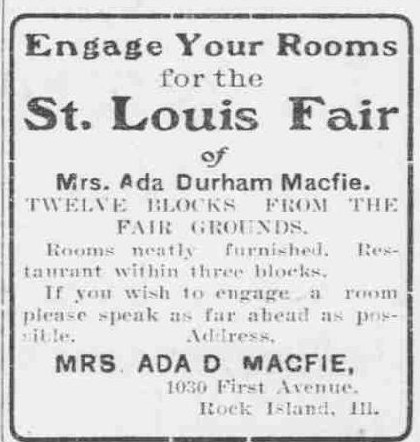
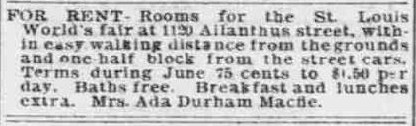
In Illinois Latshaw married the former Ada Durham Macfie, niece of Lt. Schwatka. Fairbanks Daily News-Miner, 1 Oct 1955 Russell turned 24 in 1910 but so far has not been located in either the U.S. Census for that year or the 1911 Canadian Census. It was probably 1911 or 1912 when Russell married Ada Durham Macfie who in 1910 was enumerated with her parents, Charles and Mary Durham, in Rock Island, Illinois. This census noted that she age 27, widowed, and had born one child who was deceased. Ada's first husband was James A. Macfie. Old newspapers articles give some clue as to when she married James. In 1901 she was using the surname Durham and in 1904 she was Mrs. Ada Macfie. The 1907 Rock Island city directory recorded her as a widow living with her father so James probably died in 1905 or 1906. Ada's child must have been born between 1901 and 1907 and died prior to the enumeration of the 1910 U.S. Census. It is unknown where Russell and Ada met or were married but it may have been in Rock Island, Illinois where the 1910 U.S. Census enumerated Ada living with her father, Charles Durham. As noted earlier, Russell was not found in the 1910 U.S. census, but by the time of the wedding perhaps Russell worked in the Rock Island area as a photographer, which was his lifelong occupation. Russell was next located in Idaho where he co-owned the Bowman & Latshaw photography business in Idaho Falls. On June 5, 1917, Russell completed a required WWI Draft Registration Card that he signed with his full name, Russell Jacob Latshaw. He stated he was born on March 1, 1887, in Durand, Wisconsin and was married. His address was 211 E. Water Avenue in Idaho Falls and he described himself as tall, medium build, blue eyes and partially bald. On July 17, 1918, Ada Durham Macfie Latshaw died in Idaho Falls, Idaho. No record has been found of any children being born to this union. A death notice in a local Idaho Falls newspaper stated that a Mrs. R.J. Latshaw, wife of R.J. Latshaw of the Bowman Studio, passed away at 7 o'clock this morning at her home�. A follow-up notice indicated that her body was being returned to Rock Island, Illinois, her childhood home, for burial and that Mr. Latshaw would accompany the body. Another published article on that day was a notice of thanks by Russell Latshaw for the many kindnesses and expressions of sympathy extended during the illness of his wife. The Idaho Death Index recorded her date of birth as November 29, 1884, which is one year later than enumerated for her in the 1910 U.S. Census. |
1869-1952 |
29 June 1904 Clarenceville, Que |
1879-1973 |
1905-1996 |
1908-1960 |
1911-1924 |
1913-1914 |
1916-1916 |
1917-1917 |
1905-1996 |
01 May 1924 Acton , Ontario |
1905-1961 |
xxxx-xxxx |
xxxx-xxxx |
xxxx-xxxx |
xxxx-xxxx |
xxxx Acton , Ontario |
xxxx-xxxx |
xxxx-xxxx |
xxxx-xxxx |
xxxx-xxxx |
1937-2018 |
xxxx Acton , Ontario |
xxxx-xxxx |
xxxx-xxxx |
xxxx-xxxx |
xxxx-xxxx |
xxxx-xxxx |
xxxx Acton , Ontario |
xxxx-xxxx |
xxxx-xxxx |
xxxx-xxxx |
xxxx-xxxx |
xxxx-xxxx |
xxxx Acton , Ontario |
|
xxxx-xxxx |
xxxx-xxxx |
xxxx-xxxx |
xxxx-xxxx |
xxxx Acton , Ontario |
xxxx-xxxx |
xxxx-xxxx |
xxxx-xxxx |
xxxx-xxxx |
xxxx-xxxx |
xxxx Acton , Ontario |
xxxx-xxxx |
xxxx-xxxx |
xxxx-xxxx |
xxxx-xxxx |
1905-1996 |
3rd Oct 1964 Acton , Ontario |
1906-xxxx |

1836-1920 |
29 May 1861 Clarenceville, Que |
1840-1921 |
1862-1946 |
1863-1943 |
1865-1865 |
1862-1946 |
3 August 1892 Grand Haven Mi. USA |
1868-1955 |
1893-1964 |
1895-1986 |
1898-1966 |
1899-1899 |
1893-1964 |
xxxx XXXX |
1898-1981 |
1924-1924 |
1925-1999 |
1928-2016 |
1825-1999 |
xxxx XXXX |
xxxx-xxxx |
xxxx-xxxx |
xxxx-xxxx |
xxxx-xxxx |
1928-2016 |
xxxx Alameda Ca |
1926-2018 |
1957-xxxx |
1959-xxxx |
1962-xxxx |
 |  |
1895-1986 |
25 June 1919 XXXX |
1893-1975 |
1924-xxxx |
1928-1955 |
1898-1966 |
April 2nd 1922 California USA |
1899-1963 |
1922-2013 |
1924-2007 |
1922-2013 |
xxxx California USA |
1921-2013 |
1946-1946 |
1924-2007 |
xxxx California USA |
xxxx-xxxx |
1960-xxxx |
1963-xxxx |
1838-1905 |
13 May 1861 Clarenceville, Que |
1832-1881 |
1862-1944 |
1863-1924 |
1865-1945 |
1867-1937 |
1869-1940 |
1871-1897 |
1873-xxxx |
1876-1956 |
1840-1899 |
14 January 1880 Clarenceville, Que |
1859-1928 |
1881-1972 |
1885-1901 |
1887-1966 |
1889-1966 |
1892-1930 |
1894-1948 |
1897-1925 |
1899-xxxx |
1881-1972 |
19 February 1909 Clarenceville, Que |
1885-1945 |
1909-1970 |
1915-xxxx |
1915-2009 |
1887-1966 |
xxxx Clarenceville, Que |
1896-1942 |
 |
1892-1930 |
xxxx Clarenceville, Que |
1885-1978 |
1919-1930 |
1922-2018 |
xxxx-xxxx |
xxxx-xxxx |
1899-1956 |
1918 Clarenceville, Que |
xxxx-xxxx |
xxxx-xxxx |
1927-xxxx |
1931-xxxx |
1927-xxxx |
XXXX xxxx |
xxxx-xxxx |
1954-xxxx |
1955-xxxx |
1959-xxxx |
1931- |
6 December 1952 Peckskill, NY |
1930-2012 |
1953-xxxx |
1956-2019 |
1960-1975 |


1953-xxxx |
7 April 1979 Las Vegas Nv. |
1951-xxxx |
1979-xxxx |
1981-xxxx |
1990-xxxx |
1956-2018 |
17 September 1983 Port Jervis NY |
1960-xxxx |
1993-xxxx |
1993-xxxx |
xxxx Port Jervis NY |
xxxx-xxxx |
1909-1970 |
XXXX xxxx |
1908-2009 |
1932-2020 |
1935-xxxx |
1947-xxxx |
1932-2020 |
xxxx XXXX |
1934-2016 |
1961-xxxx |
1963-xxxx |
1961-xxxx |
1987 |
1963-xxxx |
1985 |
xxxx-xxxx |
xxxx-xxxx |
1935-xxxx |
13 June 1953 Arlington Va |
1933-xxxx |
1954-xxxx |
1956-xxxx |
1958-xxxx |
1961-xxxx |
1954-xxxx |
13 January 1979 Marietta Ga. |
xxxx-xxxx |
1980-xxxx |
1983-xxxx |
1986-xxxx |
1956-xxxx |
25 September 1982 Lawrenceville Ga |
xxxx-xxxx |
1986-xxxx |
1958-xxxx |
6 December 1980 Matietta Ga |
1956-xxxx |
1982-xxxx |
1958-xxxx |
4 May 1985 Decatur Ga |
1962-xxxx |
1985-xxxx |
1958-xxxx |
3 January 1991 Decatur Ga |
1953-1991 |
1961-xxxxx |
13 April 1991 Atlanta Ga. |
xxxx-xxxx |
1998-xxxx |
1961-xxxx |
1997 |
xxxx-xxxx |
1947-xxxxx |
xxxx xxxxx |
John Edward Hilson xxxx-xxxx |
1967-xxxx |
1971-xxxx |
1967- |
1989- |
1914-2009 |
xxxx xxxx |
1907-1986 |
1915-2011 |
27 December 1940 Plattsburg NY |
1915-1944 |
1942-2008 |
1915-2011 |
5 August 1950 Plattsburg NY |
1915-2002 |
1951-xxxx |
1942-2008 |
1964 xxxx |
xxxx-xxxx |
1969-xxxx |
1951-xxxx |
1 June 1974 Springfield OH |
1952-xxxx |
1977-xxxx |
1984-xxxx |

1842-1920 |
13 April 1870 Clarenceville Que |
1837-1912 |
1871-1912 |
1873-1887 |
1875-1876 |
1877-1878 |
1884-1947 |

1844-1901 |
25 September 1872 Fort Covington NY |
1833-1886 |
1873-xxxx |
1874-1909 |
1876-1944 |
1884-1943 |
On Daniel' s burial marker are the initials D M B H, so perhaps one of our names is incorrect
1844-1901 |
12 July 1892 xxxx |
1836-1921 |


1846-1906 |
20 March 1870 Trout River NY USA |
1847-1871 |
1870-1946 |
| 1879 " At the Democratic caucus which convened atthe office of Wilson & Mears on Saturday evening last Dr James Macfie , A S Creighton and r Degowin were the delegates chosen to attend the county convention, which convenes at Malone to day ." ( we foind here that James was a politiclly involved citizen) 1882 - " Miss Macfie and Miss Hawley of Clarenceville were visiting with Dr. and Mrs James Macfie " ( a family member ) 1885 - " The Chair appointed Dr James Macfie of Fort Covington ,Chars A Burke of Malone and Jos Walker ofWestville , a committee on reslutions" ( an involved citizen ) 1885 - " Fire at Fort Covington " On Saturday last, Dr Macfie`s residence at Fort Covington was destroyed by fire. Most of the house hold effects were saved, but the building was atotal loss. The firs is supposed to have been caused by the explosion of a kerosene lamp ( a similar situation was encounded by his father Alexander and his brother Robert) . The doctor had occasion to go up into the attic in the morning , where some of his books were kept, for a book of reference. The room being dark he took a lamp and after procurring the book he carried it down stairs for the purpose of looking it over, leaving the lamp in the room, as he intended to immediately return , but before he did so he recived a call which delayed him a short time and when he went back the lamp had, as he supposed exploded and the smoke was so dense in the room that he could not enter. Nearly everyone was at church at the time and before aid could be summoned the building was past saving. When the alarm was given at the different churches, the peopl ran in a body to the rescue , but as the could not save the Doctor`s reresidence, went to work to save those near. The fire caught on the residences of Mr Chapman and Mr Hollenbeck, but they were saved by the effective work of the citizens. There is a fire engine at Fort Covington, but the hose was found to be worthless and consequently the engine was useless. The doctor has moved in the Anna McDonald's residence. He had an insurance of $1,000 which only partically covers his loss. He has the sympathy of the whole community in his misfortune. 1887- " The DemocraticCounty Convention met, pursuant to call at Howard Opera House, this village, on Tuesday last, for the purpose of nominating a county ticket and choosing delegates to the State, Judicial and Senatorial Conventions. The Convention was called to order by N W Porter, chirman of the Democratic COunty Committee at 2 o`clock p.m. and Dr James Macfie , of Fort Covington was elected temprary chairman, and W S Lawrence of Moria, temporary secretary. Dr Macfie taking the chair made a few happy remarks and the business of the Convention proceeded. ( James was a plesant person) 1887- Coroners - Drs James Macfie and Henry Jordan ( James was a responsible man) 1888- James Macfie was member of the Franklin Co. Medical Society 1888- " The singing of comic sons by Dr James Macfie was enjoyed by all who heard him " ( James was talented and musical as were his sisters) 1890- " In the second district the convention wisley selected Dr James Macfie , a man of wide acquaintance , of large professional experience and a gentleman of culture and education. Dr Macfie , as a physician and citizen of the second comissioner district , needs no futher endorsement here ,and his many years of faithful service in the Democratic party will ensure him the solid support of that party at the polls. ( need there be more said) The Malone Framer 1905- " Fort Covington - June 2 ...... Dr James Macfie , who left this town about thirteen years ago and has since resided in Fort Mead, Fla, is visiting his daughter Mrs Jos H Fay . Needless to say that the Doctor is receiving a warm welcome from his many old friends" 1926- " Dr W N Macartney , of Fort Covington , wishes to announce his partnership with Dr Bruce T Smith , formerly of Montreal. calls for either physician should be made at Dr Macartney's office Fort Covington N Y phone 38-F2 . Dr Smith is a graduate of McGill University, has subsequently held an appointment for one year in the Montreal General Hospital , is a licentiate of the Medical Council of Canada and the Board of Regents of the State of New York. That he is a relative of Dr Macfie, one of the earlier physicans of Fort Covington, will be of interest to many of the older residents on the district. |
1870-1946 |
8 March 1892 Madrid NY USA |
1846-1932 |
1893-1924 |
1896-1976 |
1898-1978 |
1900-1939 |
1902-1984 |
1905-2009 |
1907-1988 |
1915-xxxx |
Joseph H Fay merchant of the firm Fay brothers, married Agnes Macfie, eldest daughter of Dr James Macfie ,
all of Fort Covington NY, at Madrid NY ( 8 Mar 1892) Sarah Fay only daughter of Joseph Fay of Fort Covington village NY and wife of James Caul, formerly of Fort Covington died at North Lawrence NY aged 52 years. ( 8 Mar 1894) Ella Skinner wife of John Fay and daughter of Dr Skinner of Malone NY died at Malone NY aged 50 years. (16 Mar 1894) Joseph Fay senior died at the village of Fort Covington, age 85 years . ( 6 Jan 1897) James Fay merchant died at his residence in Fort Covington ages 61 years (7 Jul 1897) |
Find a grave info
|
Agnes Smith (Macfie) Fay Birth: 1870 - Death: 1946 # 89223026 |
Joseph Henry Fay Birth: 1870 - Death: 1946
Spouse: Agnes Smith Macfie (1846 - 1932)
Children:
Burial: #89222980 |
1846-1906 |
8 Oct 1873 Fort Covington NY USA |
1847-1896 |
| Mary Parkhurst Macfie 1874-1878 |
1876-1882 |
1877-1878 |
1880-1901 |
1880-1971 |
12 September 1901 Fort Covington NY USA |
1881-1947 |
1906-1993 |
1908-1979 |
1911-1985 |
1920-2007 |
.
1893-1924 |
2 June 1920 XXXX |
1892-1965 |
1922-2019 |
1924- |
1922-2019 |
1 May 1943 XXXX |
1892-1965 |
xxxx-xxxx |
xxxx-xxxx |
-
1896-1976 |
20 December 1924 Proctor Vt |
1878-1970 |
1926-2009 |
1930-2000 |
1932-2009 |
1926-2009 |
July 29 1951 Shelburne Vt |
1932-2001 |
1952-1966 |
1954-xxxx |
1930-2000 |
Sept 5 ,1964 Proctor Vt |
1929-xxxx |
1952-xxxx |
1954-xxxx |
1955-xxxx |
1956-1956 |
1958-1958 |
-
1898-1978 |
15 September 1919 XXXX |
xxxx-xxxx |
1920-xxxx |
1898-1978 |
xxxx XXXX |
1895-1971 |
1923-xxxx |
-
1900-1939 |
1936 |
xxxx-1949 |
-
1902-1984 |
30 June 1926 Proctor Vt |
1905-1981 |
1928-2003 |
-
1928-2003 |
July 1931 xxxx |
1925-1988 |
-
1905-1998 |
19 July 1930 Proctor Vt |
1905-2009 |
1935-xxxx |
1937-xxxx |
1939-xxxx |
-
1939-xxxx |
30 August 1963 |
1942-xxxx |
1964-xxxx |
1966-xxxx |
1969-xxxx |
-
1969-xxxx |
xxxx-xxxx |
1907-1988 |
1929 |
1906-1994 |
1933-2008 |
1915-2019 |
November 2 ,1936 Burlington Vt |
1914-1997 |
1938-xxxx |
1941-xxxx |
1941-xxxx |
1941-xxxx |
xxxx Red Bluff Ca |
xxxx-xxxx |
xxxx-xxxx |
xxxx-xxxx |
xxxx-xxxx |
1941-xxxx |
Red Bluff Ca |
xxxx-xxxx |
1961-2001 |
1966-1966 |
1968-1968 |
1961-2013 |
Red Bluff Ca |
xxxx-xxxx |
xxxx-xxxx |
xxxx-xxxx |
xxxx-xxxx |
xxxx-xxxx |

xxxx-xxxx |
Red Bluff Ca |
xxxx-xxxx |
xxxx-xxxx |
xxxx-xxxx |
xxxx-xxxx |
Red Bluff Ca |
xxxx-xxxx |
xxxx-xxxx |
1906-1993 |
June 23 ,1937 Polk Florida |
1905-1960 |
1941-xxxx |
1943-xxxx |
-
1908-1979 |
1933Sumter Fl |
1911-2009 |
1933-2010 |
1936-xxxx |
1941-2003 |
1955-2012 |
1933-2010 |
xxxxxxxx |
xxxx-xxxx |
xxxx-xxxx |
1965-xxxx |

1965-xxxx |
xxxxxxxx |
xxxx-xxxx |
xxxx-xxxx |
xxxx-xxxx |
xxxx=xxxx |
xxxx-xxxx |
1936-xxxx |
xxxxxxxx |
1935-2020 |
xxxx-xxxx |
xxxx-xxxx |
xxxx-xxxx |

xxxx-xxxx |
xxxxxxxx |
xxxx-xxxx |
xxxx-xxxx |
xxxx-xxxx |
xxxx-xxxx |
xxxxxxxx |
xxxx-xxxx |
xxxx-xxxx |
xxxx-xxxx |
xxxx-xxxx |
1941-2003 |
xxxxxxxx |
1944-xxxx |
1971-xxxx |
1975-xxxx |
xxxx-xxxx |
xxxx-xxxx |
1911-1985 |
April 29 1944 xxxx |
1922-2010 |
1947-xxxx |
1920-2007 |
December 25 1946 Fort Meade Fl |
1921-2001 |
1948-xxxx |
1950-xxxx |
1954-2018 |
xxxx-xxxx |
1948-xxxx |
xxxx Fort Meade Fl |
xxxx-xxxx |
xxxx-xxxx |
1950-xxxx |
Feburary 17 1981 Fort Meade Fl |
1949-2018 |
xxxx-xxxx |
xxxx-xxxx |
xxxx Fort Meade Fl |
xxxx-xxxx |
1954-2018 |
xxxx Fort Meade Fl |
1921-2001 |
xxxx-xxxx |
xxxx-xxxx |
xxxx-xxxx |
xxxx Fort Meade Fl |
xxxx-xxxx |
1948-xxxx |
1874-1909 |
June 20 1898 Boston Mass |
1876-1944 |
1898-xxxxx |
1904-xxxx |
1904-xxxx |
January 1 1923 Los Angeles Ca |
1893-1939 |
1924-2007 |
1924-2007 |
October 2 1944 Maricopa Az |
1924-2006 |
xxx-xxxx |
xxxx-xxxxx |
 |
 |
xxxx-xxxx |
xxxxx Maricopa Az |
xxxx-xxxx |
xxx-xxxx |
xxxx-xxxxx |
xxxx-xxxx |
Maricopa Az |
xxxx-xxxx |
xxx-xxxx |
xxxx-xxxxx |
xxx-xxxx |
xxxx-xxxxx |
xxx-xxxx |
1876-1944 |
1883-1955 |
1910-1968 |
1910-1968 |
xxxx xxxx |
1889-1967 |
1937-xxxx |
1937-2019 |
xxxx XXXX |
1932-2007 |
xxxx-xxxx |
xxxx-xxxx |
xxxx-xxxx |
xxxx-xxxx |
xxxx XXXX |
xxxx-xxxx |
xxxx-xxxx |
xxxx-xxxx |
xxxx-xxxx |
xxxx XXXX |
xxxx-xxxx |
xxxx-xxxx |
xxxx-xxxx |
xxxx-xxxx |
xxxx XXXX |
xxxx-xxxx |
xxxx-xxxx |
xxxx-xxxx |
1884-1943 |
1907 Philadelphis Penn |
xxxx-xxxx |
1908-1945 |
1909-1989 |
1910-1910 |
1908-1945 |
July 27 1930 Oklahoma City , OK |
1912-2000 |
1909-1989 |
1940 Dallas Tx |
1918-1999 |
1884-1943 |
December 1915 Calcasieu La |
1885-1940 |
1916-2010 |
1920-2010 |
1916-2010 |
xxxx xxxx |
1914-1997 |
1916-2010 |
1941 xxxx |
1914-1946 |
1945-xxxx |
1945-xxxx |
1945-xxxx |
xxxx xxxx |
xxxx-xxxx |
xxxx-xxxx |
xxxx-xxxx |
1945-xxxx |
xxxx xxxx |
1949-1986 |
1970-xxxx |
1971-xxxx |
1973-xxxx |
1975-xxxx |
1977-xxxx |
1979-1986 |
1971-xxxxx |
xxxx xxxx |
1966-xxxx |
1996-xxxx |
1998-xxxx |
1971-xxxx |
xxxx xxxx |
xxxx-xxxx |
1977-xxxx |
xxxx xxxx |
xxxx-xxxx |
1916-2010 |
1948 xxxx |
1914-1989 |
xxxx-xxxx |
xxxx-xxxx |
xxxx xxxx |
xxxx-xxxx |
xxxx-xxxx |
1920-2010 |
zzzz xxxx |
xxxx-xxxx |
1952-xxxx |
1952-xxxx |
xxxx xxxx |
xxxx-xxxx |
1871-1912 |
4 May 1905 Alburg East VT |
1838-1915 |
 |
 |
1884-1947 |
11 November 1912 xxxx |
1888-1974 |
1913-2003 |
1915-2002 |
1916-1998 |
1918-xxxx |
1923-1967 |
1913-2003 |
xxxx xxxx |
1918-2014 |
1943-2016 |
xxxx-xxxx |
1946-xxxx |
xxxx-xxxx |
xxxx-xxxx |
xxxx-xxxx |
 |
 |
 |
1946-xxxx |
xxxx xxxx |
xxxx-xxxx |
xxxx-xxxx |
xxxx-xxxx |
xxxx-xxxx |
xxxx-xxxx |
xxxx xxxx |
xxxx-xxxx |
xxxx-xxxx |
xxxx-xxxx |
1946-xxxx |
xxxx-xxxx |
xxxx xxxx |
xxxx-xxxx |
xxxx-xxxx |
xxxx-xxxx |
xxxx-xxxx |
1916-1998 |
1942- |
1943- |
1946- |
1947- |
Geraldine is buried in Woonsocket RI along side her mother in the Valois family plot
1923- |
1950- |
| E-mail |
Index | GUESTBOOK |