"1-9 WATER ROW," on the River Clyde,
near ELDER PARK, ELDER street and NAPIER Streets
MAP
http://goo.gl/maps/wfuMX
Isabella ELDER - Cemetery Monument Photo - Glasgow Necropolis
http://www.glasgownecropolis.org/profiles/mrs-elder-pioneer
Monuments to Isabella and John ELDER in ELDER Park
http://www.glasgow.gov.uk/index.aspx?articleid=7825
GOVAN Parish History
RE: John's father: DAVID ELDER
"David Elder was born in Little Seggie, near Kinross in 1785.
From
his earliest years, he evinced a genius for mathematical studies,
and continued to master, without assistance, Simson's Euclid and
a separate work on Algebra, translated from the French, which he walked 18 miles to procure."
Biographical info about JOHN ELDER and DAVID ELDER:
(CENSUS
for KINROSS-SHIRE 1841, etc.)
Digitized book online, University of California:
http://www.openlibrary.org/details/memoirofjohnelde00rankiala
A MEMOIR of John Elder.
****
US Naval Academy has:
A memoir of John Elder, engineer and ship-builder,
by William John Macquorn Rankine
Type: Book
Language: English
Publisher: Edinburgh, London, W. Blackwood, 1871.
OCLC: 12780671
Related Subjects: Elder, John, -- engineer.
Page 1:
"The earliest accounts of the family of ELDER show
it Milnathort
Churchyard monument photos
to have flourished in the county of Kinross, in the
east of Scotland, during the sixteenth and seven-
teenth centuries. The leading branch of the family
seems to have been that which possessed the estate
of Arlarie, near the town of Milnathort. There are
ARLARY
and MILNATHORT in KINROSS
on record the names of two JOHN ELDERS of Bal-
bughtie, cadets of the family of Arlarie, one of whom
lived in the sixteenth, and the other in the seven-
teenth century, both forefathers of the subject of
this Memoir.
The line of his direct ancestors for nearly two
centuries affords a remarkable example of a fact
which is more common than is usually supposed--
the hereditary transmission of skill and talent; for
they all practised that art from which (as Fairbairn
tells us) mechanical engineering has sprung--that
of the millwright--and were all remarkable for
ability and success.
The first of those regarding whom we possess
definite information was Alexander ELDER, wright
at Craigo, about two miles west of Milnathort, born
towards the end of the seventeenth century. He
married Marion Ireland. His son David ELDER,
born in 1724, was a wright at Little Seggie, in the
same neighbourhood; and from note-books of his,
which are still preserved, he appears to have been
a man of talent and information, and to have pos-
sessed considerable knowledge of mathematical and
mechanical science. He was cut off in 1756, at the
early age of thirty-two, leaving, by his wife Ellen
Henderson, three sons and three daughters. His
eldest son, ALEXANDER, born at Little Seggie about
1748, carried on at the place, and afterwards at
Milnathort, the same business. He married Eliza-
beth Morrison, by whom he had two sons and
three daughters, and died at Milnathort in December
1823.
In his eldest son, DAVID ELDER, the talent of the
race, handed down through so many generations,
began to achieve public distinction. He was born at
Little Seggie on the 7th of January 1784, and died
at Glasgow on the 31st of January 1866, at the close
Page 3:
of a vigorous old age, being then in his eight-second
year. A memoir of his life by Mr. James R. Napier,
in which full justice is done to his remarkable
character and abilities, was published in the "Trans-
actions of the Institution of Engineers in Scotland"
for 1865-66; and therefore it is sufficient now to
recapitulate the leading events of his career only.
He learned the practical part of his trade as an
apprentice to his father, and its scientific principles
by the private study of mathematical books during
intervals of leisure.
In 1808 he succeeded to his father's business at
Little Seggie, which he quitted a few years after-
wards for Paisley; and in 1817 he removed to Glas-
gow, thus obtaining a wide field for the exercise of
his knowledge and skill as a millwright and mecha-
nical engineer. In 1821 he became manager of the
works of Mr Robert Napier, which office he con-
tinued to hold until induced by advancing age to
retire.
In 1812 he married Grace, daughter of Mr. John
Gilroy; and the subject of the present Memoir was
their third son.
John ELDER was born at Glasgow on the 8th of
March 1824. His elementary education was obtained
in the High School of Glasgow...."
****
More Biographical info found in GOOGLE BOOKS:
at
http://tinyurl.com/2wv4zz
THE CIVIL ENGINEER AND ARCHITECT'S JOURNAL, vol. 29
London, W. Kent and Co.
May 1, 1866, pages 121-124.
Digitized from copy at NY Public Library, May 26, 2006
Notes from article, titled:
"THE LATE MR. DAVID ELDER, ENGINEER" BY JAMES E. NAPIER.
"The history of so remarkable a man as David Elder must be
interesting to many on account of his connection with works
which have made Glasgow and the Clyde notable, and given to his
employer a fame which is known over the engineering world.
A respect for his memory, and the great benefits received from his
advice and experience, induced the author, in the absence of
those older and more able for the duty, to make the attempt.
The author is indebted to an old friend of Mr. Elder's family
for an account of his early life, of which he has availed himself.
David Elder was born at Little Seggie, near Kinross, in
January, 1785. His father was an Anti-Burgher elder, and in
consequence of the religious strife in the district, he was deprived
of such education as the parish school of Orwell then afforded,
a
loss he ever after regretted.
About the age of 15 he was put to learn his father's business,
that of a country wright, and at this period the repairs of Craigie
Mill, at which he was occasionally employed, afforded him an
early opportunity of studying mill work. The intermittent noise
of this mill, which had wooden cogs and rungs, and a flat bar for
the axle of the trundle, attracted his attention, and taught him
his first lessons in wheel work and gearing, which he afterwards
practised so successfully. It appears that as his studies were not
in accordance with his father's wishes, he resorted to Little Seggie
Glen to study Simson's Euclid, and a work on algebra translated
from the French—which hé had travelled 18 miles to get possession
of; and when his seniors would be devoutly employed at a
tent-preaching, David Elder would be found studying hydraulics
before some old water-wheel in the neighbourhood, or the architecture
of some old castle.
In 1804 he went to Edinburgh and was employed
at Charlotte-
square buildings, and borrowed such books as he could get to
study, from a bookstall in the Luckenbooths in the High-street,
for a penny a night.
...In 1814 we find him married, and employed by Messrs. J. Clark
and
Co., of Paisley, and afterwards superintending the building of their
factory at Mile-end, Glasgow.
....in 1821 he became manager of Mr. Robert Napier's engineering
works, then at Camlachie...."
..DAVID ELDER died 7th Feb, 1866 in the 82nd year of his age.
**
"ORWELL, a parish, containing the post-town of
Milnathort, and
the village of Middleton, in the north of Kinross-shire. It is
bounded on the eastern part of the south by Loch-Leven, and elsewhere
by the parishes of Kinross, Fossoway, Dunning, Forgandenny,
Forteviot, Arngask, Strathmiglo, and Portmoak. Its length eastward
is
9 1/4 miles; its greatest breadth is about 3 1/2 miles; and its
area
is about 21 square miles. The surface, in all the southern and
south-eastern districts, is low, prevailingly level, and diversified
with gentle swells and rising-grounds; and thence it gradually rises
into hilly heights, called the braes of Orwell, and then, toward
the
northern boundary, shoots suddenly up into a frontier range of the
Ochils, with summits of about 1,000 or 1,100 feet above sea-level
...
The parish is traversed northward by the public road from Edinburgh
to Perth, and eastward by that from Stirling to Cupar. Population
in
1831, 3,005; in 1861, 2,399."
from the Imperial Gazetteer of Scotland, edited
by John Marius
Wilson, 1868.
***
Another JOHN ELDER
listed at
Milnathort Primary School (KINROSS-SHIRE, near PERTH)
Bridgefauld Road
Milnathort
KY13 9XP
Tel: 01577 863264
Headteacher: John Elder
(now Retired)
*****
His ancestors:
Robert Elder, Edinburgh, b. 1750
--m. Margaret Stewart, Edinburgh, b. abt 1750.
Robert Elder, b. 1780, Edinburgh
Charles Forbes Elder, b 1804, Edinburgh
John Francis Elder, b 1832
George Elder, b. 1867
John Francis Elder, b 1893, Leith
--Married Williamina Berry McIntosh born 7th Oct 1896 Leith
-----son Gregor McIntosh ELDER
---- her f: Gregor McIntosh, b. 1859 Inverness
****
Steamships:
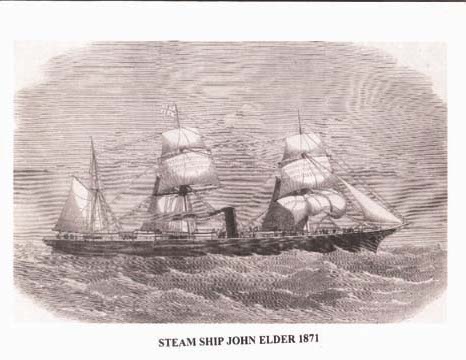
Compound expansion engines had been developed by John Elder
of Glasgow in
1854. Improved metallurgy and boiler design enabled steam to be
supplied
at higher
pressures, and the steam was led through two cylinders in succession.
Later
it
became normal to have three cylinders in series, hence the term
triple-expansion.
Engines which reused the same steam in this way led to a reduction in
coal
consumption by as much as 50 percent, and this clinched the commercial
advantage
of steam over sail. The P & O tried them first in Mooltan in 1861,
and after 1869 no
new tonnage was ordered without. Australia had compound engines, and
from
1870 to 1873, much of the company's fleet was converted.
...Colonel Stevens designed a form of iron-clad in the year 1812, since
reproduced by the late John Elder, of Glasgow,
Scotland. It consisted of a saucer-shaped hull, plated with iron
of ample thickness to resist the shot fired from the
heaviest ordnance then known. This vessel was to be secured to a
swivel, and anchored in the channel to be defended.
Steamship: NORD AMERICA
The "Nord America" was built in 1882 by J.Elder & Co, Glasgow
as the "Stirling Castle" ...
*********
BOOK about JOHN ELDER's wife
ISABELLA:
John Francis
URE, engineer
"The Lady of Claremont House; Isabella Elder, Pioneer and philanthropist,"
by C. Joan McAlpine, Argyll Publishing, 1997.
Glendaruel, Argyll, Scotland
Interlibrary loan from University of Georgia Library.
Page 11:
C. Joan McAlpine says:
"I first became aware of Isabella Elder when I was asked to be a
trustee of the Ure Elder Fund for Indigent Widow Ladies.
John Elder, b 8th MArch 1824 d. 17 Sept. 1869
married 1857 Isabella Ure
page 190 note:
Info from Miss Marion Peat, Stirling, a descendant of the family
on the Elder side.
Page 204
Alexander Elder 25, 178, 196 (note5) 197 (note 18)
Page 178:
Isabella's will:
She continued annuities to her sister-in-law, the widow of David
Elder, her
husband's older brother and she ensured that Alexander Elder, her
husband's younger brother who was in
receipt of an annuity given to him by John Elder's will, had this
continued.
Alexander was wealthy in his own right and had formed the firm of
Elder, Dempster & co trading to West Africa.
He lived in Southport. He founded the Alexander Elder Chair
of Naval Architecture at Liverpool University in 1909.
He died in 1915 and left 100,000 pounds for a hospital to be built
near the Elder Park to be known as the David Elder Infirmary.
now David Elder Wing of the Dept. of Obstetrics and Gynaecology
in the
Southern General Hospital, opened in March 1987.
Page 198
Note 18:
Mr. Alexander Elder's will from Journal of Commerce March 26, 1915.
He also left 50,000 pounds for a new wing for the Western Infirmary
to be named the
Alexander Elder wing. Also Alexander Memorial Chapel, opened
in 1915.
"Alexander Elder had no family and his wife was very frail when
he died.
David Elder Junior, page 19, 21, 64, 185 (note 29)
David Elder Jun. appears in the Post Office Directory of 1857 as
being in business for
himself as D Elder & Co at 11 Rutherglen Road Glasgow.
died aged 51 years in 1872.
note 33. Antenuptial Contract of Marriage between John Elder and
Isabella Ure
dated 30th March 1857 in archives of McGrigor Donald, Solicitors,
70 Wellington St, Glasgow
Page 21:
Marriage ceremony took place in her mother's home on the 31st March
1857, conducted by the Rev Macleod.
Event was recorded in the North British Daily Mail.
She was 29 and John was 33.
Page 64:
The second death was that of her brother-in-law, David, on August
11th at the age of
51 years. His death is commemorated on the Elder Tombstone
in the Glasgow Necropolis.
(Elder stone near John Knox)...
He left a widow but no children...
Notes for David Elder Jr.
http://freepages.genealogy.rootsweb.com/~nancyelder/ed/DavidElderJrSteamships.htm
In 1871, Melbourne House, Bridge of Allan, near Stirling, was the property of David Elder, Civil Engineer and, originally, John Bayne, builder.
Portrait of Isabella Elder - painted in 1886 by Sir John Everett Millais******
BOOK ABOUT ELDER DEMPSTER company (on Interlibrary loan from The
Citadel Library) More
about Alexander ELDER from book
Author Davies, Peter N
Title The trade makers : Elder Dempster in West Africa, 1852-1972,
1973-1989 / Peter N. Davies
Imprint St. John's, Nfld. : International Maritime Economic
History Association, 2000
Edition [2nd ed.]
LOCATION CALL # STATUS
Book Stacks HE945.E5 D38 2000
CHECK SHELVES
Description xxxii, 555 p., [16] p. of plates : ill., facsims.,
map, port. ; 23 cm
Subject Elder Dempster Lines Ltd
Steamboat lines -- Great Britain -- History
Great Britain -- Commerce -- Africa, West -- History
Africa, West -- Commerce -- Great Britain -- History
Bibliog: Includes bibliographical references: p. 525-535 and
index
Series Research in maritime history, 1188-3928 ; no. 19
ISBN 0968128890
*****
Search “ELDER DEMPSTER” history in Google.com
found:
Maritime Archives & Library
Sheet No. 15 : Elder Dempster and Company
“In 1868 John Dempster went into partnership with Alexander Elder,
brother of the eminent Glasgow shipbuilder, John, to act as
Liverpool agents of the British and African Steam Navigation Company
of Glasgow. The company's vessels were constructed in John
Elder's
Fairfield Yard, in Glasgow. The British and African and the
older
African Steam Ship Company, both with headquarters in Liverpool,
prospered and came to an arrangement to divide sailings. In
1875
Alfred Lewis Jones set up a shipping and insurance broking office
in
Liverpool under the name, Alfred L. Jones & Co., and with some
small
chartered sailing vessels, began trading with West Africa.
By 1879
Jones, whose competition was feared, became a junior partner in
Elder
Dempster and by 1890 he had bought a controlling interest in the
African Steam Ship Company...."
******
Who is the DAVID ELDER living in 1976?
From book: TRADE MAKERS: ELDER DEMPSTER...
Page 360
Re: OCEAN GROUP
... "These developments also affected the position of Elder Dempster
within
the Group. Although the process of integration would continue,
the operations of
its day-to-day business remained largely in its own hands.
But the decline of Ocean's other cargo-liner trades led to
a growing interchange of staff and vessels;
for example, a number of Blue Funnel ships were shifted to West
African routes.
The formation in 1976 of an Executive Committee, which was given
responsibility for
the overall control and investment decisions of the Group, was a
further step in the merger process.
Fortunately, (Sir) Geoffrey Ellerton, formerly Chairman of
Elder Dempster Lines, became a member
alongside Sir Lindsay Alexander and David Elder, so it may be safely
assumed that West African
interests always received a fair hearing...."
Obituary for Sir Geoffrey James ELLERTON d. 31 May 2005.
The Independent, 2 Derry Street, London W8 5HF
Monday, 22 August 2005
"Geoffrey James Ellerton, public servant: born London
25 April 1920; officer,
Colonial Civil Service 1945-63; MBE 1956; CMG 1963;
Secretary, Maud and Mallaby Committees on Management and Staffing
in Local Government 1964;
staff, Elder Dempster Lines 1965-74, chairman 1972-74;
chairman, Globe Management 1981-83;
Chairman, Local Government Boundary Commission for England 1983-92;
Kt 1992; married 1946 Peggy Watson (three sons); died Cheltenham,
Gloucestershire 31 May 2005.
" ...In the 1970s, Ellerton made
use of some of his father's old business contacts and gradually
built up a portfolio of directorships in such companies as Elder
Dempster Shipping Lines,
Ocean Transport and Trading Limited, Electra Group Services and
the Globe Investment Trust.
Then he was offered the chairmanship of the Local Government Boundary
Commission for England,
with offices and a small group of staff at 20 Albert Embankment..."
**
Summary History of ELDER DEMPSTER (.pdf)
British Merchant Navy Cadet Training Ships
http://www.rakaia.co.uk/downloads/elder-dempster-summary.pdf
..."On 15th October 1962, Elder Dempster officially opened River
House
a purpose-built residential complex in Riversdale Road,
Liverpool. River House was designed to enable the Company's navigating,
engineer, purser and catering cadets to live together
whilst undergoing the shore-based elements of their respective training
programmes.
The Elder Dempster management believed that integration at such
an early stage would help
their future officers to acquire the qualities of loyalty and comradeship
so necessary in a career at sea..."
Malcolm Falkus, author of "BLUE FUNNEL Legend"
in New South Wales, Australia
http://www.une.edu.au/staff/mfalkus.php
***
1851 Scotland census
Name: David Elder
Age: 66
Estimated birth year: abt 1785
Relationship: Head
Spouse's name: Grace
Gender: Male
Where born: Orwell, Kinross
Parish Number: 644/2
Civil parish: Govan
County: Lanarkshire
Address: 19
Occupation: Superintendent Of Enginer
ED: 31
Household schedule number: 69
Line: 11
Roll: CSSCT1851_166
Household Members:
Name Age
David Elder 66
Grace Elder 59
David Elder Junr. 29 son 1822 Engineer Mechanical
(em 60 Men)
John Elder
27 son 1824 Engineer Mechanical (em 60 Men)
Alexander Elder 18 son 1833 Engineer
Mechanicals Apprentice
Mary McGregor 18
Cathrine Dingwall 25 (cook)
****
From TAY VALLEY BRIDGES Membership Queries:
See:
"Distinguished Men of the County;
or Biographical Annals of Kinross-shire", by T.M.T. [T.M.Todd],
published by "The Kinross-shire Advertiser", Kinross 1932:
"64. David Elder.
"The death occurred at Glasgow, in January, 1866, of David
Elder,
aged 82, who was known as the pioneer of marine engineering on
Clydeside.
Born at Little Seggie, Milnathort, he succeeded his father as a
country wright; indeed, several generations of the family had carried
on that vocation there.
His grandfather was noted for his mathematical and scientific
accomplishments.
David Elder proceeded to Paisley in 1814, and three years
later
removed to Glasgow. Commencing as an engineer's apprentice, he rose
step by step until he was manager of the large works of Messrs.
Napier. Mr. Elder married in 1812, Grace, daughter of Mr. John
Gilroy. A memoir of his life was written by Mr. J.R. Napier.
His third son, John, followed in his father's footsteps.
Entering the Napier Company, he was
associated with the construction of the Cunard steamers.
Joining the Randolph firm in 1852, which was latterly known
as
Randolph, Elder & Co., he assumed full control.
Mr. John Elder was known in philanthropic
circles in the city, and was much respected for his integrity and
honour. His untimely death in the full plenitude of his labours
in
September, 1869, was a distinct loss to the city. His widow, a
daughter of Alexander Ure, of Glasgow, carried on the business for
some time, when other partners were assumed. A memoir of this
enterprising engineer and shipbuilder was published in 1871 from
the
pen of Mr. Rankine."
There is likely to be more about the Elder family in the back issues
of the Kinross Advertiser held in Perth. [Indexing project online]
Newsplan Scotland
*******
Steamship George ELDER (New York)
ELDER Family of WISCONSIN - matching DNA of "FRANKLIN CO PA"
http://freepages.genealogy.rootsweb.com/~nancyelder/ed/WisconsinDocuments.htm