A collection of articles presented via five separate indices:
The Railroads (see chart immediately below)
The 'Bertrande' Columns of the Syracuse (NY) Post Standard
The Stages
OFF SITE: (link also on "The Stages" Richard Palmer's Stagecoach Blog.
Waterways & Canals
Miscellany - Articles of Historical Interest
RAILROAD LORE AND A COLLECTION
ARTICLES ABOUT RAILROADS
Note by Sitehost: The development of the railroads in the central and northern part of New York State makes for an interesting study. The railroads changed the complexion of the north country, the lives of its people, its businesses, and its future. There are several people who enthusiastically research early railroads. I have been honored to have been sent the results of their findings. Most of the articles came from Richard Palmer and he admits he has barely started to dig up what's available.
The index for the railroad section is immediately below and it shows the year and source of each of the articles found, along with the title or topic of same.
I suggest you read the segment pertaining to the railroad which I have taken from Child's Gazetteer of Jefferson County, N. Y., pub. 1890. It is found among the "Internal Improvements" portion.
You will want to check out four additional categories to which I have made reference in the heading: The Bertrande columns (in part), The Stages, Waterways & Canals and Miscellany. To gain access to these indices, click on the underlined categories at the top of this page.
|
Ref. |
Date |
Source |
Title/Topic/Content |
|
1 |
December, 2003 |
Sitehost |
North Country Railroads- an Introduction |
2 |
------ |
New York State Legislature, |
Laws of New York |
|
3 |
------ |
Research by Richard Palmer |
|
2-d |
none stated |
Research by unknown |
Rome, Watertown & Ogdensburgh |
|
4 |
------ |
Research by Richard Palmer |
|
5 |
------ |
Research by Richard Palmer- |
Sackets Harbor & Ellisburgh Rail Road Time Table |
|
6 |
------ |
Research by Richard Palmer |
How travelers once got to Auburn by 'stages.' |
|
6-a |
undated |
Authored by Richard Palmer |
"Where did the term, 'Hojack' originate? |
|
6-b |
undated |
Authored by Richard Palmer |
"A Biographical Sketch |
|
6-c |
Jully 27, 1839 |
Rome Sentinel |
"Utica to Syracuse" |
|
7 |
July 14, 1841 |
Rochester Daily Democrat, Rochester, N.Y |
Railroad Excursion |
|
9 |
May 5, 1853 |
Jefferson Farmer, Sackets Harbor, N. Y. |
Five accounts of the S. H. & E. RR, May to August |
|
8 |
June 17, 1853 |
Watertown Reformer, Watertown, N. Y. |
Firemen's Excursion |
|
10 |
Feb. 28, 1856 |
Jefferson County Journal, Adams, N.Y. |
A Day Upon the Watertown & Rome Railway |
|
10-a |
March 8, 1856 |
Colburn's Railroad Advocate |
"A Day From Home" |
|
11 |
1856 |
unknown |
Timetable of the Sackets Harbor & Ellisburgh Railroad for 1856 |
|
12 |
Aug. 24, 1859 |
Cortland Republican Banner, Cortland, N. Y. |
The Excursion to Oswego |
|
13 |
March 27, 1860 |
Jefferson County News, Adams, N. Y. |
Reorganization of the Sackets Harbor & Ellisburgh R.R |
|
14 |
May 6, 1860 |
Jefferson County News, Adams, N. Y. |
A Note Concerning the Reorganized Sackets Harbor, Rome & N. Y. R. R. |
|
15 |
June 28, 1860 |
Jefferson County News, Adams, N. Y. |
Sabbath School Excursion to Pierrepont Manor |
|
16 |
July 12, 1860 |
Jefferson County News, Adams, N. Y. |
Sunday School Picnic - Belleville group travels to Railroad to Sackets Harbor |
|
17 |
July 26, 1860 |
Jefferson County News, Adams, N. Y. |
"An Update Regarding the Reorganized Railroad" |
|
18 |
Aug. 9, 1860 |
Jefferson County News, Adams, N. Y. |
A new schedule for the Sackets Harbor, Rome &New York Railroad |
|
19 |
1860 |
Gazetteer of the State of New York by J. H. French |
Sackets Harbor & Ellisburgh Railroad opened |
|
20 |
Aug. 9, 1861 |
Jefferson County News, Adams, N. Y. |
Sackets Harbor, Rome & New York Railroad Timetable |
|
21 |
Nov. 4, 1861 |
Jefferson County News, Adams, N. Y. |
Timetable as of November 2, 1861 -- Sackets Harbor, Rome & New York Railroad |
|
22 |
1853--1861 |
From the annual report of the New York State Engineer and Surveyor |
Notes on the Sackets Harbor & Ellisburgh Railroad |
|
23 |
Feb. 6, 1862 |
Jefferson County News |
Clearing the road by presevering energy |
|
24 |
1863 |
The New York State Legislature |
Brief History of the Sackets' Harbor, Rome & New York Railroad. |
|
25 |
June 25, 1863 |
Jefferson County News, Adams, N. Y. |
S. H., R. & N.Y. Railroad election of Stockholders |
|
26 |
Aug. 20, 1863 |
unknown |
The stockholders of the S. H., R & N. Y. Railroad may sell iron track |
|
27 |
Sept. 10, 1863 |
New York Daily Reformer, Watertown, N. Y. |
Sackets Harbor Railroad Suit Settled |
|
27 |
Oct. 2, 1863 |
Oswego Commercial Times |
The Oswego and Rome Railroad |
|
27-a |
April 28, 1865 |
New York Tribune |
Our Dead President |
|
27-c |
October 8, 1867 |
Carthage Republican |
The New Railroad |
|
27-b |
December 24, 1867 thru March 29, 1870 |
Carthage (NY) Republican |
Fifteen articles written about the Black River & St. Lawrence Railway. |
|
28 |
June 18, 1868 |
Sherburne (N.Y.) Home News |
Locomotive Engineers |
|
28-e |
December 29, 1868 |
Carthage Republican |
WANTED!!! |
|
28-o |
January 21, 1869 |
St. Lawrence Plain Dealer |
The New Railroad Superintendent |
|
28-f |
March 23, 1869 |
Carthage Republican |
The Clifton Railroad |
|
28-k |
August 21, 1869 |
N. Y. Daily Reformer |
"Switching Off Our Trade" (railroads in the North Country) |
|
28-m |
August 30, 1869 |
Ogdensburgh Daily Journal |
Black River & St. Lawrence Railroad |
|
28-n |
September 6 & 7, 1869 |
Ogdensburgh Daily Journal |
The Clifton Fire |
|
28-d |
November 30, 1869 |
New York Daily Reformer |
Black River & St. Lawrence R. R. |
|
28-g |
June 29, 1870 |
Watertown Daily Times |
A Trip to Clayton |
|
28-h |
October 17, 1870 |
Watertown Daily Times |
The Arched Culvert |
|
28-l |
December 26, 1870 |
St. Lawrence Plain Dealer |
Palace Cars |
|
28-a |
February 18, 1871 |
The Railroad Gazette |
"Wooden Railroad, The Narrow Guage And The Old-Fashhioned 'Strap Road' " |
|
28-b |
September 6, 1871 |
Oswego Advertiser & Times |
New Rolling Stock |
|
28-c |
September 19, 1871 |
Syracuse Daily Standard |
Henderson - A Deep Harbor - But No Suitability for the Iron Rail |
|
28-i |
November 1, 1871 |
Watertown Daily Times |
Cost of Cars & Locomotives |
|
28-j |
November 7, 1871 |
Watertown Daily Times |
A Visit to the R. W. & O Car Shops at Rome |
|
29 |
Nov. 23, 1871 |
Oswego Palladium |
Most Remarkable Cat Journey on Record |
|
29-e |
March 11, 1872 |
Watertown Daily Times |
"A Little Skirmish With The Snow" |
|
29-b |
June 4, 1872 |
Watertown Daily Times |
Another Railroad |
|
29-d |
July 6, 1872 |
Scientific American |
Locomotive Boiler Explosion |
|
29-f |
August 14, 1873 |
St. Lawrence Plain Dealer |
New Ore Bed (at Russell, N. Y.) |
|
29-a |
August 28, 1873 |
Chenango Union |
|
29-c |
Feb. 4, 1874 |
Watertown Daily Times |
Natural Bridge Looks Forward To The "Iron Horse" |
|
30 |
July 13, 1875 |
Oswego Palladium |
The New Coaches for the Lake Shore Railroad |
|
30-a |
February 26, 1876 |
Syracuse Courier |
A Review of the R. W. & O's Annual Report |
|
31 |
Sept. 23, 1876 |
Syracuse Journal |
The Auburn Branch - A Fragment |
|
31-z |
Sept. 6. 1877 |
Oswego Palladium |
"Taking Up the Track from Sandy Creek to Pulaski (Abandonment) |
|
31-g |
June 24, 1880 |
Cattaraugus Republican |
"The Erie Narrowed Standard Gauge" |
|
40-e |
July 20, 1880 |
Rome Sentinel |
"How the Syracuse & Utica |
|
31-h |
July 30, 1881 |
Rochester Union & Advertiser |
"The Battle of The Gauges" |
|
h-31 |
October 10, 1882 |
Rome Daily Sentinel, |
"The R. W. & O. R. R. Shops" |
|
31-a |
March 24, 1885 |
Daily Sentinel, Rome, N. Y. |
"The Locomotive in Winter" |
|
31-d |
July 8, 1888 |
New York Times |
"Opening the Adirondacks" |
|
31-i |
April 14, 1891 |
Rome Daily Sentinel |
Three articles regarding the use of |
|
31-b |
April 17, 1889 |
Rome Daily Sentinel |
Two articles - A Personal and one written about an early railroader, Joseph Higgins. |
|
40-aaa |
November 28, 1891 |
Letter found via Palmer research |
|
31-c |
August 12, 1892 |
Rome Daily Sentinel |
Great Railroad Work - How The New York Central Has Come To The Front - Remarkable Growth of the Vanderbilt System in This State - The Origin of the Road |
|
31-o |
September 11, 1901 |
Adirondack News |
"Last Wooden Railroad Broken Up" |
|
31-p |
February 10, 1902 |
Oswego Palladium |
"Stuck Fast in Snow Drifts" |
|
35-a |
January 21, 1903 |
Canton Commercial Advertiser |
"Old Time Railroads" |
|
31-e |
March 31, 1903 |
Rome Daily Sentinel |
"Old Times On The R. W. & O." |
|
31-j |
September 2, 1903 |
Watertown Daily Times |
"The Origin of the Word "Hojack" |
|
31-k |
February 24, 1904 |
Ogdensburg News |
"Snowplows Over Northern Roads" |
|
31-l |
November 26, 1904 |
Syracuse Telegram |
"Get Ready for Hard Winter" |
|
31-m |
November 2, 1905 |
Oswego Daily Paladium |
"Work Along the Hojack |
|
31-n |
September 4, 1908 |
Watertown Daily Times |
"The Passing of the R., W. & O. Division |
|
31-ff |
July 30, 1908 |
Lowville Journal & Republican |
"Proposed Line: Copenhagen to Camden |
|
31-f |
Sept. 28, 1908 |
Watertown Daily Times |
"Changes with R. W. & O. Became |
|
40-a |
July 11, 1912 |
Rome Daily Sentinel |
|
32 |
May 24, 1913 |
Oswego Daily Palladium |
A New Coal Train |
|
33 |
Sept. 3, 1919 |
Oswego Daily Times |
Twenty-Five Years And Then To The Scrap Pile |
|
33-a |
Feb. 8, 1920 |
St. Lawrence Plain Dealer |
Theron Fox Pensioned by Railroad |
|
33-b |
Aug. 17, 1920 |
St. Lawrence Plain Dealer |
"The Rounder" - A Description of Clifton, N. Y. |
|
33-c |
February 16, 1923 |
Canton Commercial Advertiser |
"Rotary Snow Plow First Used North" |
|
34-a |
May 11, 1926 |
Canton Commercial Advertiser |
Beecher's Snowplow Recalls |
|
34 |
December, 1926 |
New York Central Lines Magazine |
A Chronicle of R. W. & O. Days Since 1851 |
|
34c |
November 28, 1934 |
Oswego Palladium Times |
"Hojack - Abandon 10-hour Trains" |
|
38 |
March 14, 1936 |
Watertown Daily Times |
|
40-c |
August, 1939 |
Railroad Magazine |
|
40-d |
Sometime in 1940 |
Researched and found by Richard Palmer |
The Milk Business of the St. Lawrence |
|
40-b |
July, 1940, |
Railroad Magazine |
|
40-e |
Jan. 10,1941 |
Oswego Palladium Times |
Two articles from Jay Knox's column, "Do You |
|
36 |
August, 1945 |
Railroad Magazine - pp. 104-105 |
|
38-a |
1946 and earlier |
Several newspapers |
Several Articles Relating |
|
49-a |
re: Feb. 13, 1949 |
Richard Palmer |
Last D. L. & W Passenger |
|
37 |
September, 1950 |
Railroad Magazine - p. 92 |
|
43 |
February 15, 1964 |
timetables and |
____________________________________________________________________
Laws of New York
Seventy-Second Session
Chapter 295, Page 423
AN ACT to declare the public use of a railroad from Sacket's Harbor, in the county of Jefferson, to Adams or Ellisburgh in said county.
Passed April 9, 1849.
The People of the State of New-York, represented in Senate and Assembly, do enact as follows:
1. Petitions having been presented to the legislature by Edward B. Hawes, Jabez Hunting, William Dodge, George Redfield, Daniel Hunter, Jesse Dunn, Elisha Camp, Allen Lord, James L. Hooker, Dier W. Burnham, Edward Sacket, Thomas L. Hall, Otis M. Cole and others praying for the legislature to determine whether the construction of a railroad from Sacket's Harbor in the county of Jefferson to connect with the Watertown and Rome Railroad at the most eligible point in the town of Adams or Ellisburgh in said county will be of sufficient use to justify the taking of private property for the construction of such road: It is hereby determined and decided by the legislature that a railroad commencing at and from the village of Sacket's Harbor and running thence to the line of the Watertown and Rome Railroad in the town of Adams or Ellisburgh aforesaid will be of sufficient utility to justify the taking of private property for constructing and maintaining such railroad under and in pursuance of the act entitled "An act to authorize the formation of railroad corporations," passed March 27, 1848, and by said petitioners when they or such number of them or others as required by the same, shall be duly formed into a corporation under the said act.
2. Said corporation when duly formed may make joint stock with any other company or companies of this state with which it may connect its road, and on such terms as may be agreed upon by the directors of such companies respectively.
3. This act shall take effect immediately.
____________________________________________________________________
Back to IndexIncidental Facts Concerning The Road
The road is 18 miles long; one terminus at Sacketts' Harbor; the other at Pierrepont Manor, 53 miles from Rome, on the Rome, Watertown and Ogdensburgh Railroad.
The roads are nearly parallel, varying from three to seven miles apart, and consequently competitors for freight; of which the Watertown road has always had the power to make its tariff of rates oppressive to the Harbor road. For instance: they would carry through freight for five cents per bushel from Cape Vincent, and require five cents of the Harbor road from Pierrepont Manor, when delivered on their own loaded cars, one half the distance.
They would deliver merchandise at Adams at the same rate that they delivered it to the Harbor road at Pierrepont Manor. Grain and produce buyers on account could pay more for the article purchased when delivered to them on the Watertown road than they could pay on the Harbor road and pay transportation to Pierrepont Manor; thus, destroying, in a great measure, the local business of the Harbor road. The local business of the road was mostly confined to the southern portion of four and nine miles; too short a distance to be of material benefit to the road.
It had always been hoped by the Harbor road that, at some time, the Watertown road would find it for its interest to consolidate the road with theirs, and make the better Harbor accommodations and less distance induce them to abandon Cape Vincent (for through freight), and take Sacketts' Harbor. Sanguine of this, the road has struggled along, under embarrassing circumstances, hoping to accomplish it and save the road, until now; the decision of the Watertown road seems to be final, and that it does not want the Harbor road. It cannot abandon Cape Vincent for Sacketts' Harbor, or support both.
The road cannot be maintained as an independent organization, however economically managed.
The inhabitants on the line of the road are mostly farmers, and men of moderate capital. They have done so much already, so many times over, to "save the road," that it would be impossible to induce them to "try again." Many claim that the road is not needed, as the Watertown road accommodates them more, to their advantage, than the Harbor road has ever done.
Who would be benefited should the petition be denied? On the contrary, those persons represented by the petition would evidently be injured to a large amount by one year's delay. If sold now it would pay back something to those who have suffered the greatest loss; while the delay would endanger an entire loss of the whole, as there are about $10,000 of debts pressing for liquidation, and the company no means to pay them.
Amount of stock issued,.......... $85,000
Represented by petition,......... ..77,000
We certify the foregoing statement to be true, according to our best knowledge and belief.
R. W. BISHOP, Director.
ALDEN ADAMS, Treasurer.
Directors :
JOHN BUTTERFIELD
JOHN THORNE
CHESTER BARRETT
SAMUEL GREGGS
W. P. DAVIS
JOHN D. GILLET, Jr.
C. VAN ALLEN
____________________________________________________________________
Back to Index
Lewiston Branch
|
Suspension Bridge |
0 - Abandoned 1950 |
|
Lewiston |
5.38* |
|
Lewiston-Lewiston Jct. |
3.60- Abandoned 1895 |
*(former connection with Lewiston & Youngstown Frontier RR)
“Ontario Secondary”
MILEPOSTS FROM BUFFALO
|
Buffalo NYC Terminal |
0 |
|
Niagara Falls |
25.07 |
|
Suspension Bridge |
26.90 |
|
Model City |
34.29 |
|
Ransomville |
39.95 |
|
Elberta |
42.54 |
|
Wilson |
42.65 |
|
Slash Road |
47.05 |
|
Beebe Road |
49.04 |
|
Burt |
51.59 |
|
Appleton |
54.80 |
|
West Somerset |
57.13 |
|
Barker |
59.74 |
|
Millers |
64.05 |
|
Lydonville |
68.08 |
|
Ashwood |
72.04 |
|
Waterport |
75.17 |
|
Carlton |
78.10 |
|
Brice |
80.72 |
|
West Kendall |
83.82 |
|
Kendall |
85.74 |
|
Morton |
88.04 |
|
Hamlin |
92.16 |
|
Walker |
95.14 |
|
Collamer |
97.47 |
|
Hilton |
98.57 |
|
Greece |
101.83 |
|
Charlotte |
108.48 |
|
Barnard |
111.36 |
|
Otis |
114.89 |
|
Rochester |
117.85 |
|
MILEPOSTS FROM |
ROCHESTER TERM. |
|
Windsor Beach |
10.59 |
|
Sea Breeze |
13.36 |
|
Forest Lawn |
15.49 |
|
Webster |
19.99 |
|
Union Hill |
22.86 |
|
Fruitland |
24.68 |
|
Ontario |
27.47 |
|
Williamson |
32.30 |
|
East Williamson |
34.49 |
|
Sodus |
38.51 |
|
Wallington |
41.50 |
|
Alton |
43.43 |
|
North Rose |
48.54 |
|
Wolcott |
53.16 |
|
Red Creek |
58.92 |
|
Sterling |
63.63 |
|
Crocketts |
66.84 |
|
Hannibal |
69.38 |
|
Metcalf |
72.06 |
|
Furniss |
74.95 |
|
Oswego |
79.47 |
Hannibal to Red Creek (Conrail) 1980 (OMID had been designated operator).
Hannibal to Webster sold to Ontario Midland, Oct. 15, 1979.
Webster to Windsor Beach abandoned 1978
(Portion from Suspension Bridge at Niagara Falls to “Riverview” north of Niagara
University campus dismantled in the late 1960s by Penn-Central.
Had not been used since construction of Niagara Power Project)
Rochester to Windsor Beach abandoned 1978
Through passenger service, Oswego to Rochester and Suspension Bridge,
discontinued Feb. 2, 1935 Passenger service discontinued, Oswego to Pulaski, Sept. 25, 1947
Cape Vincent Branch
|
C. Vincent - now marina |
0 |
|
Rosiere |
4.38 |
|
Three Mile Bay |
7.72 |
|
Chaumont |
11.16 |
|
Limerick |
16.04 |
|
Dexter Junction |
17.9 |
|
Brownville |
19.86 |
|
Main St., Watertown |
23.31 C. V. |
|
C. V. Wye |
22.89 |
|
Coffeen St. |
24.06 |
|
Watertown Station |
24.68 |
Limerick to Cape Vincent Abandoned 1952
Watertown to Limerick Abandoned 1976
Passenger service discontinued March 14, 1936
Sackets Harbor Branch
|
Sackets Harbor |
0 |
|
Chamberlain’s |
2.00 |
|
Camp’s Mills |
3.39 |
|
Alverson’s |
5.62 |
|
Green’s Corners |
6.13 |
|
East Hounsfield |
7.51 |
|
Watertown Junction |
11.04 |
Abandoned 1949.
Passenger service discontinued Sept. 30, 1934.
Utica Branch
|
Lyons Falls |
0 |
|
Glenfield |
6.65 |
|
Martinsburg |
10.18 |
|
Lowville |
13.94 |
Abandoned 1964
Passenger service, Utica to Massena, discontinued May 21, 1961 (RDC)
Watertown Passenger Train Cutoff
|
Watertown |
0 |
|
Pamelia |
5.39 |
|
Calcium |
8.18 |
|
Roots |
8.68 |
Abandoned 1963
Carthage Branch
|
Mileposts from Sackets Harbor |
|
|
Watertown |
12.00 |
|
Black River |
18.45 |
|
Felts Mills |
20.66 |
|
Great Bend |
22.91 |
|
Carthage |
29.68 |
Watertown - Great Bend abandoned 1967
Great Bend- Carthage abandoned 1970
Trackage in Watertown, Abandoned 1970
Passenger service, Utica to Watertown, this route, abandoned Nov. 3, 1958
(RDC)
Carthage & Adirondack Branch
|
Newton Falls - Clifton Mines |
10.04 1955 |
Passenger service, Carthage to Newton Falls, discontinued June 7, 1942
Clayton Branch
|
Clayton |
0 |
|
LaFargeville |
8.77 |
|
Orleans Corners |
5.55 |
|
Strough’s |
12.17 |
|
Rivergate |
15.88 |
|
Shurtleff |
17.75 |
|
Philadelphia |
21.7 |
Abandoned 1973 Passenger service discontinued April 29, 1951
Ogdensburg Branch
|
Ogdensburg |
0 |
|
Shipyard |
0.84 |
|
Terrace Park |
9.52 |
|
Morristown |
10.67 |
|
Brier Hill |
16.8 |
|
Hammond |
21.43 |
|
Oakvale |
25.49 |
|
Redwood |
33.19 |
|
Theresa |
39.32 |
|
Rivergate |
41.82 |
Ogdensburg Branch (2)
|
Dekalb Junction |
0 |
|
Rensselaer Falls |
6.73 |
|
Heuvelton |
11.77 |
|
Ogdensburg |
18.91 |
Abandoned 1979
Passenger service discontinued Oct. 28, 1956
Abandoned 1962
Passenger service discontinued Nov. 9, 1958, Utica to Ogdensburg
Canadian Pacific car and passenger transfer - Ogdensburg to Prescott, Ont., abandoned 1971
Gouverneur & Oswegatchie Branch
|
Gouverneur Jct. |
0 |
|
Hailesboro |
3.26 |
|
York |
5.94 |
|
Emeryville |
7.72 |
|
Hyatt |
10.37 |
|
Talcville |
11.32 |
|
Edwards |
13.82 |
Abandoned Emeryville - Edwards Jan. 1, 1978
Passenger service discontinued June 26, 1932
Syracuse Northern
|
Pulaski-Lacona |
7.09 miles |
Abandoned 1878 |
Miscellaneous Notes
Antwerp to Jefferson Iron Mine 2 miles Abandoned pre-1900
The Mohawk, Adirondack & Northern operates from Carthage to Lowville (17.2
miles); Carthage to Newton Falls, 45.7 miles (out of service, 1996, up for
abandonment); Utica to Lyons Falls, 45 miles; also trackage and rights at
Utica and Rome. All remaining portions of the St. Lawrence Division
formerly operated by Conrail were transferred to CSX in 1999.
Additional Abandonments Which Had Been Omitted in Above List
Column at right represents Milepost numbers
Abandonments: New York Central St. Lawrence Division ("Hojack")
|
Rome |
|
|
Humaston |
6.50 |
|
Taberg |
10.60 |
|
McConnellsville |
13.18 |
|
Camden |
17.91 |
|
West Camden |
22.80 |
|
Williamstown |
27.65 |
|
Kasoag |
30.80 |
|
Altmar |
36.50 |
|
Richland |
41.30 |
Abandonments:
Camden - Richland 1957
Camden - McConnellsville 1977
Rome - McConnellsville 1982
Passenger service discontinued Oct. 28, 1956, Utica to Philadelphia, via Richland.
Note by typist: As far as I can determine the above data was researched and assembled by Richard Palmer. He sent it to me on September 13, 2002, advising me that these abandonments covered the complete R W & O system.
____________________________________________________________________
Back to Index Sackets Harbor & Ellisburgh Rail Road Time Table
Effective June 25, 1856
Going South, Leave
Miles A.M. A.M.
Sackets Harbor 0 7:00 11:22
Smithville 5 7:25 11:37
Henderson 9 7:45 11:50
Belleville 13 8:05 12:03 P.M.
Arrive at Pierrepont
Manor 18 8:30 12:20 P.M.
Going North, Leave
A.M. P.M.
Pierrepont Manor 0 10:12 5:40
Belleville 5 10:32 6:05
Henderson 9 10:45 6:25
Smithville 13 10:57 6:40
Arrive at
Sackets Harbor 18 11:14 7:00
Connecting at Pierrepont Manor with the trains on the Watertown & Rome Railroad, both to and from Watertown, Cape Vincent, Rome, New York & Boston. And at Sackets Harbor with the American Line of Steamers, to and from Ogdensburgh, Alexandria Bay, Kingston, Oswego, Rochester and Lewiston. At Niagara with the Great Western Railroad, and Lewiston with the Lake Shore, Michigan Central and Michigan Southern Railroads, for Detroit, Toledo, Chicago, Milwaukee, Sheboygan, and all parts West.
D.B. KELLOGG, Supt.
:
____________________________________________________________________
Back to IndexHow travelers once got to Auburn by 'stages'br> by Richard Palmer
In December, 1837, the newly-completed Auburn & Syracuse Railroad, which passed through the towns of Geddes, Camillus and Elbridge, contracted with Col. John M. Sherwood of Auburn to operate the line using his horses and altered stagecoaches until such time as the company could afford to purchase locomotives.
At the time, scrap iron was also unavailable, so locomotive operation would have been impractical on the plain wooden rails that had been laid. Sherwood was one of the major partners in a consortium loosely called the "Old Line Mail," which had controlled public land transportation between Albany and Buffalo and had the mail contracts since about 1800.
According to Thomas Y. How, Jr., treasurer, as recorded in the company letter book, the directors had decided it was in their interest to contract with Sherwood and also secure his business rather than compete against him. This arrangement lasted for about 14 months until locomotives were purchased from Rogers Locomotive Works of Patterson, N.J.
Following is an account of a ride in one of the horsecar trains from James S. Buckingham's "Travels in the Eastern and Western States of America," published in London in 1842. The author and his party had traveled by canal packet to Utica, and then by stagecoach to Syracuse. He noted that the journey from Utica to Syracuse, a little more than 50 miles, took eight hours, from 8 a.m. to 4 p.m., or an average of 6 1/4 miles per hour.
"On the following morning, Thursday, August 9th (1838), we left Syracuse in a coach that conveyed us to a rail-way, beginning at a distance of 3 or 4 miles from the town, to take us to Auburn; but great was our disappointment at finding, that instead of a locomotive engine, the cars were drawn by horses, of which there were only two, to draw about 20 passengers, the horses being placed one before the other, as tandems are driven, and not abreast.
"The rails, too, were of wood instead of iron, and the rate of travelling was estimated to be about six miles an hour. We had to wait half an hour before starting, and our progress was then so tedious that we all thought of getting out to walk the distance, as the most expeditious mode of the two. To add to our mortification, we met a train of cars drawn by a single horse coming right against us, and, the rails being single, and the places for turning off being wide apart, we had to shift our tandem pair from the front to the hind part of the train, and be drawn back about a mile and a half to get off the track, and let our advancing rival go past us.
"After a very tedious ride of four hours in performing 22 miles, we reached Auburn, the entrance to which was by the great State Prison, and the other public buildings, which gave it a very striking appearance."
____________________________________________________________________
Back to Index
December 29, 2002: Mr. Palmer shared with me another article tagged “More on the “Young Lion.” He prefaced this finding with this note which takes us up to the railroad’s current status:
This railroad was completed to Auburn in November, 1841. It and the Auburn & Syracuse were merged in 1850 to form the Rochester & Syracuse Railroad Company. It was consolidated into the New York Central in 1853. Passenger service discontinued May 18, 1958. Abandoned Victor to Pittsford in 1960; Canandaigua to Victor in 1978, and Pittsford to Rochester in 1982. Operated by Conrail, April 1, 1976 to July 1, 1995, when turned over to Finger Lakes Railway, along with remaining segment of Lehigh Valley mainline, about 15 miles, Geneva to Kendaia.
And now for the article, entitled “Railroad Excursion” from the Rochester Daily Democrat, Rochester, N.Y., Tues., July 14, 1841
RAILROAD EXCURSION.
On Saturday last, the Directors and Stockholders of the Auburn and Rochester Railroad Company, resident in this city and the several villages through which it passes, accompany by the Corporations of the several places, their ladies, and the Editors of the daily papers of this city (ahem!) made a delightful excursion to Seneca falls, a distance of 62 miles. The company which left this city numbered about one hundred, and increased to nearly twice that number before it reached the point of destination. Four superb passenger cars left this city at half past eight o'clock, drawn by the locomotive "Young Lion of the West," which had been very appropriately detailed for that service.
The day was beautiful - one of those which at this season of the year frequently succeeds a heavy rain, which had been falling through the night, and had left every thing in its freshest and loveliest garb. The fears of a rainy day created by a cloudy morning, were dissipated before the hour of departure, by the wind changing into the north, breaking up the reign of the Storm King, and scattering the fleecy clouds - the shadows flittering over the plains and hills scarcely keeping pace with the "Young Lion" -- until the clear blue became predominant, and all nature seemed to keep jubilee (sic) with us in victory which the ingenuity of man has achieved in overcoming distance and binding together more strongly the different portions of our continent.
Such was the rapidity of our flight, that in looking out upon the fields and forests through which we passed, it was no fancy to imagine every object around as in one grand whirlpool, hurrying off to be succeeded by new circles. Scarce had we time to recover from these reveries, before we were passing Brighton Corners, and the splendid groves and farms which constitute the beauty and wealth of that thriving town. The lazy motion of here and there a deeply laden canalboat, seemed in comparison too snail-like to deserve contempt. We soon passed that comfortable retreat, the Monroe Springs, and in a moment were halted at Pittsford, where we received the first accession to our happy number.
Leaving Pittsford, the road passes through sand hills and over short embankments until it crosses the canal at Cartersville, a few rods from the Great Canal Embankment, and nine miles from Rochester. Here is a fine spring of soft water, where the "Young Lion" slaked his thirst, and a few more joined us. A little onward, following the western side of the valley of the Irondequoit, we passed the "Railroad Mills," where good flour may be made, but not yet in quantities large enough to excite the apprehension of our millers that they will there very soon meet with a successful rival.
The sudden change of scenery along this valley is an object of interest to the lover of nature - scarcely noticed, however, before passed, and Victor, with its spires and neatly painted dwellings, is in view, at the distance of half a mile to the left. Here also the "Young Lion" found another spring of soft water, none other being allowed him, for fear of choking his pipes (Considering his speed and bottom, what an argument is this for cold water men!)
The gravelly hills and ledges of rocks through which the road has been constructed to the edge of Bloomfield, might interest a geologist, but we had no time for such investigations, the fine farms in that town and Farmington were soon passed, and Canandaigua in all its loveliness was in full view. At this place we received a large delegation, and well might her citizens feel proud of the occasion. To her capital, enterprise and perseverance are the public mainly indebted for the projection and speedy construction of a work which brings her within two hours travel of this city and in the immediate vicinity of the large villages at the east.
From this point, the road passes down the Outlet of the Canandaigua lake to Manchester - within a few rods of Clifton Springs - between Hildreth's old stand and Flint Creek (another watering place) a little north of Vienna - between Oaks' old stand and the Phelps meeting house - and thence in nearly a straight line to the north end of Water street, Geneva. The grading is made between these two villages for a double track, and some of the way the workmen were putting down the rails. A double track is necessary here, as well for passing the trains between Auburn and Rochester, as for the great amount of freight to be transported east and west on this section.
At Geneva, we found a fifth car, well filled with those who were on the same errand as ourselves; and after hitching on and giving our inveterate drinker a taste of the pure waters of the blue Seneca, we moved forward, but not without casting many a longing, lingering look behind at the beautiful village of Geneva, which it was impossible, with our other engagements, to visit on that occasion as we should wish.
The road here snakes a short curve, taking the straightest practical route to Waterloo, passing a little west of the jail in that village, and in Seneca Falls, also a little west of the center of business in that thriving place.
The Auburn and Rochester Railroad passes through one of the finest portions of the State, and at this season of the year, when "the fruitful fields laugh with abundance," what could be more interesting than such a trip, so politely furnished, and participated in by those who all appeared in the right mood to enjoy it. The cars on this road are universally admired for the ease of their motion - being suspended on springs - and the stillness with which they run enabling the passengers to converse without much difficulty. The seats are remarkably easy, and a passage through the center affords an opportunity for sociability among those congregated in the different parts of the train. The track of the road is comparatively smooth and even, while the Agents are prompt, attentive and obliging, and every precaution is taken to prevent accidents.
The Depot Building on the west side of the Genesee River at Rochester, is one of the largest and most commodious in the United States. The Bridge crossing the river a few rods above the Great Falls, is open, affording from the cars one of the most romantic views to be found in the world. This grade is so low that it passes by a deep cutting under St. Paul street.
The whole road when completed, which will be the first of November next, with the requisite locomotives and cars, will have cost, we are told, from one million to eleven hundred thousand dollars, and the stock before January next must be worth from $110 to $120 a share. No one acquainted with the amount of business to be transacted aside from the passengers and mails, can doubt the correctness of this opinion.
We were four hours in reaching Seneca Falls, where we took dinner. On our return we spent an hour at Canandaigua very pleasantly, and during the whole excursion, every thing conspired to render it all that could be expected, and one long to be remembered.
____________________________________________________________________
Back to Index
Firemen's Excursion
Watertown Reformer, June 17, 1853
The fire department of our village made a trip to Pierrepont Manor, on Saturday last, passing over the Sackets Harbor and Ellisburgh R. R., accompanied by the fire engine, which was placed upon a platform car, and beautifully decorated with flags and flowers. The company was in full uniform, and made a very pretty appearance, and we learn, enjoyed themselves finely. A band of music was engaged for the occasion, which added to the interest and pleasures of the excursion. A large number of our citizens accompanied them, and we learn were all treated to an excellent dinner by our friend Mason, at the Manor House. We would here express our thanks for the invitation kindly extended to us to accompany them, but which we were compelled to decline. The publisher of this paper Mr. J. D. Huntington was along, and can speak of the trip as it deserves.
____________________________________________________________________
Back to IndexFive accounts of the Sackets Harbor & Ellisburgh Railroad, May to August, 1853.
Rail Road Again.
Jefferson Farmer, Sackets Harbor, Friday, May 5, 1853
The recent wet weather has somewhat retarded the work on the Sackets Harbor & Ellisburgh Rail Road, but every exertion is used to complete it for the running of the cars through the water, and the Steam Horse makes his visits now every evening, every thing being in readiness for the Engine House just outside of the village.
We understand they ran over a cow at Smithville, on Saturday last, a pretty good beginning.
Our Rail Road
Jefferson Farmer, Sackets Harbor, Friday, May 20, 1853
It is now stated by those posted in such matters, that the cars for passengers and freight, will commence their regular trips on the Sackets Harbor & Ellisburgh Rail Road, on Monday the 23 inst., and will make regular trips in connection with the trains on the Watertown & Rome road, passing each way twice daily, as soon as their arrangements can be perfected.
The road is said to be in pretty condition for a new road, and has been undergoing the finishing up process by the aid of the gravel train for some weeks past. A good deal of confidence is felt that there will be no hindrances to the running of the regular trains after this week.
The Locomotive (weighing 22 tons, the "Sackets Harbor,") Baggage and one passenger car, have been made for this road, and are said to be as good as can be found in the State; so that the running will be commenced in a manner favorable to a successful result. The running of this road, so delayed by obstructions unforeseen and difficult of removal, will be hailed with great joy, and all are sanguine of its doing a good business.
The grading and rock cutting through the village, was finished up last week, having been going on just six months, and a pretty hard work it has been. Much work doubtless remains to be done, but the running may now be commenced, a thing long looked for with great anxiety by our citizens.
Come At Last.
The cars on the Sackets Harbor and Ellisburgh Rail Road, commenced their regular trips on Wednesday morning last (May 31).
They form a connection between the trains on the Watertown and Rome Rail Road and the steamers here, both up and down the Lake -- making two trips each way, every day.
The boys took it into their heads to celebrate this advent a little by firing a few guns. The arrival of the steamers Ontario and Cataract, at the same time, with the screech of the "steam animal," the ringing of the bells, &c., made quite an animated scene for Old Sackets.
Our Rail Road
Jefferson Farmer,Sackets Harbor, Friday, June 10, 1853
The Cars on the Sackets Harbor & Ellisburgh Rail Road are now making their regular trips between Sackets Harbor and Pierrepont Manor, connecting at the latter place with the trains on the Watertown and Rome Road, and with the Lake Steamers, at this place.
They have but just got under way, and as yet, very little public notice has been given of their running, still they are doing a business that equals the expectations of the friends of the Road, and leads them to expect a good business both in freight and passengers. Arrangements abroad are yet to be made, and until such is the case, no great amount of business can be expected, but no one despairs of business as fast as the company are prepared for it.
They are getting ready their extensive dock and buildings, and will have every facility for doing business soon. The new Locomotive "Sackets Harbor," has arrived together with one splendid new passenger car, built at Springfield for this road. In consequence of the road not being thoroughly graveled and settled, the new Engine, which is a heavy one weighing 22 tons, will not be used for the passenger train for some days, the passenger train in the mean time being drawn by the "Chicopee," a lighter but very good engine. The trips thus far are made with commendable promptness, and the time for a new road is good. We notice a general disposition on the part of our citizens to patronize the road, and already several excursion trips are being talked of to come off soon.
Since writing the above, we have passed over the road, and find the track much better than we expected. The time made was good, and everything seemed to operate admirably, much better we think, than most new roads, before arrangements are perfected.
We spent the day very pleasantly in connection with a few friends from our village, enjoying an excellent dinner at the Pierrepont Manor House, kept by Mr. Mason. We would suggest to our citizens, that they may have a very pleasant trip over this road, and what is better, a good dinner at the Manor, returning in time for their evening recreation or business, as duty or pleasure leads them. Try it, patronize the road, form new acquaintances, and make new friends, since they are brought within an hour's ride of you or less.
Who’s Responsible?
Jefferson Farmer, Sackets Harbor, Aug. 12, 1853
It is almost every day's report that persons wishing to come to Sackets Harbor from the east, go to Watertown because they can get no information in regard to the Sackets Harbor & Ellisburgh Rail Road. It is but a few days since that two ladies sought information of the best way of getting to this place, and were told by some one that they must go to Watertown and take the stage, which they did.
This gave them a ride some two miles more by Rail Road, and ten miles in a crowded coach over a rough road, more than necessary, to get here. Of course no responsible or decent person would mislead strangers, and muchless ladies travelling alone, but still this is practiced almost every day, and hundreds are imposed upon by persons interested in that road or at least apparently in the interest of that road.
We expect that agents and runners will work for the interest of their road, but it would seem that at Rome some persons might be found that should know that two trains a day each way are running over the Sackets Harbor road, and that persons coming to this place should leave the Watertown & Rome road at Pierrepont Manor, and take the cars for this place, which are always in readiness on the arrival of the eastern trains.
The public may be misled for a season, but, with all the knavery and misrepresentations practiced so successfully now, travelers will by and by find out their best route. It is true that a responsible (?) citizen of Watertown said at Albany one day last week, that the “cars on this road run two days without a passenger." If necessary the name can be given. These misrepresentations are of frequent occurrence, but generally by persons of no responsibility, and entitled to no credit or attention.
Amusements. Jefferson Farmer, Sackets Harbor, N. Y., August 12, 1853
As the Oswego City Firemen are to spend tomorrow (Friday) with the Firemen of our village; and we are to have a call from the combined Circus and Menagerie, we will undoubtedly have a lively time of it in our little "Seaport town."In consideration of the above amusements, the S. H.& E. R. R. Co.., have issued half price tickets for the accommodation of visitors from abroad. The day will, no doubt, be a very pleasant one, amply repaying our friends from the country, for their time and money spent with us.
____________________________________________________________________
Back to Index
A Day Upon the Watertown & Rome Railway
Jefferson County Journal, Adams, N.Y., Thurs., Feb. 28, 1856
Editors Morning (Albany) Argus: The heading of this letter may seem commonplace to the quiet citizen who tarries at home during snow storms, and hears no worse sounds than the crackling fire as it roars up the chimney, or who, for want of better occupation, like another Ik (sic) Marvel, build glorious palaces and cities out of the ashes of a coal fire. The storm had laid an embargo on all railroads, and none were so thoroughly blockaded as the Watertown & Rome. Our first sight at the depot was five enormous engines, with the snow-plow as a leader. We say the snowplow, for this is an institution which is peculiar to the W.& R. railway - everything which had been tried was found useless, and the busy brain of those Yankees of the Rome shop conceived this invention. It grew out of the associate counsel of men who have lost half their individuality in their generous rivalry for the company, which they call our road. The snow plow is a small house on wheels, with a front shaped like a monster plow, and its sides ribbed together like the bow of one of Uncle Sam's frigates. It’s made strong as wood as iron can make it, and weighs near ten tons. On either side are wings, which can be extended or withdrawn at pleasure, and the bearing of the weight is such as to keep it close to the track, very much as a weight on the plow beam causes it to hug the hard green sward. With some curiosity, and much more fear, we accepted the invitation of our railroad friends and entered the cabin of this Arctic traveler. Think of it! Five engines behind you, each carrying from 100 to 120 pounds of steam, and before you, Alps upon Alps of snow; where there was only two or three feet of snow, and the country open, we whirled along at ordinary speed, plunging into drifts like a frolicsome boy, and sending the snow balls over fences 30 or 40 feet distant, and surrounding our house with clouds of the sparkling snow flakes. There are long wastes of snowy mountains on this road which would defy all ordinary railway power; when we came upon these, Greek met Greek, and here came the tug of war. The train came in at its usual speed, the snow fairly covering us, and you could only think of a vessel completely submerged in its white foam. Slower, slower, almost stopping, moving like a snail, on we went, until at last we shot out of the mountain, each engine giving a hoarse puff as of a cry of victory. T here were places too difficult even for this snowplow, where for miles there is a canal with banks 10, 12, 15, and even 10 feet high. In such places we were forced to stop and clear the snow from our wheels, but in no place was there any shoveling in front of the plow. We have never spent a more exciting day. The train reached Watertown at about 4 o'clock. There is no railway where all hands work with such good will as upon this. It would be unjust to give particular praise where all deserve credit, but we say, that for companions in a snow squall, give us the operatives and machines of the Watertown & Rome Railway.
Feb. 19, 1856, A PASSENGER.
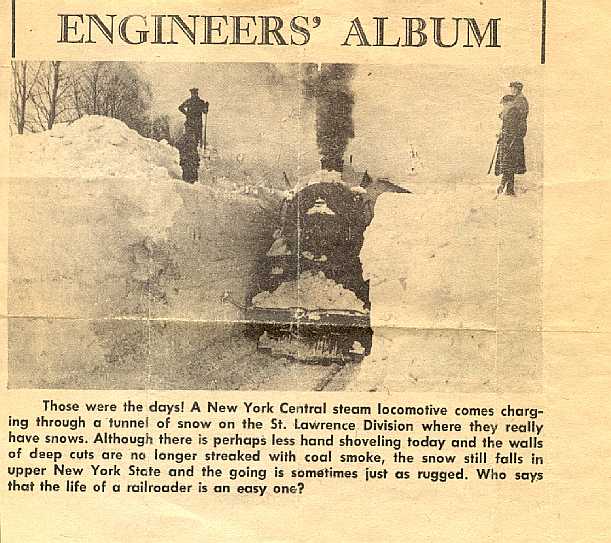
Typist's Note: Richard Palmer found the above letter in the Jefferson County Journal, Adams, N. Y. It appeared in the Journal on Thursday, February 28, 1856 and goes quite nicely with an interesting photo sent by Susie Loveland Jones, a native of Brownville, N. Y. Despite the contrasting eras between the letter and the photo, I have included the photo in hopes that someone can help her identify the date of the photo. We are calling the photo, “Snowtrain.”
____________________________________________________________________
Back to Index
Timetable of the Sackets Harbor & Ellisburgh Railroad for 1856
Source - unknown
9:45 a.m., 1 p.m. , 5 p.m.
Arrive Sackets Harbor: 10:45 a.m., 2 p.m., 6:30 p.m.
Leave Sackets Harbor: 11 a.m., 7 p.m. (connections with downboat for Kingston and Ogdensburgh)
____________________________________________________________________
Back to Index
The Excursion to Oswego
Cortland Republican Banner, Wed., Aug. 24, 1859
With some hundreds of others, we participated in the enjoyment of an excursion to the city of Oswego on Thursday last. The day was all that could be desired for such an excursion, and nothing occurred to mar the enjoyment of the trip. Starting punctually at the hour advertised, we proceeded to Homer, where we were joined by a large number from that place, but not so many as went from here.
Homer is rather behind in such matters to what she used to be. When about three miles north of Homer the train came nearly to a stop on account of the driving wheels of the locomotive slipping on the track, which was wet with dew. A number got off and "worked their passage" for a mile or so by putting sand and gravel on the track to overcome the effect of the wet upon the rails.
However, we were only detained long enough to make it interesting, before the sun had so dried the track that we gained the usual headway. We were reinforced at the several stations along the route, by a large number, who were all, like ourselves, bet on a day of recreation and pleasure.
Arriving at Syracuse in due time, we walked to the New York Central Railroad station, and took the cars for Oswego. That railroad being of a narrower gauge, the cars were not so commodious and roomy as those upon the road through this valley, and are therefore not quite so pleasant to travel in, but thanks to the liberality of the Messrs. Stearns we had plenty of room upon the train, so that all could get seats.
Proceeding northward through a newish and as it appear to us rather rough country, the crops looking rather stinted and the soil barren. Passing Baldwinsville, the residence of the veritable "Jeems" of the Baldwinsville Gazette, and near Fulton, we arrived in Oswego, less than half an hour behind the time advertised, a circumstance almost unequaled in the annals of railroad excursions.
Of Oswego as a city we can say but little, as we had but little time to examine it, but we passed some fine buildings, some fine residences, but it contains too many of the poorer class of buildings to be ranked among the first cities in the state in regard to appearance.
The manufacturing of flour is carried on to a greater extent, probably more than in any other place in the state. The large flouring mills are among the curiosities of Oswego. The lumber trade is also very extensive. The lighthouse at the entrance of the harbor is rather a curiosity to people from inland towns, but we did not get time to visit it, merely seeing it as we passed on the steamer.
The Steamer, "Bay State" one of the best boats on the lake was chartered for an excursion upon the water, and such as chose to go took a lake ride of about two hours in duration, passing over a distance of from 15 to 20 miles.
The surface of the lake was nearly smooth, the wind not being high enough to disturb the water, yet with the motion of the boat, made a breeze exceedingly refreshing. We are sure more pleasant trip was never made upon the bosom of Lake Ontario.
While upon the lake we counted 14 vessels within sight at one time, pursuing their course, either in the pursuit of pleasure for their living freight, or in pursuit of profit in the various channels of commerce and trade, for their owners.
Returning to shore we visited Fort Ontario, which is situated upon a commanding eminence, near the shore of the lake, upon the right side of the harbor, and in the north easterly part of the town. Having never before particularly noticed a fortification of this kind, it was an object of great interest to us.
It is built with its principle sides forming a pentagon, with a smaller pentagon extending out from each of the angles of the sides, one side of the smaller pentagons opening into the enclosure, the other four sides being walled with embankments the same as the main sides of the fort and they forming the strongest portions of the works.
Outside of this embankment is a ditch carrying in width from 25 to 40 feet, the bottom of which must be as much as 20 or 25 feet from the top of the inner wall. Outside of the ditch is another embankment about one half the height of the inner one and is so arranged that it serves as an excellent breastwork, commanded by the guns of the fort above, and protected by them.
The entrance to the inner fort is through the ditch and closed at the outer bank with strong gates, and at the inner by strong doors of oak plank firmly bolted together, and when shut to be firmly locked, bolted and barred on the inside. The embankments are held in their place by heavy plank and timbers placed one end in the ground at the bottom of the ditch, the other end held in its place by cups of timber, the outer embankment being composed of one, and the inner of two tier of planks. The higher embankment is about 60 feet thick at the bottom, and about 10 feet at the top.
In the smaller pentagons at the angles of their sides with the main pentagon are apertures from which guns can be directed which will sweep the whole length of the ditch. In each of the smaller pentagons there are arrangements for mounting seven guns, beside those which have command of the ditch. We found but one gun mounted, that of a field piece, pointing in a southeasterly direction. Some 10 or more other guns lay there upon blocks of wood, but none of them are now in a position or condition for use. There are three buildings inside the fort, besides the magazines, in order one of which we saw a quantity of warlike stores, cannon balls etc. The magazine is in a protected spot on the south east side, and nearly overhung on two sides by the high embankment and entirely out of the way from shots from an enemy. With a strong force thoroughly armed and provisioned, it seems that this fort must be able to hold out a long time before it could be brought to surrender, and having, as it does the command of the harbor and lake in that vicinity, it serves the double purpose of protecting the commerce of the port, and also the surrounding country.
But the time for returning having arrived our company gradually gathered at the train and were soon on our way home, where we arrived a few moments past 9 o'clock in the evening, very much fatigued, but having highly enjoyed the trip. Almost every one who went seemed pleased with their day's journey, and we hope that the excursion proved as much a source of profit to Messrs. Stearns, as it did of pleasure to us.
____________________________________________________________________
Back to Index
Reorganization of the Sackets Harbor & Ellisburgh R.R
Jefferson County News, March 27, 1860
Reorganization of the Sackets Harbor & Ellisburgh R.R. - Mr. Searles, member of Assembly from this district, has, we notice, introduced a bill into the Legislature for the reorganization of the Sackets Harbor and Ellisburgh Railroad Company. Preparations, we also understand, are making to put this road in running order as early the coming summer as possible.
____________________________________________________________________
Back to Index
A Note Concerning the Reorganized Sackets Harbor, Rome & N. Y. R. R.
Jefferson County News, Adams, Thursday, May 6, 1860
Sackets Harbor, Rome & N.Y. R.R.
The old Sackets Harbor & Ellisburgh Railroad, which has been entirely reorganized under the above title, has been repaired so far, that trains for passengers and freight are run three times a week between Pierrepont Manor and Sackets Harbor, the repairs on the road still going forward. Trains leave Sackets Harbor Tuesdays and Thursdays and Saturdays, arriving at Pierrepont Manor in time to connect with the first train going south on the Watertown & Rome Railroad, returning to Sackets Harbor on the arrival of the first train from Rome.
Back to Index____________________________________________________________________
Sabbath School Excursion to Pierrepont Manor
Jefferson County News, June 28, 1860
Sabbath School Celebration at Belleville. - The several schools uniting in this celebration will meet at the Fair Ground in Belleville, where addresses will be delivered by Rev. R. R. Kirk, A. Cleghorn, J. Summerbell, and others. Tables will be provided for all giving notice that they will attend, upon which they can spread and partake of the refreshments they my bring.
The Sackets Harbor, Rome & New York R.R. will leave Sackets Harbor at 8 A.M. going south, and Pierrepont Manor at 9:15 A.M., going north. After the exercises at the Fair Grounds, an excursion will be made to Sackets Harbor, at which place they will remain one hour, returning to Pierrepont Manor at 5 P.M. Tickets for the excursion are only 10 cents.
____________________________________________________________________
Back to Index
Sunday School Picnic - Belleville group travels to Railroad to Sackets Harbor
Jefferson County News, Thursday, July 12, 1860
(Excerpt of article concerning a large Sunday School picnic at Sackets Harbor on July 4, 1860).
The Excursion. - at 2 1/2 o'clock the warning note was given that the train was ready for Sackets Harbor. In a short time fourteen cars were loaded with as many hundred happy children and their friends. To help break up the celebration, reports had been circulated that "the Road was unsafe;" "that we would get our bones broken," &c. Now we were about to try it, and the multitude that went showed that these reports had little effect upon them.
All ready with banners flying, and music playing - by two Bands, and that of Belleville now added, we started in fine style. we reached the Harbor, stated there awhile, and returned more heavily loaded than we went, without the least mishap.
The Railroad is in good preparation. The Trussle (sic) work is as firm as any part of it. Seventeen cars, with as many hundred persons on, beside the engine and tender, were all on it at once, and no jar! All fear about the Sackets Harbor Railroad may henceforth vanish.
____________________________________________________________________
Back to Index
An update Regarding the Reorganized Railroad
Jefferson County News, Adams, July 26, 1860
Sackets Harbor, Rome & New York R.R. - The old Sackets Harbor & Ellisburgh Railroad, which has been entirely reorganized under the above title, has been repaired so far, that trains for passengers and freight are run three times a week between Pierrepont Manor and Sackets Harbor Tuesdays, Thursdays and Saturdays, arriving at Pierrepont Manor in time to connect with the first train going south on the Watertown & Rome Railroad, returning to Sackets Harbor on the arrival of the first train from Rome.
____________________________________________________________________
Back to Index
A new schedule for the Sackets Harbor, Rome &New York Railroad
Jefferson County News, Adams, Aug. 9, 1860
Sackets Harbor, Rome & New York Railroad. - This road will be opened on the 14th inst., and daily trains will connect with the Watertown & Rome R.R. to and from Rome.
Going South, leave Sackets Harbor at 7:15 A.M., Smithville, 7:38;
Henderson, 7:25; Smithville, 7:40, arriving at Sacket's Harbor at 8 P.M.
Going North, leave Pierrepont Manor, 6:45 P.M., Belleville, 7:10, Henderson, 7:25. Smithville, 7:40, arriving at Sackets Harbor at 8 P.M.
The Stockholders on this road, we learn to have a free ride on Monday, August 13th, the day previous to the opening of the road. A gala time is anticipated at Sackets Harbor.
____________________________________________________________________
Back to IndexSackets Harbor & Ellisburgh Railroad opened
Gazetteer of the State of New York by J. H. French, (Syracuse, N.Y.) 1860. page 72
May 23, 1850, opened June 1, 1853.
Stations
Sackets Harbor 0
Smithville 5
Henderson 9
Belleville 13
Pierrepont Manor 18
____________________________________________________________________
Back to Index
Sackets Harbor, Rome & New York Railroad Timetable
Jefferson County News, Adams, Aug. 9, 1861
Timetable
On and after Tuesday, August 14th, daily trains will run on this road, connecting with trains on the Watertown & Rome R. R. from Rome, morning and afternoon, and at Sackets Harbor with the American Line of Steamers both ways.
GOING SOUTH STATIONS GOING NORTH
A.M.
P.M.
7:15 Sackets Harbor arrive 8:05
7:38 Smithville
7:40
7:53 Henderson
7:25
8:10 Belleville
7:10
8:30 arrive Pierrepont Manor leave 6:45
W. T. Searles, Supt.
____________________________________________________________________
Back to Index
Timetable as of November 2, 1861 -- Sackets Harbor, Rome & New York Railroad
Jefferson County News, Adams, Nov. 4, 1861
Sackets Harbor, Rome & New York Railroad :
Timetable
Winter Arrangement
Mail Accom Stations Accom Mail
A.M. P.M. A.M. P.M.
7:30 6:00 Sackets Harbor 12:50 9:40
7:55 6:25 Smithville 12:30 9:15
8:10 6:40 Henderson 12:15 9:00
8:25 6:55 Belleville 12:00 8:45
8:50 7:20 Pierrepont Manor 11:35 8:26
The trains on this Road connect with all passenger trains on the Watertown & Rome R.R. at Pierrepont Manor, to and from Watertown, and with the steamboats at Sackets Harbor for Oswego, Rochester, and the upper lakes, also from Kingston, Ogdensburg, Montreal. By taking the morning train south, passengers can visit Rome and Utica or Watertown, and return the same day.
Belleville, Nov. 2, 1861 W. T. Searles, Supt.
____________________________________________________________________
Back to Index
Notes on the Sackets Harbor & Ellisburgh Railroad, later the Sackets Harbor,
Rome & N.Y. Railroad
From the annual report of the New York State Engineer and Surveyor
1853
Length of road laid................18 miles
Length of double track laid........1 mile
Weight of rail per yard on main track - 58 pounds
Number of engine houses and shops, 1
Number of engines (none listed)
Number of 8-wheel freight cars.....30
Rate of speed of passenger trains....20
1854
Passenger cars
One First Class
One Second class (Emigrant)
One freight, mail and express car
Freight cars, 30
(No mention of a locomotive)
1855
Farm crossings - 10 above grade, 4 below grade, 15 level with grade
Road crossings - 1 above grade
Street crossings - 1 above grade
Single switches - 12
Excavations - Width at grade line, single track - 14
Embankments - Width at grade line, single track - 14
Slopes in earth.... 1/4 to 1
Box culverts....25
Crossties....1,757 per mile
Average length in feet... 7 1/2
Average thickness in inches...6
Chairs - 500 per mile - weight, 12 to 16 lbs.
Iron rails
1,837 tons
36 miles
58 lbs per lineal yards
Average number of years in use - 2 1/4
Gradients, Alignment and Elevations.
Ascents in 18 miles....310 feet
Total ascent and descent ....620 feet
Average 34 feet per mile
Maximum grade per mile 17 feet
Length of straight lines...13 miles
Length of curved lines.....5 miles
Whole number of degrees of curvature...666
Average degrees of curvature per mile of the curved part, 133.2 degrees
Maximum radius on main line ...5,730 feet
Minimum radius on main line ...1,494 feet for 0.5 miles
Passenger and freight houses of wood, 4
Water stations, wood, 3
Wood sheds, 1 (60 feet long)
Turntables, 2
Engine house, 1 with 4 stalls
1 locomotive, in use and good repair, 20 to 25 tons
1 lst class passenger car, 8 wheels, seats 40 to 60 passengers
1 baggage, express and mail car
10 freight and cattle cars, 8 wheels
20 open platform cars, 8 wheels
1 other service cars
1856
States the railroad had 1 borrowed locomotive, weighing 16 to 20 tons. Consist of passenger train was 1 passenger car (sic); 1 baggage car and 3 freight cars. Passengers charged 3 cents per mile. Line closed October through February except for an occasional freight movement.
1860 - Sackets Harbor, Rome & N.Y. Railroad
Accident Report, Sept. 6, 1860 - Approaching Henderson Station, at Stony creek, Jefferson county, town of Henderson, morning train south on regular time, a man was seen on the track, with his back towards the train. The accustomed signals were given and repeated, but were disregarded, and the cow-catcher struck him when crossing a short bridge, causing him to fall into Stony Creek, a distance of about ten feet, breaking his leg; he has nearly recovered from the accident. The name of the person insured was Mr. S. Williams. The accident did not arise from carelessness of any one in the employment of the corporation.
(W.T. Searles, President and Superintendent and Mason Loomis, Treasurer and Secretary)
1861
A note states: "There are two engines used on this road, one of which belongs to stockholders of this company, the use of which has cost the company nothing." Searles is no longer president, replaced by Alcander Dickinson of Belleville.
Note by typist: While on the subject of snow removal, here's a photo found by Susie Loveland Jones whose father was a railroad man. We offered this up for identification as to place and year.

Somewhere on the Hojack lines........
July, 2003: Bob Reagan wrote this regarding the quest as to place and year this photo was taken: "A few months ago you sent me the attached picture and inquired about the date and location. I still can't give you the date but a neighbor who recently retired from the railroad informs me that the picture was taken just outside of Norwood on what is called the Dry Bridge Road. He claims that he was told that there were over 70 men shoveling that day. On each side of the Dry Bridge, there is a gully that is probably at least 50 foot below the surrounding fields."
Thank you, Bob, for your help.
____________________________________________________________________
Back to IndexClearing the road by presevering energy
Jefferson County News, Feb. 6, 1862
The Sackets Harbor, Rome and New York Railroad Company have, by persevering energy, succeeded in clearing the road from the accumulation of snow, which ad temporarily blockaded this road.
The trains now connect with all the trains North and South, on the R.W.& O. at Pierrepont Manor, as heretofore.
____________________________________________________________________
Back to Index
Brief History of the Sackets' Harbor, Rome & New York Railroad.
To The New York State Legislature
(Printed in 1863)
In the year 1851, the Sacketts' Harbor and Ellisburgh Railroad Company was organized, with a capital stock of $150,000. In 1852, it was mortgaged for $150,000. In 1853, a second mortgage of $150,000 was executed, of which about $100,000 was negotiated. In 1854, the company issued $15,000 income bonds to raise money to pay the interest on the mortgages, &c. In 1855, the interest was raised by subscription, so that the railroad could be kept in operation. The company continued to advance, from their own private resources, all the deficiency of means, from the earning of the road, necessary to keep in operation, until 1858, when they came to the conclusion to discontinue running it, as it could not be made to pay either dividends on the stocks, interest on the mortgages, repairs necessary to the safe operation of the road, or its running expenses.
The earnings of the road never paid dividends on the stock or interest on the mortgages the amount of one dollar.
In 1858, the first mortgage was foreclosed, and the road sold.
In 1860, a new company was organized under the title of The Sacketts' Harbor, Rome and New York Railroad Company, with a capital stock of $100,000, of which something less than $86,000 have been issued, and the Sacketts' Harbor and Ellisburgh Railroad interest purchased of its then legal owners for $85,000, with the plain and perfect understanding and stipulation with those who subscribed for the stock, that if, on a trial, the road could not, from its earnings, be made to pay interest on the capital stock, repairs and running expenses, it should be sold to run, or failing in that, taken up and the most made of it possible for the benefit of the stockholders. This argument was used to induce subscriptions to the stock.
There has been a constant loss since the road commenced running in 1860, and the company finds itself in debt about $10,000. In addition to this a portion of the road known as the trestle work, 1,200 feet long and 13 feet high, has become decayed and unsafe, and requires $5,000 to fill it up. The bridges are also unsafe, by time, use and decay, and require, at least, $7,000 to rebuild them. The ties are decayed and gone to that extent that it will require 20,000 new ties, at a cost of $8,000, to renew them.
The road has never been gravelled, and will cost about $10,000 to do it properly. The engines are out of repair, and will take $2,000 to repair them. The cars are worn and out of repair, and need about $3,000 to put them in order. It will be observed that, to pay the liabilities of the company, and lay out on the road what is apparently necessary to a safe running condition, will amount to $45,000.
From the various experience of the ten years, the company have come to the conclusion to abandon running the road, passing resolutions to that effect at a general meeting of the stockholders and directors, in October last, at which time a committee was appointed to confer with the Rome, Watertown & Ogdensburgh Railroad Company, and see if the would not purchase the road, and run it, at a price to be named by them. Said committee, with their superintendent, went over and examined the road, also furnishing him with such information from the books as he desired to present to their board of directors at a meeting held by them in December last. The result of which was that they declined to purchase, and would not take the road as a gift, and come under obligation to run it.
For reasons above mentioned, your Honorable Body, in Senate and Assembly session, are, by a petition of the stockholders, representing $77,700 of the capital stock of said road, requested, to empower them to take up and sell said road for their benefit.
Of the remaining stock there are persons in the army holding about $3,000, who, when they left, desired the sale of the road, and the company believe would sign the petition had they the opportunity. Others are absent, supposed to favor it. The company believe stockholders, representing $82,000 of the stock, are decidedly in favor of the object of the petition.par. The books show the whole amount of stock issued to be $85,600. It is to be distinctly understood that the stockholders on the line are, almost without exception, the same persons who held stock and suffered loss by the failure of the first organization.
____________________________________________________________________
Back to Index
S. H., R. & N.Y. Railroad election of Stockholders
Jefferson County News, June 25, 1863
At the annual election of the Stockholders of the above road, held at Smithville Hotel, June 16th, 1863, the following persons were elected Directors for the ensuing year: John Butterfield, Utica; John Thorn, Utica; George B. Phelps, Watertown; Alden Adams, Sackets Harbor; W. P. Davis, Smithville; Samuel Griggs, Smithville; C. W. Bishop, Henderson; John D. Gillett Jr., Henderson; Chester Barrett, Henderson; Green Packer, Belleville; Daniel C. Robbins, New York. At a meeting of the Board of Directors after the election, held at the same place, Alden Adams was elected President; and W. P. Davis, Treasurer.
____________________________________________________________________
Back to IndexThe stockholders of the S. H., R & N. Y. Railroad may sell iron track
Aug. 20, 1863
The stockholders of the Sackets Harbor, Rome and New York Railroad have succeeded in getting into a very interesting litigation in regard to this road. The Directors, or majority of them, it appears, decided upon taking up the iron on the track and selling it on behalf of the Company, and some half a mile was accordingly taken up, when other stockholders who objected to the proceeding obtained an injunction, on the ground that the Directors had no right to take up the track for the purpose of destroying a Railroad corporation The trial is noticed for the second Tuesday in September before Judge Mullen.
____________________________________________________________________
Back to IndexSackets Harbor Railroad Suit Settled
New York Daily Reformer, Watertown, N.Y., Sept. 10, 1863
SACKETS HARBOR RAILROAD SUIT SETTLED. - George Clark, Esq., the plaintiff in the injunction suit against the directors of this road, to restrain them from removing the iron from the track, with those he represents, have settled this suit, by being guaranteed by the individual responsibility of the directors, that the stockholders to this action shall receive par value for their shares of stock, they consenting to a removal and sale of the iron from the track. There are still other shareholders, resident along the line, that have not consented to this arrangement, but we learn that the directors are removing the track, notwithstanding the objections to it from other quarters.
____________________________________________________________________Back to Index
Locomotive Engineers
Sherburne (N.Y.) Home News, June 18, 1868
The employment of the locomotive engineer is one of continually recurring perils. He stands as Uriah, in the "forefront of battle." If there is danger ahead, he is the first to see it and must be the first to meet it. If death comes to any it must come probably to him. And frequently he is without any warning as to what danger may be before him, and without signal or guide to avert it. In the darkest nights, when the fog may be "cut with a knife," he must drive in unpitying steed over trestle-work, bridge and culvert, either of which may be undermined by torrents or burned by sparks from the locomotive of a preceding train, even if the evil passions of men have not combined to provide the means for a catastrophe.
Miles away from the habitations of men; he may have no assurance that kindly hearts will prompt to timely warning. He cannot rest; cannot relax for a moment the vigilance which is the price of safety for himself as well as the hundreds of human beings behind him. Overlooking his fireman, noting the height of water in his boiler and the pressure of the steam, keeping his eyes directed ahead and his hand on the throttle-valve or reversing lever, he must be continually wide awake and watchful while on the road. Such labor is exhausting, and affects the mental as well as the physical powers. The jars and jolts of the locomotive are believed to tend greatly to the impairment of the engineer's health. The violence and extent of these shocks can be understood only by those who have ridden the iron horse. The passenger in the upholstered cars conceive but a faint idea of the movements of the locomotive, from the easy swinging of the cars.
At times the whole machine, with its tons of moving weight, appears to leap from the track. It jerks from side to side of the road as if a sentient orgasm in spasms, and shakes the engineer and fireman in every fiber of their bodies. But with all this the engineer must not allow his attention to be diverted from his duty. He gets to learn the present condition of his machine even by the noise it makes as it echoes through cuts or tunnels, or spins hummingly along the open track. If a single thing is wrong, his educated ear detects in the darkest night what his obscured sight fails to discover.
The perpetual strain upon the mind - the sense of never mitigated responsibility - and the continual facing of possible death or disaster, more or less affects the mental character of the locomotive engineer. He partakes of the character of his machine, of which he becomes insensibly a part, and is sometimes rough, perhaps in manner; always ready, and blunt in his communications with others. From his position and the demands of his office, he seldom speaks - never converses - when up on the engine. Thus he becomes in time taciturn in manner, although not in reality. This brusqueness and reticence, if not a part of his duty, becomes a part of his character; and even if time permits, he seldom allows himself to unbend in social life. With such responsibilities as he bears, levity soon becomes gravity and lightheartedness, seriousness.
____________________________________________________________________
Back to IndexMost Remarkable Cat Journey on Record
Oswego Palladium - Thurs., Nov. 23, 1871.
At the office of the Northern Transportation Co. is a cat which has made the most remarkable journey on record. The name of the cat is "Daisy," and she was born in Ireland. She was left at the N. T. Co.'s office by some emigrant passengers through here last summer.
She proved to be a remarkable ratter, tackling the monstrous "vermin" like "winkin." About two days since "Daisy" disappeared leaving two kittens of a week old upon the hands of John O'Brien and Mr. Pigeon, employees of the Company. The latter took the infantine cats home and vainly endeavored to bring them up by hand.
Yesterday one of the N. T. Co's. men was crossing the lower bridge from West to East when he met the living skeleton of "Daisy" about midway of that structure. The animal presented the most "bunged up" and forlorn appearance imaginable. She was covered with mud, torn and bruised; her tail worn almost off and her fur sadly demoralized. She made for the office of the N. T. Company, where she mournfully "wauled" for her progeny. "Daisy" was welcomed back, and properly cared for, but would not be comforted. About an hour after the return of the Milesian feline, the propeller Michigan arrived from Ogdensburg. The captain informed Mr. Henry Stowell and Mr. O'Brien that when he left Oswego on the down trip, he discovered he had carried off "Daisy," who, no doubt, came aboard to see the cook.
That he carried the animal to Ogdensburg and put her ashore there. This let the cat out of the bag, and disclosed that poor "Daisy," who had been carried off from her little ones, had come afoot all the way from Ogdensburg to Oswego to find them gone the way of all cats.
We desire to say to our readers that the circumstances above related are true in every particular, and that poor "Daisy," though badly used up, is likely to come out all right under the kind care of the N. T. Company's men.
____________________________________________________________________
Back to Index
The New Coaches for the Lake Shore Railroad
Oswego Palladium, Tues., July 13, 1875
(Utica Herald’s Rome Correspondence.)
For elegant passenger coaches are in process of construction for the Rome, Watertown and Ogdensburg Railroad Company, at the shops in this city, under the supervision of Master Car Builder H. H. Sessions. These are built for pleasure cars on the Lake Ontario extension of the Rome, Watertown and Ogdensburg Railroad.
It became evident that more coaches were needed for that route and it was thought best to build something that would come as near as might be to the drawing room coach and still not make it necessary to charge passengers additional fare for riding in them. Two of them are ready for the paint shop and the other two are in the carpenter shop, the mere skeletons of what they will be when completed.
The interior of the coaches are to be finished in Hungarian ash, French walnut and gilt, and will contain three large windows in the center, with window cornices, lambrequins and curtains. Each coach will be provided with a ladies toilet room, also a room for a Baker & Smith steam heater, from which there is no danger of fire in case of an accident. They are mounted on standard six wheel trucks, with Sessions’ patent spring. The floors will be lined with felt and cement, which will give perfect ease in riding, and shut out all noise of the wheels and the jolting of the train. This will be a new feature in car building, and will be a great advantage over the old style of floors.
The cars will be furnished with Bunton’s medallion seat, with spring bottom and back, thus making a double sofa seat. Two of the new cars will run from Rome to Niagara Falls and two from Ogdensburg to Niagara Falls. As I said before, they were built more especially for the pleasure travel on the Lake Ontario extension, but it is thought that owing to a scarcity of coaches on this road two of them will probably have to be used this fall and winter.
All four of the coaches will be furnished this fall, and will be named the “City of Oswego,” “ Charlotte,” “City of Rochester” and “Niagara.” They will be the finest and best coaches yet turned out at the company’s shops, and will be nearly as easy and convenient as any drawing room car, with no extra charge for fare.
Back to Index____________________________________________________________________
The Auburn Branch - A Fragment (a poem)
Syracuse Journal, September 23, 1876
The Auburn Branch - A Fragment
Years ago, when the N.Y.C.
Was not the road in grew to be;
When a single track was enough and more
To do the work that now takes four
That single track, as you may be aware,
Ran up to Auburn and west from there,
Through towns and hamlets that give a home
To names from the empires of Greece and Rome.
But when the Central grew rich and strong,
Its managers thought this route too long;
And so with expenditure profuse,
They made a short cut from Syracuse
To Rochester, and Auburn became
A deserted village, sad worthy its name.
And now when or on the N.Y.C.,
There happens by chance to be
A car which is old, and shaky and mean,
With comfortless seats which are never kept clean;
Or an old locomotive, grown wheezy with age,
With boiler unsafe and imperfect steam gauge.
With pistons and driving wheels no longer staunch,
They say "It will do for the Auburn branch."
[Auburn Advertiser]
____________________________________________________________________
Back to Index
Opening the Adirondacks OPENING THE ADIRONDACKS An ideal border settlement in the mountains. Jayville, N.Y., July 7.-- It may interest many hundreds of people who seek rest and recreation in the great forest preserve of New York State to know that here, on the western slope of the Adirondacks, a new and favorite route to the desired haven is about to be opened up. Already the pleasure seeker can penetrate the "mountain fastnesses" by an "all-rail route" in less than 12 hours from the Grand Central Station, and ere another year will be completed some 20 miles further, running all the way through the virgin forest. Some three years ago the Carthage and Adirondack Railway Company began the construction of a road into the wilderness, the object being to reach the rich deposits of magnetic iron ore at this place and Little River,
some 20 miles further back in the woods. Thirty miles of this road is now in operation, seven miles further the rails are laid, and for still another 12 miles the roadbed is graded, so the work of completion will require only three or four months at the outside. The southern terminus of this road is at Carthage, where it connects with the Rome, Watertown and Ogdensburg. The northern terminus is Jayville, 30 miles from Carthage. Jayville is a backwoods town in
every particular. The only buildings in the place not built wholly or partially of logs are the railroad station and one small hotel. These, with 15 or 20 primitive log houses built in a ten acre clearing, make
an ideal border settlement the counterpart of which probably cannot be found in the State. The occupants of the log houses have not taken the trouble to remove the stumps of the trees cut down to make room for
their habitations, as none of them care to become tillers of the soil in this part of the country, the land being, as one of the natives expressed it, "too consarned poor to raise white beans." The mines, the railroad, and the neighboring lumber camps give employment to all who have houses here, therefore they are content to leave agricultural pursuits to people more favorably situated. The settlement is situated in the midst of good hunting and fishing grounds, and all spare time is devoted to the deer, bear, and speckled trout which here abound. From this point nearly a score of of small lakes and streamscan be reached by taking a two or three hours' tramp through the woods. Among them may be mentioned Little Bear Lake, Greenwood Lake, Long Pond, Little Round Pond, Timber Lake, Twin Ponds,
Little River, and Jenny Creek, all famous for speckled trout and game. During July and August deer come to all these lakes to feed on the tender grasses and "lily pads" that fringe their shores, and many of them are killed by "floating." Little Bear Lake is specially noted as a great place for deer, and there seems to be no doubt about their being killed out of season, for only a few days ago a party passed through here well equipped for hunting and they did not attempt to conceal their intentions to visit this particular lake for venison. While trout fishing on Little River a few days ago I found the skin of a fawn that had been recently killed. On more than one occasion since reaching the woods I have been reminded that "sheep" were plenty hereabouts, and if one was wanted to carry home it could easily be secured. No one wanted any "sheep" to take home; therefore no one was made particeps criminus in a violation of the game laws, or a witness of any such misdoing on the part of the woodsmen, who were willing to do what they thought would be a favor to one slightly inexperienced. The lawful season for deer shooting does not begin until Aug. 15, but it is safe to say that a majority of the woodsmen pay very little attention to that part of it, preferring to make the open season to suit themselves. This part of the woods being in St. Lawrence County, where it is unlawful to run deer with dogs, some sportsmen argue that this is the reason game is so plenty. Those who run deer with dogs do
most of their hunting in another part of the forest, while here they are left unmolested. This idea, that deer are driven into St. Lawrence County from other parts of the woods and there left to the tender mercies of the still hunter, is probably what makes the statesmen from that section fight so strongly for exemption from a law that prevails in all the rest of the State. Whatever the reason, it can be said that
deer are not scarce. One day last week, while driving over the unfinished portion of the new railroad beyond Little River, a deer was seen in the road not very far ahead. We stopped and watched him for several minutes as he fed beside the track. Then one of our party made a noise loud enough to be heard, and he hoisted his "white flag" and was off in a tinkling. Had we been so disposed we could easily have
killed the animal, for he was within easy rifle shot. Early in Spring a gang of men working on the road about a half a mile from this place had the pleasure of seeing a big black bear come down the side of a mountain, cross the track, and after he had climbed the
rocks on the opposite side, calmly turned around and looked at them for several minutes. The brute was no more than 40 rods away, but none of the men had a gun. Bears are no uncommon thing hereabout
anyway. About ten days ago two young men from here while going to Harrisville encountered one in the road. Instead of making off as bears usually do, this one reared up on his haunches and disputed
their right to pass. There were plenty of stones close at hand, and the young men having no firearms with them began to pelt his bearship to the best of their ability. The bear held his ground, and with his powerful paws kept striking at the missiles as they came near him. The boys say he could bat cobblestones better than half the ball players could bat a ball, but he "didn't get on to their curves," and became disgusted and gave up after receiving three or four "hot ones" in the rigs. He moved out of the road, and they passed by within two rods of him. The inhabitants of Jayville tell some big stories about fishing in lakes and streams in their vicinity, but the tales will stand investigation. In the Spring it is no uncommon thing to take from 50 to 75 pounds of speckled trout out of Little Round Pond in two days' fishing. Numerous parties can be found who will testify to feats of that sort. It can be said, however, that July is not the month for
speckled trout in the lakes. At this time of year they are in deep water and it is difficult to find them. It is not so hard to find the beauties in the streams. The warm weather drives them into the
"spring holes," which are easily found, and 55 trout out of one spring-hole is not an uncommon catch on Little River in July or August. When the railroad is completed it will run within two miles of Star Lake, which is one of the prettiest sheets of water in the Adirondacks, and the only lake in this vicinity that affords salmon fishing. A couple of enterprising gentlemen have already put up a small hotel on its shore, and it bids fair to be a popular resort in the near future. The lake is some 1,500 feet above the sea level, its waters are clear as crystal, and its shores are lined with an almost unbroken forest. From its south shore it is only two miles to the fine
trout-fishing grounds on Little River. Cranberry Lake, another famous place for deer and speckled trout, will be only five miles from Benson, the terminus of the Carthage and Adirondack Road. From here it is not far to the Saranac lakes and the highest point in the Adirondacks. The highest elevation reached by the new road is where it skirts the base of Panther Mountain, about 36 miles from Carthage. At this point it is about 1,800 feet above the sea. When the line is finished the managers propose to pay especial attention to the wants of tourists who wish to gaze on the finest scenery and enjoy the best hunting and fishing in the Adirondacks. It will traverse an entirely new section of the woods and a portion of them that heretofore has been but slightly known to city tourists.
____________________________________________________________________ Rome Daily Sentinel - two articles from 1889. Rome Daily Sentinel April 17, 1889 pg. 2, col. 2 Rome Daily Sentinel April 17, 1889 pg. 2, col. .3 Interesting Reminiscences by Joseph Higgins. Station agent for the Syracuse & Utica Railroad nearly fifty years ago - old time methods - early engineers and conductors other points. Everybody in Rome knows Joseph Higgins, the blacksmith, who keeps a shop on South James Street near the New York Central Railroad, but few people, comparatively are aware that he has done business in and lived over that same shop for nearly half a century. Yet such is the fact. Mr. Higgins has seen many changes in Rome since he began work at the forge and anvil in the old shop. Joseph Higgins was born in Shandaken, Ulster County, N.Y., March 19, 1818, and was the son of a farmer. At six years of age he went to Kingston, in the same county and lived with an uncle. At 14 he began to learn the blacksmith's trade of Pierce Catlin and boarded with him. After he had mastered his trade he came on up to Schenectady, and spent one summer digging wells. The journey from Albany to Schenectady was accomplished by means of the Albany & Schenectady Railroad, which was then young: the cars were small and primitive affairs. There were three compartments, and in each compartment were two seats, facing each other and running clear across the car. F our persons could sit on each seat. So twenty-four persons made a car-load. There were doors to the different compartments on the side of the car, and a little low platform or foot-board ran along the sides. The conductor walked along the foot-board and collected fares through the doors. There were no
tickets in those days and all paid their fare in cash. The train on which Mr. Higgins rode from Albany to Schenectady - his first railroad ride - was called the John Bull. The train was made up of two or three cars. After one summer in Schenectady Mr. Higgins took the cars and came up as far as Utica. There he went to work (for) Asa Smith, who had a contract for enlarging the Erie Canal from the weigh lock to West
Utica. e worked there as a foreman of a gang of men one winter, and while there did the excavating for the Genesee Street bridge. In the spring of 1838 Mr. Higgins came to Rome with three of Mr. Smith's teams to do some contract work on the construction of the Black River Canal. He scraped and cleared off the corner of Liberty
and Spring Streets, the site of the late Hon. John Stryker's house. It was a part of the grounds occupied by old Fort Stanwix; and Mr. Higgins says he found a large number of relics of the Revolutionary
War, such as cannon balls, bullets, arrow heads, etc. The manager of a museum in Utica heard of the find and came up here and took away a wagon load. It was a cold day, even in those early times, when Utica got left. From Timothy Ressegue's quarry, near Hatch's Corners, Mr. Higgins drew the stone for the basement walls of Mr. Stryker's house. Then he took charge of the excavating for the second and third locks of the Black River Canal, and much of the dirt which was taken out was drawn for ballast for the Syracuse & Utica Railroad, which was
building. A good deal of filling was done through Rome. After finishing the lock work Mr. Higgins went to work on the Croton Water Works, 17 miles this side of New York, and worked there a part of the summer. While he was there a number of dangerous rows took place between gangs of workmen, and there was also a near approach to a riot because the men failed to get their pay for work done. They
threatened to tear up the work which had been done, and the militia from New York was called out to put a stop to the row; a number of men were killed. Mr. Higgins quit work there principally because the board furnished by the contractors was so poor. they boarded the men in long wooden shanties. Slimy pork, sour bread, coffee without milk, etc, drove him away. He intended going to New York but, having some money in Rome, came back here to get it. He boarded at the Northern Hotel, which stood at the corner of James and Dominick streets, where C. H.
Saulpaugh's store now stands, and which was kept by Horace Putnam, father of Prosper R. and Bela H. Putnam of this city. One day Daniel Lewis of Canastota, who was action section superintendent of the new Syracuse & Utica railroad, being at the Northern, asked Mr. Putnam if he know of a young man who would make a good station agent at the depot. Mr. Putnam referred Lewis to Mr. Higgins, and the latter was persuaded to stay till Lewis could get another man. The depot was a frame building, painted yellow, standing with eaves toward the tracks. Some years ago it stood on the east side of south Washington Street, below john, but has been burned down or torn away.
In this frame building were the waiting room, baggage room, water house and wood shed. There were two large wells - six feet across, and laid up with stone - near the track. One was under the west end of the
depot building and the other was further east, about in front of the powers house. small, two-story houses with tanks or tubs in them were built over the wells. It was one of the duties of Mr. Higgins to pump water from these wells, by hand, to fill the tanks, from which the locomotives got their supply. Wooden pumps, made by Jason Farr, father of Arch. Farr of the Mansion House, were used. They reached from the well to the top of the tower. It was hard
work. Mr. Higgins says he sometimes pumped water all night to fill the tubs. Near the bottom of the tub leather hose was inserted and lay in a wooden through which the water ran out to the locomotive. When an engine stopped for water the engineer would insert the end of the hose into the engine tank and
Mr. Higgins would pull the valve in the water tank. It would thus be seen that the supplying of locomotives with water took much labor and time. Now-a-days an endless supply of water flows through iron columns which are always ready without the expenditure of time or labor. On the inside of the
track was an iron-cylinder in which a fire was kept during winter, so that the water was sent to the engine warm. The steam making capacity of the little locomotives of those days was so small that if cold water was pumped into them it would take an hour to get up steam. Mr. Higgins says that the water in the tub was kept as hot as it could be and not injure the hose through which it ran. Another duty of stations agent Higgins was to watch for the approach of trains and ring the bell at the depot. Locomotives were supplied with neither whistle nor bell, and could give no warning of approach. Two trains ran each way daily, and it was (important ?) to know about what time they would reach here. When a train was expected from the west Mr. Higgins would go to a point near ridge street crossing the track, and watch. When he saw a train approaching he would hustle back to the depot and ring a bell that was hung between two poles. This notified the people of the village that a train was coming, and passengers would go to the station. Great crowds of people, not passengers, would also flock to the depot when they heard the bell
ring, for the cars were a curiosity, and continued to be so for years after they began running. Mr. Higgins also had a lookout east of the depot. To aid his vision he provided himself with a spy-glass. There were mischievous boys in those days, and they got into the habit of ringing the bell when there was no train in sight, thus bringing the people out en masse on a false alarm. So it became necessary to place the bell on the top of the depot and run the rope down through into a room that the station agent could lock. On foggy and stormy days the trains could not be seen till they were very near the depot. Among the other duties of the station master were the handling of baggage and piling wood by the track to be loaded on to the tenders when trains stopped. No tickets were sold and there was no printed time table of the arrival and departure of trains. Mr. Higgins says the four trains did not carry as many passengers all told as one coach does now, and still people used to wonder where all the travelers were going. Among the first engineers of the road that Mr. Higgins remembers were John Mills, who was a daring runner, John Clear and W. C. Purdy. Peter Bevee and John Campbell were early baggagemen. Among the first conductors were men named Cole and Gilmore. John Wilkinson of Syracuse, father of the Wilkinson brothers, bankers of this city, was president of the road. Mr. Higgins was station agent for six years from 1840, and then he took the position of section boss, which he held for five years. Some of his experience in that line, together with curious facts about the
construction of the road, the first building near the railroad depot and personal reminiscences of Mr. Higgins will be given tomorrow.
A New Coal Train Central Will Haul Twenty-eight Cars of Coal Daily From Wallington to
Norwood
That a new train will run over the Ontario and St. Lawrence divisions of the New York Central from Wallington to Norwood, beginning June 1st, is the information received by railroad men in this city. The train, a freight of twenty-eight cars of coal daily, will furnish a regular run for a full crew from this city. It will come from the Pennsylvania lines at Wallington for delivery to the Central Vermont. At present it goes over the main line of the Central, but by delivering it at Wallington the Pennsylvania can get more mileage and can retaliate in a measure on the Central for shifting the fruit business. Fruit from the Western division was formerly delivered to the Pennsylvania at Wallington, but now the Central carries it down on the Fall Brook branch to Newberry Junction, cutting the Pennsylvania mileage
considerably on this class of goods and sending some on other lines from Newberry Junction. ____________________________________________________________________
Twenty-Five Years And Then To The Scrap Pile Wed., Sept. 3, 1919 The Central Pony Engine Ontario Was Well Known All Along the Line of the Road - George Walker and Phil Baxter Were Her Pilots After over twenty-five years of continuous service as an inspection engine and observation car of the Rome, Watertown & Ogdensburg and the St.
Lawrence division, the old “Ontario,” better known as the “pony” has made her last trip and was scrapped a few weeks ago, says the Watertown Times. On Wednesday Superintendent T. W. Crowley will make his first inspection of the division in the pony engine “Mohawk,” which has been brought here from the Mohawk division with headquarters in Albany, to replace the “Ontario.” Supervisor Charles D. Simonds, who for some time has been the engineman of
the “Ontario,” will run the “Mohawk.” The “Ontario” came to the R W & O division in the days when the late E.G. Russell was superintendent and has been worn out in the service. many of the most prominent officials of the New York Central Railroad have ridden in her making inspection of this division and it is probable that she has traveled nearly 500,000 miles. For many years George Walker was the engineman and for a number of years the late Phil Baxter operation the “Ontario.” Engineman Simonds was fireman for several years and then became engineman, a position which he held when the little locomotive was put on the scrap heap. The “Mohawk” is of similar type, but in excellent condition and has many years of usefulness ahead, it was said today at division headquarters. ____________________________________________________________________
A Chronicle of R. W. & O. Days Since 1851 December, 1926, pp 84-85.
New York Times, July 8, 1888
A paradise for hunters and fishermen opened up in
the heart of the virgin forest.
Personal - George H. Haselton of Oswego, Master Mechanic of the R. W. & O. Railroad System, is in town in behalf of his company, for which the locomotive works are building some engines.
An Early Railroader.
Oswego Daily Palladium, Sat., May 24, 1913
Oswego Daily Times,
New York Central Lines Magazine
In 1851 and 1852 the Watertown & Rome Railroad was completed only from Rome to Cape Vincent. I was born in the Town of Dekalb and my father helped build the road through Dekalb Junction. he was killed five miles east of Dekalb Junction Station, September 16, 1857, on the railroad opposite the Tabor Farm. I went to work for the railroad at Dekalb Junction in 1872 and worked continuously for 21 years at odd jobs around the depot and yard and wherever I was needed or sent by the agent. I spent one year of that time firing the engine "Jefferson" on the work train. For two years I was night watchman at the engine house.
In the spring of 1893 I was sent to Gouverneur and from there I went to Norwood Yard where I remained four years. From Norwood Yard I went to the Rutland Railroad and helped build the railroad across the islands from Alburgh to Burlington. Later I went to Malone Yards where I remained for two years, then I returned to Dekalb Junction.
It was in 1854 and 1855 that the railroad was built from Watertown to Norwood by a contractor named Phelps. This was called the Potsdam & Watertown Railroad and the name of Norwood was changed to Potsdam Junction, remaining so for 15 years before being changed back to Norwood.
In 1861, the branch from Dekalb Junction to Ogdensburg was built and the name of the railroad was changed to the Rome, Watertown & Ogdensburg. The Dekalb Junction Station was located about three miles west of Red Rock and another station was located just east of the Forrest House crossing and was called Hermon Station. J.W. Moak and Addison Day were the two superintendents of the line with headquarters in Watertown.
Those were the days when all woodburning engines were used. They were all Taunton engines, made in Taunton, Mass., with 10-by -20-inch cylinders and a capacity of 10 cars of 10 tons each. All the engines were named as well as numbered. Some them I remember were: No. 1, Watertown; No. 2, Rome; No. 3, Adams; No. 4, Kingston; No. 5, Orville Hungerford (named after a director of the road); No. 6, Kirby, and No. 7, Norris M. Woodruff (named after a stockholder of the road from whom the Woodruff Hotel in Watertown also derived its name).
The Norris M. Woodruff was used on the work train summers and on the snow plow in the winter and was run by J. B. Cheney, Engineman, and A.V. Huntress, Fireman. Other engines were No. 8, Camden; No. 9, J. L. Grant; No., 10, Collamer; No. 11, Jefferson; No. 12, Doxtater, which was run between Dekalb Junction and Norwood for 10 years by George Schell, Engineman; No. 13, O.V. Brainard; No. 14, Moses Taylor (later number changed to 35); No. 15, T. H. Camp; No. 16, Silas Wright; No. 17, Antwerp (run by Jeff Wells); No. 18, W. C. Pierrepont; No. 19, St. Lawrence; No. 20, Potsdam; No. 21, Ogdensburg; No. 22, General Kirby; No. 23, Farlow; No. 24, J.W. Moak (run by Sam Purdy who used a board with cleats on one side to get into the cab and the smooth edge to slide out on); No. 26, Delos DeWolf; No. 27, Utley; No. 28, M. M. Massey; No. 30, Comstock (run by James Simonds); No. 31, S. F. Phelps (run by Samuel Clark); No. 32, W. M. Lord (run by Samuel Clark); No. 33, Gardner Colby; No. 39, Zabriskie; No. 40, Theodore Irwin; No. 41, Denny; and No. 42, White.
In those days all engines had pop-strings until No. 38, the Garner (sic) Colby, blew up just east of Canton Station in Harrison's Cut. A popular joke in rhyme about No. 30, run by Jim Simonds with "Zebe" as Fireman, was the following:
"Says Jim to Zebe, Pull down the pop,
Or with the slack we¹ll surely stop.
Says Zebe to him, At this here rate,
We¹ll reach Watertown four hours late."
These engines were in use until about 1880 when a larger and improved type replaced them. It was at this time that two coal-burning engines came into use and they were named “Samson" and "Goliath.” Their first trips were to Norwood after circus trains.
About this time the Rome, Watertown & Ogdensburg took over the Syracuse Northern which operated between Syracuse and Sandy Creek since 1871. With that road they received four heavier engines named “Pulaski,“ “Brewerton,” “Sandy Creek” and “Syracuse.“ The R.W. & O. next took over the Lake Ontario Shore which operated from Oswego to Niagara Falls. The Oswego River was bridged at Oswego and a through line from Norwood to Niagara Falls was thus established. At this time E. A. Van Horn was appointed superintendent in place of J. W. Moak.
There was great rivalry at this time between the R.W.& O. and the Utica & Black River as to which would carry the New York mail into this north country tract. I have seen mail, express and passengers loaded onto the train at Dekalb Junction and delivered in Norwood, a distance of 25 miles in 35 minutes and that included stops at Canton and Potsdam. A Main Line train made the record run, Ben Batchelder, Engineman, from Watertown to Ogdensburg, making 11 stops, in one hour and 48 minutes.
About 1884 or 1885 the road was purchased by Parsons & Sons, and H. M. Britton became General Manager in place of E. A. Van Horn. W. S. Jones was Superintendent of the East End and F. M. Britton was superintendent of the West End. In 1892 the road was purchased by the New York Central.
Early in the 1870s a man named Warner was train dispatcher at Watertown Junction. A few years later N. B. Hine of Dekalb Junction took his place and William Lawrence was night dispatcher. Lawrence later went to work for the Rock Island Railroad. A. C. Hine was station agent at Dekalb Junction at this time.
On Oct. 14, 1872, A. J. Penney became clerk and operator at the station. Later he was made agent and F.W. Thompson was clerk and operator. In 1880, A. J. Penney went to Potsdam, and Fred DeSalles took his place at Dekalb Junction with Frank L. Wilson as clerk, A year later Wilson was made agent. That was in the time when clerks and operators earned their money, as there were no night operators. The day clerk was called up to attend the midnight train and remained on duty until the train arrived in Ogdensburg because there were no night operators in Rensselaer Falls or Heuvelton. There was a severe snow storm in January and February of 1880. The Cape Vincent Branch was tied up for 28 days. Three trains stalled on the branch remained there until the snow melted. The mail was taken to Cape Vincent from Watertown by teams.
At this period all oil for station, section, and engine use was supplied from Dekalb Junction. The repair shop and tool and rail store houses were located there also. Wood sheds with fuel supplies for the locomotives were located at Norwood, Dekalb Junction, Gouverneur, Philadelphia, and Watertown. The wood was racked in cords and half-cords and the amount of wood each engine took was recorded in each wood shed. The record was turned over to the wood piler at the end of each month and he in turned it over to the station agent. The coaches on passenger trains were heated by means of common wood-burning box stoves in the end of each coach. They were lighted with one-candle-power sperm candles, four in each coach. Three snow plows, “Storm King,” “Snow Bird” and “Pathfinder” were used to keep the track clear in winter.
H. S. Leach, Road Master, was located at Dekalb Junction for 17 years. Later he went to Malone on the Rutland Railroad and served there until his death. E. M. Moore, General Freight Agent, was located at Watertown, and Hiram Moore, his father, was Assistant Master Mechanic.
The following are the names of some of the men who still survive: Fred Cooper, George Webb, Frank Smith, Ed. Mahan, Eugene Sullivan, Lawrence McCormick, John McCormick con (sic) McCormick, F. J. Britton, B. Reynolds, Jake Angley, O.A. Hine, Jake Hermann, William Carnes, B. Dullea, John Anable, Timothy McCarty, F.L. Wilson, Fred Thompson, George Brown, Eugene McCarty, Alvin Barber, Frank E. Taylor, John O¹Sullivan, John O¹Neill, Charles Seaman, Robert Colburn, M.J. Smith, J. H. Lent, B.E. Jones, D. Regan and E. Regan.
(by P. E. Carney, DeKalb Junction - published in 1926)
Edited and posted: January 4, 2002
NOTES ABOUT THE ABOVE POSTING:
The donor of this article, Dick Palmer, wrote back to me after he observed the posting and had this to say:
“First of all the New York Central has been defunct since 1967. Secondly, the publication was just for passengers to read on the trains. They didn’t worry about copyrights in those days. .......
“In the early days locomotives not only carried numbers, but the names of railroad company officials, directors, or anyone who had a lot of money invested in them, as well as communities through which the railroad passed......
“By the 1890’s the practice of naming locomotives had been discontinued as it got too confusing and was out of style. The RW&O was absorbed by the New York Central in 1891."
In reply to my comment that my 2nd great-grandfather, Conrad Lingenfelter, was known as a railroad superintendent (of construction????), Dick had this to say: “Your ancestor probably was a contractor who worked on numerous railroad building projects. Much of that sort of work was let out to bid. If he was living in Burlington, Vt. (1840), he would have been working for what became the Rutland Railroad."
“Like people, railroads evolved from a long pedigree of companies which merged and consolidated and names changed over the years.....”
Another comment resulted from my statement that my sister's f-i-l was the Station Agent at Brownville in the 1940's. I had mentioned that he started out in Fernwood, and this comment came back:
"Fernwood is on the branch that ran from Pulaski through Mexico, to Oswego and then west. This was also part of the RW&O, with the nickname "West Hojack." It was torn up in the late 1960s. Don't ask me where the term "Hojack" came from. I don't know." Anybody know?
Thank you, Dick, for your comments.
Shirley, the sitehost.
____________________________________________________________________
Back to Index
Miscellaneous Contributions Regarding the Railroads
May 6, 2002 - Note the names, D. Regan and E. Regan, in the preceding article. Tonight, I received a letter from a new reader, Bob Reagan, who is the grandson of D. Regan and nephew of E. Regan. Amazing! There’s a bit of trivia here, too, folks, so read on. Bear in mind that Bob is speaking of Norwood, N. Y.
............ After seeing your website address, I decided to take a look at it and I sure am glad I did. The heading of North Country Railroads caught my eye as I have been a long time railroad buff. I was brought up in Norwood during the 40's and 50's (now I'm giving out my age) and lived within sight of the railroad yards. My father, grandfather and great grandfather all worked for the railroad plus a few uncle's. The article on your site mentions my grandfather, D. (Dennis) Regan and my uncle E. (Edward) Regan. A few years ago, the local newspaper carried an article about my family having a combined total of over 250 years on the railroad. Norwood's claim to fame was that it was (so the story went) the only town east of the Mississippi River that had three railroads passing through it. The New York Central, the Rutland and the Norfolk & St. Lawrence railroads. I can remember as a child of getting cinders in my eyes from the steam engines and also I remember that my mother had to check the wind direction before putting clothes on the line to dry as the smoke from the engines would make a mess of the clothes.
I have heard my father mention the word Hojack but I can't remember the meaning..........
Bob ReaganThank you, Bob, for your nice note. (newest e-mail addy as of 1/26/2010)
Shirley, sitehost
June 20, 2002 -- While I was typing articles for the "Rowena's Writings" segment of my website, I found one explanation for the meaning of "ho-jack." It appeared in the Spring 1951 issue of "North Country Life." Rowena gave me written permission to use her articles on my website:
"JOE HUGHES, CONDUCTOR on the New York Central since 1912, told me that an older railroad man explained to him that the term “hojack” originated when one man on the main line waved his hand to the other man on the sideline and hollered--often in derision--”Ho, Jack.
"John Elsworth told Paul Needham, both railroad men, that men on the St. Lawrence Division of the New York Central were in the habit of saying “Hello, Jack” to each other. Those on the main line picked up the greeting and gradually the term became “hojack.
"At any rate, today the
Robert Reagan wrote me today (6-24-2002) with another version of the meaning and origin of “Hojack.” He didn’t state where he found this. Thanks, Bob.
Placed January 6, 2002
The Lake Ontario Shore Railroad Company organized in Oswego on March 17, 1868.
Work on the railway began in August of 1871 in Red Creek, Wayne County. The Railroad roughly parallels the southern shore of Lake Ontario stretching from Oswego to Rochester.
Many people fondly called the R.W.& 0. by its nickname, "Hojack." It seems that in the early days of the railroad, a farmer in his buckboard drawn by a bulky (sic) mule was caught on a crossing at train time. When the mule was halfway across the tracks, he simply stopped.
The train was fast approaching and the farmer naturally got excited and began shouting, "Ho-Jack, Ho-Jack." Amused by the incident, the trainmen began calling their line the "Ho-Jack." Abandoned in 1978, the former rail way has been for the most part designated for recreational use. The trail has low grades and is an easy hike and great for biking.
____________________________________________________________________
Back to Index The Locomotive in Winter.
Rome Daily Sentinel, March 24, 1885 Pg. 1 Col. 4
The Locomotive in Winter
A locomotive cab, in winter is a dreary place. It is bad in daytime, but on a winter night, when the snow flies fast, the locomotive cab is a good place to keep out of. Even in the day it is impossible to see anything if a snow storm prevails. Nothing can be seen ahead but a jumping-off place. The windows are frozen up or covered with snow, and from innumerable cracks and crevices around the floor where it joins the boiler come draughts that bite and sting. The engine caws like a crow - haugh, haugh, now fast, now slow, according as the drifts covers the track or uncover it for a brief space, and when it strikes a drift it throws the snow in blinding clouds all over itself, just as the spray flies over a vessel shipping a sea. The track is rough, for the frost has disturbed it, and the engine lurches ahead, staggering to and fro like a drunken man.
There are few more impressive spectacles in this world than a powerful locomotive laboring through a heavy snow storm. To the observer beside the track it looms up through the gloom tremendous and awful. The locomotive seems the embodiment of the death angel, moving swiftly and noiselessly. The snow has muffed the whir of the rolling friction of the wheels on the rails, and the train glides by like the
insubstantial pageant of a dream. With its black breath, its snorts of fire, its hoarse voice, it is truly Apollyon, the destroying angle, and the man must be un-impressible indeed who does not feel a thrill at its advent. - Mechanical Engineer
Back to Index
____________________________________________________________________
Memories of the “Hojack”
Railroad Magazine, August, 1945, pp 104-105
Memories of the winter of 1908 are recalled by John F. Roden, c/o Mrs. Lena Hilton, Fair Haven, N.Y. He was then working on the old Ho-Jack Line (the Rome, Watertown & Ogdensburg, now in the New York Central system). One morning they were starting out from Rome, N.Y., snow mantled the ground; the weather was crisp and cold.
“We backed our train into a freight yard at Oswego,” he writes, “near where an Adirondack Mountains guide named Gill lived with his family. Mr. Gill’s dog, Spot, liked to ride the engine cab with us. He’d sit on the little drop seat ahead of the seatbox of Fireman Pat Rogan. Pat taught the animal to hold a corncob pipe in his mouth. It was comical to see the two of them, man and dog, sitting there, each with a corncob pipe.
“On this particular morning we took Spot with us, as usual, while we picked up cars from various manufacturing concerns. The weather continued sunshiny until about 2 p.m. Then a few snow flurries drifted down. As soon as the snowfall started, our four-legged railroader disappeared, much to our surprise, but we kept on with the job of making up our train.
“Without any warning, a fierce northwestern wind blew in from Lake Ontario. I t was almost impossible for us to see signals in the swirling snowstorm. This slowed up our work. Not until about 5:30 did we get the train ready. Then we set out to the junction three miles away, where the Gill family lived and where stood a telegraph station at which we received orders before entering the main track. By this time the drifts had piled up so high that we had to do a regular snow-bucking job to get our train through.
“When we arrived at the junction we decided we could go no further without a helper engine, so our conductor, David Knight, barged into the operator’s shanty to explain the problem to the yardmaster on the west side. He was told, in reply, there would be no helper engines available until 8:30 p.m. It was then about seven. The op went home immediately after our arrival. This left us alone. There was nothing else for us to do, so we climbed into the engine, pulled the storm curtain tight, and sat around telling yarns.
“That morning, we learned later, Mrs. Gill had been fooled by the nice weather into taking a shopping trip with her small daughter. Of course, she had not expected a blizzard. The two of them had walked three-quarters of a mile to the trolley car and boarded it for the ride to the city.
“But getting back to our party in the engine cab: While we were entertaining each other and keeping as warm as we could, we suddenly heard loud and persistent barking. We thought Spot wanted us to take him into the cab. I got down to lift him up, but he would not let me do it. He ran away a few feet, still barking vociferously.
“ ‘Well,’ I said, ‘if you don’t care to come here where it’s warm, you can stay there and bark your head off.’
“With that I climbed back into the engine and made myself comfortable again. The dog returned, barking louder than ever, a sharp persistent bark. it was still snowing and blowing; you could not see more than 10 or 15 feet ahead. Spot really howled. At length Conductor Knight said:
“ ‘Boys, there’s something wrong. That dog wouldn’t stay out there barking for fun on a terrible night like this. I’m going to find out what it is. Our helper won’t get here before ten o’clock anyway.’
“So Dave started out and I followed. Yelping excitedly, Spot ran ahead of us, occasionally running back to see if we were trailing along. He led us up the road a half-mile. There we found Mrs. Gill and her daughter. The lady had fallen down from exhaustion and the child was too small to help her.
Dave and I carried them to their home. We phoned for a doctor and stayed till he came. Mrs. Gill gave birth to a boy.
“That boy is now 36. He mother is still living. Both owe their lives to Spot. The dog died long ago. I hope he has gone to some railway beyond the sunset. Only two of my old crew are left. I often visualize that gang in the engine cab, with Spot on his accustomed seat, and he and the fireman grinning happily, each with a corncob pipe in his mouth.”
Back to Index____________________________________________________________________ Great Railroad Work.
Rome Daily Sentinel Aug. 12, 1892 Pg. 2:7
How The New York Central Has Come To The Front.
Remarkable Growth of the Vanderbilt System in This State The Origin of the Road
More Than 1,250 Miles Added in Six Years The Latest Acquisition.
The policy of the New York Central & Hudson River Railroad Company in securing control of railroads running in various directions and especially through the northern part of the state has of late become marked. When Chauncey M. Depew, became associated with the Vanderbilt system there were but few hundred miles in it. Now that great system includes more than 10,000 miles of railroad throughout the country and something more than 2,500 miles in this state alone. It practically gridirons the northern section of New York. From a modest beginning, the Vanderbilt corporation has reached out gradually here and there, until now it practically controls the railroad traffic in the northern half of the state. Indications are plain that its policy for several years has been to get control of every railroad in the state north of its main line.
By its purchase of Dr. Webb’s road the New York Central practically secures control of the Adirondack traffic and establishes an almost straight line up into Canada. With its grip on the Delaware & Hudson on the east, its control of the Rome and Watertown on the south and west, and its ownership of the Adirondack & St. Lawrence in the center, the Vanderbilt corporation is certainly master of the situation in the great Adirondack region. The well populated section of the state on the southern border of Lake Ontario also gives its traffic into the hands of the same corporation through the medium of the Rome, Watertown & Ogdensburg road.
Six years ago the mileage of the Central road was less than a thousand miles. It may not be uninteresting to recall that the original New York Central Railroad Company was formed by a consolidation of several small roads between Albany and Buffalo. These were the Albany & Schenectady, the Schenectady & Troy, the Utica & Schenectady, the Syracuse & Utica, the Rochester & Syracuse, the Buffalo & Lockport, the Mohawk Valley, the Rochester, Lockport & Niagara Falls, and the Buffalo & Rochester. This consolidation took place May 1, 1853, since which time the course of the New York Central has been that of steady acquisition. Soon after Dean Richmond died Commodore Vanderbilt got possession of the road, and in 1869 consolidated it with the Hudson River Railroad.
The New York & Harlem was the first leased in 1879 for 400 years. This lease covered seven miles of track operated by the New York and Mahopac Railroad. The next effort at expansion on the part of the New York Central was in 1884, when the Dunkirk, Allegheny Valley and Pittsburg (sic) Railroad was leased for 400 years. A year or two later the growing Vanderbilt corporation built the Syracuse Junction Railroad, the Buffalo Junction Railroad and the Geneva and Lyons Railroad, and the latter connecting Geneva on the Auburn branch with Lyons on the main line. About the same time the Niagara Bridge and Canandaigua Railroad and the Troy and Greenbush Railroad were leased in perpetuity. On Jan. 1, 1886, the New York Central took possession of the West Shore’s 450 miles of track, and felicitated itself upon its ability to carry passengers up and down on both sides of the river. In the fall of 1890 the New York Central reached out further into the coal regions and leased the Beech Creek Railroad, with its 148 miles of track, for a period of 999 years. This road runs from Jersey Shore, Penn., to Gazzam, Penn., and has various branches to the coal mines.
The circumstances of the acquirement of the Rome, Watertown & Ogdensburg Railroad are still fresh in the public recollection. The negotiations for the control of that prosperous and important railroad were preceded by a game of bluff, in which Mr. Depew and his associates raised the expectations of the tradesmen along the line of the Watertown road several degrees by threatening to parallel that line. Surveyors were sent out and portions of the proposed new route were staked out and the citizens of Rome, Watertown and Ogdensburg were invited to confer with the New York central people relative to the location of stations, freight yards, etc. Some rumors began to circulate that the New York Central was really after the Rome and Watertown road and had no intention of building a new line. Such rumors were promptly pooh-poohed by the Vanberbilt people, and President Parsons of the Rome and Watertown observing that the rumors increased the market value of his stock, sat still and said nothing. Thus matters drifted along for several months, until one Saturday afternoon, about 18 months ago, Mr. Depew calmly informed the newspaper men that the New York Central had secured control of the 412 miles of the Rome, Watertown & Ogdensburg by a lease in perpetuity. Soon after this the Central made a close traffic agreement with the Canadian Pacific road, which gave the Canadian road a New York terminal in the Grand Central Station.
When Dr. W. Seward Webb began the construction of the Adirondack railroad the New York Central people were especially anxious to have it understood that they were in no was connected with the scheme. And they were not, except sympathetically. Dr. Webb started the project with his own means and carried on the work single-handed until its success was assured. Quite naturally the Delaware & Hudson people looked on with suspicion. The new road was bound to become a competitor of the Delaware & Hudson road and the managers of the latter would not believe that the New York Central their closest ally could be interested in the scheme. And they were partly right, but recent developments have shown that the New York Central never for a moment suspended its quiet but determined suspended its quit but determined policy of acquisition. Its hold on the Delaware & Hudson was immediately strengthened to such an extent that now the announcement that Dr. Webb’s road is to become a part of the New York Central system can be made without fear of any rupture of the relations between the Vanderbilts and the Delaware & Hudson Company. They belief that the Vanderbilts’ control of the last named company will become absolute within a few years is not an uncommon belief by any means.
The acquirement of the Adirondack & St. Lawrence Railroad will add 178 miles to the New York Central system, and it will not only enable the Central to take passengers to all the chief places of interest in the Adirondack region, but it forms the shortest and most direct line to Montreal. Connection is made at Coteau Junction with the Grand Trunk road. A considerable part of Dr. Webb’s road runs through wild and picturesque forest. The northern terminus of the road is Malone.
What the next acquisition of the New York Central will be a question that is frequently discussed among railroad men. It would not be strange, some venture to say, if the New York, Ontario & Western eventually became a part of the great absorbing system. That road runs to Oswego, and the New York Central could make some very convenient connections with it.
____________________________________________________________________
The World’s Oldest Newsbutcher
The World’s Oldest Newsbutcher
by Watson B. Berry
Up in Carthage, N.Y., where a branch of the Rome, Watertown & Ogdensburg from Watertown connects with the Carthage & Adirondack and the line that runs from Utica to Ogdensburg, known formerly as the Utica & Black River - all now and for many years a part of the New York Central system - lives the world’s oldest newsbutcher. He is Theodore J. Valley, 89 years old and still going strong in that town where so many railroad men have lived ever since that part of the north country was opened up and made accessible from the outside world one hundred years ago, in 1851, to be exact. Valley runs his own business, a tobacco shop and lunch parlor much frequented by railroad men. The enterprise was started on the savings of the young newsbutcher 71 years ago. Mr. Valley wrote to me last fall about one of my articles in Railroad Magazine. This letter and many others published in the Watertown Daily Times prompted me to make some inquiries about this lively and intelligent oldtimer.
When the Union News Company advertised for a newsboy to make the daily run from Watertown to Utica and return in the spring of 1875 a lot of Watertown boys applied for the job. Theodore Valley landed it. He was not quite fifteen years old at the time. Many boys who started their careers in the early days of railroading rose to be successful businessmen, the top one, of course, being Thomas A. Edison. Theodore Valley has been content to run a successful small business and at the same time develop into an intelligent and respected commentator on current events. He has contributed four hundred letters over the years to the popular Watertown Daily Times feature, “Letters from the the People.” His offerings have dealt intelligently and acutely with every subject of popular interest. Here is the old veteran’s story in his own words:
“I worked on 20 percent commission, and would average sales of $15 a day. So my earnings were three dollars a day, which was mighty good for a fifteen-year-old boy then, when that was as much as a first-class carpenter got. Part of my job was to carry a red tea kettle filled with icewater through the train and give drinks to the passengers. Some boys got tips for this service, but I refused tips and found it paid, because most passengers would buy candy, fruit, newspapers or books. I took the opportunity to get acquainted with them without getting too fresh.
“The top-selling newspaper on my runs was the Utica Observer, with the Watertown Times and the New York papers in second and third place. I worked first for two years on the Utica & Black river road, working all the trains and covering about 400 miles a day. One day I was called into the manager’s office and he (P.93) told me they were giving me a run on the R W & O, from Ogdensburg to Rome and return. That was Conductor Pangborn’s train. He was extremely nice to me and helpful in many ways. We had some pretty tough winters then, enormous snow drifts and cars heated only with wood stoves making travel uncomfortable.
“In the winter of ('79), just 71 years ago, we left Ogdensburg one Monday morning and were not able to return for a solid week. We started our return trip from Rome on time and soon were stuck in snow drift and finally only finished that short run from Rome to Richland the next day. We got stuck there too, and at Sandy Creek we were again snowbound for a day and a half. We literally fought our way to Adams and laid up at the depot three days. We had 70 passengers, including Holmon’s Opera Company, billed for a week’s engagement at Watertown.
“Snowplows were stuck all along the line and all cuts were filled right to the top. The railroad’s snowplows couldn’t do much. The snow was too heavy and high winds from Lake Ontario filled up the cuts as fast as the shoveling made dents in them. We had hard work carrying wood from the railroad wood shed to keep the passengers warm and keep the engine from freezing. I sure did a land office business on that trip. I sold everything I had. I even dragged myself through the snow to the village stores and bought everything they had to eat. The passengers cleaned me out. There was a baby on the train and I managed to get milk for the tiny little fellow. Passengers could not get farther from the train than the station. We finally got to Watertown and 24 hours later reached Ogdensburg, just a week late.
“That was worse than the blizzard of 1888, at least from a railroad standpoint. It’s when you strike a tough spot that character comes out. There are always some grouches, but our little group of 70 human beings was cheered by that opera troupe. Their singing and jokes made those uncomfortable days and nights endurable. There were no dining car on the R W & O or the U & B R 70 yeas ago. On the run from Utica to Ogdensburg all passenger trains stopped at Lowville for meals. A three-course meal was served at the station restaurant for 50 cents. The food was good and there was plenty of it.
“I had a pretty good deal on the side, for I gave to every passenger card advertising the Woodruff House at Watertown and for this I got my room and meals there. That hotel was later for many years run by Charles Hungerford, father of Ed Hungerford, who wrote books on railroads and was as well posted on railroads as anyone I ever knew.
“The only train wreck I was ever in was enough for a lifetime. It happened on October 11, 1877. Between Lyons Falls and Glendale (now Glenfield) our train ran over a horse. The engine, baggage car and one coach of the five-car train left the track and plunged down a 116-foot embankment into a creek. The engine broke away from the tender and the tender getting stuck in the sand held up the baggage car and coach. Of the seven persons hurt my case was the most serious. I was laid up four months before I could return to work. I was reported killed and my father came up on the special relief train. The doctors had me all bandaged up and my dad was much relieved when he found me sitting on the top of my trunk smoking a big cigar.
“Well, I worked as a newsbutcher for four years till I was nineteen, which was almost the retiring age then. I had saved my money and was able to establish a business and be my own boss. There were a fine lot of men railroading 70-odd years ago. I made many friends among them and have always considered myself a railroader.”
Unlike many men who have reached a great age, Mr. Valley does not live in the past. It was an effort to get him to tell his story. He’s as alert today as when he earned three dollars a day as newsbutcher and saved enough to go into business for himself.
Cape Vincent Branch Ends 84 Year's Service
This is a link to material your site host typed for the Jefferson County GenWeb. Go to "Tidbits" then "Bits and Pieces (14). Type in "Cape Vincent Branch" and you will be taken to where this item is presented.
Back to Index Palace Cars Two palace drawing room cars have been placed on the Rome, Watertown & Ogdensburg Railroad. for a small additional expense. Travelers upon that road can enjoy all the comfort to be derived from these elegantly fitted up and easy riding coaches. The cars are called the "St. Lawrence" and "Ontario." They have twelve wheels each, and are ten feet longer than ordinary cars. They are elaborately finished with black walnut, French plate glass, elegant upholstery, and first-class carpets. It is hardly expected that they will be a source of revenue, but their presence will insure to travelers every comfort to be enjoyed upon any road in the United States. A Day From Home We have all seen, - those who judge of the utility of railroads by the current quotations of their stocks in Wall street, - say “the Hudson River road should never have been built. it as never needed! What did we want an expensive railroad in opposition to the greatest steamboat navigation on the globe?” Leaving New York when the river has been ice-bound for two months, - when an immense flood of freight was pressing on from the West, we could set down all such talk as vapor. What would they do, - the throng who, three times a-day, fill five or seven of the long cars full, each way, between Albany and New York? What an embargo on trade and pleasure would there be but for this same Hudson River road? And in summer, too, it has long since asserted its command of a vast through and way of travel. The hurrying
merchant pays double the fare charged on the best boats, - braves all the dust and all the din of a railroad ride, that he my reach the Metropolis six hours sooner. And why shouldn’t he? The magnificent boats that were once the pride of the American waters, now go crowded with freight and emigrants, - but for the business travel their glory has departed. Whether the Hudson River road has cost too much money or not, it will always command a great business. But what a winter has this been for the railroads. Broken rails, wheels and axles, - and all the other breakable fixtures about the track or machinery. This road has had its full share of ill-luck. With all the
exertions at its own repair shops, with sending disabled engines up to Schenectady and with borrowing power of the New York Central, it has barely been able to keep all its trains going. We make good time however, and are in Albany in season for a welcome lodging. Going out in the morning, we proceed to the New York Central depot, or shed. What a terminus for such a road! In new England, a one horse road, with two locomotives, would have a better affair for the reception and discharge of passengers. But so far as appearances go, they are not worth much here, for this is the commencement of the greatest, richest, and best equipped and worked roads in the world. We hope the owners may some time extend this general character to include a suitable Albany depot. It is but few steps to the engine house and machine shop. Here we find E. H. Jones, the master mechanic, busy with the repairs of the engines, for the cold season has been as severely felt, and has done as much damage on the Central as anywhere. The road has not been suffered, however, to be in want for power. Jones is building a locomotive in the intervals between urgent job and repairs. The boiler is that of the old “Lightning,” the engine turned out in 1849 by Edward S. Norris, at the original Schenectady Works. When done, the new engine will be a powerful machine, the boiler being very large for a 15 by 22 cylinder, while the drivers are well spread and the truck very far ahead, which will give ample weight on the drivers. The old Albany and Schenectady road had an inclined plane at each end, one going down to Albany, the other to Schenectady. Fleming, one of the earliest civil engineers on the line, wished to locate the road just as it is now, with a workable grade at each end. The old Board of Managers thought him cracked, they knew well enough that their little cubs could not scratch up anything like 100 feet grades. So they built and worked the planes, and left, to a more advanced stage of locomotive science, the task of revising
their original location. We have stepped upon the powerful Express engine “Gardner B. VanVorst,” built by Mr. Jones, and are running up the 100 feet grade with five long cars behind us, and are making 15 miles an hour. The road is as rigid as a rock, but the engine goes steadily along. At the top of the grade, on the line of the old road, the track ahead is as straight as an arrow. We gather speed and run along at 30 miles an hour. In the distance we see a train standing on the other track. As we run up near them our train stops. The engine of the standing train has broken its right hand forward driving wheel. Every spoke has broken from the hub. We take a message for Schenectady and go on. T he “Van Vorst” broke a tire lately. It burst when running 30 miles an hour, and was thrown up through the cab. Nobody was hurt, and the hind wheels kept the engine on the track. Some of the track is of the old kind, just as it was laid down when the first was first built. Very heavy stone blocks, with longitudinal sills over them and the rails on top. There is not much of this track left, but what there is, is rough. The cars of our train have each a stove in each end, and a signal cord both on the inside and on the top of the cars. We are soon in Schenectady. We go over to the Locomotive Works and spend a couple of hours very pleasantly with much instruction to ourself. McQueen is turning out about three locomotives a month, besides doing considerable repairing for the Hudson River road. There are four hundred men at work at the shop. A final finished, outside connected engine, is just completed for the Michigan Central road. So, outside connections are getting a foothold there at last. More of this bye-and-eye. John Ebhart of the Galena and Chicago Union road, is having a coal burner built here. Nothing peculiar about it, except the large firebox, five feet long inside. The engine will have 17 by 24 inch cylinders, 5 feet wheels; boiler 47 inch shell, 158 two inch tubes, 11 feet long. The engines now building here have the slab-frame, center bearing truck; and the cylinder fastening has been much strengthened and improved. While at the Works, we had the pleasure of looking over the specifications furnished by S. T. Newall, of Detroit, for the news (sic) outside connections for the Michigan Central road. These specifications are for thoroughly first class engines, equal in every point of arrangement and proportion, to the best patterns of engines in use. There is also a careful and intelligent regard exhibited, on every page of the specification, for the most thorough and finished work. Case hardened crank pins, case hardened rockers and valve yokes, etc., are all insisted on. These specifications
reflect much credit on Mr. Newhall, and prove at least that the general old-fashioned style of the present equipment of the Michigan Central road, has not been due to any want of appreciation, on his part, of the requisites for a good engine. G. B. Van Vorst, of the Schenectady repair shops of the N.Y.C.R.R., has had his hands full, in keeping his engines running. Yet they are looking well, and the Utica and Schenectady division is well supplied with power. We regret we could not have seen Mr. Van Vorst’s new engine, the “Noah Vibbard.” It went out just before we called at the shops. It is giving a good account of itself. At Union College, Professor Gillespie has a large class under instruction in civil engineering. While in Europe, last summer, Professor G. procured a most valuable and ingenious collection of bridge models and geometrical illustrations, which he is now using before his class. On a future occasion, we promise ourself a pleasant visit at the college. Returning to Albany, we crossed the ice to Greenbush. A venerable
collection of engines with small boilers and fixed cut-off, met our examination in this quarter. The little tank engine on the Troy and Greenbush road is worthy of note, and we hope to give a suitable notice of it on another occasion. It was built by Wilmarth, has 7 by 14 inch cylinders and one pair of 4 1/2 feet drivers. We really believe the use of such an engine, on the light grades and trains of this road, is attended with an economy which could not be had with any other kind of engine. In economy, fuel, repairs and in ease on the track, we believe it saves some hundreds yearly. In one shop which we visited, we saw a pair of drivers in the lathe, with a thickness of heavy sheet iron between the tire and the rim of the wheel. At some places, the sheet iron did not fill up all the space, and we could see places, three inches wide on the wheel, where we could look through an open space between the rim and the tire. Will tire, put on in this fashion, run smooth? While we were at Greenbush, a new engine from William Mason’s came in, on its way to the West. It was called the “Chicago.” Mason’s engines have many neat points of finish about them. The forward end of his engine, has the smoothest and best looking finish, - about the bumper beam, boiler front, lantern stand, etc., - of any engine we ever saw. The arrangement inside of the cab is especially neat. The Ashcroft gauge is set in a brass frame, and a window pane is sent in a sash. On the top of this frame are
brass cars to take on to the lower ends of the spring balances. The balances are round, entirely smooth outside. The graduations are marked on a sort of solid plunger coming out of the bottom of the balance. The whole is very neat, finished and simple. Neatness and good workmanship, with modern arrangements and proportions, are the characteristics of these engines. On the whole, we spent a pleasant day away from home.
Change in the R., W. & O. Became Effective on Saturday. Our Dead President Our Dead President ____ The Funeral Progress Westward. ____ Scenes Along the New York Central ____ The Arrival at Buffalo. ____ Albany, Wednesday Afternoon. - The following named gentlemen accompany the remains of the late President through the State of New York by invitation of Gov. Fenton; Judges Davies and Porter of the Court of Appeals; the Hon. Chauncey M. Depew, Secretary of State; Gens. Alexander W. Harney
and George S. Batchellor; E. Merritt and S.E. Marvin, Staff Officers; Col. L. L. Doty of the Military Bureau; George Dawson of The Albany Journal, and William Cassidy of the Argus and Atlas. Gov. Fenton himself could not attend the party, owing to the fact that the Legislature is on the eve of adjournment. A delegation from Utica was also on board the train. For a long distance after we left the dense assemblage at the railroad station, thousands of people were passed, quiet observers of the fleeting
train - the men lifting their hats in view of the hearse-car containing the remain of the truly lamented dead. Far beyond the city limits we only see here and there a national flag with the appropriate mourning badge before some solitary house, the occupants being on the door step or piazza. Two small boys are on a hill
top holding in their hands miniature draped flags, and standing with heads uncovered. Small groups on a hillside occasionally appear. At the crossroads are men and women on country wagons. A party of about thirty young girls with a few mail companions are in line on a lever green at the opening of a wood. They all bow their heads in final adieu. The scenery is beautiful, animated at various points with human feelings. Flags at half mast continue to be seen at houses draped with mourning. Schenectady, 4:45. - Here the people are gathered in large numbers in the streets, on car-tracks, in railroad coaches, at the windows, on the porches, house-tops, in the trees - every elevated position having an occupant. The station is beautifully draped, and badges and flags on private residences are draped in mourning. There is here a company of soldiers on each side of the track. Ladies were seen shedding tears. The signal men bear in their hands white square flags, bordered with black. Amsterdam, 5:25. - Here another large crowd is gathered at the station, at door fronts, and along the road. The scene is picturesque. The emblems of mourning everywhere appear. Draped flags are thrown out and the bells are tolled. Fonda, 5:55. - We stopped for a few minutes. Many persons were gathered; minute guns were fired. Palatine Bridge, 6:25. - Here the roads and both sides of the hills, and the bridge, were lined with spectators of all ages and of both sexes. In fact, every inhabitant of that locality seemed to be abroad. The depot was elaborately draped in front with National flags, nearly associated with black cloth. the roof of the building was festooned with long pieces of black and white, the drapery elevated on the posts and gracefully drooping. Minute guns were fired, while a dirge was performed by an instrumental band. The interest of the living scene was enhanced by the natural beauty of the romantic locality. There are individual demonstrations all along the line. Fort Plain, 6:32.- A large National flag, edged with mourning, is displayed, held at the four corners by as many lads. The scholars of he Academy, with their teachers and a few others of the neighborhood, are
ranged in line - the men with heads uncovered. St. Johnsville, 6:47. - We stopped here for thirteen minutes in order to lunch. A fine collation has been provided at the railway station. The waiters are 22 young ladies, dressed in black skirts with white waists, and black scarfs on the left arm. They are admired as much for their attention as for their personal appearance. They are volunteers for this occasion. The officers in charge of the remains, in acknowledgment of their kindness, extend to them the privilege of passing through the funeral car to
see the coffin. Little Falls, 7:35. - We here have an interesting and affecting scene. As at the previous places, many persons were assembled. the mournful music of an instrumental band, blended with that of the village bells and minute guns, added their heavy brass to the sacred concert. The scenery here is represented to be of a romantic character, but its beauty was clouded in the partial darkness of night. A note, of which the following is a copy, was presented in behalf of the ladies. Little Falls, April 26, 1865. Mrs. S. M. Richmond Miss Minnie Hill These artistically arranged flowers were then brought forth. There was a surging of the multitude in that direction, and, in consequence, there was some difficulty with the bearers of the delicate and expressive tribute of affection in reaching the hearse-car; but the floral emblems were deposited on the coffin, the band, meanwhile, performing a dirge. Women and men were moved to tears at this solemn exhibition of heartfelt regard. Herkimer, 7:50. - The crowd here was very large. On both sides of the road the people in a body impulsively moved toward the hearse-car, when Mr. Lafflin, mounting the platform of the car, addressed the assemblage, saying: “The body of our departed friend is in the second car from the rear, and if the citizens will retain their present positions they will be able to see the car when the train again moves.” This appeal partially produced the desired effect. Standing by the station near the track, plainly visible in the glare of many lights, were thirty six young ladies, representing the States, dressed in white, with heavy black sashes. On their heads were crowns of flowers, and in their hands small national flags draped with crepe. T he scene was truly beautiful. Utica, 8:45. - The depot buildings are heavily draped and the flags at half-mast. House fronts bear symbols of mourning. It is slightly raining and not a few umbrellas are hoisted. There are
minute guns, funeral music and the tolling of bells. It is said that there are at least 25,000 persons here. This does not appear to be an under-estimate. T he soldiery have much difficulty in keeping the masses off the track, as at various other places. The “moral” object of interest is the hearse-car, and thither persons of both sexes are pressing. The guests having been entertained by the Utica escort, which accompanied the remains from Albany, take leave, and amid the excitement the solemn music of the band is again heard; minute guns are fired and the bells tolled. The instrumental band performing a plaintiff air, pass the hearse-car, and soon is heard the rumbling of the moving train. An application had previously been made for the remains to be exposed to public view, but a telegram from Major-Gen. Dix informed the Hon. Roscoe Conkling that the arrangements made at Washington did not admit of such a deviation. Oriskany, 9:36. - The people are here assembled, and have kindled a bonfire. Other places were passed during the night. Syracuse, 11:15. - The depot was heavily draped with American flags, on each side through the entire length. Each flag was trimmed with black and decorated the sides f the building. Evergreen trees were placed at intervals of about 10 feet along both sides of the depot. In addition to the ordinary gas-lights, four large locomotive lamps illumined the interior, and four others illuminated the track east and west. The hotels in the vicinity of the depot and nearly all the private residences along the street through
which the railroad extended, were appropriately draped and illuminated. The bells of the city tolled and minute guns were fired while the funeral train was within the limits of the city. A large police force was in attendance to preserve order, and a company of Veteran Reserves were in attendance to pay honors to the illustrious dead. A band of music played a dirge as the train entered the depot, and a choir of 100 voices sang appropriate hymns during the stoppage of the train. The crowd of citizens was immense, and large delegations came in from Oswego and the surrounding towns. Thousands were standing for hours in the depot and adjoining streets, waiting for the arrival of the funeral train. The train was received by the assembled multitude with uncovered heads, and with every manifestation of heartfelt sorrow. A small bouquet was handed to the delegate from Idaho (the Hon. W. H. Wallace), upon which were the appropriate words, “The last tribute of respect from Mary Virginia Raynor, a little girl 3 years of age, - Dated
Syracuse, April 26, 1865.” It was placed on the President¹s coffin by Gen. Aken. Warners, 11:54. - Torchlights are burning on each side of the train. Many hundreds of people are gathered in groups here, as at previous places, with uncovered heads. A. L. Dick, General Superintendent of Telegraph, is on the train. Memphis, 12 o’clock midnight. - The train passes onward. Many spectators here bearing torchlights. Bonfires blazing. Jordan, 12:14 - Large fires and throngs of citizens are seen. Weedsport, 12:26. - Large crowds of citizens are gathered here and bonfires are blazing. Port Byron, 12:40. - The Depot Agent, A. M. Green, has draped the depot with mourning. Two large American flags are flying at half-mast, and numerous chintz lanterns light up the depot. Savannah, 1 a.m. - Many spectators are gathered here and bonfires blaze one each side of the depot. Clyde, 1:15 a.m. - The depot is trimmed with mourning. There is a large demonstration here. Guns are fired, bells tolled. Lyons, 1:20. - A very large number of persons is gathered at the station to view the train as it passes along. The train moves onward. Newark, Palmyra, Macedon and Fairport are successively passed. Bonfires are seen blazing, flags draped with mourning, and many spectators gathered together. Rochester, 3:20 a.m. - As we enter Rochester minute guns are fired and the bells tolled. On the north side of the railroad station were drawn up in line the 54th Regiment N. G., 1st company of Veterans Reserves and hospital soldiers, and a battery attached to the Twenty-fifth Brigade, and the 1st company of Union Blues. The Independent and Newman’s regimental band played a funeral dirge. On the south side were Mayor with 25 members of the Common Council of Rochester, together with Gen. John Williams and staff, Major Lee, commanding the post, with is corps of assistants, and Gen. Martindale and
staff. We stop 10 minutes at Rochester. The people are abroad in full force. The streets in the vicinity of the stopping place are crowded. Houses are seen draped with the usual emblems and draped flags. We soon pass the intermediate stations are at: Batavia, 5 a.m. - Large masses of people appear on the road. Our party has been increased by the addition of ex-President Fillmore and Messrs. J. A. Verplanck, J. Gallastin, James Sheldon, S. S. Jewett, Henry Martin, Philip Dorsheimer, J. P. Stevens, E. S. Prosser, John Wilkinson, Henry Morrison, N. K. Hopkinson, on behalf of the Mayor of Buffalo, who was prevented from being personally present, to tender the hospitalities of the city to the party accompanying the remains of the late president. Marked attention was extended by Mr. H. N. Chittenden, General Superintendent, and Mr. E. Foster, Jr., and Z. C. Priest, Assistant Superintendent of the Eastern Division, and Messrs. W. G. Lapham and J. Tillinghast, Superintendents of the Western Division; also by J. P. Dukehart, connected with the Baltimore & Ohio Railroad Company, who is in charge of the train as through conductor from Washington to Springfield, with Homer P. Williams and Samuel Holdreth, as assistants. Buffalo, 7 a.m. - We are now at Buffalo. Not the slightest accident has happened on the way from Washington, owing to the admirable arrangements, and the faithful and experienced officers in charge of the train. We were met at the depot by large concourse of people, the men with uncovered
heads. The funeral party were entertained at breakfast at Bloomer’s dining saloon, by the city authorities. The procession was formed between 7 and 8 o’clock, and proceeded toward St. James Hall, under a civil and military escort, in company with the party which had followed the remains from Washington. The coffin was prominently in view of the very many persons who lined the streets through which the cortege passed. The hearse was heavily covered with black cloth, surmounted with an arched roof and tastefully trimmed with white satin and silver lace. An extensive display of the military and civilians was omitted in view of the fact that Buffalo had a funeral procession on the day the obsequies took place at Washington. The procession reached the young Men’s Association building at 9:35 a.m. The body was taken from the funeral car and carried by soldiers up into St. James Hall and deposited on the dais in the presence of the accompanying officers, the guards of honor, and the Union Continentals, commanded by N. .K. Hall. The remains were placed under a crape canopy, extending from the ceiling to the floor. The space was lit by a large chandelier. In the gallery outside the canopy was the Buffalo St. Cecilia Society, and Amateur American Music Association, who, as the remains were brought in sang with deep pathos the dirge, “Rest Spirit, Rest,” affecting every heart and moving many to tears. The Society then placed an elegantly-formed harp, made of choice white flowers, at the head of the coffin as tribute from them to the honored dead. Shortly after this the public were admitted. Ex-President Fillmore was among the civilians escorting the remains to St. James Hall. Also Company D, 74th
Regiment, Capt. S. G. Bowles. This Company acted as an escort to President Lincoln four years ago from and to the depot, on his way to Washington. They will escort his remains from Buffalo to Cleveland. The Rev. Dr. Gurley, who officiated at the funeral in Washington, accompanies the funeral party to this city. The following named members of Congress reached Buffalo, with the train: Senators James W. Nye of Nevada and George Williams of Oregon, accompanied by George T. Brown, the Sergeant-at-Arms of the Senate; Representatives E. B. Washburne and S. M. Collum, Robert C. Schenek, Illinois; Charles E. Phelps, Maryland; James B. Sherman, California; Samuel Hooper, Massachusetts; William A. Newell, New Jersey; White Forrie, Michigan; Sidney Clark, Kansas; Killion V. Whaley, Western Virginia; Burt Van Horn, New York; and ex-Representatives Isaac N. Arnold of Illinois; Joseph Bailey, Pennsylvania;
W. H. Wallace of Idaho; Augustus Frank and John Ganson of New York; with M. Gordway the Sergeant-at-Arms of the House of Representatives. Second Dispatch. The following are the names of the Army and Navy officers in the funeral party: Brig. Gen. E. D. Townsend of the Adjutant General’s Department, representing the Secretary of War; Maj. Gen. David Hunter, U.S. Vols.; Rear-Admiral Davis, U. S. N.; Brevet Major Gen. J. G. Barnard, U.S. Vols.; Brig. Gen. Ramsey, Ordinance Department; Brig. Gen. Eaton, Commissary-General of Subsistence; Capt. Taylor, U. S. N.; Brig. Gen. Howe, Chief of Artillery; Brig. Gen. Caldwell, Brig. Gen. McCallum, Superintendent of U.S. Military Railroads; Brig. Ekin, Quartermaster’s Department; Major Field, U.S. Marine Corps. As erroneous statements have been in the press, it is necessary to say on the authority of the embalmer and undertaker, that no perceptible change has taken place in the body of the late President since we left Washington. The Washington physicians removed a part of the brain only for the autopsy but this was replaced, so that no part of the body whatever is now deficient. The remains were visited through the day from 9:30 this morning until 8 o’clock this evening by an immense number of persons. The arrangements
generally are pronounced to be better than elsewhere on the route. Great credit is therefore due to the Committee who perfected them. The hospitalities were everywhere liberally extended, both by the
corporate authorities and individual citizens. During the morning there was placed at the foot of the coffin an anchor of white camelins (sic), from the ladies of the Unitarian Church of Buffalo. A cross of white flowers was also laid upon the coffin. At the request of Major General Dix and others, the officers of the St. Cecilia Society this afternoon repeated the dirge, which was sung, with, if possible, more solemn
and touching effect than in the morning. The procession, with the remains, left St. James Hall at about 8:45, escorted to the depot by the military, followed by a large crowd. The depot was surrounded by persons anxious to get a last view of the coffin. The train left at about 10 o’clock for Cleveland.
St. Lawrence Plain Dealer, Canton, N.Y., Dec. 26, 1870
Back to Index
Colburn’s Railroad Advocate, March 8, 1856
Watertown Daily Times, Sept. 28, 1908
Watertown, Sept. 28. The Rome, Watertown & Ogdensburg division of the New York Central railroad, after being known by that name for more than forty-seven years, ceased to exist as such at midnight Saturday and the trackage that the big division once included now comprises two divisions on the Central the St. Lawrence division, with headquarters in this city and Cornelius C. Christies as superintendent, and the Ontario division, with general offices at Oswego and F. E. MacCormick, formerly assistant superintendent of the Rome, Watertown & Ogdensburg, as superintendent of the new division.
The Rome, Watertown & Ogdensburg, with its total trackage of 683.67 miles, and extending from Messena (sic) on the Northern Canadian border of the State to Suspension Bridge, on the extreme Western Canadian border, and having many branches, had become too unwieldly on account of the wide extent of territory it covered and the enormous amount of traffic it handled; and its separation into two divisions for operating purposes became a necessity.
The Rome, Watertown & Ogdensburg road had its nucleus in the old Watertown & Rome road, the first to tap this section of the State, which incorporated in 1835 and completed in 1861 and has grown by the absorption of other short lines until it became what it was up to Saturday night at 12 o’clock. In 1891 the road was leased to the New York Central for a period of ninety-nine years, and has since been a part of that great system, know during the blizzards of winter, which have so frequently blocked the line for days, as the “Hojack.”
Back to Index
The ladies of Little Falls, through their Committee, present these flowers and the shield, as an emblem of the protection which our beloved President ever proved to the liberties of the American people. The Cross of his ever faithful trust in God, and the Wreath was the token that we mingle our tears with those of an afflicted nation.
Mrs. E.W. Hopkins Miss Helen Brooks
Mrs. Power Green Miss Maria Brooks
Mrs. Jas. H. Buchlin Miss Mary Shaw
Committee.
Buffalo, Thursday, April 27, 1865.
Gustavus A. Newell of New Jersey, has been invited to accompany the
remains to Springfield.
Fun Facts About Railroads - An Internet Site
Back to Index
Letter to R W & O Shippers/Receivers
regarding freight rate changes
November 28, 1891
ROME, WATERTOWN & OGDENSBURG RAILROAD.
N. Y. C. & H. R. R. R. Co,.. Lessee.
OFFICE OF THE GENERAL FREIGHT AGENT.
OSWEGO, N. Y., Nov. 28th, 1891.
CIRCULAR No. 292.
DEAR SIR:
After careful consideration, it has been decided to discontinue the practice of executing contracts between shippers or receivers of freight and this company. Very many reasons contribute to this conclusion, but perhaps the most important, is the belief that our mutual interests would be best served by the cancellation of nearly all contract specials and the use of revised tariff between all stations. This revised tariff represents a very material reduction. It is, in many cases, as low on 3d class freight, and in nearly every case lower on 4th, 5th and 6th classes, than the rate at which contracts have been executed between us in years past. When we consider the fact that, approximately, 80% of the tonnage is classified at 3d, 4th, 5th or 6th class rates, which are as low, or lower than any contract rate heretofore made, it is evident that this change benefits the shipper or consignee.
It is proposed to cancel contract specials affected hereby at once, that the lower rates may be used the balance of this year, although contracts expire by limitation December 31st, proximo.
Such contract rates as have been found for shippers, more favorable than the reduced local, will be continued until December 31st, 1892, unless sooner revoked.
In conclusion, it is proper to say, that although contracts will not be executed, we ask a continuation of all your shipments via rail, that our present low basis of rates may be continued during the winter season as well as open navigation.
Our agent will be pleased to give you the reduced class rates upon application.
L. A. EMERSON. H. A. HODGE,
Gen'l Traffic Manager. Gen'l Freight Agent,
NEW YORK. OSWEGO, N. Y.
TO........................
............................
Last North Passenger Train Jammed for Run
Watertown Daily Times, Watertown, N. Y.
February 17, 1964
Railroad Enthusiasts Crowd Beeliner -- 113 Years’ Service Ended.
By A. W. Starkweather, jr.
Staff Writer of The Times
(Photo: "ALL ABOARD" -- Conductor William Carson gave the familiar railroad call Saturday night at Watertown, starting the last passenger train from Massena to Syracuse in motion.)
They ran the last passenger train through Watertown Saturday night.
Thus ended 113 years of service to passengers in the north country.
Known as Train 194, the southbound New York Central railroad Beeliner arrived in Watertown at 8:08 p.m., en route from Massena to Syracuse. Earlier in the day, the same unit, then called Train 193, had gone north to Massena.
Officially called a Budd Rail Diesel car, the Beeliner, which had made many passengerless or near-passengerless trips on the St. Lawrence division, was jammed to capacity by rail “buffs,” history lovers and people who “wanted to make the last trip” for both the northbound and southbound runs.
One passenger was heard to remark, “If the train had normally carried this many passengers, there would have been no need to discontinue service.”
The railroad, after a long battle to discontinue, announced cancellation of service last Tuesday.
According to Conductor William Carson, about 120 persons made the north-bound trip and between 55 and 90 were aboard at various times on the southbound run.
Underlying the superficial, gay atmosphere, was an air of depression and gloom. Lending to this feeling were the dimly lit, dingy stations along the line, mournful crossing bells and the slightly shabby interior of the R. D. C. car. The scene aboard the car was reminiscent of the old-time excursion trains, such as the one on Orangeman’s day.
It was a sad day for the train’s crew. Conductor Carson, his seniority gone, plans to retire. He has been on the run two years. Engineer Kent H. Cosselman, 608 Gotham street, will have to switch to freights if he wants to stay on the line or go to Syracuse for passenger duty.
Although Conductor Carson has had about 50 years service with the road, several were spent on the old New York and Ottawa, Ont., run, another division. Seniority on that run does not count.
Also, making the trip were a “bull” or railroad policeman, Sgt. Donald D. Heagerty, 328 Ten Eyck street, and “brass hats,” or railroad officials, Ernest M. Fleming, 624 Hamlin street, road foreman, and M. R. Rogers, Utica, chief dispatcher.
The loss of passenger service was “a bad, move on Watertown’s part,” according to Conductor Carson, who said the city could have saved it. The city “didn’t put up enough fight,” he said. Mr. Fleming said he “doesn’t like it” (the loss of service) and “hates to see it go.”
Mr. Carson was conductor on the run Tuesdays, Thursdays and Saturdays.
Making the run from Watertown to Adams Center was Joseph F. Hughes, 707 State street, conductor on Mondays, Wednesdays and Fridays. Mr. Hughes, who has been a conductor on the run for eight years, has 47 years’ service with the railroad, most of them being on the St. Lawrence division. Just after joining the run, he suffered a broken leg in a train accident at Norwood on June 16, 1955.
Although he feels the discontinuance of service was a real loss, Mr. Hughes appreciates the other side of the story. “The private automobile has taken it away,” he said. Times are changing and this is “something we have to accept,” he added. Main line service, New York city to Chicago, will stay, he emphasized. Mr. Hughes, who has the top seniority on the division, plans to work on freight.
Also making the run were 12 members of the National Railway Historical society.
Members from the Central New York chapter, Syracuse, were President Al Kallfelz; Secretary David Ross, Richard Palmer, Charles Parsons, Mr. and Mrs. Sanford Whittum and Mr. and Mrs. Andrew Morrison. Three members of the Susquehana chapter, Binghamton, made the trip as did one member of the Rochester chapter.
Many persons on the last trip decided to take it after reading stories in their local newspapers. A majority of those riding the Beeliner had boarded in Syracuse in the morning to make the round trip.
Groups from other organizations boarded at various points so they “could ride into history.” Eighteen persons from the Greater Watertown chamber of commerce made the trip from Watertown to Syracuse.
More than 30 brownie scouts, sponsored by the Twin Rivers P. T. A. rode the northbound trip from Potsdam to Massena.
Unlike Saturday, the usual passenger load ranged from eight to ten on heavy days down to two or three. Last Monday and Tuesday only one person daily bought a ticket for the northbound run. These passengers were brought north by taxi. However, in the true tradition of railroading, a conductor rode along.
The self-propelled Budd unit making the final run had been in use since 1957, when the passenger load seriously began to lag. The train had consisted of a diesel switch engine and two or three cars before that time. The St. Lawrence division had been dieselized since about 1952, this being a major blow at the time to steam locomotive fans.
Probably the greatest real loss will be felt by students at St. Lawrence university, Canton A. T. I., Clarkson College of Technology and Potsdam State University college who jammed the train to capacity at holiday times. Students at St. Lawrence fondly called the train the “Canton Creeper.”
Also, suffering will be the now useless stations along the line. Typical of these structures, built about 1900, is the one at Philadelphia, where a Watertown Times reporter boarded for the final run to Watertown. Its original splendor long gone, this station has been deprived of its last shred of dignity---it now has no purpose. The 16 persons boarding the train at Philadelphia had to wait in the station agent’s office, because the waiting room is no longer heated. On duty at the station was Charles Bura, 720 Myrtle avenue.
The waiting room was nearly empty, many of its benches having been removed. The only convenience left was a telephone booth in one corner. Since tickets are purchased aboard the train, the ticket window has long been closed. Mr. Bura said the fate of the stations is undecided.
Conductor Carson attempted to keep the train on time, although the passenger load was heavy and newspapermen, radio and television reporters were at many of the stops.
In Watertown, Times Staff Photographer Federick (sic) D. Fisher lost track of time when he went aboard for the five-minute stopover at the Coffeen street shelter. So, when the train pulled out, Photographer Fisher was still aboard. The train made an unexpected stop at the Massey street yards to let him off.
However, Conductor Carson’s schedule and the demise of passenger service were altered by one hour and 50 minutes in Parish by a freight train which broken down. Scheduled to arrive in Syracuse at 10:35 p.m., Train 194 arrived at 12:30 a.m. Sunday.
Photo: MAKE LAST RUN -- Eighteen members of the Greater Watertown chamber of commerce made the final run of the Beeliner from Watertown to Syracuse Saturday night. Left to right: Manager Floyd E. Ruble, Richard R. Macsherry, director of the transportation committee; John A. Helm, chamber vice president, and J. Ray Linehan, past chamber president.
Photo: LAST RUN ENGINEER -- Kent H. Cosselman, 608 Gotham street, was engineer on the last passenger run of the New York Central railroad from Syracuse to Massena and back Saturday. Mr. Cosselman will have to switch to freight service or travel to Syracuse for passenger duty.
Back to IndexOdd Fellows’ Excursion
Chenango Union, Norwich, Thursday, Aug. 28, 1873.
A more favorable day than Thursday last could not have been selected by Canassawacta Lodge, I. O. of O. F., of this village, for its excursion to Frenchman’s Island, in Oneida Lake. Cloudy, warm and breezy, the excursions were neither scorched by the heat nor frozen by the cold. Nor were they drenched with rain; and some of the good stay-at-homes would have it they were, just because Norwich was.
The train ran too fast for the rain; and on the lake, though it appeared to rain all around the border, the excursionists “went over dry.” The excursion train left Norwich at a few minutes past eight o’clock Thursday morning. It consisted of four coaches, which had been chartered by the Lodge. These were attached to the regular morning train for Oswego. They contained about 250 passengers, of whom at least one-third if not one half were the wives and daughters and lady friends of the members of the Lodge. The 103rd Regiment Band, in full uniform, and a Union reporter, also accompanied the excursion. The former, with their brilliant epaulets and tossing plumes, had it “all their own way with the girls.”
The trip was begin without incident worthy of notice. At or near Plasterville, the morning train on the Delaware, Lackawanna & Western Railroad was sighted. From this point to the place where the track of the latter crosses the Midland, an interesting and exciting race as kept up. For a long way the two trains ran neck-and-neck. The passengers became intensely excited. At length, at the old junction, here the paths of the two trains cross, amid considerable excitement, one contesting train on its way to Sherburne went over the other on its way to Smyrna, and the race was drawn.
After leaving the crossing, the journey was comparatively a common-place railroad ride. As the Oneida Community was passed, it attracted considerable attention. Its broad and thoroughly cultivated fields gave rise to many admiring and favorable remarks. Only one or two of its inmates were to be seen. A bloomerized lady in black solemnly trundled a baby cart backward and forward on one of the front walks, and near her was “the man with the lawn mower,” while another female in pink calico “shorts” enthusiastically waved a handkerchief at the passing train. At Oneida Castle, a baseball tournament was in progress. Quite a considerable crowd was assembled to witness the playing. A Oneida, one of the excursion coaches was found to be disabled. It was detached from the train, and left for repairs. Here another excursion party, going to North Bay, was met.
Arrived at Cleveland, the excursionists left the train. A short walk brought them to the wharf where the steamer “Oswego” was waiting for them. All who dared were soon on board. A few faint-hearted ones, scared by the story of the “crow-bar,” stayed on shore. The grater portion, however, was courageous, and crowded the boat. Then, with music from the band, the little steamboat began its journey.
Frenchman’s Island, the place of the party’s destination, is about seven miles west of Cleveland. the island received its name, so the proprietor of its hotel informed us, from the following legend. It seems that a French nobleman by the name of Henry De Vitzi fell in love with a beautiful maiden, Marie Buchez. Their union was opposed by the father of the girl. Yet the parties were wed. Then came the terrible days of the Reign of Terror. De Vitzi was exiled. In 1797, with his wife, he came to America. By some means they at length drifted to Oneida Lake. The Oneidas and Onondagas, who inhabited the country (around about), pitying the poor Frenchman and his beautiful consort, gave him the island for a home. De Vitzi soon reduced the island to a state of cultivation. Here he lived for years, till his wife died. Then in time the noble parent relented. And after searching, according to the landlord, “through Europe, Asia and the inhabitable portions of Africa,” he, by some “fortuitous concurrence of events” came to Frenchman’s island, and amid tears and rejoicings carried his son-in-law and his two motherless children to France, where their descendants now dwell. The island contains thirty acres of land; half of it is vineyard and half grove. It also has a hotel - the Sylvan House. The hotel is pleasantly located, and is commodious and well arranged. The Wright Brothers, of New York City, are proprietors. In passing we might state that the hotel has a landlord who knows how to “charge.” He compelled the managers of the excursion to pay $20 for merely landing upon the island. The charge to most of the party looked very much like a “swindle.” We doubt whether the Wright Bros. ever get another like chance to bleed any party from Norwich. Excursions from this place to Frenchman’s island will be few in the future.
The “Oswego,” with Capt. Bliven, of the “American,” at the wheel, arrived at the island near two o’clock. Our party disembarked, and headed by the band and piloted by the landlord, marched to the hotel. Then the members scattered through the grove, and fell to eating lunch. After a stay on the island of an hour and a half, the whistle sounded and we began our return trip. The lake was quite rough, a strong wind blowing. Some of the party stood on the bow of the boat, and, as the waves came rolling up, watched them with great interest, and if by chance a white cap of more than ordinary size dashed a little spray upon deck, “greeted it with a smile,” and felt as happy as though they had been shipwrecked “in the bay of Biscay, O!”
Back at Cleveland we met our friends who had stayed on the shore. Here we remained till the night express came, about 7:30 p.m., hitched to our coaches, and whirled us rapidly home. We arrived Norwich at a few minutes past 10 p.m., all prodigiously tired but at the same time extremely happy party. All agree that the excursion was well managed, and reflects much credit upon the originators.
Back to Index
Wooden railroads, The Narrow Gauge and the Old-Fashioned "Strap Road." Wooden railroads, The Narrow Gauge and the Old-Fashioned "Strap Road." (This following, according to Mr. Palmer, is the line that ran from East DeKalb, a station on the Rome, Watertown & Ogdensburg R.R., to Clifton Mines.) One of the arguments advanced by the advocates of the narrow-gauge system in support of their theory is, profitable to build short lines for feeders to trunk lines in localities where the traffic would not be such as to warrant the construction of track of the ordinary gauge. This is what may be called "their best hold," as it presents some features that are at least entitled to consideration, which is not the case with most of their "statements." There is, however, another claimant, in point of economy, for short lines and feeders, which is entitled to more than a passing thought by those who contemplate investing money in a narrow-gauge railroad. I have reference to what is now coming into fashion under the name of the "wooden railroad." It is well known that the wooden rail was extensively used in the early days of railroading in this country, and
that it is now being resurrected in various parts of the United States and the Canadas, is sufficient evidence that its claims on public notice are not entirely unfounded. No doubt there are engineers who
have had the benefit of late experience in the construction and operation of wooden railroads, who could give the public valuable information on the subject. Unless the enterprise has been abandoned,
there should now be one of these roads in operation in Northern New York. At least, it was announced some two or three years since, that the construction of a wooden track had been commenced, and was in a
fair way of completion, from Carthage to Harrisville, a distance of 47 1/2 miles. We also have some accounts of a wooden-track road, recently put in operation near Quebec, and others contemplated in various parts of the Dominion. I have seen no published statement of the cost or manner of construction of these, but it seems that the Quebec road is a substantial one, as they are said to be using locomotives of from 19 to 22 tons weight. It would therefore seem that that road was built for "business," and it appears that experiments justify the belief that heavier engines can be profitably used than was at first supposed
possible. Since writing the above, I have unearthed a published report of a committee of Canadian gentlemen appointed to examine and report on the Clifton Wooden Railway. This is the road above-mentioned as located in Northern New York. The committee report as follows: "The locomotives weigh 10 tons without wood or water, have taken 30 to 40 tons freight a trip, and cost $6,500 each, American currency. They have since been supplemented by engines weighing 20 tons and costing $8,500, which will draw double the weight on the general down-grade from the mines to Ogdensburg, over, in some places, an up-grade of from 80 to 90 feet to the mile as soon as some portions of the road-bed have been strengthened, some of the rails now springing under the immense weight. Mr. Hulburt (the engineer of the road) says the expense of keeping the track in repair will not hereafter exceed the wages of two men for every three miles of road, and these men will keep it in good running order, and replace the worn out rails as fast as required. This does not include renewal of trestle or crib work. “We notice that from one to two new rails per mile were put in this spring, and this was rendered necessary from the difficulty of obtaining good sound maple when the road was built; and some of the rails had got "warper" before being used, so that they were laid on the ties "heart-side" up; they will not last so long that way as if the heart of the rail was laid downward. We counted twenty-one track men on the twenty miles we passed over. The track was required to be made ready for the large locomotives as quick as possible. It is estimated that these twenty-ton locomotives will take easily eighty tons per trip, and they intend to make two trips daily. It takes 22,000 feet of maple to lay a mile of track, and from $80 to $100, State's currency, will pay for the labor required to place it in position . We may mention that we came down from the mines at the rate of eight miles an hour, including all stoppages, having about
twenty-five tons of freight aboard. Mr. Hulburt is strongly in favor of the gauge generally in use in the United States for railways, and thinks that a narrower gauge than 4 feet 8 1/2 inches will not be
found an improvement; though at the same time he acknowledges that rolling stock can be built much cheaper for a gauge, say 3 1/2 or 4 feet, than for the other gauge. We noticed that where in building an
iron railway there would have been "steep fills," trestle work was used for cheapness; and in some cases for a long distance where, say a mile or more of low, wet land had to be crossed, the track was made by
placing logs crosswise of the road, with stringers upon these logs, the ties being placed in the usual way upon the longitudinal stringers. This gives a cheap road-way perfectly safe for a number of years. When we traveled over the railway the rails were quite wet, and in going up the steepest grades sand had to be used; the cars were loaded with from fifteen to eighteen tons of castings for the works of the mines. The sharpest curves on the road were of 250 feet radius, which would seem hardly practicable; but it is beyond question that such curves are used in several places to avoid rock cuttings. A 14-ton engine can draw, on these wooden roads, on an occasional up-grade of 250 feet to the mile, twenty tons of freight easily, and
from 100 to 140 feet grade is not considered very objectionable. Of course the easier the grade the better for any sort of road, and the more level the route can be made, without too great expense, the
better. The rails are made of maple, 14 feet long, 6 by 4 inches, laid edgewise. Mr. Hulburt suggests that rails would be best 7 by 3 1/2 inches. The rims of the wheels are like those used on iron railways, only wider, and the flanges a little beveled, so that the flange, in pressing against the rail, does not cut it. We did not see a single rail "broomed up" or cut on the inside, and only a few on the outside, where the heart of the rail had been laid uppermost. The "switches" are made in the usual way, the rails being kept together with iron rods when required to be moved. The "keys" are made of maple plank. The rails are sunk into the ties (which are cut into, 6 inches wide and 4 inches deep) and are kept in place by wedges or keys twelve inches long by four inches wide, and one and a half inches thick at one end by three-fourths of an inch at the other and driven in on the outside of the rail, keeping it against the shoulder of the ties. The ties are put down without being sided. There has not been a single car off the track since the road went into operation. The country through which the Clifton Railway is built is not only broken but even mountainous, and there is not difficulty, in our opinion, in constructing such a railway in almost any part of these townships, from the information obtained as to cost of labor, materials, etc., in the vicinity of the Clifton road. We are of the opinion that the cost of grading, furnishing ties and rails, and laying the same, with a moderate allowance of rolling stock, sufficient for some years, will not exceed for our railroads $5,000 a mile exclusive of large bridges--and this to build in a more permanent manner than the Clifton road is built. We are fully convinced of the practicability of wooden railways, where the principal object is a freight traffic at rates of speed from 8 to 12 miles an hour; and that next to an iron railway, or where the cost of an iron road is too great to be undertaken, that wooden railways can be cheaply built, economically carried on and a large paying business done by their means." The above report is not very elaborate, but it has the marks of candor about it so far as it goes, and is valuable on that account. The report states that maple is the timber used, and it might be inferred
that no other timber was suitable for that purpose. Maple is the most suitable of any timber growing in that region, but oak will answer equally well for the rails or ties. Beech, especially red beech, is excellent for ties, and in fact, any kind of timber that is durable will answer for ties, but it is better that the rails be made of timber that is not liable to warp and is very hard and close-grained. In regard to the durability of wooden track, the President of the Clifton road says, in a statement on this point (made since the above
report), that the company expects to move from 50,000 to 100,000 tons of freight yearly, and that the rails will last 5 or 6 years. He says light trains have been run on that road at 20 miles an hour. It does
not appear that any of the new wooden rails are mounted with iron straps after the fashion of the old wooden roads, and it is doubtful whether that was any advantage. The writer had some experience years
ago on a "strap road," and it then seemed that the strap was a damage rather than a benefit. Those who are about to build wooden roads will no doubt be interested to know in what way a bar of iron two inches by
one-half inch spiked to the top of a wooden rail would be a damage, and I will tell them: Firstly, there is the cost of the iron and spikes, and the expense of laying it, whatever that may be. After this is done, the first injury noticeable is the injury to the rails caused by the spikes. The rails are frequently split and the spikes soon work loose, leaving a space for water to enter, which causes the rails to decay rapidly; and as the iron will not fit the wooden rail so snugly as to exclude water, the wood under the iron is constantly wet or moist, which causes the iron to force its way into the wood, and in a very short time the bar will have settled its thickness into the rail, so that the portion of the tread of the wheel outside of the iron would run on the wood. I have noticed that after a new rail had been in the track a few weeks there would be a layer of pulp one-eighth of an inch thick (or perhaps one-sixteenth would be nearer the truth) between the strap and the rail, while that portion of the wood outside the strap remained sound. Of course this pulp was formed from the fibers of the wood which had become separated by the action of the moisture assisted by the vibration of the strap while trains were passing, and was nothing more nor less than decay. I also noticed that the portions of the rails outside the straps that were acted upon by the tread of the wheels grew hard instead of "pulping" like the portion under the iron. The rolling of the wheels on the wood had the effect to expel the moisture (on the principle of a clothes-wringer) and to compress the fibers of the wood and in a great measure prevent decay. It is doubtful about the straps strengthening the rail to such an extent as was generally supposed. A bar of iron one-half inch or five-eighths inch thick laid flat-wise would of itself sustain only a light load, but by reason of its continuous support by the wooden rail would add considerably to the strength of the wood. But it is safe to say that the strap will not strengthen the rail sufficiently to warrant the expense of using it. Another serious objection to the strap is contraction and expansion, which frequently renders it difficult to keep the track in a safe condition. I have seen these strap rails buckled and twisted by the force of expansion until they were torn from the track, in fact resembling a quantity of old harness strewn along the track. Another trouble arising from the use of iron on a wooden rail is what we used to call "snake-heads." The action of heavy loads rolling over these flat bars is similar to that of the machines used for bending wagon tires, giving the ends of the bars a tendency to rise, drawing the spike with it. It is exceedingly difficult, I may say impossible, to prevent this, and when the bar has once commenced bending it seems to bend more rapidly, or the more it is bent the easier it bends, and pretty soon the bar is curled up in the form of a section of wagon tire. These are the "snake-heads," and so long as they did not reach above the center of the wheels they were not regarded as dangerous; but as soon as a wheel struck one that had curved a little too much, there was mischief. Those who have never witnessed a wheel running under a snake-head can scarcely imagine its effect. A 20-foot bar of iron wriggling its way through a well-filled passenger coach has, on more than one occasion, resulted in the mangling of as many human forms as some of our first-class "smash-ups." To all these charges against the strap rail may be added the expense of track repairs, which will obviously be much greater with than without the iron. From the nature of the combination of the wood and strap rail, it is necessary that it be kept in good repair. Of course this is important on any railroad, but a slight derangement of the strap road would be dangerous, and such a road would need constant watching and would require a larger number of men to keep it safe than a well-built wooden track without the straps. And, finally, if cheapness is the main reason for building a wooden railroad instead of an iron one, the least iron used, within reason, the better. There are thousands of places in this country where wooden tracks could be built and operated with profit; and in most of such cases where the traffic would not pay for the building of iron roads at present, if wooden roads were now built the traffic would increase so that by the time the rails need renewal, or extensive repairs became necessary, it would pay to lay a substantial iron track. It would therefore seem advisable to use the present standard gauge (4 ft. 8 1/2 in.) The road-bed would then become firmly settled and everything in good condition for the iron, to say nothing of the convenience and economy, in the meantime, of moving freight without transshipment. The rolling stock on a wooden railroad may be so constructed as to run with safety on iron roads connecting, so that cars may be run into the timber regions or the mines, and loaded and sent to market without unloading; and if cars were so built they need not be thrown away when the change is made to an iron road, and that would be money saved. Review of R W & O’s Annual Report In the annual report of the Rome, Watertown and Ogdensburg Railroad company, it stated that the entire equipment is worth $1,250,000, and is as follows: Fifty-five locomotives, all but five in excellent condition; fifty coaches, including drawing room and twelve wheel cars, twenty four mail, baggage and express; 444 boxes (?), caboose and cattle; 751 platform and ore cars, snow plows, hand cars, trucks, &c. The property now owned by this company originally belonged to five different corporations, to wit: Watertown and Rome - Rome to Watertown and Cape Vincent, 97 1/2 miles; Potsdam and Watertown- Watertown to Potsdam Junction, 95 miles; Oswego and Rome - Oswego to Richland, 29 miles; Syracuse Northern - Syracuse to Sandy Creek, 45 miles ; Lake Ontario Shore - Oswego to Niagara Falls, 150 miles; total 417 miles. - Watertown Despatch.
The Railroad Gazette, Feb 18, 1871.
By Wm. S. Huntington.
Back to Index
Syracuse Courier, Feb. 26, 1876
Watertown, July 11 Differences between the New York Central and the town of LeRay reached an acute stage yesterday afternoon when the railroad made its first move in carrying out its recent decision to abandon the work of double tracking if the town insisted in its demands for the abolishment of the eight grade crossings incurred in the double tracking.
All teams employed in the grading work were laid off last night and the two steam shovels will be removed from within the limits of the town before the end of the week. With that all the work on the important stretch of double tracking will stop and developments will be waited.
It is considered likely that the local Chamber of Commerce will now step in the breach. A decision on the part of the railroad to stop the work is to detriment of the entire northern New York and ties up a plan which is expected to eventually give the line double track its entire distance.
New York Central officials declare that there is no money on hand other than for the cost of the double tracking, and that if the elimination of the grade crossings is persistently demanded that all work must necessarily cease on the improvement.
The Public Service Commission will consider the case on July 18.
New Rolling Stock New Rolling Stock. - At the Rome, Watertown and Ogdensburg R.R. car shops, at Rome, has for some time past been under the process of construction a new and powerful locomotive - which, now that it is completed, bears the name of J. W. Moak, so called from the genial and efficient Superintendent of the road. The work has been under the immediate supervision of Mr. Jackson, Master Mechanic. Yesterday the engine was got out and a test of its powers taken, with a view to its being put permanently on the road the last of the week. Its weight is 29 tons, wheel 5 1/2 feet, 15 inch cylinder and 20 inch stroke, and in all respects a model of beauty. It is a first class passenger coal engine, and is to be run by that veteran of engineers, “Sam” Purdy, and was made large on purpose probably to accommodate one of his portly frame. That the engine might have its present name, the master mechanic had to make a flank movement on Superintendent Moak, and so, unknown to the latter, Mr. J. applied to a higher power, and obtained the proper directions as to the name. The trial trip was in all respects satisfactory. In addition to this, two new coaches will be turned out of this shop within a couple of months. They are finished off inside with black walnut and Hungarian ash, and are to be twelve inches higher than the other passenger coaches. they have underneath Sessions’ patent truck, now coming into general use on this railroad, because of the spring they give to the coaches. The coaches are heated by stoves, but have the automation ventilators, with sofa spring seats, and all the modern improvements. These additions to the rolling stock of this popular road show once more the intention on the part of the management to furnish the traveling public with every facility for comfortable transportation. The road takes a first class position, and is looked upon by all as one of the most judiciously managed in the State.
Erie Railroad Scraps the Broad Gauge It is generally known among railroad historians that the Erie Railroad was originally constructed to six-foot gauge, and it has been chronicled many times in various histories. Less known is the long-term project to convert it to standard gauge. Starting in the late 1860s, a third rail, as finances would permit, was gradually laid the length of the system to accommodate standard-gauge rolling stock and to permit interchange with other railroads. It is recorded that the Lehigh Valley Railroad advanced the money to the Erie to lay a third rail west from Waverly, N.Y. so it could operate standard-gauge coal trains to Buffalo. This arrangement was continued until the 1890s when the Lehigh Valley built its own main line from Sayre to Buffalo. This eliminated the complicated operation in which railroad officials had to sometimes resort to peculiar methods of coping with the different gauges. For example, Erie locomotives were equipped with offset couplers to handle both wide and standard-gauge cars. Dual-gauge yards could be nightmares when snow covered the tracks only experienced trackmen could contend with. Virtually the only source of information for this interesting chapter in railroad history is the local newspapers of the day. They reveal fascinating details of how this massive slimming of the rails was accomplished. Although the actual changeover may in many cases have been done in a matter of hours, months of preparation went into this. The newspapers hailed the changeover as a miracle of technology. Following are two richly detailed newspaper articles that tell us how this was actually accomplished. It wasn’t until 1882 and the investment of some $22 million that the Erie management finally corrected this extremely costly mistake of not going to standard gauge in the first place. It all but drove the Erie into bankruptcy because it also necessitated the standard-gauging of thousands of pieces of rolling stock, including locomotives, coaches and freight equipment. Most of the rolling stock conversion took place at company shops such as Susquehanna, Pa. and Hornell, N.Y., while some was done at smaller facilities for convenience.
Cattaraugus Republican, Salamanca, N.Y., The Erie Narrowed Standard Gauge--A Day Without A Railroad Train--Waiting Passengers--Quick Work--An Ovation--Again On Time. Never was the enterprise and push characteristic of our age more fully exemplified than in narrowing the gauge of the Erie last Tuesday. For the last few weeks extra gangs of men had been busily at work preparing the track and switches for the change, and getting everything in readiness for the moment when the order should be given to move one rail fifteen and a half inches nearer the other. Moving the rail, however, did not constitute the greatest amount of work to be done. The handling of the vast amount of rolling stock was one of the largest jobs in connection with the work. Monday morning the yards all along the division were full of broad gauge cars, and these had to be sent to Hornellsvile on that day. During the day 300 cars were shipped out of Salamanca, and at night the yard on the Erie side looked desolate and deserted. The old switch engines, 304, 36 and 73, which had so long pulled in and out on the labyrinth of switches, were likewise sent away. As these old switch engines left the yard the Atlantic (and Great Western) engines and engines in the shops gave them a parting salute. The departing locomotives gave a long good-bye blast, which had in it some little tinge of sadness, and the whistles which had become familiar to all were heard for the last time on the Reservation. At 6 o'clock Monday evening there were but three broad gauge cars in the Erie yard -- the tool car and two gondolas, which were to be narrow-gauged here. The passenger trains ran regular Monday forenoon, but in the afternoon there was a general abandonment after train 9 had passed over the road. The last broad gauge train over the road was a wildcat from Dunkirk to Hornellsville, run by conductor Kimball, and passed Salamanca at 9:30 P.M. Monday night was a remarkable one in the history of the Erie road. After Kimball's "wildcat" reached Hornellsville, the shriek of no engine broke the stillness between Dunkirk and Hornellsville. The moon shone down upon a stretch of 198 miles of track upon which stood not a single car. Excepting a few cars in the shops at Salamanca, there was not a car on the Western division from 12 M until 9 o'clock on Tuesday morning. The work of moving the rail began at 4:30 Tuesday morning, and at 8 A.M. intelligence was flashed over the wires to Superintendent Beggs that the work was completed on the main line. About 800 men were employed in the great enterprise, which was carried through without accident in just three hours and a half from the time the first spike was pulled. The Little Valley section was first to report its work finished. In just two hours from the time of beginning Foreman Carroll sent in his report that his section was ready for the narrow gauge trains. Track Foreman Wyman telegraphed to Superintendent Beggs that the Salamanca section was ready at 7:30. A number of sections were completed at almost the same moment. Shortly after the news that the line was reduced to standard gauge, an inspection train, with Wm. Wilcox as conductor and containing Division Superintendent Beggs and other railroad officials was started out of Dunkirk. The train was pulled by an engine from the Dunkirk & Allegany Valley Railroad, "The Conewango, No. 3"--with engineer Tibbits at the throttle. The engine and cars were decorated with flags and the train was greeted with continuous ovation as it passed over the road. As it reached Salamanca, at 11:45, there was such a screeching of engines as is seldom heard. The "wildcat" inspection train proceeded to Olean where it was met by a similar train from Hornellsville. The Dunkirk train returned to Salamanca and was closely followed by the Homellsville inspection train, under the direction of Conductor Langworthy. The train was pulled by engine 574 and reached here at 2:30 P.M. and was greeted with an enthusiastic reception. M. W. Coburn, one of the most reliable engineers on the road, has the distinction of driving the first Erie engine over the narrow gauge track. Engine 574 is nearly new, having been used on the Buffalo Division for a few weeks. It is a 60 ton Mogul, built at the Grant Locomotive Works at Paterson. The inspection trains having passed over the road, the track was pronounced in good condition, and train three was dispatched from Homellsville as "wildcat." The train, run by Conductor Martin, came into Salarnanca at 2:50 P.M., being about three hours behind its regular time. David Cary, one of the oldest men on the line, pulled the train with engine No. 57. Thus with comparatively little inconvenience to the traveling public the Erie was reduced to standard gauge, and again the trains are speeding over the road nearly on time. Notes The gauge of the New York, Pennsylvania & Ohio Railroad between Leavittsburg, Pa., and Dayton, Ohio, was changed Tuesday from broad to standard. Two thousand five hundred men were placed along the line from Dayton to Leavittsburg, 325 miles. The work began at 3 a.m. and ended at 9 a.m. the shortest piece of work of this kind on record. The trains on the Eastern Division of the N. Y. P. & O., with few exceptions, ran on about their usual time Monday and Tuesday. Twenty new consolidated 60-ton moguls from the Grant Locomotive Works are to pull the freight on the western division of the Erie. Their power seems almost limitless, and the boys say they will draw everything that can be hitched to them. One of them took about eighty log fed cars out of Salamanca yesterday morning. On Monday a special order was issued by Superintendent Beggs, enjoining engineers and conductors to use the utmost care in running trains. The order was faithfully obeyed and the great amount of rolling stock moved to the east terminus of the division without delay or accident. The same care was enjoined and complied with in moving the train after the road had been reduced to standard gauge. About 70 cars have been narrow gauged at the Erie shops since the 15th of May. They are stamped "N. G. Salamanca, May (or June) 1880." "N. G." doesn't always stand for "no good." The new bob-tail switch engine No. 515, to be used in the yard here, reached Salamanca Tuesday. Two more of the same pattern are expected to do the same work by the old switch engines. Train 12 on the N. Y. P. & 0. came into Salamanca Tuesday with narrow gauge coaches. 1,600 cars from the N.Y.P.& 0. road were sent east over the Erie between Monday and Monday night. Since the "embargo has been raised," freight traffic has been lively.
Rochester (N.Y) Union and Advertiser, "The Battle of the Gauges" Last of the Broad Gauge--The New York, Lake Erie The broad gauge of the New York, Lake Erie & Western Railroad is no more. In the bright light of this beautiful summer morning with each moving rail a change was wrought and in a few short hours the diligent hands of experienced workmen had transformed the Erie road from a broad gauge route to one of standard gauge. It was a matter of expediency, nothing more. A few years ago this fact was fully appreciated by the directors and managers of the road, and a third rail -- allowing means of passage for both broad and standard cars -- was placed on the main line. To-day an important step has been taken by the company. The road between this city and Coming has been narrowed from a width of six feet between the rails, to one of 4 feet 8-1/2 inches, the standard gauge. How It Was Done As the Erie was the last railroad to submit to the "battle of the gauges," some little interest may be excited as to the manner in which the change was made. For several months past extensive preparations leading to a rapid narrowing of the road have been going on. All along the line between Coming and Rochester, a distance of 94 miles, the measurements for the new gauge have been made. In fact the line had already once been laid before work was commenced this morning. The east rail was the one to be moved, and just 15-1/2 inches from the inside of this rail spikes had been set, throughout the entire distance, at intervals of time throughout the past two months. Mr. Canfield of Buffalo, Road-master, and Thomas Conners, Supervisor of Tracks, had thoughtfully and carefully made preliminary arrangements and G. E. Butterfield, stationmaster in this city, had changed the switches in and about the yard, thus completing the preparations for successful and speedy changing of the gauge. Last night the rolling stock of the road was all transferred to Corning. The Last train running on the broad gauge, drawn by engine number 11, B. Rogers, engineer, and A. S. Alexander, conductor, arrived in this city at thirty minutes past eleven and almost immediately returned to Coming. Between two and four o'clock this morning about 500 experienced workmen, employees of the Rochester, Buffalo, Susquehanna and Western Divisions, were distributed in gangs of six or eight each at equal intervals along the line of the road between this city and Corning. Strict orders were given to begin the work promptly at four o'clock and at that hour, all being in readiness, almost simultaneously each separate force of workmen began their allotted task. It was an interesting sight to one walking along the line of the railroad to see these men busy as beavers tearing up and rapidly replacing the rails. In each division the work was so arranged that it was carried on in the most systematic manner possible. Perfect System First came the men who skillfully and quickly withdrew the spikes, then followed swiftly those who moved the rail from its old position to the one destined for it alongside of the spikes already set, and last of all in quick succession came those who drive the spikes about the rail in its new place. The work progressed far more rapidly than one would readily believe, the rate of taking up and relaying the rails being about one mile in four hours as performed by each gang. By eight o'clock the whole distance of ninety-four miles had been transformed from a broad gauge to the standard measurement and the last victory of the standard width, 4 feet 8-1/2 inches, in the battle of the gauges in this country has been won. The first arrival this morning over the newly laid track was the "wild cat" train from Avon, drawn by engine 60, Frank Marsh engineer, and A. S. Alexander conductor. This train left Avon at 8:15 and reached this city at 11:45, being detained about an hour and a half at the Henrietta section; the only place along the route where the men laying the track had not done all that was expected of them. At a quarter before twelve o'clock the train from Corning, drawn by engine 35, in charge of Augustus Johnson engineer, and G. H. Brown conductor, reached its destination, thus proving the complete transformation of the road. Although this train was an hour and forty minutes late running time had been made, the delay being occasioned by waiting at various stations for orders, the passengers on this train report a gala day all along the line. At each station crowds were assembled to welcome the train and great enthusiasm prevailed. Hats were thrown in the air, handkerchiefs were waved and cheers burst from the lips of many. The change is completed and general satisfaction prevails and great credit is due to both managers and men for the highly creditable manner in which this work has been accomplished. Fish Plates and Spikes --J. E. Butterfield and his men did some hard work yesterday. John Wieman is the Boss man to "fix" switches.--The Hog (switch engine) left on Thursday morning at 5 o'clock never to return. The porcine locomotive, almost a historical machine, has done its duty. --John English began at this end of the branch, with twenty men. --Thirty men from Avon to Attica breakfasted at Mrs. Kelly's hotel at half-past two o'clock this morning. --V. Rogers, the well-known engineer, enjoyed the distinction of driving the last locomotive over the broad gauge. He "made the old gal scream" before leaving the city. --Frank Marsh is the first engineer over the narrow gauge on the Rochester branch. --Tom Ford wants a little more practice before he can draw a spike properly. --It as amusing to see Dan Turner handle a crow bar yesterday. --It was a big surprise to some of the boys on this end of the division to see themselves in the agony of perspiration. --Joseph Bradt was out with his rail gang this morning and did splendid service. --Tom Connors, the supervisor of the tracks, tough obliged to forego the pleasure of helping in the narrowing, on account of indisposability, followed the work of the men in his mind and was almost well when he heard the scream of the last engine out on the broad. (Note: To give this article some perspective, In the fall of 1871, the Syracuse Northern Railroad was opened from Syracuse to Sandy Creek. No sooner had this been completed when rumors began circulating that it might be extended on to Henderson Harbor. This never occurred. - Richard Palmer) Henderson Harbor, Sept. 14. A story is current here to the effect that the celebrated Stonewall Jackson in his youthful days made this place a flying visit in search of health; that he found the object of his search and returned to his old Virginia home overflowing with gratitude towards the physician whose counsels and prescriptions brought success to his weakened constitution. The physician whose instrumentality the cure was wrought, it is further stated, had a son killed during the rebellion, whose body falling into the hands of the rebels, was recognized by Jackson and sent home by him to his agonized parents, accompanied with expressions of the deepest sorrow at the death of the young man, and of sympathy for the afflicted ones. I do not know how much truth there is in this rumor, but the older residents here affirm its truthfulness without hesitation. Some of them remember well the sudden appearance in their midst of a young and gentlemanly stranger, and of his equally sudden departure, occurring fifty years ago, and doubt that this young man and the strongly-marked character among the rebel leaders, were one and the same person. The oldest and best sailors on the lakes pronounce Henderson Harbor the best on Lake Ontario, or any of the lakes above. Not being familiar with the subject, I cannot vouch for the correctness of their statements. But that this harbor is a most excellent one, is admitted by all disinterested parties. It has a shore line of seven or eight miles, with a uniform depth of about thirty feet, and is admirably sheltered all around. The water at the entrance, for a distance of more than half a mile, has a depth of 18 to 22 feet, which is more than sufficient for the passage of the largest vessels; while inside any craft which navigates the lakes may lie safely at anchor during the most violent storms. It is a magnificent harbor, without doubt, but yet, with all its natural advantages, no business of any account has grown up here, while at other insignificant points along the shore, more or less commerce has been established. How is this fact accounted for? I have inquired of the Henderson Harbor people here, and they assign two reasons for the phenomenon. They say that at the beginning, when the Government wished to establish a military post in this vicinity, all the land hereabout belonged to a British emissary, and finding the ownership of the land at Sackets Harbor in the hands of their friends they determined to found the military establishment there instead of at Henderson Harbor. This I believe is not disputed. Of course this was a severe blow to Henderson. under the stimulus created by the government, Sackets Harbor, notwithstanding it possessed few natural advantages for trade compared with Henderson, soon rose into a position of considerable importance, and continued to prosper until the construction of the Watertown and Rome Railroad brought it into a sad decline, about two years ago. What little trade Henderson enjoyed prior to the opening of the railroad above mentioned, was absorbed by that railroad; so that both Sackets and Henderson have alike suffered from the same cause. The great want of these places would seem to be, therefore, a communication by rail with the interior. With such a communication there might spring up a considerable trade at both of these places, and especially at Henderson with its safe and spacious harbor. Oswego has now more business that its existing capacity justifies; and to carry out its pet scheme of a new harbor would involve a government outlay of $20,000. At Henderson there is a natural harbor of tenfold the capacity of Oswego, on which not one dollar of expenditure will ever be required. It would, therefore, be clearly for the interest of the Government to encourage trade at this point, instead of continuing to force business through a channel in which nature has place so many obstructions. With an outlet by rail toward Central New York and the seaboard, and with fair treatment on the part of the General Government, Henderson might speedily rise into a town of considerable importance. The people have been for many years hoping, that something would turn up for their relief. Two or three years ago they made an attempt to induce the Syracuse Northern Railroad Company to extend its road to the harbor, and thence to Watertown. But the Directors of that company have, as yet, done nothing to encourage the enterprise. On the contrary, they have made Sandy Creek their northern terminus, and entered into arrangements with the Rome, Watertown & Ogdensburg for connections at that point. The Henderson people regard this as a serious blunder on the part of Syracuse; but for the present there is no prospect of any break between the two companies, or of such a serious misunderstanding as would justify the Syracuse Northern Road in extending its track to this point. Under these circumstances the prospect of tapping this fine harbor with the iron rail is not encouraging to the friends of the enterprise. But what often appears to be far flung in the future, is much nearer to us than we imagine, and Henderson may yet secure the coveted prize, and this much earlier than the people dare imagine. Yours, &c., X.
Oswego Advertiser & Times
Wed., Sept. 6, 1871
Thursday, June 24, 1880:
Saturday, July 30, 1881
& Western Railroad Conforms to the Standard
Syracuse Daily Standard, Tuesday, Sept. 19, 1871
To the Editor of the Syracuse Daily Standard:-
Remembering the Rome, Watertown & Ogdensburg Railroad
Railroad Magazine, July, 1940, P. 128
Who remembers the old Rome, Watertown & Ogdensburg (now a part of the New York Central)? I spent the winter of 1880 at the RW&O station in Mexico, N.Y., near Oswego, and I'd like to hear from readers who were acquainted with this 400-mile pike.
The RW&O was rather primitive. With the exception of a stretch of four miles, iron rails were still in use in 1880. These rails, which had been brought over from Wales, were of the 56-pound type. No fishplates were used on them, the joint coming on a tie. A chair, made of boiler iron, about six inches square, with a lug turned up on the two opposite sides to keep the "chair" in place, was used to prevent low joints. The ends of these rails often became battered and a low joint was almost inevitable. In such a case "shims," or broad, flat wedges of wood, were used to correct the low spots. Bridges, usually of wood, were often too frail to support two engines at once. In case of a double-header, the leading engine was cut off before the train crossed. In 1880 the RW&O had about fifty serviceable engines. A dozen or more of them were ancient and very light.
Not an engine on the line was equipped with air, while very few had injectors. I vividly recall a time when one of the injectorless engines was stalled in a long deep cut, behind a snowplow. Before the gang could shovel her out, the water was low. To meet this emergency, they set men filling the tank with snow, jacked her free from the rails and let her drivers spin, thus keeping her alive.
Of the other engines, I remember two of the inside connected vintage. Steam chests, cylinder, guides and crossheads, etc., were under the boiler and back of the smoke arch. Main rods connected with cranks in the driving shaft instead of with a crank-pin in the driver, as at present. Perhaps a dozen of the locomotives were wood- burners, with balloon stacks. Firemen became very expert in handling the blocks of wood, often standing well back of the tender, hurling the blocks end-over-end and seldom missing the firebox door. Long woodsheds were not rare along the line, but the majority of the engines were soft-coal burners, with diamond stacks. It was at about this time that straight stacks with red-banded tops began to make an appearance.
Our train orders were anything but simple. There was no such thing as a "standard" order. Semaphores were unknown on the line. In most cases, operators used a flag, stuck in a crack on the platform, or wedged against the rails. The simplest orders were entangled in endless red tape, a change of meeting-place between two trains requiring as many as nine separate and distinct messages, answers, verifications and okays. In spite of all this, or possibly because of it, timetables had often not the faintest connection with actual running schedules. An extra train, called a wildcat, was enough to throw the line into a frenzy of orders and counter orders. To illustrate: An original order would be sent out,"Welch and Welch (conductor and engineer). Wildcat, London to Liverpool, this day." At this point, the dispatcher stepped in with orders. He first designated a meeting-point, ignoring the timetable. The operator at the designated point was then given the following order, "Flag and hold Train One until Train Two arrives, this day." The operator was required to repeat this order and receive an okay before the next step could be taken. The next order went to the wildcat, "Run to M (the point designated) regardless of Train One." Next, Train One (assuming there had been no mixup in this storm of orders) was held at the designated point. This state of affairs was reported by the operator to the dispatcher. The dispatcher then okayed the statement. The op returned to Train One with the okayed statement and his order book. Conductor and engineer were then required to okay this already okayed statement and the whole thing was once more relayed to the dispatcher. When, or if, the second train arrived at the meeting-point, the whole procedure was gone through once more. An additional complication was that separate copies of each order had to be given to conductors and engineers involved and carbon paper was not used.
In January, 1881, I was given a position as operator with the Lackawanna in the freight and coal yards at Syracuse. This line was far more modern than the RW&O. The two divisions of the Lackawanna reaching Syracuse were both laid with steel rail. For some years, the Northern Division had operated a clumsy and costly system of trackage. It consisted of standard and broad gauge on the same ties. This made a specially designed drawhead necessary, Couplings had to be made at an angle, and links of an unusual shape were carried on the tank of every engine. "Foreign" cars sometimes proved puzzles. Just when the third rail was taken up, I don't know, but I well remember that the marks were still on the ties.
At that time most of the engines on the roads I saw, in contrast to the Rome line, were equipped with air for train use, but had no power brakes on drivers and trucks. A hand-brake on the tank and the reverse lever had to serve the purpose when the engine ran light. I believe injectors were in universal use on these lines.
Vast quantities of anthracite were carried, not only for home consumption but also for shipment by water to Canada, through the port of Oswego. Most coal was handled in jimmies, four-wheeled, boxlike affairs, each carrying about six tons. The jimmy was
equipped with a bib hook for drawhead, a three-link coupling and a cruel dead-block. This type of coupling left some inches of slack between any two cars and what happened to the caboose riders when the engine took up the slack, I leave to the reader's imagination. The brake on these jimmies consisted of a long lever and rachet, operated from the running board side of the car. All boxcars, flats, gondolas, and jimmies were equipped with the bloody dead-block.
As far as I can learn, not another man of those who were working on the line from 1880 to 1884 is now living. If, however, I'm wrong and any of the number read this letter, I would be most happy to hear from him. - L.S. Boyd, Geneva, N.Y.
Back to Index
Railroad Magazine, August, 1939, P. 24
True Tales of the Rails
The Death Order
By Ralph A. Snyder
In the days when I knew Remsen, N.Y., the Thousand Islands Special, No. 55, would pause there briefly for the many orders on the telegrapher's desk, for Remsen was one of those brass-pounding jobs where good telegraphers worked like the devil to move the business.
One order for the Special stood above all others in importance on a certain morning in 1904. A restrictive order is always so. The flimsy delivered that morning read: "No. 55 will wait at Boonville until 5:15 a.m. for No. 90." It was a simple wait order, entirely correct even to the signature and timing. The conductor's lantern swished. The long train of vacationists moved away. Darkness enveloped Remsen.
Train orders containing a meet or wait affecting trains always go to all trains affected. In this case, the fast southbound cheese train, No. 90, drew the other side of this correctly repeated order. No. 90's part of the order was copied by a lady operator up the line. The night was warm, yet at her office a brisk fire burned in the stove. An intruder, a man bulked in a heavy overcoat, sat against the stove. After the lady had copied the order and properly repeated it, the man stalked over to her side. His lips trembled with questions and cautions. Was she sure she had copied it right? How would she manage to hand it up? Couldn't the order be written out in more plain words? It hardly made sense, according to the man, who was a soldier just returned from the hot Philippines. The woman was his wife. His prudence evidently undermined her not too great ability. Perhaps that's why she began recopying the safe order.
No. 90 slowed, for the crew knew there was a lady at Lyons Falls. As soon as the caboose had highballed, the engineer opened again. He checked with his watch and timecard. Time to make the siding at Boonville on his order. He'd not delay No. 90 a moment. The fast freight shot past the siding of Port Leyden, around the curves and stretches leading to the place he had selected to head in. Suddenly a level beam of light rounded a curve, then the lights of an oncoming Thousand Island Special. There was no time to wonder. No time to apply air, for before the engineer could scream a warning they were at each other. Two speeding iron monsters in a fatal embrace on a single-track road!
Officials met and conferred. The sudden death and maiming of scores of vacation-bound passengers was more than a divisional incident. Back at Lyons Falls telegraph office, the wires had abruptly gone mute. The lady might easily have grounded the wires south and gotten in touch with her dispatcher, but fear had grappled her. The returned soldier understood no wires. They called the day man. The agent promptly grounded and got (P. 25) the dispatcher. But the director of train destiny (sic) knew nothing. Only time would reveal the secret. Idly the agent looked down to see the many tissues in the waste basket, which held an unusually large number of crumpled order forms. Slowly he began spreading them out. Several orders, parts of orders, all about one situation - the time No. 90 had on No. 55. When he checked with the file the order that had been delivered, it told a horrible story. The delivered order read: "No. 55 wait at Boonville until 5:55 a.m. for No. 90." It was a recopied order.
Should ever an emblem of death in railroading be carved, it would be that of a recopied train order. Under the original order which the agent found in the basket, he knew that No. 90 would have been compelled to take siding at Port Leyden. But under the order
the freight crew received, they would have plenty of time to make Boonville - a point the dispatcher never intended them to make. There was only a difference of forty minutes. Surely time is the essence of Railroading.
Back to Index
The Black River & St. Lawrence Railway Company
Carthage Republican, Sept. 15, 1868
We are frequently asked how this Company is progressing; when the work will be let; how soon it will be commenced; and other kindred questions. Some seem to fear (probably because there is less talk on the part of those who have the enterprise in charge, than formerly,) that matters are not as favorable as have been represented.
For the purpose of replying to all these queries at once, we will state, that the work of locating and procuring the right of way is progressing as rapidly as can reasonably be expected, and at a rate that warrants the belief that the work of grading will be commenced very soon - certainly this fall. In relation to the letting of the work we feel warranted in saying that this will be done in a manner that will admit of any one securing a contract who chooses to do so, provided he is able to perform it at a reasonable price. People should bear in mind that the character of an enterprise does not depend upon the amount of talk indulged in. That it requires work to build a railroad; and we can assure all that this is precisely what the officers of this Company are now doing.
New Stage Route.
Carthage Republican, Oct. 6, 1868
To Harrisville, via Natural Bridge. Leaving Carthage Mondays, Wednesdays and Saturdays at 9 A.M. leaving Harrisville Tuesdays, Thursdays and Saturdays at 8 A.M.. and arriving at Carthage in time for the stage to Watertown and Lowville. Express business promptly transacted. J.E. Thrall.
Railroad
Carthage Republican, Dec. 8, 1868
The Black River & St. Lawrence Railroad Company have received and accepted a proposition from James Row and Henry Row, of Brockville, Canada, for the construction of 34 44-100 miles of road, commencing at this place and extending to the village of Edwards. The only point yet remaining to be adjusted between these gentlemen and the Company, is the length of time they shall have for the accomplishment of this work - they desire two years from the first day of last November. The Directors of the Company would like to complete the work sooner. this point will undoubtedly be adjusted this week.
Black River & St. Lawrence Railroad
Carthage Republican, Tues., Dec. 15, 1868
The contract for building this Road from Carthage to Edwards has been signed, and the work will be commenced at once. The contractors agree to complete the road from the Black River to the St. Lawrence County line by the first of June, 1870, and the remainder by the first day of November in the same year. If there was a hearty cooperation on the part of the mill owners and those who have timber to furnish (as we believe there will be), we shall undoubtedly have the road completed much sooner than the time above named; but if, on the other hand, the people along the line should seize upon this opportunity to demand higher prices than they have heretofore been in the habit of receiving, we may be certain of its completion being delayed until the last moment, for in that event the contractors will be almost certain to use the broad axe instead of the mills.
Black River & St. Lawrence Railroad
Carthage Republican, Dec. 29, 1868
The contractors for building this road from here to Edwards, are on the ground, and making arrangements for the delivery of large quantities of ties and timber upon the line of the road this winter. Those who are desirous of furnishing any part of this material will do well to call on them at the Hatch House, in this place. We are fully advised in relation to the character of these men, and can assure all that their agreements will be performed to the letter, on their part.
Black River & St. Lawrence Railroad
Carthage Republican, Tuesday, May 4, 1869
The "breaking of ground" on this road, took place near Carthage Friday last. Ceremony, on this occasion, was waived; no bands or cannon assisted in useless parade, but a spade, in the hands of an official, did the first business, and without more ado, the laborers fell to work on the line of the road.
Black River & St. Lawrence Railway.
Carthage Republican, May 25, 1869
_____
The grading on the line of this road is now progressing rapidly. the portions through woods are already cleared; and most of the timber required for trestle work, ties and piles is delivered all along the line between Carthage and Harrisville. Strong efforts will be made to have this portion of the route completed during this season. A locomotive and a number of platform cars, to be used to ballast the road, are already contracted for, and will be delivered at this end of the road about the 1st of August.
There being doubts, with some persons, as to the practical use of the maple rail, which is to be laid temporarily on the first section of this route, the few following remarks with reference to that subject, may have a tendency to cause the projected enterprise to be seen in a more favorable light:
The Clifton Company has twenty-two miles of wooden railroad. Two new locomotives have been bought this year, and the road is being thoroughly repaired. Many of the grades on the line of that road ascend towards the mines at the rate of 264 feet per mile, and those generally occur on sharp curves. Any one visiting the Clifton mines will be satisfied that a vast amount of freight has been carried up to construct the steel works. It is indeed questionable whether as much could have been accomplished on iron rails laid on such curves and grades.
The Black River & St. Lawrence Railway as located, is to be a first-class road. The maximum grade does not exceed 61 feet per mile, and no curves nor grades, a tolerable good load will be moved.
The means of the Company are at present limited. The cost of the maple road laid, is $600 per mile. For iron, it is $7,000. By using the former sufficient length of route can be (sic) constructed with the means at hand, to be profitably operated. If iron is used nothing can be accomplished until more means are obtained. When 20 miles of railroad are completed, the heart of the lumbering district will be reached, also extensive tanneries, and the iron ore region. More than half of the lumber and shingle carried daily over the Rome, Watertown & Ogdensburg Railroad, are manufactured between Harrisville and Edwards and carried by teams to Gouverneur, a distance of 20 miles. The manufacture of coarse lumber, which has heretofore been unproductive for want of means of transportation, will become a very important branch of business when a railroad is constructed to reach the Black River canal. Many enquiries have been made at the railroad office, by parties well experienced in the lumbering business to know what the Company will charge for the use of platform cars to be loaded with pine logs in the vicinity of Bonaparte's Lake and drawn to the Black River at Carthage. It is believed that a very extensive business of that description will be done at this end of the route.
The plan of grading the Black River & St. Lawrence Railway is the same now generally adopted on the newly built railroads. There are no deep cuts. The low places are passed over on trestle work or piles. The grading can be accomplished in this manner at a much reduced cost and in much less time. The timber work will last for eight or nine years. The first cost of the trestle work and the subsequent filling up with embankment will not be as much as the filling in the first instance. The advantage to have the road to deliver the earth more than offsets the cost of the trestle work. A road constructed on this plan has the great advantage of seldom being obstructed by snow drifts.
The earnest desire of the Company is to lay the foundation of a superior road, which is destined eventually to form part of the main line of transit from the capital of Canada to the New York Central.
The success of this enterprise is of vital importance to this village. Not only after the road will be in operation; but while it is in progress of construction, every owner of property, merchant, mechanic and laborer is reaping more or less benefit.
Black River & St. Lawrence Railway
Carthage Republican, June 8, 1869
At a meeting of the Directors of the Black River & St. Lawrence Railway Company, held at Natural Bridge May 27, a Committee, composed of the President, Secretary, Treasurer and Engineer of the Company, was appointed to negotiate with Smith & Porter, of Pittsburgh, Penn., for the purchase of a locomotive. Mr. Smith invited the Committee to meet him at the Clifton Railroad to ride after the one he had just delivered on that road. After a fair trial for speed and strength, the Committee unanimously agreed to order a similar one. The weight will be 14 tons, and is guaranteed to draw 140 tons over grades ascending 40 feet per mile, on the maple rail. the locomotive and tender is to be built in first-rate workmanlike manner, and will be delivered at Carthage the 1st day of August next.
Black River & St. Lawrence Railway
Carthage Republican, Tues., Aug. 31, 1869
A new locomotive and tender was landed last Saturday, 28th inst., at the newly built engine house on the bank of the river, from the shops of Smith & Porter, of Pittsburgh, Pa., which is guaranteed to draw 140 tons over an ascending grade of 40 feet to the mile, with the maple rail, at the rate of 12 miles an hour.
The friends of the road have abundant reasons to believe that as soon as 20 miles of the road are completed, reaching the large tanneries and lumbering establishments, the iron ore region and pineries of Pitcairn and Bloomfield in St. Lawrence county, they will obtain as much freight as they can carry to the Black River Canal.
The friends of this enterprise are pleased to see that the grown and prosperity of this town depend greatly on the success of their road. Carthage already feels the effects: - a number of fine stores, a town house, private residences, and a beautiful church are in progress of construction, with several other improvements. Car wheels of the best patterns, are cast by Messrs. Brown & Ryther, and platform cars are constructed by that firm for the Black River & St. Lawrence Railroad. Their new brick foundry is of larger dimensions than any in Northern New York.
Carthage Republican, Tues., Sept. 7, 1869
Black River & St. Lawrence R. R.
The first trip of the "Pioneer" locomotive on the Black River & St. Lawrence R.R. was made today over the sections completed. So far everything works smoothly and well. No "celebration" attended the advent of the iron horse in this vicinity, but half a dozen or so, of "uninvited guests" seated themselves on a carload of ties, nd thus made the "trial trip" a matter of fact combination of pleasure and business.
Important.......
Carthage Republican, Tues., Feb. 28, 1870
To the stockholders and subscribers to the Black River & St. Lawrence Railway:
The Secretary, of this road, has just issued a call for the three last payments. Those stockholders residing in this vicinity may pay to Richard Gallagher. Prompt payment will be required, in all cases.
The officers have cleared all difficulties, in regard to contracts, &c. and are ready to complete the road - on the opening of spring - to Natural Bridge by May 1st. (if the weather is at all favorable), and to Harrisville on or before the 1st of September.
Black River & St. Lawrence R.R.
Carthage Republican, March 29, 1870
With the opening of Spring active operations will again be commenced on this road. Nearly all the timber that is required to complete it to Harrisville was delivered on the track during last winter. The President, S. R. Beach, is a thorough-going business man, and is heartily enlisted in the work.
The following probably represents further research done by Mr. Palmer, contributor:
B. R & S. L. is not in Poors 1868-69 volume. Poors 1873-74 volume says “In progress, with 12 miles constructed from Carthage north toward Edwardsville, its other terminal. Has one engine and 11 cars and on 9-30-72 had $380K stock authorized with $183.5K subscribed and $144,988.55 paid in. Floating debt 266.79.
Poors 1877-78 says to “mind your own business.” It recommends that you look at the Carthage weekly newspaper. “No change in stock situation. RR not in operation. Has wood rails with same equipment. It gives the two termini, 38 miles apart still ‘in progress.’ Corporate headquarters and offices of the president are at Harrisville (not to be confused with Harrisburg, Pa.) N.Y. Their secretary who processes all mail because the president is out on the railroad pushing cars around is Max Milarky. He only replies if you include postage and an envelop.”
A later Poors says “ran 12 miles Carthage to Russell and torn up 1872.”
Back to Index
Black River & St. Lawrence R.R. - Contractors obtaining an injunction
It seems that the Company of the Black River & St. Lawrence R.R. were not satisfied with the progress which the contractors, Row, Field & Co., were making, and assumed the control of the construction themselves; which resulted in the contractors obtaining an injunction, stopping further progress in the construction. We presume the matter will be satisfactorily arranged and the building of the road pushed with increase energy to its early completion next season.
The New Railroad.
Carthage Republican, Oct. 8, 1867
_______
Will the contemplated wooden railroad from DeKalb to Carthage pay so well that money invested elsewhere, at ordinary profits, can be reinvested here to great advantage?
Allow the over estimate of $150,000 for the cost and equipment of the proposed road, and allow six years for its durability, will be the accruing advantages largely repay the stockholders? This should be so - even the freight business should make the road a good investment.
Glance at the mines: Mr. Blanc, in his report, states that "A contract has been made to extract 100,00 tons of iron ore annually for ten years, from the Clifton ore bed. It is safe to say that one half will find its way, from South Edwards, over this projected road and the Black River Canal to its destination." The Clifton Iron Ore Co., is composed of such men as John J. Cisco, late Assistant U.S. Treasurer, Simeon Cameron, Ex-Secretary of War, and Duncan Sherman & Co. - responsible parties. Mr. Blanc, with the aid of J. Pahud, Esq., of Harrisville, also estimates an annual freight of 20,000 tons of iron ore from Pitcairn for Carthage and Port Leyden. At the probable rate of one dollar a ton, we have, then, an annual income of $70,000 from mines.
Glance at the lumber: For thirty miles this road will skirt a region of magnificent virgin forest of spruce, hemlock, and will cross first class lumber streams that can feed all this timber onto the road, and thus bring the lumber within reach of large markets. The above authorities estimate that the present condition of business of the several towns depending for transportation on this projected railroad, will warrant an annual freight of 27,000 tons of lumber, hence, an annual freight of $27,000. While that large region - the only portion of the great Northern wilderness yet absolutely not entered by lumbermen - will warrant an increase in this business one half for the first five years; we then have for this road an annual income of $40,000 for lumber. A third source of freight revenue is in the tanneries and farm products, and may be safely estimated to give an income of $12,000. Adding up these estimates, we have an annual freight income, for the road, of about $150,000. Make the usual allowance of half, for running expenses, and thee is left an annual net profit of $75,000, on an investment of $150,000. The road can pay for itself in two years. The investment yields fifty percent profit, and nothing is said about the passenger business, nor of the indirect advantages of the road to the businessmen and property holders of Carthage. E. W. B.
The survey, on the route above mentioned, has been completed. Mr. Octave Blanc's report will be forthcoming very soon. The result is entirely favorable. Theron Fox Pensioned by Railroad And Becomes Flagman
Section Boss 37 Years
____
Theron Fox Pensioned by Railroad
And Becomes Flagman
____
After Long Service and Seeing Many
Changes He Will Now Guard
The Main Street Crossing.
From 1883 to 1921 is a long time - 37 years. Theron Fox, who last week gave up the job of section-boss here in Canton after 37 years of constant service, says that it doesn't seem any time at all as he looks back on it. Yet in railroad history it is about one-third the life of the railroad in the United States. When Theron Fox came from Chaumont to Canton to be section-boss here there were but two switches in the Canton yard, one at Park street crossing and one at Miner street, and two side tracks, one the old "passing track," across from the station, and the "house" track where Oscar Brown and "Hank" Basset daily backed up their wagons to draw freight for Safford & Havens, J. B. Ellsworth, M. D. Packard, Bonney Brothers, J. VanBrocklin, G.H. Gilmore, and the other merchants of that early day. That was the period, too, when the waters of the Grasse River were plowed by the "Bessie K.," under the careful direction of Captain Gillett. The New York Central had not reached into this section then, and Canton was on the Norwood branch of the Rome, Watertown and Ogdensburg.
Mr. Fox began his work for the railroad at Chaumont in 1877, shoveling snow. No rotary plows traveled the line in those days and that winter the Cape branch was snowed under for 28 days.
"When I came to Canton," says Mr. Fox, "it wasn't the place it is now. I guess all the college students then could be put into one small room, with space to spare. I followed a man named Lubey, who had been here one month. Do you know Dan Cunningham? Well, he was working on the section then. J. D. Remington was the superintendent and E. Dennison was roadmaster. O. A. Hine and Henry Dick and Frank Cornish and Mr. Garrison and Alec Bews and Archie Dixon were the conductors. I remember well the time when the main line was changed to go to Norwood. Dav Pangborn was the conductor on the first train to come from Rome direct and Frank Smith was engineer. There was a postal clerk on the train and that was the first time a mail car had been seen here. "Fen" Everett was postal clerk. I read in the paper a little while ago about his retiring and going to Watertown to live.
"Iron rails and the block joint were all we had in those days. Rails were 24 feet long and weighed about 45 to 50 pounds. The steel we are using today weighs 80 pounds and is 33 feet long. The 80 pounds means for each yard. We don't have trackwalkers at night any more, but then we had to have them because the iron rails used to break and he had to keep watch of the track. I remember one rail that just broke in five pieces once. It was just below the Main street crossing. It broke on the inside of the curve and a train went over it. If it had been on the outside there would have been a wreck.
"The elevation on the Harrison curve was 9 inches then. I thought it was too high but I didn't know much of anything about curves. Over on the Cape branch where I worked we had just one little bend. I got a book on curves and figured out that about 3 1/2 inches was enough. I cut the elevation down and the first engineer that went over it, "Bi" Reynolds, told them down at Watertown that I was going to put some train in the ditch. The roadmaster came up here on the next train. But when I showed him my figures he said that it would be all right and that's all it is today.
"C.N. Thompson was station agent and I've seen a lot of them since. Hiram M. Britton was superintendent after J. W. Moak and then came W. S. Jones. The engines of those days weren't much in size besides the ones today, but those little ones were as powerful in proportion. The "Lewiston," the "Goliath" and the "Sampson" were moguls of that day. Ben Bachelder was running then and had the "Watertown," No. 1.
"The gang doesn't get pulled out to shovel snow all night and all day like they used to. Those were days of the freight wrecks on Jerusalem Hill and many a time we have had to streak it up there to lay track after a smash up. Those were the old days too of the link and pin and hand brakes and if the engineer wasn't mighty careful about taking up slack he broke in two. My gang went down to Clark's Crossing below Potsdam to help clean up the Barnum & Bailey wreck. That was along in the late eighties.
"My gang laid all the side tracks for the New Mill as we called it in those days, and my gang took them up again when it went out of business. H. D. Sackrider had a coal shed then across from the freight house. We used to "spot" three of the little old fashioned coal "jimmies" there to unload. George Schell and Cheney (he was brother-in-law to Station Agent Bixby) and William Bevins and Charley Vogel and Jeff Wells were some of the old time engineers.
"Jeff Wells was the fast runner of his day. They used to say that he couldn't keep a fireman. He frightened 'em off by running so fast I remember Patrick E. Crowley well. He was operator, then despatcher at Watertown, then trainmaster, then superintendent, and today is a vice-president and general manager of the New York Central, and has offices in New York. The St. Lawrence division has turned out some pretty good men. J. H. Hustis, now President of the Boston and Maine, D. C. Moon, for a long time operating head of the Lake Shore, and a lot of men who are now division heads on the main line. When a man gets so he can handle this division up here, summer and winter, he is a pretty good railroad man.
"The section here runs from a mile west to five miles east, and in the old days we pumped it on a hand car. Now the boys have a gasoline motor to ride around in. Still I guess there is as much work as there ever was."
Mr. Fox can't leave the railroad. He is now flagman at the Main street crossing, and still keeps an eye on the track. He has received letters of commendation from a number of officials of the division, and expressing regret that he has seen fit to leave the service. For six years Theron Fox's section was the prize section of the St. Lawrence Division, though Mr. Fox had little to say about that himself.
Wanted!!
Wanted!! To contract for a large amount of a square hemlock timber, ties and maple rails. To be delivered along the line of thew (sic) Black River & St. Lawrence Railroad, during the present winter. Apply at Hatch House, Carthage, to ROW, FIELDS & CO., Contractors. Dec. 24th, 1868.
Back to Index
The Clifton Railroad
Carthage Republican, Tues., March 23, 1869
No trains have been run on the Clifton Railroad for several weeks. The accumulation of ice and snow on a wooden track upon which light engines are used, must make the running of trains almost impossible. We imagine that the projectors of the road from Carthage trough Pitcairn and Edwards, will do well to substitute iron for wood, if they want a road that will be of any benefit to them. - Reformer.
______
It is well enough to criticize the Clifton Railroad, but we should not be in too great haste in charging all its defects or misfortunes to the wood rail; because if this wood rail is a thing of real utility, its us should not be discouraged.
"No trains have been run on this road for several weeks." About one year ago the same remark would have been substantially true of the Rome, Watertown & Ogdensburg road. Yet that road had not yet adopted the wood rail. We read in exchange that no trains have arrived or departed from the city of Montreal in two weeks. We have not heard of the Grand Trunk adopting the wood rail. We read of various other roads in this northern latitude being obstructed by snow. What shall the people depending upon these obstructed roads do, in order to have a road that will be of benefit to them? But seriously, if the Clifton road was laid with iron rails would its stoppage for a few weeks in the winter be at all surprising. Its construction was mainly for the benefit of the Clifton Iron Works, and not for public convenience. It has always seemed strange to us that they could operate this road at all, with its very sharp curves and grades of nearly, or quite, 300 feet to the mile.
Yet with one full year’s experience the Company owning that road have resolved to add four new locomotives and eighty cars to its rolling stock, by the first of April next. I n view of this fact, have not the projects of the road from Carthage through Pitcairn and Edwards, reason to expect some benefit from their road, with its gentle curves and easy grades, even though a wood rail is used in the first instance. We do not pretend the wood rail is equal to an iron one, but we do believe that it may be used in many instances, and yield beneficial results to the country, and satisfactory dividends to the stockholders.
Back to Index
A Trip to Clayton
- Having business in Clayton, I started, a few days since, for that place by way of Cape Vincent. The train left in time, and all went well (but rather slowly) until we reached the Cape. There we found the ferry steamer ready to take passengers for Kingston, but what was our surprise to find no boat for Clayton, though often told that the boats ran regularly.
There were several passengers besides the writer, who waited and looked anxiously and vainly down the river for the little steamer, until about one o'clock, when we were informed that the boat had delayed to please certain parties at Clayton until afternoon, and instead of making two trips, the passengers of the morning train reached the Cape at 9:15 must pay the price of accommodating the afternoon passengers who were able and willing to, and no doubt did, pay well for all the favors they received.
The result, however, to us was, we arrived at Clayton at 7:30 p.m., when we ought to have been there at noon, if the captain of the steamer had been true to public expectation. We learned, however, that he was liable to swerve a little from his regular trips, when an excursion or something else which could pay well gave occasion. Having had a tedious journey and being several hours too late to meet a previous engagement, I resolved to return by stage, by which means I was home on time, feeling quite determined to take the stage route in the future.
Allow me to add that Mr. Cal. Richey by his comfortable new coaches, good teams, gentlemanly drivers, and personal attention to his business, is doing a good thing for the public between this city and the pleasant little town of Clayton.
June 28, 1870 A TRAVELER.
Back to Index
The Arched Culvert. The Arched Culvertat Felts Mills, For The New Railroad /P>
This is probably one of the largest arched culverts in the State. The length of the arch is fifty feet, with a span of twenty feet. The length of the bench walls, including the wing, is 107 feet and six inches. The walls are set six feet below the bed of the stream upon solid rock. The parapet walls reach six feet above the arch, and are surmounted by an eight inch coping, the grade-line of the road being thirty feet above the bed of the stream. This class or style of masonry is termed rock-faced rubble work. The stone used in building this culvert is the Black River lime, and is quarried on the grounds of the railroad company, but a few rods distant. The materials are all on the ground for completion of this culvert, which will probably be accomplished in about two weeks. The weight of this immense structure, when completed, will be four million pounds. Messrs. Wood & Brainard, of this city, are the contractors for building all the cement masonry of the Carthage, Watertown & Sackets Harbor road. If this culvert is a sample of the quality of the work which they are accomplishing, we should judge it will compare favorably with that of any road in the State. We are indebted to the politeness of A.A. Benson, under whose immediate supervision the work is accomplished, for the above particulars. Mr. Benson's executive ability, and complete knowledge
of his business, enables him to do the work in a manner, and with a rapidity, which is very satisfactory to the contractors. The work on the road is progressing rapidly, much to the satisfaction of the people inhabiting the towns through which it runs. All are anxious for its completion; even the "croakers" have forgotten their grievances in contemplating the benefits shortly to be realized from first class railroad running through the fertile valley of Black River, giving this region a competing line, and rendering available some of the best water power in the State. (This line was abandoned in 1967 between Watertown and Carthage, but the culvert remains). Cost of Cars and Locomotives.
Watertown Daily Times, Oct. 17, 1870
We have been asked an innumerable number of times what did the new car cost, and what did the locomotive cost? As there is no secret about these matters, to save the trouble of asking and asking questions, we may state that the Locomotive Norris Winslow of the Carthage, Watertown & Sackets Harbor Railroad cost $10,000; new passenger car, $4,500; baggage car, $875; box cars, each, $800; platform cars each, $500. handcars each, $90.
This is perhaps sufficient to indicate to the general reader that rolling stock for railroads costs something, and when they hear of a smashup, they will know there is some property destroyed. Locomotives cost somewhat according to their size and weight. The one purchased for the Carthage road is only of medium size. The larger ones to be seen on the New York Central, attached to long freight trains, cost from $13,000 to $14,000 each. Some passenger cars are longer than others, and more elaborately finished , and consequently cost more. The new car on the Carthage road will seat from eight to twelve more passengers than the generality of coaches.
Back to Index
A Visit to the R.W.& O. Car Shops at Rome.
Correspondence of Watertown Daily Times.
Under the present able management of this road, its rolling stock has been augmented to such an extent that it is now upon an equal, if not superior footing with all the first class roads in the State.
Their liberal policy and their willingness to meet the demands of their increasing business, and the public, by furnishing new and elegant passenger coaches, baggage and freight cars, is evidence of their determination to make the road still more popular and profitable. Some idea may be had of their increase facilities in the passenger and freight department when it is stated that during the fiscal year ending September 30, 1871, the master car builder, Mr. H.H. Sessions, has turned out of the shops at Rome, one new ladies' car, re-built four coaches, two baggage cars, new, re-built fifteen box and fifteen platform cars, entire, and built new, thirty-six more platform cars, besides engine pilots, cabs and tank frames, costing in the aggregate $61.750.
In addition to this, improved machinery has been introduced into the car shop, at a considerable expense, enabling them now to compete successfully with any, and all car manufacturing establishments. All the work from this shop during the past year or more, bears abundant evidence of the genius and skill of the master builder.
A visit to this model shop would well repay any one. It is well ordered, systematic and busy. The men, all good mechanics, are always at work; and speak in the highest terms of the one "who makes the designs and sets the craft to work."
We propose to pay a visit to the master mechanic's department some day.
Back to Index
Another Railroad
Watertown Daily Times, June 4, 1872
Another Railroad. - A meeting of the officers and stockholders of the Black River & St. Lawrence Railroad was held on the 30th ult. to take measures to authorize the Commissions of the town of Wilna to dispose of the stock of said town in said railroad, to any company who will guarantee the building and ironing of said road to Harrisville, other towns owning stock in the road already so authorized their Commissioners. A paper being circulated to obtain the consent of a majority of the taxpayers of the town for the purpose above stated. We understand that an officer has already been received from the Clifton Iron Company. There is some $15,000 or $20,000 worth of rolling stock on the road. Individual stock remains unchanged.
Back to IndexWatertown Daily Times, Feb. 8, 1874
Natural Bridge - The people here are looking forward to the time when they will have a railroad. They have tasted the "sweets" of bonding, without having any return. We have no doubt that five years time will see the "iron horse" on his daily passage through or near this village. There's a company seriously considering the project of building the road. This company, we understand, have received an offer of the road as it now stands, if they will iron it within a given time, and they have until some time next summer to determine whether they will accept the proposition or not.
Back to Index Locomotive Boiler ExplosionScientific American, July 6, 1872 .
One of the most destructive boiler explosions which has recently come under our notice, our readers will find represented in the accompanying engraving, which is from a photograph furnished by our correspondent, Mr. Charles D. Bingham. It seems that, on the 9th ult., the locomotive Charles Millar, of the Utica and Black River Railroad, while preparing to start out from the depot at Watertown N.Y.,
(Webhost Note: The following sentence appears in this piece as sent to me - I know it doesn’t make sense, but I was told to present the piece exactly as sent to me, without changes of any type. I was reassured that this is the way the article was written in its original form. - Thank you.)
(sBoiler explosion in Watertown.em suddenly exploded, the boiler being under a pressure of but 105 lbs. of steam.
The whole top of the boiler, weighing some 2,000 lbs., was projected into the air to a height of at least six hundred feet, falling at a distance of a quarter of a mile from the engine. Other portions of the machinery were hurled nearly half a mile away, many tearing through roofs of houses, but providentially injuring no one, The smoke stack was thrown some two hundred feet, falling between a couple of freight cars. One of the heavy driving wheels was tossed ten feet away like a feather, and the steel connecting rod twisted all out of shape. The force of the explosion was terrific, shattering every window in the vicinity, and, as it shown in our illustration, expending itself on the forward portion of the locomotive. The apparatus in the interior of the cab escaped with but little damage, and its occupants at the time--The engineer and fireman--were, strange to say, unhurt.
No lives being lost, it is of course probable that the circumstance will, in course of time, be forgotten, and no official investigation made; but a mere superficial examination of the broken portions of the boiler conclusively proves gross and criminal negligence on the part of the railroad company. Our correspondent informs us that the iron was corroded in places almost entirely through; that he saw a deposit of scale in a rust crack which extended within one tenth of an inch of the outside surface, and that the thickness of sound iron varied from one eighth to one thirtieth of an inch. The employees of the road state that the boiler had been in use for over seventeen years, and the condition of the pieces shows that it had been poorly cared for.
What the consequences would have been, had this accident occurred when the locomotive was attached to a passenger train in motion, or had it been stationary in a crowded depot, we leave our readers to conjecture. There are plenty of laws in our statute books which compel parsimonious corporations to manifest some regard for human life, and it is the duty of the government to enforce them. We have no doubt but that there are hundreds of locomotive boilers throughout the country which are in as bad a condition as this one was, and which may at any moment prove the means of a fearful calamity.
Watertown Daily Times, Monday, March 11, 1872
The 6:18 train south Saturday evening on the Rome, Watertown & Ogdensburg Railroad left this city on time, in charge of that "old established" Conductor - Aiken. The air was calm, but the violets were not yet in bloom. At Adams Center a zephyr met the train, and more zephyrs kept following after the further south it went. At Mannsville, which was reached on time, the wind was blowing fiercely, and packing the loose snow upon the track head, so firmly that it would support a man walking over it. Nobody suspected trouble, however, but when within two miles of Sandy Creek, the train came to a full halt. The freight train just ahead was struggling in the snow, and we couldn't pass it with any assurance of safety. So we stopped, and visions of missed connections haunted us. Spades with trumps at once, and the battle with the drifts began to release the freight train. It would have been an all night's job had not the engine of the Rome train come up from Sandy Creek to the rescue. It was the "S. F. Phelps" manned by Phippin, and the prompt way that engine has of digging through snow drifts shows its good "bringing up."
The freight engine was speedily reached, and the train of ten freight cars pulled out two by two, until the whole were started. But now the freight engine wanted to "drink," and before she was satisfied the snow had made good headway, filling up the track in the rear of the "Phelps." On the retreat to Sandy Creek, the plow was found on the wrong end of the engine, and the shovels had to help the tender break down the stubborn drifts. The freight train was finally brought to Sandy Creek at 11 o'clock. Then the two liberated engines returned to dig out Aiken's train. There were about forty wells of well distributed snow to get through before the "J. W. Moak" received her liberty, but at one o'clock we were at Sandy Creek only five hours behind time. Aiken made up his mind he could strike that special at Rome by Monday morning.
Superintendent Moak was found at the depot busy giving orders about snow plows and holding trains, &c., and the industrious Stevens was making the telegraph wires very talkative. A number of Watertown gentlemen were heard from on the Syracuse Northern, snowed in between Pulaski and Sandy Creek, and they were still snowed in when Conductor Mills captured the engine of the night freight, the "Colby," which had reached Sandy Creek, and which he coupled to the "Phelps" bound to reach Watertown if it could be reached. Fears of trouble were entertained when we left for the north at 1:50 a.m. Once or twice the train slacked and trembled as she met one or two of "those drifts," but they were all mastered, and Watertown was reached at 3 a.m. on Sunday, just in time for a "nap" before church.
Back to IndexTheron Fox Pensioned by Railroad And Becomes Flagman
Section Boss 37 Years
____
Theron Fox Pensioned by Railroad
And Becomes Flagman
____
After Long Service and Seeing Many
Changes He Will Now Guard
The Main Street Crossing.
From 1883 to 1921 is a long time - 37 years. Theron Fox, who last week gave up the job of section-boss here in Canton after 37 years of constant service, says that it doesn't seem any time at all as he looks back on it. Yet in railroad history it is about one-third the life of the railroad in the United States. When Theron Fox came from Chaumont to Canton to be section-boss here there were but two switches in the Canton yard, one at Park street crossing and one at Miner street, and two side tracks, one the old "passing track," across from the station, and the "house" track where Oscar Brown and "Hank" Basset daily backed up their wagons to draw freight for Safford & Havens, J. B. Ellsworth, M. D. Packard, Bonney Brothers, J. VanBrocklin, G.H. Gilmore, and the other merchants of that early day. That was the period, too, when the waters of the Grasse River were plowed by the "Bessie K.," under the careful direction of Captain Gillett. The New York Central had not reached into this section then, and Canton was on the Norwood branch of the Rome, Watertown and Ogdensburg.
Mr. Fox began his work for the railroad at Chaumont in 1877, shoveling snow. No rotary plows traveled the line in those days and that winter the Cape branch was snowed under for 28 days.
"When I came to Canton," says Mr. Fox, "it wasn't the place it is now. I guess all the college students then could be put into one small room, with space to spare. I followed a man named Lubey, who had been here one month. Do you know Dan Cunningham? Well, he was working on the section then. J. D. Remington was the superintendent and E. Dennison was roadmaster. O. A. Hine and Henry Dick and Frank Cornish and Mr. Garrison and Alec Bews and Archie Dixon were the conductors. I remember well the time when the main line was changed to go to Norwood. Dav Pangborn was the conductor on the first train to come from Rome direct and Frank Smith was engineer. There was a postal clerk on the train and that was the first time a mail car had been seen here. "Fen" Everett was postal clerk. I read in the paper a little while ago about his retiring and going to Watertown to live.
"Iron rails and the block joint were all we had in those days. Rails were 24 feet long and weighed about 45 to 50 pounds. The steel we are using today weighs 80 pounds and is 33 feet long. The 80 pounds means for each yard. We don't have trackwalkers at night any more, but then we had to have them because the iron rails used to break and he had to keep watch of the track. I remember one rail that just broke in five pieces once. It was just below the Main street crossing. It broke on the inside of the curve and a train went over it. If it had been on the outside there would have been a wreck.
"The elevation on the Harrison curve was 9 inches then. I thought it was too high but I didn't know much of anything about curves. Over on the Cape branch where I worked we had just one little bend. I got a book on curves and figured out that about 3 1/2 inches was enough. I cut the elevation down and the first engineer that went over it, "Bi" Reynolds, told them down at Watertown that I was going to put some train in the ditch. The roadmaster came up here on the next train. But when I showed him my figures he said that it would be all right and that's all it is today.
"C.N. Thompson was station agent and I've seen a lot of them since. Hiram M. Britton was superintendent after J. W. Moak and then came W. S. Jones. The engines of those days weren't much in size besides the ones today, but those little ones were as powerful in proportion. The "Lewiston," the "Goliath" and the "Sampson" were moguls of that day. Ben Bachelder was running then and had the "Watertown," No. 1.
"The gang doesn't get pulled out to shovel snow all night and all day like they used to. Those were days of the freight wrecks on Jerusalem Hill and many a time we have had to streak it up there to lay track after a smash up. Those were the old days too of the link and pin and hand brakes and if the engineer wasn't mighty careful about taking up slack he broke in two. My gang went down to Clark's Crossing below Potsdam to help clean up the Barnum & Bailey wreck. That was along in the late eighties.
"My gang laid all the side tracks for the New Mill as we called it in those days, and my gang took them up again when it went out of business. H. D. Sackrider had a coal shed then across from the freight house. We used to "spot" three of the little old fashioned coal "jimmies" there to unload. George Schell and Cheney (he was brother-in-law to Station Agent Bixby) and William Bevins and Charley Vogel and Jeff Wells were some of the old time engineers.
"Jeff Wells was the fast runner of his day. They used to say that he couldn't keep a fireman. He frightened 'em off by running so fast I remember Patrick E. Crowley well. He was operator, then despatcher at Watertown, then trainmaster, then superintendent, and today is a vice-president and general manager of the New York Central, and has offices in New York. The St. Lawrence division has turned out some pretty good men. J. H. Hustis, now President of the Boston and Maine, D. C. Moon, for a long time operating head of the Lake Shore, and a lot of men who are now division heads on the main line. When a man gets so he can handle this division up here, summer and winter, he is a pretty good railroad man.
"The section here runs from a mile west to five miles east, and in the old days we pumped it on a hand car. Now the boys have a gasoline motor to ride around in. Still I guess there is as much work as there ever was."
Mr. Fox can't leave the railroad. He is now flagman at the Main street crossing, and still keeps an eye on the track. He has received letters of commendation from a number of officials of the division, and expressing regret that he has seen fit to leave the service. For six years Theron Fox's section was the prize section of the St. Lawrence Division, though Mr. Fox had little to say about that himself.
Back to IndexPalace Cars
Two palace drawing room cars have been placed on the Rome, Watertown & Ogdensburg Railroad. for a small additional expense. Travelers upon that road can enjoy all the comfort to be derived from these elegantly fitted up and easy riding coaches.
The cars are called the "St. Lawrence" and "Ontario." They have twelve wheels each, and are ten feet longer than ordinary cars. They are elaborately finished with black walnut, French plate glass, elegant upholstery, and first-class carpets. It is hardly expected that they will be a source of revenue, but their presence will insure to travelers every comfort to be enjoyed upon any road in the United States.
Back to IndexWhy the R.W.& O. Adopted the Four Leaf Clover Trade Mark - Other Items
Railroad Matters.
______RW&O The choice of the four leaf clover as the trade mark of the Rome, Watertown & Ogdensburg Railroad was the idea of the general passenger agent. Mr. Butterfield chose the four leaf clover because of its popular symbolism with all good luck, and also for its peculiar adaptability to the R. W. & O. initials. To further carry out the idea of good luck for road and patrons, Mr. Butterfield selected for the stem of the clover trade mark the French legend "Bonheur," which says, in one word familiar to everybody, "good luck go with you," "good fortunes attend you," "god speed you." This trade mark has attracted wide-spread attention, and the general passenger agent has received hundreds of letters commending the appropriateness of the design. The extreme appropriateness and unique blending of the legend with the trade mark have been the cause of very general remarks and even of envious emulation. A western railroad of prominence and size has recently, through the New York State superintendent of public instruction, offered a prize of one hundred dollars to any teacher in New York state who shall suggest a word for a trade mark which will be as appropriate as "Bonheur." The word has not yet been found and probably will not be. The German "gluck aut" is the only motto approaching "Bonheur" in comprehensiveness, and this motto, although under consideration at the time of the selection of "Bonheur," was discarded in favor of the more euphonious and generally comprehended one. The trade mark is now to be found on all freight cars, including coal cars of the R. W. & O., and in differing sizes on all advertising matter, and on all stationery of the passenger department. Application for a patent of the trade mark has been filed in Washington, and the patent will, of course, prevent the adoption by any other corporation of the four leaf clover and its legend "Bonheur."
The trestle built in Utica in 1887-8 by the New York, Ontario & Western Railroad, connecting the Rome, Watertown & Ogdensburg, has been abandoned. This trestle was built so that the former road could transfer its cars over to the Rome, Watertown & Ogdensburg without having to pay the Central road for the privilege of crossing its tracks. It was also used by the Delaware, Lackawanna & Western railroad for the same purpose, the charges being only 50 cents a car, while the Central railroad charged $1 a car. During the period that the trestle has been used thousands of cars have been run over it and a large amount of money has been saved by the roads. The reason for abandoning it is that cars are not loaded at the Rome, Watertown & Ogdensburg freight house now, but at the Central freight house, and since the central road does its own shifting and transferring no charges can be made. Superintendent R. C. Jackson of the railway mail service has directed that mail be forwarded on Sunday trains between Utica and Watertown and Utica and Ogdensburg.
Railroad News.
Oswego Palladium April 14, 1891 pg.1, col.1
Theodore Butterfield, the general passenger agent of the Rome, Watertown & Ogdensburg Railroad, is the inventor of the trade mark recently introduced upon all the cars, stationary and advertising matter of that line. The trade mark consists of a four-leaf clover bearing the initials "R. W. & O." and carry upon the stem the word "Bonheur." It is an appropriate and suggestive symbol, and readily imprints itself upon the eye. Mr. Butterfield has applied for a copyright to protect the trade mark.
Railroad Matters.
Utica Daily Observer, April 14, 1891 pg. 4, col. 7
It has become quite popular recently for the different railroads companies to choose a "trade mark" or a distinctive sign by which their cars, advertising paper, stationery and various belongings may be marked and which distinguishes them at a glance. The black diamond, white diamond, maltese cross, maple leaf, arrow, winged wheel, etc., have all become familiar, and when one of them is seen by a railroad man he knows the name of the road at a glance. It is a very convenient custom and in many instances a very pretty one, as it renders possible effects in advertising and printing that would not be secured otherwise. Among the recent trade marks is the four leaf clover, which within a few weeks has suddenly bloomed out upon all the printing of the Rome, Watertown & Ogdensburg Railroad. Someone has said it was the idea of the late H. M. Britton, but this it is not so. The design was original with Theodore Butterfield, general passenger agent, because of its popular symbolism with good luck. The R. W. & O. design carries upon the clover stem the word "Bonheur," which says in one word, "good luck go with you; good fortune attend you; God speed you." It is very pretty design, and Mr. Butterfield has been complimented upon its selection by many railroad and newspaper men. In all quarters the R. W. & O. will be known as the Four Leaf Clover route. It is learned that a western railroad of prominence and size has recently, through the New York State superintendent of public instruction, offered a prize of one hundred dollars to any teacher in New York State who shall suggest a word for a trade mark which shall be as appropriate as 'Bonheur.’ T he word has not yet been found and probably will not be. The German " Gluck Auf" is the only motto approaching "Bonheur" in comprehansiveness, and this motto, although under consideration at the time of the selection of "Bonheur," was discarded in favor of the more euphonious and generally comprehended one.
Where did the term "Hojack" Originate?
By Richard Palmer
Although the rail lines north of Syracuse, both abandoned and existing, have passed ownership from Rome, Watertown & Ogdensburg to New York Central, to Penn Central, to Conrail and finally CSX, the nickname "Hojack" has prevailed for more than a century. Attempts have been made to determine the origin of this nickname, but without much success. The term applied to the entire system, stretching from Massena to Lewiston. The portion of the line from Oswego to Lewiston, running parallel to the shore of Lake Ontario, was always known as the "West Hojack."
One often quoted story is that the term Hojack originated from the engineer of the first train between Rome and Cape Vincent, who was named Jack Welch (often called "Big Jack"). Welch used to be a farmer and was more familiar with horses than steam locomotives. When he
stopped the trains he would shout "Whoa Jack!". This supposedly evolved into "Hojack" over time.
Even more unbelievable is this quotation taken from a history of the R W & O written by Dick Batzing, Town of Webster (N.Y.) Historian:
"Many people fondly called the R.W.& 0. by its nickname, "Hojack." It seems that in the early days of the railroad, a farmer in his buckboard drawn by a bulky mule was caught on a crossing at train time. When the mule was halfway across the tracks, he simply stopped. The train was fast approaching and the farmer naturally got excited and began shouting, "Ho-Jack, Ho-Jack." Amused by the incident, the trainmen began calling their line the "Ho-Jack."
Back to IndexThe Syracuse Post-Standard of Jan. 12, 1906 carried this brief article:
EDICT AGAINST
'HOJACK"
____
Central Employees Ordered to Drop the Nickname. Henceforth in the lexicon of the New York Central Railroad there is to be no such word as "hojack" if the authorities of that road can render the use of the word obsolete. An order, it was said last night, has been privately issued to the employees of the R. W. & O. division prohibiting them from using the objectionable nickname.The question then arose as to why the term would be objectionable. Obvious the edict did not work as "Hojack" has continued to prevail right to this day. It soon became obvious that the term meant something completely different than people have concocted over the years, which tend to be unsubstantiated folklore.
An article was finally discovered in the Syracuse Herald of May 11, 1926 that sheds more light on this subject. This was a feature article about the work of the New York Central police force in
Syracuse. Of course this was during Prohibition, and vagrants were riding the rails. The article states these people were classified by railroad men into three categories - the hobo, the hojack and the tramp. "The hobo," according to Inspector F. E. Welch of the Second Railroad Police District, "is a person who will not work, but will steal. It is custom to pillage and rob stores in small towns and hop a freight to the next town or village, there to repeat the procedure. A hojack works now and then, dresses fairly well and although always with some funds, will not pay for railroad transportation. The tramp is a harmless sort of a person who, through laziness alone, will not work. However, he is honest and generally carefree and happy. He spends most of the winters in jail and in the summers roaming the country."
It was also discovered that the term Hojack applied to the R W & O division at least as far back as the early 1900s and probably before, as n (sic) newspaper articles refer to trains being late l due to bad weather on the Hojack.
Still further evidence shows that the term "Hojack" was by no means confined to the R W & O. Even the Erie used the term. The Port Jervis Evening Gazette of Feb. 5, 1880 claimed it assigned this name to the way freight.* (sic)
*Port Jervis Evening Gazette, Oct. 28, 1879 - While the Hojack was backing down to the depot Wednesday afternoon a horse in a team attached to a wagon from the country got its foot fast between the rail and the bed of the track in a manner similar to that which a horse belonging to Thomas Cuddeback was ruined some time ago. It was with a great difficulty that the horse Wednesday was saved from a similar fate. The foot was got out just in time to get out of the way of the train.
Port Jervis Evening Gazette, Feb. 5, 1880 - The name Hojack, which the Gazette gave to the way train laving (sic) here for the west at 1:30 in the afternoon, sticks closer than a brother, and the train is now generally known by that name.
Back to IndexBlack River and St. Lawrence Railroad.
The work on the above named railroad is progressing rapidly in the most satisfactory manner. The road has been graded from Carthage to Natural Bridge, a distance of nine miles and will be ready for the ties on the 1st of September. The work of grading between Natural Bridge and Harrisville will be commenced immediately and prosecuted with vigor. Messrs. T. Daly and P. Golden, of this city, have the contract for grading the entire distance from Carthage to Edwards, in this county, and will push it on as rapidly as possible. G. Gilbert, Esq., of Carthage, Secretary of the Company, and Octave Blanc, Chief Engineer, both wide awake and energetic men, are devoting their time and special attention to the prosecution of the work and are determined to push it through to completion at the earliest possible day. They design to connect with the Clifton Road near Edwards if sufficient encouragement is given to continue through to Canton and Waddington.
Back to IndexFire at Clifton.
The Clifton Iron and Steel Works were totally destroyed by fire Saturday morning the 4th inst. The fire was discovered at four o'clock in the morning. We have not ascertained the amount of loss.
The Clifton Fire
Ogdensburg Daily Journal, Tuesday, Sept. 7, 1869
- Loss $140,000 - We learn from Col. Morgan, one of the stockholders of the Denemora Iron & Steel Co. of Clifton, that the works destroyed by fire on Saturday morning cost about $1140,000 (sic); that they had just been placed in running order, ad (sic) had manufactured and sent off their first batch of steel. he thinks there may have been $25,000 insurance on the building and machinery. The loss to the proprietors beyond insurance, will be over $100,000.
Webhost/Typist’s Note: The second article was typed as it was sent to me -- I suspect the one set of figures is incorrect.
Back to Index The Rounder
The Rounder
Tells About a Sunday Automobile Trip to Clifton's Falls - Describes the Clifton of 50 Years Ago, With Its Railroad and 600 Inhabitants, Its Big Furnace
and Mines, Its Original Settlers and Gordon's Famous Hotel, When John
Mills Was Conductor on the Wooden Railroad.
I had more real satisfying fun in four hours last Sunday than such a bunch could get in four weeks. It was the sort of fun that appeals to me. It was the sort that any owner of a Canton car or any car can have. I have been through Clifton many times but just recently I got to wondering how Clifton happened, particularly after J. H. Mills in the Ellsworth shoe store told me about being a conductor on a railroad that used to run from DeKalb up there.
I had never seen a semblance of a railroad and I began grubbing around in histories and asking questions and learned some things, and when I went up there Sunday and lay around for two hours every minute counted. There is today just one inhabitant of the Clifton I was talking about, which is Clarksboro.
The houses are all ruins, tumbling to decay, and nature is obliterating the spoor of man but knowing what I had learned I realized why at one time it was a little city of six hundred toiling souls, with a twice a day train, with stores and shops and black smoke coming from a big chimney. And I knew why it is down at the heel today, and the trip paid big dividends in just looking at things.
We Americans never used to have much time to stop and ask questions on the way, and since gasoline has given us wings we go too fast to stop. Back when you and I used to start for Cranberry Lake for two weeks camping, in a wagon, with a boat on a frame overhead, and spent the night at Clifton, we didn't even then ask many questions. We were satisfied with the accommodations of "Gordon's" wonderful log hotel.
Because his wife served such absolutely perfect meals and because those splendid falls almost at the door of the hotel lulled us to sleep so instantly we never asked for any bill of particulars about things. We took them as we found them. We knew in an indefinite way about the rumored romance of that quaint and ever courteous couple, Mr. and Mrs. Gordon, who were even then stooped with the burden of years.
It was whispered to us that once he was an employee on an English estate and that he and the daughter of the master fell in love and that after marriage she was disinherited. We never asked them how they happened to come to Clifton of all places. We just knew about the meals and the beds, and that Mr. Gordon, in spite of his old world punctilious courtesy could never unharness or harness our horses. When we got to "Bishop's" at Cranberry when it was the only building on the lake, we never asked him any questions. We didn't even discover that he was the first poormaster Clarksboro ever had. When we stopped at Col. Ingerson's at DeGrasse we never found out that he was the original justice of the peace at Clarksboro in its beginnings, when Clarksboro was breaking away from the wild into a wilder civilization. We miss a lot of things by not asking questions.
In April, 1863, the legislature took a 61,930 acre rib from the side of Pierrepont and from it formed Clifton. About four years before that the Clifton Iron Ore Company had been organized by a Mr. Clark, of New York. His company brought the first white settlers into the town in '66. Go up Sunday and sit on the grass before these Clifton falls and think back only fifty-four years and imagine the first white settlers coming in, when Jo Carlyle and Charles Gotham took up the first two farms.
Mr. Clark named the place Clarksboro. The first town meeting was called in June, '68. Col. Ingerson was elected justice and W.R. Bishop, poormaster. Hugh Gordon was made town clerk. One of the assessors was John Negus. Charles Snell was made supervisor. Charles Brundage was also made a justice. There were other officials, but these men have been known by most of us, the first white settlers in a town that had grown and died within a few years. I believe all these men are dead.
Magnetic iron ore gave labor to six hundred inhabitants. It was largely surface ore although the company sunk a ninety foot shaft also. They utilized the fifty foot head of water at the falls for a sawmill. That water is still tumbling down to the ocean in huge quantities. It never gets tired. It was boiling down just the same on the first trip I ever made up there. Some day it will be harnessed. In '66 a furnace was erected with a very tall brick chimney. They had to have means for transporting large quantities of ore and iron and they went into the forest and cut timber for wooden rails and laid a track down through Russell and Hermon to East DeKalb. This was laid in '65 in order to get ready for the big work that was in progress. A Clifton Steel Company was also formed and united in the common work.
Around the big chimney and mine were built log shacks for the miners and frame houses for the officers, and out at the falls a little city sprang up, with stores, a hotel and a real street. The train of little cars, drawn by a little engine, made two trips daily to the outer world. The railroad crossed the river and over at the mines were two dinky little engines that did the shifting. In '69 John Mills went up there as conductor on the train. He pulled the ore and iron and the bell-cord until fall. R. M. Stocking was superintendent and bookkeeper but he decided to leave for Quebec, where he later emassed money, and he saw that Mr. Mills was promoted from the cab to the official cabin. Things had begun to "slow down," from what cause I can not learn, and the mines were closed that winter. Mr. Clark was sick in Ogdensburg and sent for Mr. Mills and told him to be ready for their opening in April.
Mr. Mills told him that when he could examine the books he thought he would change his mind about opening, and he did, for they have never been opened since. Who knows but there may be a world of wealth in the ground up there? Go up for a day's picnic and hunt up the old ruins. Pick up relics and berries. Go to Benson Mines and find the off-shoot of the Clifton enterprise still doing business. Gradually the settlers began to leave and abandon things and nature claims its own.
Mr. Gordon with his family stuck. The whole family were delightful. Nowhere else in he woods could such a meal or such beds be found. Most of the inhabitants went to nearby places, many to DeGrasse. There Col. Ingerson built his famous hotel. Bishop loved the woods. He secured the log hotel on Cranberry and became famous. It was then the only building on the lake. Brandy Brook was full of big trout. The woods were full of deer. There was real delight for the man with the gun and rod and flannel shirt.
There the guides gathered and many was the hunting tale told on the old front steps. There the artist, Frederick Remington, was wont to spend weeks. He used to say that he had shot tons of lead into the lake from those steps trying to shoot loons. For years his drawing of an immense trout he had captured adorned the outer porch wall. There J. B. Ellsworth, of Canton, launched his catamaran after spending a year in its building. He was nearly upset by a mountain breeze and never sailed it but once. Today at Cranberry are hotels and motor boats, and white flannels and civilization.
That Sunday at Clifton I took the old overgrown road down past "Jim Sheridan's." Do you remember Jim? He looked after the property after the mines closed, and was supervisor. About election time all roads in Clifton led to Jim, for he was the overlord not only of the land but of the franchise in that town. Do you remember the story of how he got lost in the woods for three days and when found was naked and crazed? I went by the old house. Abandoned. I went by the old Robinson house and remembered how Robinson once stood in his door with a rifle and tried to "shoot up the town" when he was intoxicated and how he served a year for it. Abandoned, everything, and then I came to the Alva Allen Hotel and saw Ed Duffy, of Gouverneur, out on the steps. Everyone down to Watertown and beyond knows Ed.
"What in the world --" but he cut in. "Let me tell you. It's mine, the whole darned shooting match, the hotel and the farm. Look at the garden. It's a wonder. I snatched it out of the burning. The state has taken all the Higbie tract from Cook's down through Tooley Pond and New Bridge, through here to DeGrasse. I am surrounded by state land for miles. No private preserve can prevent me from hunting and fishing anywhere. It was the chance of a lifetime.
"Some day the state road is going to be continued from Russell to Cranberry. It's the only way to connect with Sevey's. Think of me then. Come on in. See the paint and paper. It's going to be a real hotel and as clean as a hound's tooth, with running water from the big spring in every room. The falls are going to furnish my electric lights. Partridges are thick. So are the deer, and the fishing is fine. I had two guests here today and fed them two pans of fish. Over Lake Placid way they are hunting for landing places for flying machines on this side. There is the landing place right out in front. Think of the tourists and the spring fishing and the deer and partridges in the fall and then tell me I am a chump. I tell you I am here to grow up with the country, the new country to be traversed by tourists and hunters. My guests are going to be handed the real woods life and game."
Back to Index
New Ore Bed.
St. Lawrence Plain Dealer, Canton, Aug. 14, 1873
New Ore Bed. - Ed. Plaindealer:
On the 12th day of last month a large and valuable ore bed was discovered on the farm of Chauncey Gibbons, lying midway between this village and Hermon. It was immediately leased on favorable terms by parties here, and since that time it has been opened enough to demonstrate the fact of its being a large bed. The ore is Hemitite, and of a very rich quality. Steps are being taken to erect a forge and furnace on the Grasse river, about 150 rods from the bed, and on the line of the Adirondack Railroad survey.
The lease of the bed is owned by Capt. H. Derby and J. R. Smith. Derby also has a large bed of Magnetic ore, two miles south of here, and lying about three fourths of a mile from the line of the above railroad. Three hundred tons from the latter bed have been worked with very satisfactory results in forges and furnaces. Derby & Smith have also purchased the waterpower and sufficient land where the proposed works are to be built. It is without doubt, the best waterpower on the river. Samples are being sent to different parts of the country for analysis.
Who says that Russell will not be the iron center of Northern New York?
Yours Truly,
T.G. HAMLIN
Russell, August 11th, 1873
WEBHOST’S NOTE: Along with this article from Mr. Richard Palmer, came the following correspondence from Russell Nelson (nelson@crynwr.com). You will note Mr. Nelson’s referral to his railbed database, the address of which is http://russnelson.com/nyrr/html The link below may not work.(Feb. 16, 2006). --
“I believe that that railroad is the one that has a simply *beautiful* map registered in the County Clerk's office. The railroad was to have gone from Ogdensburg (all railroads were interested in Ogdensburg because it was the last town on navigable water from Lake Ontario) roughly southeast through the Adirondacks. There's a lot of paper railroads. The only thing that interests me about this one is the love and care expended on the strip map. I don't think they ever graded any of it, so it's not going to go into my railbed database.
The New Railroad Superintendent.
The New Railroad Superintendent.
J. W. Moak, whom we mentioned in our last has having been appointed General Superintendent of the Rome, Watertown & Ogdensburg Railroad, has accepted the position and entered upon the discharge of the duties of his office. It is stated in the Ogdensburg Journal that a few days before receiving his appointment, Mr. Moak had received and accepted the appointment of Superintendent of the Eastern Division of the Union Pacific Railroad, but upon the earnest solicitation of the other employees of the R., W.& O. Road, he reconsidered that acceptance to remain with them.
Mr. Moak came to the employ of the company along with Addison Day, late Superintendent, twelve years ago, and has ever since held the position of track master, which he has filled with so much satisfaction to the company, that they have come to regard his further services as entirely essential to the prosperity of the road. C. C. Case, late acting Superintendent, still holds the position of General Freight Agent, which he has so long and well filled.
Back to Index<
The Milk Business of the St. Lawrence Division
New York Central Railroad
by
Charles W. Brainard
(Written about 1940. Brainard, a railroad clerk, resided at 105 Riverside Drive, Utica, N. Y.)
On Dec. 31st, 1939 train 570 came into Utica with only four wooden milk cars and one (enclosed) tank car. It also had on the head end one coach and combination smoker and baggage cars. A crew coach
was on the end, which returns on 519. This is the lightest I ever saw the milk train off (sic) the St. Lawrence Division. This includes what used to be train 20 also which picked up the milk between Watertown and Rome. This last named train used to average at least six cars at this time of the year and train 70 averaged 10 to 12 also. Train 64 which never went below six cars on this same date had one (enclosed) tank car. This is the lightest I ever saw this train. It did have three cars of paper from Lyons Falls and a crew coach. It must be remembered that a tank car with two tanks in each and of 3,000 gallons and were equal to about two ordinary cars of milk when loaded in cars. The average milk car now used and loaded with cans one tier will hold about 385 cans. Some cars have racks which let down over the first tier and cans are loaded on each side or double-decked as it is called. About 200 more 40 quart cans can then be put into the car. So it is seen that a full tank car will hold at least 600 40-quart cans of milk.
It will be seen from the above that main train #184 would have only six cars of milk for New York. This train takes the contents of St. Lawrence division trains 570 and 64 combined. If this keeps up it
will be the end of these trains as that much milk will not pay operation. This looks as though the transportation of milk by rail was fast ebbing away. These new modern trucks can leave a milk
station at ten in the morning and deliver the milk in New York by eight or nine in the evening or to do five hours quicker than by rail.
Up until ten years or so ago there were four milk trains on the Mohawk division. These trains were known as 180, 184, 186 and the West Shore milk 1088. No. 180 started out of Syracuse and loaded milk
at Canastota, Verona, etc.,, then picked up the cars of St. Lawrence Division #20; also a car loaded at Rome. This train then went on through to Rensselaer yard where it was combined with other trains
from the D. & H. Train 186 received the cars from the Black River milk #64 then picked up at Herkimer the cans from the Poland branch and generally a car loaded locally at Herkimer. This train then beat it
for Rensselaer yard unless occasionally it had to pick up milk cars at Little Falls or Fort Plain. This was sometimes combined with 180 or a D.& H. train there. No. 184 received the cars from 570 or what is still known as the big milk. In the summer time this train was run out of Watertown in two sections. The combined total of these two trains ran as high as 45 to 50 cars. I have known the Black River #84 to have 35 cars at one time into Utica. No. 184 after leaving Utica as a rule ran solid right through to New York.
Train 570 up until five or six years ago started out of Ogdensburg generally with one car. Then it would pick up a car at the Nestles condensed milk station and another at the lower station at Morristown. Boxes of cheese would be loaded at Brier Hill into one of these cars and sometimes a car would be picked up. Then another car at Hammond and milk loaded off the platform at the station at Oakvale. One and sometimes two cars would be loaded at Redwood, and very frequently cheese would be loaded there. The brakemen on the train were the stevedores and did the loading. At Theresa milk was loaded or picked up. Then at Philadelphia the cars of milk from the Clayton branch were picked up. These cars were loaded at Clayton, Lafargeville and Orleans Corners and in later years a station was built at Douglass Crossing
about two miles west of Rivergate junction. Those cars together with the cars from the Philadelphia station were attached and taken. At Evans Mills (as in later years this train ran via Watertown and
Richland) 30 or 40 boxes of cheese were loaded. Also some was loaded at Watertown Depot, then the train proceeded to Watertown junction where it was combined with Train 16 from Massena. Also, a Black River car from the station of the same name, together with any cars from the Cape Vincent branch or originating cars from Watertown (generally the Hygenic Dairy Co.) were added to the train. The train then ran solid to Utica (sometimes without a stop on a Sunday when no passengers from Rome for connection with the Empire State Express. United States Mail was also handled from Rome only.
Once in awhile this train was stopped at Adams or Pierrepont Manor to load cream or take a rush car that could not be get ready in time for #20.
Number 16 started out of Massena and picked up cars and loaded milk at Potsdam, Canton and DeKalb Junction. At DeKalb Junction, milk from the Ogdensburg and DeKalb branch was received. This came
from Rensselaer Falls and Heuvelton. These were milk stations at Gouverneur, Keene's and Richville. Cheese was loaded at Antwerp. From here the train went direct to Watertown doing no more work. It also handled passengers from Massena to Watertown.
Milk Stations Massena to Watertown
Massena - 1 station - Dairymens League Abandoned
Plum Brook 1 station torn down
No stations at Norwood
Potsdam - 2 stations - Dairymens League across river, formally Brown & Bailey,
Eben - 2 stations
Canton - Formerly two - Now only 1 station
Pyrites - 1 station - Henry Arnstein
DeKalb - l station
Red Rock - l station. Formerly Brown & Bailey
Richville - 1 station in town (have to draw to railroad0
Gouverneur - 1 station - formerly Hortons
Keenes - 1 station
Antwerp - Baumert Cheese Co. ships cheese
Philadelphia - 1 station
Evans Mills - Baumert Cheese Co.
Train #20 started from Watertown and did all the milk work, Watertown to Rome. It also handled deadhead baggage cars and coaches, Watertown to Utica. It started its work at Rice's crossing five miles
from Watertown. It required a lot of time here years ago as the car to load into had to be ahead of the engine as the siding was so short, then it would have to be run around to get back in the train again. Milk was loaded or a car picked up at the condensary at Adams Center. There was also another station on the eastbound track. This was not used after the condensary was built. At Adams a car was generally picked up and in later years there was a station at the west end over the Henderson Road crossing in which case a car had to be put ahead of the engine as at Rice's. At Pierrepont Manor the train nosed in at the old milk station at the east end of he freighthouse track. In later years this was abandoned and used for a storehouse by the condensary. All picked up cars and loading was done there after it was built. There was also a station at Mannsville which set back quite a ways and the milk had to be rolled out along a long platform to the cars. This had been abandoned quite a number of years. At Lacona there was a station at the east end near the last crossing. Here a tank was picked up in later years and trailer trucks mounted on flat cars were also used. These cars were operated upon a swivel and swung around at the platform in New York and then run off then connected to a truck cab and run off. At Richland the cars from Pulaski and the Oswego branch (Mexico, Lycoming, etc.) were picked up. About a mile or so south of Richland is Centerville where the milk cars were iced. There is an abandoned milk station here where the trains used to load about fifteen years or more ago. The next stop was Altmar where loading into the cars was done.
This station has long since been torn down. Then milk was loaded at Williamstown, Westdale and Camden. There are still milk stations at these places, also at Blossvale. The train then went to Rome where the cars were given to main line train 180. Since the main line was straightened these cars were give to train at Tower 34 about two miles east of Rome. This was the end of train 20's run. The engine
and train crew then picked the empty cars or these loaded with return empty cars and distributed then back to the stations where loaded. After April they would stop at Centerville and put ice in the cars to cool the milk loaded the next day for less than carload shipments. In carload shipments the ice had to be furnished by the shipper.
Now let us return to the old Black River road or that part of it that extends from Carthage to Utica. This section is and was the greatest milk producing country in New York State. Let's take a look at the work done by train 64 running between the above places about the year 1916. At this time there was more loading in cars then there was shipping by the carload. A great many of the stations had not yet put in sidings and the motor truck was not yet so much in use that the milk could be hauled farther and larger milk stations operated. In later years every farmer had a truck and would club in with his neighbors and they would take turns hauling the milk of each other with theirs and save the same one drawing every day.
We have seen how train #19, the return train of #20 mentioned, would stop at Centerville and put ice in the cars of empty cans for less-than-carload shipments. This was a lot harder for the brakeman as the cans would have to be piled up in the cars to make room for the ice. On train 64 at Carthage this was different as the cars were empty at the time of starting out in the morning, as the cars would be unloaded coming up the night before on train 77 (the opposite train of No. 64).
Let's see now how this ice is put in the cars. The train is made up in the yard and then proceeds over to the ice-house where the cars are spotted with their doors opposite the doors in the ice house. These doors were so built and arranged that when the door of the rear milk car is place the opposite the last ice house door the other cars are spotted also. The doors being the distance of two milk cars apart. Now the ice is dragged in by the brakeman who have long tongs furnished by the foreman of the ice house. The cakes are placed lengthwise between the car door and end of door on one side and usually between the door and end in the other end of the car on the opposite side. The milk messenger then chops them into four to six pieces and they are piled up so that half of the car floor on each side is clear to receive the milk. On arriving at a station the milk is loaded on one side opposite the ice and generally one brakeman is assigned to throw up the ice on the cans while the others are loading the one side. By the time this half is loaded the ice is all up on the cans and then the other half is filled and the ice is spread over. The water from the ice dripping down over the cans keeps the milk thoroughly cooled. As soon as the car is filled it is closed up and sealed thereby keeping out the hot air from outside. There are vents in each end to let out the water. Most of this icing is done away with at the present time by the use of tank cars. These cars have two big tanks in each end with a capacity of about 3,000 gallons or the equal of 300 forty-quart cans. As a milk car holds about 385 cans, or about 200 more if double-decked it is readily seen that these cars hold considerably more. By double-decked it is meant where there are cars that have racks that drop down from the sides and lay on top of the cans. The loaded cans have to be lifted up on these and rolled back in position. In double decking the cans have to be back far enough from the middle of the car so they will not top over and spill, as there are no racks in the center the width of the doors. Milk car doors are heavy and well insulated as also are the tops and sides of the cars. There are heavy iron handles and levers which when securely in place make the doors practically air tight.
Now to return to train 64. In heavy times in the summer the train would go to Natural Bridge and Rogers Crossing before starting to Utica. The first place is 10 and the second, five miles above Carthage on the old Carthage and Adirondack branch. At the time spoken of before, about 150 cans of milk would be loaded at the first place above and about the same number at the second place. Later cheese in boxes was loaded at the second place. The next loading would be at C. & C. Jct. where milk and cream was loaded and shipped by the Brown and Bailey firm at Copenhagen. This was received from the Carthage & Copenhagen Railroad. I have omitted to say that 200 to 300 cars of milk would be loaded at Carthage at the old station at Spring Street crossing.
In the earlier days milk was loaded off the milk station platform at Deer River. Later a siding was put in and shipments made in carload lots. Later yet it was fixed here so that only tank cars were loaded. When the C.& C. was abandoned a platform was built just west of the depot the other side of the crossing and the Copenhagen milk and cream was trucked here. When they had big shipments a car would be cut out on the back or team track and they would load same. The ice for this would be unloaded on the platform above and then when the loaded car was picked up the crew of 64 would spot it at this platform and drag the ice back off the platform into the car and lift the cakes up on the cans and the messenger would chop and spread it.
Milk would be loaded at the Borden plant station at Castorland off the main track, then the train would proceed to the other end of the passing siding and back in on the Smith Bros plant and load about 200 more cans. This last named firm also shipped carload lots or at least nearly so. In this case if the crew has to bring ice they would just drag the ice into the station and the milk-station people would ice the car the next day when loading so all the train-crew had to do was pick up the car and leave the ice. The next picking was generally two cars of milk from the Lowville & Beaver River. Up until a few years ago this milk was picked up by train No.66 which later operated as train 70 via Watertown. Then it was picked up by train No. 72 for a number of years until this train's time was changed later when the L. & B. R. R. R. arranged to get it over for 64. Boxes of cheese were next loaded off the platform just east of the depot and over at the Sheffield plant over the river (across Mill Creek bridge) two cars were picked up and generally a surplus had to be loaded into cars in the train by the crew. This station now ships in tank cars as well as
the ones on the Beaver River.
A car was nearly always picked up at Glenfield, (Martinsburgh abandoned), then the next place would be Oliver, earlier known as Burdick's Crossing. About 200 would be loaded here. Later a siding was put in here. Fred Weibel was in charge of this station and a good fellow he was. At Lyons Falls was another Borden station. Loading would be done here or a car picked up. At Port Leyden was another heavy loading station - 300 cans loaded here in the flush of the season. This was later equipped to load into tank cars. This station is now closed and boarded up.
At Boonville at the old Empire station as many as 400 cans of milk have been loaded. This station was located just north of the depot a few feet beyond the passing track switch. This is now gone and a new station built up on the hill with a siding to it is in use. This station shipped in carloads and less than carloads. In 1916 there was a station beyond the depot off no. 4 track called the Alec. Campbell station. The train would back in there and load. This station was later demolished and a small one later erected which was a heavy shipper of cream. This is now closed. Milk was also shipped at times from the condensary at Smith just south of the Remsen road crossing. Alder Creek and East Steuben did not ship such large lots - generally 150 from the first and sometimes 200 from the last named place. The station at Alder Creek is not used for milk any more and was last used for making cement blocks. The one at East Steuben finally fell down and has disappeared. In 1916 there was a station just over the crossing south of the depot off the passing track. About 250 cars would be loaded there. This station burned down and a newer one has been erected by the Dairymen's League above the depot on the west side of the main track. But this station now has a private track to it and cars are frequently loaded. This station also manufactures skim milk which is shipped in bags and loaded into freight cars. Cream is sent by milk train also from here.
We pass Prospect by as I do not recall a milk station here on the U.& B. There was one on the Herkimer branch which took care of this locality. This is abandoned now also. At Barneveld there was a large station operated by the Dairymen's league. This place quite frequently shipped in carload lots. At least 200 cars were shipped from here in the flush of the season during the months of June and July. This station is now abandoned and boarded up. This milk is handled from the Holland Patent station. In 1916 the Holland Patent station was just north of the depot adjacent to the main track on the west side. This station shipped heavy at this time - 30 (sic) cans in the flush season. This station was abandoned for the lower one below the depot over the Fox Road crossing on the east side of the main track. The new station generally ships in carload lots. The old station has been torn down.
There was a station at Stittville at this time shipping 200 or more cans in flush season. This milk goes to Holland Patent also. The Stittville station has disappeared also, as well as the one at Marcy which was going in 1916. The Marcy station was not a very heavy shipper being never much more than 150 cars in flush season.
Now it can be seen that the motor-truck has caused the smaller milk stations to be abandoned and larger ones operated. The milk can be hauled farther and quicker so the smaller ones were a heavy operating expense. Milk used to be shipped in the flush of the season from Borden stations on the U. & B. to Newport on the Herkimer branch. This is now all handled by truck or otherwise at the present
time.
Just let's make a summary of the abandoned stations from Carthage to Utica. We will not include where another station (took) the place of the one abandoned:
Carthage - 1;
Casterland Hole - 1;
Reeds - 1;
Martinsburgh - 1;
Port Leyden - 1;
Boonville (middle station) - 1;
Alder Creek and East Steuben - 2;
Barneveld - 1; Stittville - 1;
Marcy - 1
A total of 11 stations gone entirely.
Back to Index
How the Syracuse & Utica Railroad was Built.
Rome Sentinel
Tuesday, July 20, 1880 pg. 1 col.6 through 9
(Also from Oneida County Historical Society Year Book,
Vol.1 1881 pages 144 through 155.
Local Railroad History.
--------------------
How the Syracuse & Utica Railroad was Built.
The following paper on the organization and construction of the Syracuse & Utica Railroad Company was read before the Oneida County Historical Society, in Utica, last Tuesday, by D.E. Wager, Esq. of this city. While suited to the general reader, it is of special local interest, as it narrates the details of the struggle that occurred to bring the road to Rome.
The contemplated movement for the construction via Utica, of the New York, West Shore & Buffalo Railroad, with a view of adding another link in the chain of railroad connections between the Atlantic and the great west, can hardly fail to recall the events of 40 and 50 years ago, relative to the efforts then made to construct the first railroad through Central New York; and it may also serve as a reminder to old residents of Oneida, Madison and Onondaga counties of
the struggle and sharp contest which took place, regarding the location through Oneida county of the Syracuse & Utica Railroad.
Prior to 1826, there was not a railroad in America. In that year a railroad four miles in length, called the "Quincy Railroad," was built in Massachusetts, used to transport granite from the
quarries. The motive power was horses; the use of steam was an after- thought, and not dreamed of when railroads were first projected. In April of the year that the Quincy Railroad was built the Legislature of New York chartered the "Mohawk & Hudson Railroad Company" to construct a railroad between Albany and Schenectady. This was the first chartered railroad company in the union authorized to carry on a general transportation business of freight
and passengers.
It was the year the Erie canal was brought fully into use, and the public had seen and felt the beneficial results arising from internal improvements of this kind. the capital of the company was
$300,000, with liberty to increase it to $500,000. If the road was not completed in six years, the charter was forfeited; no restriction was imposed as to the charges to be made for carrying passengers; nor was the company prohibited from carrying freight, nor required to pay tolls thereon, nor restricted as to the charges to be made for carrying freight, except that such charges were not to exceed the amount of the tolls and duties, (together with the charges for carrying freight) which property was then subjected, as the cost of transportation on the
Erie Canal.
The state reserved the right to become the owner of the road at any time within five years after its completion, by providing for the repayment to the railroad company the cost of construction and interest thereon, first deducting the tolls the company had received for carrying passengers and freight.
In the meantime, and before work on this road was begun, railroads in other states were commenced, completed and brought into use, and locomotives propelled by steam placed thereon. In August 1830, and about twenty months before the six years were up within which the road was to be built, the works of construction was commenced, and it was pushed forward with so much vigor and energy that in October, 183l, it was fully completed and carrying about 400
passengers daily on an average.
This was the first railroad built in the state; it was, of course, crude in its plan, imperfect in its construction, and expensive both in its construction and operation. The road-bed was mostly of solid stone, and with such a firm and unyielding foundation, it acted the purpose of an anvil and the rolling stock as hammers, to batter up and wear out in a short time the timbers, cross ties and rails of the track. Its cost was $68,000 per mile, and the inclined plane and stationery engine thereat near Schenectady, (so well remembered by older travelers) and which skill and railroad experience had not then learned to dispense with or obviate, were an additional expense
of $1,000 per month.
But imperfect and expensive as the construction and operation of that railroad were, they had their advantages, for they served as lessons in the construction of subsequent roads; and besides, that mode of carrying passengers and freight was such a vast improvement on all former or other modes of transportation, it very naturally stimulated similar enterprises, and served to whet the appetite of the public for the chartering and construction of more railroads.
Schenectady and Utica.
Each year for the then next ten years subsequent to the incorporation of that railroad company, the legislature of New York granted many charters for the construction of railroads in various parts of the state; but nothing, however, was done under any of them (except the one granted in 1831, and the road finished in 1833 to construct the road in 1831, and the road finished in 1833 to construct the road between Schenectady and Saratoga) until after the charter in 1833, to construct a railroad between Schenectady and Utica; the last named road to run from Schenectady on the north side of the Mohawk River to the village of Herkimer, thence to Utica, at a point to be designated by the Common Council of the last named place; the point so designated was east of and at the foot of Genesee Street. The capital stock of the company was $2,000,000, and the work on the road was to be commenced and $100,000 expended within two years and the road to be completed within ten years after the passage of the act, or the company to forfeit its charter. property was not allowed to be transported over the road, except the ordinary baggage of passengers, and the company was limited to four cents per mile for transporting passengers; and before commencing to carry persons, the company was required to pay, or tender to the Mohawk Turnpike Company $22.50 on each share of the stock of said turnpike company. That turnpike was chartered in 1800 to construct a dirt road between Schenectady and Utica. the state reserved the right to become the owner of the railroad within ten years after its completion, the same as provided in the act incorporating the Mohawk & Hudson Railroad Company.
The work on this new link of railroads was begun in the fall of 1834, and was fully completed at a cost of $20,000 per mile in the summer of 1836, so that it was in running order and regular trips
commenced August 2, of that year. The opening of the road was duly celebrated, and the newspapers all through the state announced the completion of that additional link with a grand flourish, and boasted in a magnificent strain that the company had six locomotives, 50 cars, and 50 emigrant wagons, and that "each car would carry 24 passengers!!" The next year, after the Utica & Schenectady Railroad Company was chartered, the Auburn & Syracuse Railroad Company was organized, and the construction of the road between those two places was at once put under way, rapidly pushed forward, and completed in the summer of 1837, that it might be the means of attracting by that route other connecting links in the great railroad thoroughfare,
which then seemed must be inevitably and soon constructed through the entire state.
The fact that there were to be railroad connections between Albany and Utica, and between Auburn and Syracuse, very naturally stirred up the people along the line, through Central New York, to fill up the gaps and supply the needed links that should make a completed railroad chain from the waters of the Hudson to those of Lake Erie. These considerations, and the fact that railroads were not only paying investments, but were of incalculable benefit in developing
the resources of the country, made it pretty apparent in the year 1835 that the legislature to assemble in January, 1836, would be besieged for charters for railroad companies; and in many localities at the fall election in 1835, members of the Legislature were selected in reference to their power, influence and usefulness in procuring charters for such purposes.
In the fall of 1835, David Wager, of Utica, was chosen State Senator from this county. To the assembly were chosen on a general county ticket John Stryker, of Rome; Henry Graves, of Boonville; John W. Hale, of Clinton; William Knight, of Paris, and Jared C. Pettibone, of Lee. It will be assumed that these men are sufficiently well known in Oneida county, even by younger residents and new comers, as to need no introduction or further mention.
In the Assembly from Madison County were William J. Hough, of Cazenovia; John B. Yates, of Chittenango, and Ephraim Gray, of Lebanon. Mr. Hough was a leading lawyer and prominent citizen of that county, and a few years later was elected to Congress. Mr. Yates was a wealthy and influential citizen, highly respected, and so closely connected with other public enterprises as to make him a power in the state. He had been in Congress in 1814 from Schenectady, and about 1816 was practicing law in Utica, and about 1818 he made Chittenango his home, was in 1835 First Judge of Madison County, and by his liberal endowment of, and munificent donations to "Yates Polytechnic School" of his village, made himself popular and influential. He was a brother of Joseph C. Yates, Judge of the Supreme Court of the State in 1814, and Governor in 1823. He will also be remembered as one of the managers of the lotteries in this state sixty years ago. Mr. Gray was an early and old resident of his county and a farmer of influence. With persons of such position and influence Madison county was ably represented and her interest well protected. Their geographical location would naturally lead them to favor the route of a railroad that would run as far south as the hills of Madison County would permit. In the Assembly from Onondaga County, were John Wilkinson, of Syracuse; David Munro, of the town of Camillus; Sanford C. Parker, of Marcellus, and Daniel Dennison, of Manlius.
Mr. Wilkinson was a lawyer of tact, and of busy, bustling habits; he was short in stature and small in size, but he made up for these in enterprise and in physical and mental activity. He was the first postmaster of Syracuse, and it was he who in 1820 gave that place its present name, it having been theretofore known successively as "Bogardus Corners," "Milan," "South Salina," "Cossit's Corners," "Corinth," and lastly Syracuse. Mr. Wilkinson was elected to the Assembly in 1834 and re-elected in 1835. He was among the foremost and strongest advocates of the route on which the road was subsequently located. Mr. Munro was a farmer of large wealth and of
considerable influence, and stood shoulder to shoulder with Mr. Wilkinson in the advocacy of the present route; but he did not stand shoulder to shoulder with Mr. Wilkinson in stature or size, for Mr. Munro was tall in height and was large in size as well as in wealth, for he weighed between 300 and 400 pounds. Mr. Parker was a person of prominence and engaged in the
milling business; for some reason or other he cast his influence in favor of the more southern route. Mr. Dennison favored the present route. He was member of Assembly not only in 1836 but again in 1837.
When the legislature convened in January, 1836, it was besieged with petitions and applications for the granting of charters to construct railroads in almost every part of the state. At that session some 58 railroad charters were granted or old ones renewed, and among the list was one granted to build a railroad from Johnstown to Fonda, one to build a railroad from Herkimer village to Trenton, one to build a railroad from Carthage, Jefferson County, to the St. Lawrence
River, one to build from Utica to Oswego, one from Attica to Buffalo, one from Auburn to Rochester, and one from Utica to Syracuse. It is with this last named road that this article has mainly to do.
At the commencement of the session the friends of the last-named road and of the two routes were on hand in force, and at once began the maneuvering, marching and counter-marching of the two hostile forces. One party insisted that the road should be constructed wholly on the south side of the Erie canal, starting at a point in Utica near the present site of the city hall, thence through New Hartford, Westmoreland, Vernon, and as near Oneida Castle and the Madison
county hills as the grades would permit.
This was the shorter distance, and brought the road nearer the southern and more cultivated portions of Madison county and the little hamlets or county villages of Cazenovia, Chittenango, "Quality Hill," &c., and hence was strongly favored and strenuously urged by the assemblymen from that section and by about the whole of Madison county. Most of the Utica influence favored that route, too, for that would insure a break in the railroad chain in Utica, and make that locality what the site of Rome had been near a hundred years before, a "carrying place."
It was argued by Uticans that if there was no break and there should be a continuous chain of railroads, Utica in due time would become but little better than a way station upon the great
thoroughfare, and its growth and business facilities greatly crippled and dwarfed. the other party
favored a route that would take the projected railroad along or near the sixty-mile level of the Erie canal, and it was urged that although the distance by this route might be a few miles further, yet it was more than compensated by the more favorable grades, and by the cheapness of construction and the small amount that would have to be paid for land damages.
The Romans and the northern portion of Oneida county, of course, favored this route, as did the greater part of onondaga county, as well as capitalists in other parts of the state who wished to invest their money in roads that could be constructed and kept in repair the cheapest, and, as a consequence, yield the quickest and largest dividends. A road built strictly on the Erie Canal level would make the road eight miles longer than it now is, and might take it westward from Rome via Higginsville, Durhamville, and into Onondaga county through the "Cicero Swamp," much further to the north through Madison county than it now runs; and although the friends of this route promised or conceded to the Madison county people that the road, after it reached rome going west, should be constructed on or near its present location, yet the friends of the
southern route were suspicious and unwilling to yield, except by compulsion.
It must not be forgotten that at that time that, with the exception of about fifteen miles, the whole route between Utica and Syracuse, now traversed by this road, was a swamp, and much of the
way a wild and unbroken forest. The site of the present flourishing village of Oneida was a wilderness. there was a saw-mill but then recently built, a log house for the sawyer, and one erected by Mr. Sands Higginbotham, who had previously purchased a large tract of wild land
in that locality. the village of Canastota was but a hamlet, brought into existence and notice by the construction of the canal.
In the early history of railroad charters in this state, the legislature named the commissioners whose duty it was to open the books for subscription to stock, and when the stock was subscribed, to distribute it among the subscribers. The owners of the stock elected the directors of the railroad company and the latter located the road, unless the location was designated in the charter itself. It was, of course, important that the right railroad commissioners should be named, as upon them might depend the destiny of the road. It seemed to be conceded that there were to be 25 railroad commissioners, of which Oneida county was to have seven, Madison county four, Onondaga county seven, and the other seven to be selected from the state at large; and it also seemed to be understood and agreed that the senator and assemblymen were to name the
commissioners from their county, and each was to name one. Mr. Stryker, from this county, was the principal champion and wire-puller for the rome route, and Pomeroy Jones, of Westmoreland, for the southern location. From this county, David Wager, as senator, named
his choice for commissioner Julius A. Spencer, of Utica, then a director of and for a long time connected with the Utica & Schenectady Railroad. Mr. Stryker named Henry A. Foster; Mr. Graves named David Moulton, of Floyd; Mr. Pettibone named Timothy Jenkins, of Oneida Castle. (Mr. Pettibone had a brother living in Vernon, and hence was half inclined to favor that route;) Mr. Hale named Pomeroy Jones; Mr. Knight named Israel S. Parker; the seventh commissioner from this county was Riley Shepard, of Augusta.
Five of the above commissioners were positively in favor of the Rome route, and although Mr. Jenkins lived at Oneida Castle and along the southern location, yet he was not hostile to, and in case of a pinch would not act against the Rome location. The commissioners from Madison county were John Knowles, of Chittenango; Ichabod S. Spencer, of Canastota; John Williams, of Cazenovia, and Benjamin Enos, of DeRuyter. From Onondaga County were Vivus W. Smith, Miles W. Bennett, Horace Wheaton, Thomas J. Gilbert, E.L. Phillips, Aaron Burt and James Beardsley - most, if not all of them friendly to the canal location. the commissioners in the state at large (named by a select committee of the legislature, to which the charter was referred for amendments and perfection) were Henry Seymour, of Utica, father of Gov. Seymour; (Mr. Seymour was among the first canal commissioners of the state, one of its warmest and most active friends, and formerly state senator; he warmly favored the rome route, and having been so long a friend of the canal, His influence was great.) James Hooker, of Poughkeepsie; Holmes Hutchinson, of Livingston county; James M. Allen, Frederick Whitlesey, or Rochester, Rufus H. King, of Albany, and Charley Oakley, of New York City.
The Rome route had a decided majority of the railroad commissioners as thus constituted, and hence the friends of the southern route were obliged resort to other tactics to carry their measure. John B. Yates was chairman of the railroad committee in the Assembly, and hence in
that respect the southern route had an important advantage. that committee reported the fore part of the session a bill chartering the company, but required the road to be constructed wholly on the south side of the erie canal! This was a death blow to the Rome route, but the friends of the canal line succeeded in having the bill referred to a select committee consisting of Charles A. Floyd, of Suffolk County; C. T. Chamberlain, of Allegany, and G. W. Patterson, of Livingston, to amend and report the bill complete.
This move was ominous, and petitious and remonstrances poured into the legislature from Madison county and portions of the southern part of Oneida county against locating any part of the road on the north side of the canal.
On the 3d of May, 1836, that select committee reported the bill as amended, authorizing the directors of the company to locate the road. This was, of course, just what the rome friends desired, and was perhaps more than they could reasonably expect, considering the strong influence and persistent effort in favor of the southern location. The bill, as thus reported, was vigorously assailed by Mr. Yates and others. Mr. Yates moved to refer the bill back with instructions to the select committee to report the bill as it had been first reported by the railroad committee, (locating the road on the south side of the canal). Mr. Wilkinson opposed this motion, claiming that it was impracticable if not impossible to so locate the road, especially in portions of Onondaga county. Mr. Stryker urged that the Rome or canal route was almost a dead level the entire length of the road, and although the distance was a few miles greater, yet the grades were enough better to compensate for the difference in length. The motion of Mr. Yates was defeated. Mr. Parker, of Onondaga, to get rid of the commissioners named in the bill, moved that the governor appoint them. this was voted down. Orville Robinson, of Oswego, struck the popular feeling in the assembly when he moved that the majority of the directors should locate the road "on the most direct and eligible route." This was carried, and the contest was ended in the assembly, and the rome route practically adopted, for although it might not be the most "direct," yet it was the "most eligible," and it was supposed that the directors to be selected would so determine. On the 11th of May, 1836, the bill was made a law and the above persons named as railroad commissioners. the capital stock of the company was $800,000, and if the road was not commenced in two years, and at least $25,000 expended, and was not finished four years after the passage of the act, the charter was forfeited. the railroad commissioners organized by the election of Henry A. Foster as president of the board, and I. S. Spencer, of Canastota, (brother of the late Joshua A. Spencer) as secretary. the president named as a committee from this county to prepare and report a plan for receiving subscriptions and distributing stock, David Moulton, Israel S. Parker and Pomeroy Jones.
Books of subscription were opened July 19, 20 and 21, 1836, at the Syracuse House, in Syracuse; at J.C. Spencer's Coffee House, in Canastota; at T.H. Pratt's Canal Coffee House in Utica; at the Mansion House in Albany, and at the Farmers' Loan and Trust Company's office in New York City. Although the capital stock of the company was but $800,000, yet nearly two and a half millions of dollars were subscribed outside of the city of New York viz: in Syracuse, $643,000; in Canastota, $447,000; Utica, $1,066,000; Albany, $250,000. It was then a delicate task to distribute the stock, and give no real ground of complaint; but it was done.
On September 22, 1836, the first election of directors of the railroad company was held at the Syracuse House in Syracuse, at which the following were elected directors, viz: Henry Seymour, David Wager, Henry A. Foster, David Moulton, Samuel French, John Wilkinson, Oliver Teall, James Beardslee, James Hooker, Isaiah Townsend, Miles W. Bennett and Charles Stebbins. Henry Seymour was elected president of the road, H. A. Foster, vice president; Vivus W. Smith, secretary; M.S. Marsh, treasurer, and Aaron Burt, superintendent. John Stryker was selected as attorney for Oneida county to perfect the land titles, John Wilkinson,
attorney for Onondaga County, and S. T. Fairchild for Madison county.
Oliver H. Lee, formerly engineer on the Utica & Schenectady road, was made chief engineer, with J. P. Munro and C. B. Stuart, (the later of Vernon, and in 1847, state engineer) as assistants. Surveys of the different routes were at once commenced. At the election held in July, 1837, the same officers were re-elected, but as President Van Buren had called an extra session of Congress to convene in September of that year, which necessitated Mr. Foster's absence, (Mr. Foster had been elected to Congress in 1836) he resigned as vice presidency and directorship, and John wilkinson was made vice president, and John Stryker director in the places thus vacated. In August, 1837, Mr. Seymour died, and Mr. Wilkinson was made president of the road, which position he held for sixteen years, and until the consolidation of the several links into the New York Central and Hudson River railroad company in 1853. Mr. W. was in his day as great a railroad man and had as great a reputation as have since Erastus Corning, Dean Richmond or the Vanderbilts.
Construction of the Road.
In December, 1837, the company advertised for proposals to furnish 7,000,000 feet of timber, board measure, of white and yellow pine, cedar and hemlock for rail, sills and ties; and march, 1838, proposals were invited to grade 33 miles of track in sections of one mile each, and to be completed January 1, 1839. the whole contract for grading was made may 1, 1838, and in September of that year, proposals were invited for 255,000 feet of white oak for "ribbon pieces," and to be 1 1/2 by 3 inches in size, 10 to 15 feet in length, and to be free from wane, sap and knots, and to be delivered along the line of the road as soon as the canal opened in 1839; also
for 50,000 cast iron knees.
Within 14 months after the road was put under contract, it was fully completed - most of the way upon piles, a system then for the first time brought into practice use. The pile system was mainly the invention of E. P. Williams of Utica, who was formerly engaged in the construction of the first railroad in this state, and who subsequently went south and perfected his system.
The piles were first thoroughly soaked in salt to add to their preservative qualities, and provision made for resalting as it became necessary. they were driven, by steam power, to a depth of 25 to 30 feet in the marshy ground, by splicing. On the top of the piles were placed long timbers of
pine, on which rested the "ribbon pieces" of oak, and on these ribbon pieces, were spiked the flat iron rail. The long timbers of the track were kept from spreading by cross ties. Not infrequently the spikes and the flat rail worked loose, and in such cases the latter paid an unwelcome visit to the inside of the coach, by protruding through the floor, to the imminent peril of the lives of the passengers. A passenger coach in those days seated 24 persons, they facing each other, after the style of an omnibus or street car, with no stove inside, or other means to warm the travelers in the winter, then those vehicles have, or as provided in meeting houses in olden times.
The road was fully completed the last of June, 1839. Its cost was $700,000 - $100,000 less than its capital stock. On Thursday, June 27, the first train of cars reached Rome from Utica, and the
editor of the 'Rome Democratic Sentinel' boasted in its issue of July 2 1839, that on the Thursday previous he had shaken hands in the streets of Rome with persons who had left Utica 45 minutes before. the arrival of that train in Rome was the occasion of great excitement and of unusual rejoicing; it was welcomed by the firing of cannon and the cheers of assembled thousands. In the afternoon the train proceeded to Syracuse, and among the number was one who went on the first canal boat west.
The rest of the week the cars ran free over the road. On Wednesday, July 3, the company commenced taking pay and the average receipts for many successive days were over $600 per day. Thursday, July 4, there was a great excursion over the road, and the day and the scene will
not be soon forgotten by those who took part in the celebration. The road most of the way ran through a dense forest, and the road was upon piles, not filled in with earth between and the train seemingly run in the air. Everything was new and rural. the heavy forest all around, with fresh openings for the track, piles of brush, new stumps, white logs stripped of their bark, the green foliage, the broken earth, the thousands of empty salt barrels scattered along the track, the great,
excited and curious crowd, all made the day and the scene of thrilling interest.
The 'Democratic Sentinel' of July 9th, 1839, boasted that its editor, in company with a party of ladies and gentlemen, left Rome at 4 p.m. for Syracuse, and after staying there an hour and a half, reached Rome at 11 p.m.; that among the number was a gentleman (ex-Judge Foster) who went on the first canal boat.
In the spring of 1839, the primeval forest was cleared away to make room for the "Railroad House, at Oneida Depot." That building yet remains, as does the "Railroad Hotel" at Rome, erected the next year.
On Wednesday, July 10, 1839, the completion of the road was duly celebrated. Two carloads of prominent citizens came July 9, from Albany as far as Utica, where they were welcomed by John Wilkinson, and there they remained over night. Among the number were Solomon Van
Rensselaer, a solder of the Revolution; Charles E. Dudley, John Townsend and Francis Bloodgood, three ex-mayors of Albany, David Wood, president of the Mohawk and Hudson railroad; Gideon Hawley, Lewis Benedict. At 5 a.m. Wednesday, July 10, 1839, two extra trains left Utica for Syracuse, with two locomotives to each train, and with banners flying streamers flaunting, bands of music playing, and accompanied by the Utica Citizens' Corps, and prominent citizens.
All along the route large crowds of people gathered to welcome and cheer on the passing trains. The party reached Syracuse at 8 1/2 a.m., and was received at the depot with military honors by a corps of artillery and escorted around the village amid the roaring of guns, the ringing of bells and the huzzas of the multitude. Dinner was served, at which between 400 and 500 persons sat down. E. W. Leavenworth, president of the village, presided, assisted by ex-Mayor Townsend, of Albany. Toasts and speeches occupied the principal part of the afternoon. At 4 p.m. the party started to return, and the editor of the Albany Journal, who accompanied the excursionists, gave a brief but glowing account of the trip and seemed to think the acme of rapid traveling was reached.
The same week the road was completed, its stock was sold at 10 per cent advance, and the Utica and Schenectady road declared its sixth semi-annual dividend of $5 per share. In that same month this portion of the state was excited and complimented by a visit from the
illustrious Henry Clay, who visited Buffalo, Rochester, Syracuse, and thence to Oswego and down the St. Lawrence.
He spoke in the Syracuse Depot to a large crowd. a few weeks thereafter, President Van Buren went eastward from buffalo over the whole length of the then completed railroad in the state, staying over Sunday at Geneva, speaking at the depot at Syracuse, and staying at Utica on the night of September 10, 1839.
Such in brief are some of the incidents in the organization, location and construction of the above road. But a few are now living who took an active and prominent part in the matters above referred to, and to some of them am I mainly indebted for the principal facts above narrated. The local newspapers of the day furnished but little from which to gather material.
The Roman (and he is yet alive) had no more vague idea of what railroads and railroad traveling were to be, who required for a right of way over his land, the privilege to peddle milk on each passenger train, than they who required each passenger train to stop 10 minutes
at each station.
It is extremely doubtful whether the grades in the southern part of this county could be effectually used now as an argument to induce a railroad to make the curve at rome the present one does; but that argument, added to the tact, shrewd management and strenuous efforts of ex-Judge Foster and Hon. John Stryker, were the means of preventing Rome being let eight or ten miles out in the cold; and yet, subsequent experience in history of railroads and of railroad connections, has demonstrated that it would have been an unwise measure and a short- sighted policy, both for Utica and railroads, to have a break in the link in that city, and thereby necessitated a transshipment of freight and passengers from one depot to the other. Far better and wiser as it is.
A Biographical Sketch of Sam Sloan*
By Richard Palmer
(accompanied by a portrait of Mr. Sloan)
Samuel Sloan (Dec. 25, 1817-Sept. 22, 1907), was a well known 19th century railroad executive. He was a son of William and Elizabeth (Simpson) Sloan of Lisburn, County Down, Ireland. When he was a year old he was brought by his parents to New York. At age 14, the death of his father compelled Samuel to withdraw from the Columbia College Preparatory School, and he found employment at an importing house on Cedar Street in New York, where he remained connected for 25 years, becoming head of the firm.
On April 8, 1844, he was married, in New Brunswick, N.J., to Margaret Elmendorf, and took up his residence in Brooklyn. He was chosen a supervisor of Kings County in 1852, and served as president of the Long Island College Hospital. In 1857, having retired from the importing business, he was elected as a Democrat to the New York State Senate, of which he was a member for two years. Sloan at 40 was recognized in New York as a successful businessman who had weathered two major financial panics, but it couldhardly have been predicted that 20 years of modest achievement as a commission merchant would be followed by more than forty years in constructive and profitable effort in a wholly different field - that of transportation.
As early as 1855 he had been a director of the Hudson River railroad (not yet part of the New York Central system). Election to the presidency of the road quickly followed, and in the nine years that he guided its destinies (including the Civil War period), the market value of the company's shares rose from $17 to $140.
Resigning from the Hudson River, he was elected Samuel Sloan, in 1864, a director, and in 1867, president, of the Delaware, Lackawanna & Western Railroad, then and long after known as one of the small group of "coal roads" that divided the Pennsylvania anthracite territory. Beginning in the reconstruction and expansion era following the Civil War, Sloan's administration of thirty-two years covered the period of shipping rebates, "cut-throat" competition, and hostile state legislation, culminating in federal regulation through the Interstate Commerce Commission.
Sloan's immediate job, as he saw it, was to make the Lackawanna more than a "coal road," serving a limited region. Extensions north and west, and, finally, entrance into Buffalo, made it a factor in general freight handling. Readjustments had to be made. It was imperative, for example, that the old gauge of six feet be shifted to the standard 4'8 1/2". This feat was finally achieved on May 25, 1876, with a delay of traffic of only 24 hours - in some cases less. The Scranton Republican of May 31, 1876 noted:
"It is really astonishing in what a brief space of time the herculean task of changing this great highway has been accomplished, and to the uninitiated it will seem impossible that so many hundred miles of road could undergo the necessary alternation in a few hours; yet such is the case. "What to some would seem a work of weeks, or even months, has been effected in a single day, owing to the thorough and efficient minds that had the matter in charge, and thus is wrought a feat that gives to the D.L.& W. Railroad Company, facilities for sending its trains over every great highway in the United States - the Erie excepted - before the traveling public has time to think of it."
The total cost of the improvement was $1,250,000. Great changes in the road's traffic ensued. In the decade 1881-1890, (P.214) while coal shipments increased thirty-two percent, general freight gained 160 per cent, and passenger traffic, 88 per cent. Dividends of seven percent were paid yearly from 1885 to 1905.
The D.L. & W. controlled the Rome, Watertown & Ogdensburg Railroad from 1878 to 1882, which at the time seemed an obvious merger as the railroads connected at Syracuse, Utica, and at Rome (through its lease of the Rome & Clinton Railroad). Acquisition of the RW&O was seen as a new market outlet for anthracite coal. The road's locomotives were also converted to anthracite coal burners.
By the early 1880s, the D.L. & W. mainline was being extended from Binghamton to Buffalo. It is said Sloan "borrowed" the good steel rails from the R.W.& O, and substituted them with discarded iron rails, so that by 1883, less than 60 of its 417 miles of mainline track were steel rails. The R.W.& O. was allowed to deteriorate by deferred maintenance. It barely escaped receivership. But the road still had great potential. "Look out," Sloan was once warned, "some one will get that old heap of junk from you yet." Sloan laughed it off. But eventually he lost control of the road and it went under the new ownership of Charles Parsons of New York, who had carefully had Samuel Sloan for purchasing R.W. & O. stock at from 10 to 15 cents on the dollar.
Gustavus Myers, in his classic work, "History of the Great American Fortunes" (1909), described Sam Sloan as one of "the monarchs of the land ... the actual rulers of the United States; the men who had the power in the final say of ordering what should be done."
Sloan was an ally of J. P. Morgan, and one of the founders of what is now Citibank and his name is engraved in stone on the wall in the former Citibank headquarters at 55 Wall Street. There is a statute of Sam Sloan one block from the former Lackawanna Railroad station in Hoboken, New Jersey.
Sam Sloan had little patience with the likes of Jay Gould and Jim Fiske, and the other 19th-century "robber barons." In his book, "Reminiscences of a Stock Broker," Edwin Lefere, wrote: "The newspapers never had to beat about the bush with old Sam Sloan."
Although Sloan resigned the presidency in 1899, he continued for the remaining eight years of his life as chairman of the board of directors. At his death, in 1907, at the age of 90 years, he had been continuously employed in railroad administration for more than half a century and had actually been the president of seventeen corporations. He died in Garrison, N.Y., survived by his wife and six children.
Sam Sloan at the time of his death was director or officer of 33 corporations including Citibank, Farmers Loan and Trust Company, United States Trust Company, Consolidated Gas Company, and Western Union Telegraph Company.
*Note: This man should not be confused with another Samuel Sloan who was a noted Philadelphia architect. He wrote a book in 1852 which is still in print under the name "Sloan's Victorian Houses". This book was a best seller when it first came out. It essentially contained the blueprints and designs which were used in the construction of almost every house during that era.
Sources:
Dictionary of American ? Samuel Sloan Biography, PP 213-214, Vol. XVII
Evening Post (N.Y.), and N.Y. Tribune, Sept. 23, 1907;
Railroad Gazette, Oct. 11, 1907;
J. I. Bogen, The Anthracite Railroads (1927)
Annual reports of the Delaware, Lackawanna & Western Railroad Company
Information as to certain facts from a son, Benson Bennett Sloan.
(Statue of Sam Sloan at Hoboken. President of the D.L.& W. Railroad 32 years. During that time, trains were not operated on Sunday.)
Back to Index(Utica to Syracuse - Early Excursion)
Rome Sentinel
Tuesday, July 27, 1839
The cars on this road commenced running their regular trips on Wednesday last. On Monday and Tuesday of last week the company gave those citizens in the vicinity of the road who wished it, an opportunity to pass over it. Great numbers accepted the invitation and were highly gratified at the improved communication between Utica and Syracuse. the distance which has heretofore separated these two places seems now almost annibilated.
On Monday afternoon at 4 o'clock, in company with a small party of ladies and gentlemen of this village, we took seats in the cars, visited Syracuse, where we remained an hour and a half, affording ample time to partake of an excellent supper at the well known Syracuse House, and reached home again at eleven the same evening.
Twenty years ago no one would have dreamed that such a journey would ever be performed. The completion of the Erie Canal through this section of country was deemed, and certainly was, a great event. But what a contrast between that period and the present! One of our party was also one of several gentlemen who made an excursion on the first canal boat which passed west of Rome. As we flew over a country now covered with verdant fields and luxuriant crops, but then mostly a wilderness, he could not help remarking the wonderful changes which a few years had wrought. Then the completion of the Erie Canal was regarded as the acme of human enterprise; now we are driven through the country as it were on the wings of the hurricane, and have no idea of holding up until we can vie with the lightning in the rapidity of our traveling.
The Origin of The Word "Hojack"
Watertown Daily Times, Sept. 2, 1903
The name "Hojack" was the name given in derision at one time to the Rome, Watertown & Ogdensburg Division of the New York Central. It was applied in the yards at Suspension Bridge. When the Oswego train over the R.W. & O. road was about to leave each day one of the employees would stand on the platform and call out to the man in the roundhouse whose name was Jack Donohue, "hojack," and the Oswego crew made its appearance simultaneously and the road was thus christened, "Hojack."
And it was a sure enough hojack road in those days, too. The power was light and the cars small. One of the old type of engines if seen today would make a railroad man feel like putting it in a shawl strap and carrying it off. There have been many improvements since the line was first known ad the Hojack, but thee are many more necessary, including a better roadbed and two tracks the entire length of the pike.
Back to Index
Snowplows Over Northern Roads
Snowplows Over Northern Roads
____
Employees Must Refrain From Referring to R.W.& O. as the "Hojack"
___
Syracuse - Feb. 23 - While the railroad officials were feeling so warm yesterday at the New York Central station that they were obliged to open their office window, two snow plows were running at full steam northwards on the Rome, Watertown and Ogdensburg to a place called "Sour Apple Cut," near Richland to help out two trains which had become stalled there. A severe snowstorm prevailed all along the northern road yesterday and No. 8, the train which made the R., W.& O. famous, due here at 9:25 o'clock, did not come in until nearly midnight.
At "Sour Apple Cut" the snow was so dense and deep that the snowplows were still plugging away at 10 o'clock last night and would continue working today, it was said by railroad men last night. It has been rumored in railroad circles for the past few days that an order has been issued to all New York Central Employees to refrain from using the name "Hojack" in speaking of the Rome, Watertown and Ogdensburg Railroad. It is said that the only real reason for the objection to the word is that it conveys a sort of phonetic reflection of the road. It is an unusual combination of letters, but how it originated nobody connected with the road seems to be able to tell.
One railroad man said yesterday: "It sounds so like a word of Norway, where they have perpetual winter, and we have been up against it so hard this winter that it sounds like rubbing it in to call the road the "Hojack," so I hope they will cut it out. It is to be known hereafter as the Rome, Watertown and Ogdensburg branch of the New York Central railroad, and if that is good enough for Chauncey M. Depew it ought to be good enough for the public."
Back to Index
Get Ready for Hard Winter
Syracuse Telegram, Nov. 26, 1904
Get Ready for Hard Winter
_____
Central Officers Prepare for Coming Battle with the Snow.
______
"YS" on the Hojack
______
Operating officials of the Rome & Watertown division of the New York Central are already preparing for the rigors of winter. Efforts to keep this division open last winter cost of the New York Central several hundred thousand dollars and the company is not desirous of repeating the experience if it can be avoided.
Last winter snow plows were run oftener than trains and when it became necessary to turn one of the plows it had to be taken to a turntable in this city, Oswego or Watertown.
To meet this difficulty two "Ys" are being constructed, one at Pulaski and one at Woodard, near Syracuse. it is believed that this work will greatly expedite the operation of plows when necessary and it will aid not a little in keeping things moving. Railroad men do not believe, however, that the coming winter will be anywhere near so severe as the last one.
The Central is well equipped for fighting snow. New plows have been placed on the R., W. & O. and there is an abundant supply of apparatus in the yards in this city. The equipment here includes four sweepers, six different sized plows for use on different divisions, one rotary for cleaning out cuts and a Russell plow for use on the West Shore and Auburn roads.
The Auburn & Syracuse electric road suffered more than any of the other trolley lines in this vicinity last winter. To prevent a repetition of their experiences a series of snow fences several miles in length will be erected along the more exposed sections of the road. These fences have already been built and the work of setting them up will take only a few days.
The Rapid Transit company has purchased some additional apparatus during the summer and will now have no trouble in operating its cars unless there are some phenomenal storms.
Back to Index
The Passing of the R. W. & O. Division
Watertown Daily Times,
Sept. 4, 1908
In another month the Rome, Watertown & Ogdensburg division of the New York Central will no longer officially be known as such. The main line, running from Suspension Bridge on the west, along the shore of Lake Ontario to Massena Springs on the north, with its numerous branches, will then be known as the Ontario division and the St. Lawrence division: the point of bisection being at the west end of the Watertown yards.
It will, however, be many a day before the public will forget the road as the "R., W. & O." That is an euphonious name and, while it does not fittingly locate the line, there being other and larger cities touched by it than those enumerated in its corporate title, people will be prone to hang on to it.
In the old days, when railroads were sometimes given nom-de-plumes, the Rome, Watertown & Ogdensburg Railroad was referred to throughout its serpentine length as "Rotten Wood and Old Rusty Rails." That was in a time when the appellation was most fitting. The past decade or two, however, has seen much improvement in conditions on the line, and the rather unpleasant (to officials) reference has not been heard in that time to any extent.
Then, too, there is the "Hojack," a name given to the line by some one, no one knows who. Where the name originated no one knows either. Even the "stovepipe committee" says it has no knowledge of its origin and what the "stovepipe committee" does not know is hardly worth while. One old railroader, however, says "Hojack" is a western word and means "two streaks of rust and the right of way." Be this as it may, one thing is certain, the officials of the R., W. & O. hate the word "Hojack," and wax warm and sore whenever they hear it used.
It would seem that in the selection of names for the new divisions, the selector has exercised pretty fair judgment. At least no better name for that portion of the road from the Bridge to Watertown could be chosen. "Ontario" division at once suggests the lake and it is along the lake's south shore that the road runs.
So, too, in the other name, St. Lawrence, a fitting title was selected. the portion of the line to carry that name is the road that leads to the big river and its Thousand Islands and, too, much of it within the county of St. Lawrence.
But, as we said in the first place, the people will be a long time forgetting to call the line the "R., W. & O."
Back to Index
"The Wabash Flyer"
Oswego Palladium Times, March 26, 1946
(Note: This train was later shifted to the Chenango Branch at Earlville and then to the West Shore to Buffalo)
DO YOU REMEMBER
By JAY KNOX
The 'Wabash Flyer'
Sometimes during our strolls through the city streets and in places of business as well, we often have to pause long enough to to listen to all sorts of queries for this corner. Maybe we have been harping too much on the same subject. Monday, however, we accidentally came upon a couple of railroad men who were reminiscing of the years when the Wabash Flyer passed through Oswego every morning over the R., W. & O. to Niagara Falls.
And let us say right at the start, many years have rolled along since that train was in action, as far as railroading in Oswego is concerned.
We are no authority on the matter, not by a long shop, but the Wabash Flyer to us, was nothing more than the immigrant train that arrived in this city from New York between 10 and 12 o'clock each night. That train was always greeted by large groups of local people.
The old Midland depot was a busy scene soon after the arrival of the flyer, though why it was called that, we never knew. The emigrants, from foreign climes, with their queer looking costumes, would gather on the old station platform, which at one time was covered by a roof, and would strike out for Bulger's restaurant, for a cup of coffee, doughnuts and other eatables, and they would be followed by many of the spectators, on account of the strangeness of their garb and language, and could be heard a block away. They used to leave quite a little money with the eating houses around the station and the fellow who carried the coffee pot and the "red hots." They were a happy lot.
The Wabash would lay over for three or four hours, while it was being shifted from the New York, Ontario & Western to the R., W. & O. tracks, and would leave over the Hojack the next morning around 4 o'clock and often later. Well do we recall the time when we stayed up all night in order to take the train at 4 o'clock, or to learn that it was three hours late. And probably that is where we get our reputation for being a "night-hawk."
Those immigrants were a happy lot and many of them would be bound for states as far west as Idaho, Nevada and California. Most of them were Germans; and a majority of them were seeking homes in Detroit, Chicago and Minneapolis - and other cities. After a period of years the N.Y.O. & W. re-routed the flyer and sent it in another direction, and the "Wabash Flyer" has become almost forgotten as far as Oswegonians are concerned.
Railroads were of more importance in those immigrant years, at least in the passenger way, than it has been in these modern years, and it wasn't because of the immigrants either.
Typist's Note: The following articles were written several years preceding the above article - there are several:
Rumored That Wabash Flyer Cuts Out Oswego
Syracuse Herald, Dec. 9, 1912
_____
In That Case Crews Would Have to Move to Syracuse
____
EARLVILLE COMPLAINED
____
It is Said, Because of Insufficiency of Trains in Chenango
____
Oswego, Dec. 3. - There is a report in railroad circles that after Jan.1, the train known as the "Wabash Flyer," which flies between New York and Chicago via Oswego, will be changed as to route aand that it will no longer pass through Oswego.
It is claimed that people living between Earlville (Chenango County)and Syracuse have complained to the Public Service Commission of the alleged insufficiency of trains between those two points and that the New York Central has promised them two trains a day after Jan. 1. These are the trains, so railroad men say, that are to be cut off on a "y" at Earlville and run between that place and Syracuse.
This train was established a number of years ago and is a sort of fixed institution here. The change will mean that train crews cannot live in Oswego as at present, but will be obliged to live in Syracuse, where crews will change.
O & W Train Will Run to Buffalo Via Syracuse
Syracuse Journal, Dec. 12, 1912
____
Supt. Everett Announces Important Change in Route
___
CUTS OUT OSWEGO
___
Comes Over Chenango Valley Railroad From Earlville
An important change in the running plans of the Wabash Flyer running between New York City and Chicago, will go into effect Dec. 29. Instead of going up to Oswego and following the R. W. & O. to Buffalo, the roundabout way it is using at present. it will cut off in the northern part of the state and come to Syracuse via the Chenango road from Earlville.
The New York Central line from here to Buffalo will be used and the same route from Buffalo to Chicago that has always been traversed. The same route will be in effect coming back.
"This change is of great importance to both travelers and railroad people alike," said F. W. Everett, superintendent of the New York Central, "because a much faster schedule will result, and it will save a lot of transferring that was necessary in the past, if the traveller wished to reach a point between Earlville and Buffalo."
At the same time the train now leaving Cazenovia at 8 a.m. will start from Earlville to connect with the New York, Ontario & Western from Norwich.
Mr. Everett and O.E. Jenkins the general agent here, have just returned from New York, where these changes were made at a meeting of the Wabash and the Ontario & Western people.
WABASH FLYER CHANGES ROUTE
Oswego Daily Times, Friday, Dec. 13, 1912
WABASH FLYER CHANGES ROUTE
____
Will Go Through Earlville and Syracuse Hereafter.
Official announcement has been made that after December 29, the Wabash Flyer, east and west bound, will run over the New York Central lines from Earlville to Buffalo, instead of the Ontario Division of the Central. The reason has been the loss of time on the division during the winter months, for generally the main line is open, while the Ontario is occasionally held up on account of excessive snow.
The flyer will be delivered to the Chenango Branch at Earlville at 1:45 a.m., westbound, and will pass through Syracuse at 3:20 a.m., about three quarters of an hour earlier than the train passes through here at the present time. The eastbound train will go into Syracuse over the main line at 9:05 a.m. as a part of the West Shore Continental Limited and there the O.& W. train will be made up, leaving at 9:20 and arriving in Earlville at 11:05.
(From "Do You Remember" column by Jay Knox)
Oswego Palladium Times, Jan. 10, 1941
(From "Do You Remember" column by Jay Knox)
An old railroader speaks. - "Mr. Knox, maybe you haven't forgotten when Oswego was a great railroad center. You don't have to go back such a long time either. I can easily recall the years when hundreds of cars loaded with farm produce for the eastern market rolled over the old Hojack rails through Oswego.
"How we used to gather every night just to watch those trains move along: an the passenger trains running in and out on all three roads: busses meeting all trains upon arrival with hotel porters yelling free bus to the Doolittle House, the Hamilton House, also. Dozens of baggage men ready to 'smash' your baggage to anywhere in the city.
"Sometimes I can still hear a faint echo of those old voices. Remember the Wabash Flyer as she entered the city over the Midland and went west over the R.W. & O. at 4 a.m. every day. She set the pace toward the land of the setting sun with her coaches filled with immigrants from Ireland, Italy, Germany, Jerusalem, France and other countries from the across the creek, as we called the ocean then.
"They were a happy lot, too: no sign of war or any trouble to spoil their journey. They were contented brothers and sisters and parents from different climes, and all anxious to secure new homes in the far west. Remember the vender with the coffee can and 'hots' that met the same train.
An old railroader speaks. - "Mr. Knox, maybe you haven't forgotten when Oswego was a great railroad center. You don't have to go back such a long time either. I can easily recall the years when hundreds of cars loaded with farm produce for the eastern market rolled over the old Hojack rails through Oswego.
"How we used to gather every night just to watch those trains move along: an the passenger trains running in and out on all three roads: busses meeting all trains upon arrival with hotel porters yelling free bus to the Doolittle House, the Hamilton House, also. Dozens of baggage men ready to 'smash' your baggage to anywhere in the city.
"Sometimes I can still hear a faint echo of those old voices. Remember the Wabash Flyer as she entered the city over the Midland and went west over the R.W. & O. at 4 a.m. every day. She set the pace toward the land of the setting sun with her coaches filled with immigrants from Ireland, Italy, Germany, Jerusalem, France and other countries from the across the creek, as we called the ocean then.
"They were a happy lot, too: no sign of war or any trouble to spoil their journey. They were contented brothers and sisters and parents from different climes, and all anxious to secure new homes in the far west. Remember the vender with the coffee can and 'hots' that met the same train.
Oswego Palladium Times, March 26, 1946
(From "Do You Remember" column" by Jay Knox)
Typist's note: This appears to be a duplicate; however, the article was presented to me with a missing paragraph.
Sometimes during our strolls through the city streets and in places of business as well, we often have to pause long enough to listen to all sorts of queries for this corner. Maybe we have been harping too much on the same subject. Monday, however, we accidently came upon a couple of railroad men who were reminiscing of the years when the Wabash Flyer passed through Oswego every morning over the R.W.& O. to Niagara Falls.
And let us say right at the start, many years have rolled along, since that train was in action, as far as railroading in Oswego is concerned.
We are no authority on the matter, not by a long shot, but the Wabash Flyer to us was nothing more than the immigrant train that arrived in this city from New York between 10 and 12 o'clock each night. That train was always greeted by large groups of local people.
The old Midland depot was a busy scene soon after the arrival of the flyer, though why it was called that, we never knew. The immigrants, from foreign climes, with their queer looking costumes, would gather on the old station platform, which at one time was covered by a roof, and would strike out for Bulger's restaurant, for a cup of coffee, doughnuts and other eatables, and they would be followed by many of the spectators, on account of the strangeness of their garb and language.
The Wabash Flyer would lay over for three or four hours, while it was being shifted to the R.W. & O. tracks, and would leave over the Hojack the next morning around 4 o'clock and often later. Those immigrants were a happy lot and many of them would be bound for States as far west as Idaho, Nevada and California. Most of them were Germans; and a majority of them were seeking homes in Detroit, Chicago and Minneapolis - and other cities.
Railroads were of more importance in those immigrant years, at least in the passenger way, then it has been in these modern years, and it wasn't because of the immigrants either.
Back to Index
WORK ALONG THE HOJACK
Oswego Daily Palladium, Thurs., Nov. 2, 1905
WORK ALONG THE HOJACK
______
Important Work Being Rushed to Completion
______
A Thousand Men at Work Between Syracuse and Massena Springs - Cuts
Widened, Trestles Filled and Snow Fences Built - Ready for Winter
The extensive improvements which were begun on the R., W. & O. division last summer are now being pushed with the hope of finishing them before cold weather sets in. At present there are 1,000 men at work on the road between Syracuse and Massena Springs, most of the work being done on the northern division. It is there that the largest cuts are located and these are being broadened, sidings are being extended and snow fences are being erected.
The snow fences which are being put up are a new design
entirely. First of all, they will be permanent. They consist of a strong board
fence, not unlike those which surround ball fields. The great storm center on
the Rome, Watertown & Ogdensburg railroad is between Pulaski and Richland,
and this part of the track will be especially well protected this winter from
the drifting snow.
The R., W. & O. division of the New York Central Railroad is now the
great avenue of both passenger and freight traffic from this part of the country
into Canada, and it is to facilitate the handling of the heavy freight trains
without the holding up of passenger trains that the improvements were planned.
It is said that the new sidings will permit the constant travel of the snowplows
back and forth over the line and thus keep the tracks clear in winter.
The name, Ho-Jack, and the total isolation of places along the line for days, a thing which has happened as recently as last winter, will soon become things of the past, according to the railroad officials.
Back to Index
Old-Time Railroading
Commercial Advertiser, Canton, N.Y., Jan. 21, 1903
William H. Tuller, of Rome, formerly a conductor on the Rome, Watertown & Ogdensburg Railroad, has many interesting reminiscences of his experience in the service. In 1852 he received a position as conductor on the road under Superintendent Job Collamer. He remained for nine years on the line from Rome to Cape Vincent, but in 1861, upon the consolidation of the Watertown & Rome and the Potsdam & Watertown railroads, his run was from Rome to Ogdensburg. Mr. Tuller continued in the capacity of conductor until 1872, when poor health induced by irregular hours and exposure to all kinds of weather, forced him to retire. After a furlough of one year, which had been granted to him by the company, Mr. Tuller settled in Rome and has since made it his place of residence. He was told frequently that at any time he cared to resume his place on the road there would be a train ready for him. During the 20 years of his service he never had an accident that forced the company to pay a dollar for injuries to passengers. He was on the road which had but one track, in the days before the telegraph was in general use and before the time of the skilled train dispatcher. Then it depended upon the man who had charge of the train, and that was the conductor, who had to watch both ends of his train with unwearied vigilance to avoid collisions. Now the responsibilities of a safe transit for the train are placed equally upon the conductor and engineer. The other superintendents under whom Mr. Tuller worked were Carlos Dutton, Addison Day and J.W. Moak. He was under the latter eight years. In all his term as conductor he never received a reprimand for disobeying orders, for he acted always upon the belief that orders were meant to be obeyed. Engineers frequently grumbled because he would not vary from the letter of the order, and officials of the road soon came to know that he could always be relied upon to do just as he was told. The result was that when any work was to be done that required unusual caution and care Mr. Tuller was invariably called upon. During the time of the Fenian raid into Canada he was requested one night, just after having finished a long run, to take a train and convey to Norwood a United States Marshall and a United States District Attorney who wished to arrest some of the leaders. Because of the fact that he had just come in from a long run and was tired out he tried to get excused, but the order had come to get Tuller and he had to go. When he reached the station he told the United States officials that if they would wait until morning he could get them through much easier, for two freight trains which had gone north, would have to be passed and there would be the necessity of avoiding trains coming south. As this was before railroad telegraph lines had been put in there was no way by which other trains could be notified that an extra was put on the line that Railroad night. The officials would not be content to wait, however, and a train was made up. None of the regular engineers could be found, as they had all gone to Utica to attend a meeting of their brotherhood. At last it came to the necessity of taking the engineer of the shifter, who had never been over the road and was entirely unfamiliar therewith. The fireman was a young man who had been on the road only a short time. Thus in the middle of the night and with this green crew, Mr. Tuller started out on his perilous journey. He stayed on the engine most of the time to assist in keeping a sharp lookout, and not only passed the two freight trains in safety, but met the passenger trains and reached Watertown all right. When the train drew in the Watertown depot, Superintendent Moak came to meet him, and said, shaking hands with him, "I know it was tough, Tuller, but you were the only man I dared trust." In those days the railroad was without the facilities for fighting snow that it now has and the winter was almost a continuous struggle to keep the road open between Rome and Watertown. Mr. Tuller would sometimes leave Rome with seven locomotives and a large number of men and spend almost an entire week going to Watertown and back. Wood was the fuel used and there was no apparatus for forcing a draft when an engine was standing, so that when it ran into a snowbank it was quite likely to get stuck. Then, too, the engines were built so that the drive wheels had to revolve in order to pump water into the boiler. Every engineer carried a set of jack screws and when the engine was stalled in the snow it had to be jacked up so that the drivers could revolve in the air and thus the boiler could be kept full. The scheduled running time of passenger trains was from 25 to 30 miles an hour and it was necessary to keep a constant watch for other trains. Under the rules trains on time had the right of way and other trains had to give them the road. When a train became late there was no way to notify other trains coming from the opposite direction and a train would lie in a station where the two were scheduled to meet for some time, waiting for the other trains to arrive. If it failed to come after a reasonable time then the waiting train would go on ahead cautiously, keeping a lookout for the train and sending out flagmen. The rule was that when this happened both trains should run into the nearest station where they could pass, the train coming from the station having to back up. Naturally engineers disliked doing this and so when expecting to meet another train they would go faster than was justifiable in order to get as far away from the last station as possible. Mr. Tuller would never permit this, however, when he was on board and the engineers sometimes found fault. On one occasion his train ran right by a flagman sent out by another train ahead of his but the engineer failed to see him, in his anxiety to get through. Mr. Tuller happened to get sight of the man from the rear platform and immediately stopped his train, just in time to avoid a collision. Thereafter that particular engineer had nothing to say about obeying orders. In speaking of his experiences with snow Mr. Tuller tells of starting out from Rome on Monday morning, Feb. 18, 1856, after a severe snow storm. He had five engines on the head of the train and two in the rear. There was one passenger car and a baggage car. In the baggage car there was a large box stone and, before starting, Mr. Tuller took on a chest of tea and several barrels of bread and cheese. In a large boiler he had tea made and this, with the bread and cheese, sufficed to feed the men who helped to shovel out the engines as they got stalled. The train finally reached Watertown and, after running about eight miles beyond, started on its return to Rome, which was reached on the following Saturday. Mr. Tuller found that the track hands worked well after being liberally supplied with strong tea, but if they got hold of any beer or whiskey they would get sleepy right away and go into the cars to lie down. On another occasion he ran short of supplies and stopped at Williamstown, where he found the hotel proprietor had a lot of partly cooked hams and plenty of potatoes, but very little food. He had large caldron kettles put over the fire and filled with chunks of the ham and potatoes. This feast seemed to suit the trackmen to a T and they did not seriously bemoan their deprivations. Once his train became stalled and he went to the baggageman, whom he knew had on hand a number of kegs of oysters. These Mr. Tuller took in charge and every workman and passenger had an oyster stew. Among the great changes in railroad facilities have been the increased size of the engines and freight cars. At the time Mr. Tuller was first in the service the engine drew but about 15 freight cars, and the cars themselves were not to be loaded to over 10 tons each. Wood for the engine's supply was purchased of the farmers along the road. They received nine shillings per cord for four foot wood which was afterward cut into lengths of about 16 inches. The road experimented for a time with board fences to prevent the snow drifting in the cuts but after the fences had been frequently destroyed by fires the plan was changed and the movable wind breaks adopted. The Potsdam & Watertown Railroad was an independent branch running from Watertown to Potsdam Junction to connect with the Vermont Central road*. The R.W.& O. people endorsed the $800,000 bonds for the smaller road on condition that upon the first default in the payment of 7 percent interest the line should go under the control of the former company. The first payment was not made and the R.W. & O. authorities proceeded to take possession of the office, putting the P.& W. men out bodily. Friends of the latter returned to the offices and returned the compliment. It was some time before the matter was settled in the courts. When the extension was made through to Ogdensburg, Mr. Tuller had the honor of running the first train over the completed line. Mr. Tuller tells the story of a girl about 12 years of age who was tagged to go through from New York to Kingston, Ont. She was placed in his charge just before the train left Rome, ad he tried to make her as comfortable as possible. He noticed that she was tired out with her all night's ride from the metropolis, and tried to get her to go to sleep in one of the seats near the stove in one of the coaches. At nearly every stop, however, she would sit up and ask if that station was Kingston. Even when assured that she would be duly notified when it was time for her to get off, she continued to appear afraid that she might be left. This continued until a point near Adams Center was reached. There the engine ran into a cow, throwing the carcass up on the bank beside the track, whence it rolled back under the coaches, derailing and upsetting the one in which was the child, with other passengers. Mr. Tuller hurried back, and upon looking at the overturned car, and finding that it was not likely to topple any further, he proceeded to get the passengers out. No one was seriously injured, but several received cuts from broken glass. Among such was the little girl, who thrust her face up from the wreck, the blood showing on her forehead, and called out shrilly,"Is this Kingston?" It was difficult to refrain from laughing, for it really seemed as though the girl had it in mind that this was the way in which she was to be notified that her journey was ended. The passengers were transferred to the baggage car, and the train proceeded with the exception of the overturned car, and Mr. Tuller drew into Ogdensburg on time, in spite of his accident.
*originally Ogdensburg & Lake Champlain Railroad and finally the Rutland Railroad
. Back to Index
The Rome, N.Y. Sentinel says:
"Out West, where they si-i-ing raggy music to the cattle as they swi-i-ing back and forth in the saddle, in no less a state than the state of Washington, in use on the mountain railroads which, fostered years ago on the Rome, Watertown & Ogdensburg line, is still in service here.
Park Saunders of Spokane, locomotive engineer, nephew of Robert F. Walker, No. 413 Elm street this city, declares that 15- foot drifts are thrown 60 feet from the track both sides. What a boon a rotary plow would have been in the days when Nathaniel Haselton, father of the late John Haselton, directed the work train gang on the R. W. & O.!
Along in the 1880's when H. H. Sessions was master car builder in the R.W. & O. shops. when F. X. Grenia was one of the machinists, when Edward Van Vleck was foreman of the machine shop, William Evendon, foreman of the blacksmith shop, when Harris was master mechanic, the snow near Richland piled up as high as the car windows.
The work train ordinarily carried wood to the locomotives. but when the snow fell - Shove it back! Such were Mr. Haselton's orders.
With a little pointed plow on the front of a deeply chagrined engine he and his crew would set forth. Four or five days later the track would be clear. Snow offered difficulties not in this section alone. But it was here, on the R. W. & O. Railroad, that the rotary plow first proved useful, so far as this part of the country is concerned.
The rotary snow plow accomplished the work which several of the "push" plows had done before. It opened the tracks; and it opened as well the avenues to a better day in railroading. Now it is used comparatively little. Roadbeds have been widened and cuts eliminated, so that an improved "pus" plow, called the Russell plow, can handle all but unusually deep snows. More powerful engines than those constructed in the old days, supported on heavier tracks, contribute to the usefulness of the Russell type.
Railroad men half a century or more ago understood as little about building snow fences as they understood about building plows. The first snow fence on the R.W. & O. was set close to the tracks.
There! That would hold'er!
But it didn't hold.
With the wind for a partner, the snow came along, hesitated at the fence, rolled over, and covered the tracks. Then on a certain day one wise man declared that the fence should be moved far back from the roadbed. This time the barrier did hold, for the snow, exhausted from its climb, lay inert and fretting several feet from the railroad.
Twenty foot drifts gradually receded in men's memories. The rotary plow and the Russell displaced the old pointed plow entirely. In an important respect humanity had adapted itself to these northern winters.
Back to Index
Beecher's Snowplow Recalls
Beecher's Snowplow Recalls
Old Time Form of Implement Supplanted by Big Rotary
First Rotary Model was Made in Gouverneur by Blacksmith,
Who Refused Railway Offer.
Gouverneur, N.Y, May 7. - The story published in Tuesday's Commercial Advertiser, related in riding on a locomotive back of a snow plow on a northern New York railway over 70 years ago, brings to mind the old form of snowplow which was more in the nature of a plow, with beak, than the plow now used on all snowbelt railways. The old plow was quite effective, but the big rotary plow is a more powerful implement, able to cast the snow far from the steel rails, so that there is a broad right of of way not so readily filled in.
In this connection it is interesting to know that a Gouverneur blacksmith first conceived the idea of the rotary form of plow and built a model, pounding it out in his smithy. This the railway company was willing to buy but the smith was ill advised by wide friends who told them there was a fortune in it. A sum was offered that in its day, 50 years ago, would have been an ample fortune for most people, but he wanted about four times what was offered, and the result was that he didn''t sell, and the railway got the idea and worked out the rotary independently and almost on the same lines that the blacksmith's model carried.
The following is a clipping taken from a Gouverneur paper about 10 yeas ago, which relates the finding of the old model after it had been hidden in the dust and rubbish for 40 years:
"A relic of by-gone days was discovered a few days ago by Ehpriam E. Osler, of this village, while he was engaged in removing the old buildings from the John Bouck lot, at the corner of Main and Wall streets, where the new garage of Seaker-Graves Motor Company is now going up.
"Over 40 years ago the late John Bouck, who was a well known blacksmith of this village as well as a man who possessed much ingenuity, invented a rotary snowplow for use on railroads. It was the first idea of the kind put forth and it attracted much attention from railroad companies throughout the country. Mr. Bouck worked a long time on this model in secret and he finally had it patented.
"It was along the lines of the present rotaries in use, taking the snow into the front and blowing it out of an opening in the side, throwing it far afield. The model, weighing 200 pounds was hammered out by hand, aside from the heavy sheet iron covering, and it worked to perfection when turned by means of a crank, and Mr. Bouck exhibited it to many of his friends after it was completed. It is said that a New York Central official made an offer of $20,000 for it but he refused to sell for less than $80,000.
"This sum was too high for the railroad company to entertain and they set about to figure out a plow of their own and succeeded. Mr. Bouck, believing that they had encroached upon his idea, took the matter up through the late Judge Porter, of Watertown and he found that the Bouck patent had not been infringed upon. A short time later the Bouck model disappeared and it was thought that the inventor had broken it up for junk and it was soon forgotten.
"When Mr. Osler was clearing away some old timbers that had been used in a shed, which stood at the rear of the old blacksmith shop, his pick went through a rotten plank and penetrated the ground several inches, striking something metallic. He at once started to investigate and was considerably astonished when he uncovered the once-famous snowplow, which had been buried intact by the inventor.The model was found to be in good condition notwithstanding the many yeas it had reposed to the soil. It was found to be considerably rusted, but can be operated by means of a hand crank. The outfit was to have been mounted on trucks and the mechanism of the plow was to have been operated by means of a chain belt on sprocket wheels, deriving its power from the truck axle. The whole was to have ben pushed by a locomotive as the ordinary plow is now handled. Mr. Osler has stored the old model and will retain it as a souvenir of other days."
"Steel rails cost money," said the chairman.
"Sure, an' why not make wooden rails then?" said Jim Sheridan, the “King of Clifton," "they's wood enough up them hills to break a man's heart."
"Can you build a wooden railroad fit to run a little dummy engine on and a train of tip-cars?"
"I can do that!"
And Sheridan did. The rails were spruce poles, squared in the little "one-man" saw mill of the place, while log ties, half buried in the earth and staked down at either end were notched to receive them. Into these notches the rails were wedged firmly by two oaken keys sawed out in the saw mill.
These keys had a way of shrinking during a dry spell, and working loose, when it became the duty of the engineer to keep a sharp watch for them and of the brakemen to dismount upon hearing three short whistles and a long one, and with a supply of keys from a keg which was carried on the conductor's flat car at the rear to haul the rail tight again with a wooden beetle.
The engine used to run off the track into the bushes, when, it was the pleasant duty of the trainmen to get off and pry it back into place again. Just as the railroad was becoming famous the iron works burned up. The railroad didn't burn. It's there yet much of it, rotted into the ground, but it will have to come up to make way for a steel successor, not half so interesting.
Back to Index
"Would Abandon 10-hour Trains"
Oswego Palladium Times, Nov. 28,
1934
____
Central Proposes to End West End Passsenger Service
____
If plans of the New York Central Railroad Company are
approved by
the Public Service Commission, there will be no passenger
service,
after January 1, between Oswego and Syracuse on the R.,
W. & O.
The Public
Service Commission will hold a hearing in the Monroe County courthouse
December 10 at 10 o’clock, on passenger service between Oswego and
Rochester, and between Suspension Bridge and Rochester, on the
understanding it is the desire of Central operating officials to halt
all passenger service between the points involved in the hearing.
Trains 24
and 29 operate daily between Rochester and Oswego, one daily each way,
and Trains 52 and 53 between Suspension Bridge and Rochester, one
train daily each way. These trains are mixed passenger and freight,
mostly freight, with one passenger car on the end of each train. They
make all stops and sometimes remain considerable time at stations
while freight is being loaded and unloaded, or while shifts are being
made. As a result the operating time between Oswego and
Rochester is about 10 hours, and about the same between Suspension
Bridge and Rochester. There has been little or no passenger
business, the company reports, and in the interests of economy it is
desired to cease all passenger service.
This will leave
the section, west of Oswego, without public service for passenger
transportation. There are no bus lines operating on a through
schedule, and mail is carried by automobile along the route by
government contract.
Back to Index
Oswego Palladium, Monday, Feb. 10, 1902
Stuck Fast in Snow Drifts
_____Passenger Trains Stalled Since Saturday
_____Six of them Between South Richland and Charlotte -
One Contained Members of the Fifteenth Infantry
Bound for the Philippines - Thirty-six Hours from Watertown
Six passenger trains were stalled in snowdrifts yesterday on the R., W. & O. division of the New York Central railroad, operated from this city, and an army of nearly a thousand men were engaged in shoveling them out.
At Fernwood, the first station south of Pulaski on the Northern division, a special train with about 200 soldiers of the Fifteenth Infantry, from Madison Barracks, bound for the Philippines, was stalled in the snow and remained there up to last evening. The men were supplied with rations, and upon the steampipes they had an arrangement for heating coffee. Passenger Agents Gridley and Hartigan were aboard.
The train due here from Watertown and Utica Saturday at 4:45 p.m. did not arrive until about nine o'clock last night. Conductor Brumfield was in charge. The train had been stalled between Mexico and Sand Hill. The snow there was reported to be fifteen feet deep. Among the passengers on the train was John Hoffman, of Watertown, who came to this city to attend the funeral of his sister, Mrs. Louis Brosener, which occurred today. He had been thirty-six hours on the road and being a man advanced in years had suffered for want of something to eat. A rotary plow from the main line of the New York Central cut the way through the drifts and followed.
The Wabash Flyer, conductor John T. O'Brien, due to arrive here Saturday morning at eleven o'clock, was stalled in the drifts near Red Creek from Saturday afternoon and had not been released at 10 A.M. today.
The passenger train from Rochester, Conductor George Donovan, due to arrive here at 12:45 P.M. Saturday, was stalled behind the flyer and the train that should have reached here Saturday evening at 6:15 o'clock in charge of Conductor Stewart was some place between Wallington and Charlotte.
Conductor Thomas D. Clooney who left here Saturday at 1:05 P.M. with a train made up here bound for Rochester, spent Saturday night, Sunday and part of today at least among the snow drifts of Hannibal. Railroad men said this morning that unless there was a let up in the storm along the western division that the four trains stalled there would not be released before nightfall, if then.
There was no train into this city over the Phoenix line after 2:30 A.M. Sunday. Conductor Daniel R. Ryan left Syracuse Saturday night at eleven o'clock with his train and after a hard run arrived here at the hour above stated.
The D.L.& W. road had two trains in yesterday. The first arrived about 12:30 12:30 o'clock, four hours late. The next train arrived in the evening two hours late. Saturday night Conductor John H. Roche got his train, due to arrive here from Binghamton at 10:15 P.M. as far as the Kingsford farm. The snow in the long cut was solid and deep. Gathering the passengers into the baggage car the train was cut and the locomotives started with the baggage car for this city while trainmen were left behind to guard the front and rear end of the passenger coaches, Roche's forethought the passengers would probably remained in the snow all night. After the way was broken the passenger coaches came easy behind a shifting engine and were put away in the yard.
There was no Wabash train from New York over the O.& W. yesterday. Because of the storm the train was shifted to the Central tracks at Oneida and sent to Suspension Bridge by the main line. The train east took the same route.
Bucking the Drifts
The old wedge-shaped snowplows were of little use in the attempt to get through the drifts of packed snow in the cuts during the past few days. With two or three engines behind one a flying start would be picked up and the plow would be buried in the drifts at the rate of fifty miles an hour and there they would stick, with the chance of jumping and landing crosswise of the tracks. The rotaries or centrifugals do the only effective work in the succession of storms such as we have had during the past ten days, but as there is only on rotary plow on the R.W. & O. division it has been impossible to keep it working on the various divisions of the road. About five such plows for the R.W.& O. system would probably be able to do more effective work.
About Snow Drifts.
Persons who have not traveled over the line of the R.W.& O. in winter have no conception of the snowdrifts. At Kane's bridge, just west of the city, the snow in the cut is even with the bridge, which is twenty-six feet above the tracks. The cut was blown full of fine snow and when the plows came along they kept throwing up banks on either side until they were high above the stacks of the locomotives. Wednesday noon last as the westbound passenger train was going between these walls of snow the vibration loosened some at the top and it fell between the train and the wall breaking our four of five windows in the cars.
At Red House cut it is reported that there were drifts twenty feet deep and that the entire cut was filled with packed snow. Some of the men who were taken out Wednesday last to work in the snow complained bitterly. No provision had been made for feeding them and they were kept at work steadily for twenty-six hours. They received regular pay for the number of hours they worked.
Roadmaster Burke was no satisfied the way the men were provided for and he notified Superintendent Moore. The result was that yesterday morning the men went out in cabooses fitted up with stoves and carrying a quantity of provisions, provided by the men themselves. David Marlo had charge of the gag sent east yesterday morning and Roadmaster Burke took charge of the gangs sent west.
Snow in Hunter's Cut
The rotary plow, with Supervisor of Track Burke in charge, went west last night about 9:30 o'clock and at 8:30 o'clock this morning had just reached Hannibal, a distance of twelve miles. There were fifty shovelers in the party and the train was composed of the rotary plow, two cabooses and four engines. Almost from the start trouble was encountered from the great drifts that filled he cuts.
After several hours of continuous work the Kane cut was cleared and the train proceeded. At other points on the drifts were encountered.
Before leaving the city Supervisor Burke had a stock of coffee, bread, bologna and sandwiches put in so that the men might have something with which to regale themselves after their battle with the snow.
From Hannibal, Supervisor Burke and his force will push on to Crockett's and dig out a snowplow crew which has been buried at Hunter;s cut since Saturday night. The plow was sent out with two engines Saturday afternoon, Conductor Bloomingdale being in charge of the train and Engineers Finn and Van Auken at the throttle.
As many another snow-fighting crew has done, the plow pushed into the cut at Crockett's came to grief. At last reports the plow and engine were buried in twenty-five feet of snow and there was no possible chance of getting them until a shoveling party arrived. The plow is stalled about an eighth of a mile from Crockett's station and from reports received this morning the crew was not suffering from cold or lack of food.
Hunter's cut is or of the most treacherous on the western division. It is about 3,000 feet long and the snow is packed almost solid to a height of twenty to twenty-five feet.
Trains West of Charlotte.
This morning Trainmaster Halleran said that he would have the western division open late this afternoon. He was thus sanguine, he said, because there is not a great quantity of snow west of Crockett's. Supervisor Burke would, said in digging out the plow at Crocketts, have the assistance of seventy-five shovelers, as he would pick up twenty at Hannibal and he same number at Crockett's. Mr. Halleran said that passenger trains are now running between Charlotte and Suspension Bridge.
The train from the east into Oswego last night was preceded by the rotary, with Supervisor Philip Kelly and forty and forty shovelers. The men were sent back to Watertown at midnight on a special train.
Besides the rotary there are four other plows at work on the R.W. & O. Each of the trains is drawn by two engines. Mr. Halleran says that the Phoenix line the storm is most felt between Fulton and Woodard. Unless the storm breaks out afresh the company expects to have all trains running by tomorrow.
Movement of Trains Today.
Down the Lackawanna
The trains on the Lackawanna railroad were about on time today. The New York train, due at 8:35 A.M. , was only eleven minutes late, and all the out-going trains left on time. At 12:30 o'clock yesterday, the Lackawanna got the first train into Oswego. Up to that time there was no railroad communication between Oswego and elsewhere. The New York train left at 9:15 last, on time. Very little trouble is being experienced on the Oswego and Syracuse division of the road, and snow being found on the Syracuse and Binghamton division. Freight Agent Taylor said today that he would have all freight trains in and cut of this city moving today.
The noon train from Richland arrived about an hour late. Passengers brought news that the main line from Richland to Rome and north to Ogdensburg is open with trains running from thirty minutes to an hour late. The Syracuse Northern road is also open. The special train with the soldiers on board was hauled back from Fernwood to Pulaski yesterday afternoon and last evening a start was again made for Syracuse. The Phoenix and Lackawanna roads are running trains.
There was no train from the west up to 1:30 P.M. today, but it was said that the line would be open by evening and that all passenger trains, due to arrive here Saturday last, will get through by nightfall.
All roads leading to this city from the country are badly drifted and only those who found it absolutely necessary were able to get to town. Nothing was done in the city yesterday towards clearing off crosswalks by officials who look after that work. The city snow plow, however, made the usual trips about the parks and citizens generally cleared off their sidewalks, so that by afternoon there was no difficulty for ladies to get about, excepting at crosswalks, where drifts had formed.
By hard work the street railway company kept its tracks open Saturday night. The snow plow was kept moving over them constantly. Today Manager Arnold has a gang of men engaged in opening up the Minetto branch of the street car line.
Back to IndexAn unidentified article - after February 15,1964
Passenger Train Discontinuances
St. Lawrence Division, New York Central Railroad
Train No. Route Date Off
51-54 Rochester-Suspension Bridge 4-1-1932
27-28 Rochester - Oswego 4-1-1932
52-53 Rochester - Suspension Bridge 2-2-1935
24-29 Rochester - Oswego 2-2-1935
804-805 Watertown-Cape Vincent 3-14-1936
472-483 Pulaski - Oswego 9-25-1947
81-84 Carthage - Newton Falls 6-7-1942 (1)
49-50 Rivergate-Clayton 4-29- 1951 (2)
991-997 G&O Junction - Edwards 6-26-1932 (3)
403-404 Watertown - Sackets Harbor 9-30-1934 (4)
336-337 Syracuse - Oswego 4-29-1951 (5)
90-91, DeKalb Jct. - Ogdensburg 4-29-1949 (6)
92-93, " " "
96-97 " " "
61-62 Massena - Ottawa - via Canadian Pacific 9-27-1953 (7)
2-3 Syracuse - Watertown 4-24-1938
70-71 Philadelphia-Utica (via Richland) 10-28-1956
98-99 DeKalb Jct. - Ogdensburg 10-28-1956
64-65 Utica-Watertown (via Boonville) 10-28-1956
185-186 Utica-Watertown (Beeliner) 11-3-1958 (except Sun.)
190 Ogdensburg - Utica (via Boonville w/sleeper) 11-8-1958 (Sat.)
187 Utica - Ogdensburg (via Boonville) Beeliner 5-20-1961 (Sun.)
186 Massena - Utica 5-21-1961 (Sun.)
189 Massena - Utica 5-21-1961 (except Sun.)
182 Massena - Syracuse 5-21-1961 (except Sun.)
176 Syracuse - Massena (Beeliner) 5-21-1961 (Sat.)
181 Syracuse - Massena 5-21-1961
179 Syracuse - Massena 5-21-1961
198 Syracuse -Ogdensburg 5-21-1961 (except Sat.)
175 Syracuse - Massena (Beeliner) 2-15-1964 (last service)
Notes 1 to 7. These dates based on timetables and newspaper articles.
Back to IndexPredecessor
Name
Mileage
Watertown & Rome Rome to Watertown
72.4 9-1851
Watertown & Rome Watertown to Cape Vincent
24.20 6-1852
Potsdam & Watertown Watertown to Norwood
74.89 6-1857
Norwood & Montreal Norwood to Massena
13.00 9-1886
Lake Ontario Shore Oswego to Ontario Center
52.00 9-1874
Lake Ontario Shore Ontario Center to Charlotte 18.06 1875
Lake Ontario Shore Charlotte -Suspension Bridge 81.23 1876
Syracuse Northern Syracuse to Lacona 45 11-1871
Syracuse, Phoenix & Oswego Woodard to near Fulton 15.60 9-1885
Fulton & Oswego SP&O Jct. - Fulton 1.50 1-1886
Rochester & Ontario Belt Rochester to Windsor Beach 4.87 7-1883
Black River & Utica Utica to Trenton 15.90 12-1854
Black River & Utica Trenton to Boonville 18.80 12-1855
Utica & Black River Boonville to Lyons Falls 9.86 12-1867
Utica & Black River Lyons Falls to Lowville 13.88 11-1868
Utica & Black River Lowville to Carthage 15.77 9-1871
Utica & Black River Carthage to Philadelphia 12.70 2-1873
Black River & Morristown Philadelphia - Theresa Jct. 5.40 10-1873
Black River & Morristown Theresa Jct. - Redwood 8.56 9-1874
Black River & Morristown Redwood to Morristown 22.41 11-1875
Clayton & Theresa Theresa Jct. to Clayton 15.9 10-1873
Sanford's Corners Branch Watertown to Roots 5.20 4-1911
Gouverneur & Oswegatchie Gouverneur to Edwards 14.2 8-1893
Carthage & Adirondack Carthage to Jayville 29.10 1-1887
Carthage & Adirondack Jayville to Benson Mines 13.90 1889
Carthage & Adirondack Benson Mines to Newton Falls 3.10 1895
Carthage & Adirondack Newton Falls to Clifton Mines 12.00 12-1941
DeKalb Branch DeKalb Jct. to Ogdensburg 19.00 8-1862
Carthage, Watertown Carthage to Watertown 17.40 2-1872
& Sackets Harbor Watertown - Sackets Harbor 12.19 10-1874
Oswego & Rome Richland to Oswego 26.62 1-1866
Back to IndexBack to Index
By Richard Palmer
Just 60 years ago, on a dreary overcast and misty Sunday, Feb.
13, 1949, passenger service on the Delaware, Lackawanna & Western
Railroad between Syracuse and Oswego was discontinued. This was in
sharp contrast to that jubilant day of Nov. 15, 1848 - when the first
passenger train pulled out of Oswego.
Aboard the last southbound run there were among the 26 passengers,
several members of the Syracuse Chapter, NRHS, including chapter
president Jim McKenney, Clem Straub, vice president; Robert O. Hardy,
program chairman; Ollie Kenyon, Charlie Rich, Norm Kistner, Larry
Meloling, and Les Auborn. Of all of these, only Mr. Auburn is still
alive, and resides in South Onondaga. Baldwinsville station agent
Arthur A. Stryker waved as the last train passed by.
Chapter members had boarded a bus to Oswego to make the final
southbound run to Syracuse aboard Train #1906 which left at 9:55 a.m.
After arriving in Syracuse the train continued on to Binghamton.
Conductor on the last run was Anthony Schindecker. The final round
trip was made without incident, arriving on time back in Oswego at
7:05 p.m. Other members of the train crew were Engineer Leslie Miller
of Holtsville, Pa., Fireman Nelson Cole of Syracuse; Trainman
Charles Fitzgerald of Oswego, and Baggageman Joseph Longhway of Oswego
About 15 people rode the final northbound trip. The train
consisted of 4-6-4 Hudson steam locomotive #1153, baggage car and
coach. The rolling stock returned that Monday to Syracuse on the
local freight. For the next several years, an express car was
coupled to the local freight train so that service could continue.
For some time, the railroad had sought to discontinue the
remaining round trip due to declining patronage caused by competition
with automobiles and buses. The New York State Public Service
Commission granted the railroad permission to discontinue the trains
following public hearings. The railroad claimed it had lost $40,000
to $50,000 annually on the two trains for the past several years,
according to President Perry L. Shoemaker. Only one round trip daily
had existed for 35 years.
Ironically, just a few months before, the 100th anniversary of
the opening of the Oswego & Syracuse Railroad had been celebrated
with much fanfare. The O.& S. was the second oldest predecessor of
the D.L. & W. in New York State, the first being the Cayuga &
Susquehanna between Owego and Ithaca. The Oswego and Syracuse
Railroad was incorporated on April 29, 1839, and the route was
surveyed during the summer of that year. The company became
operational on March 25, 1847.
Although the D.L. & W. gave on on Oswego, the New York Central
continued to operate passenger service between Syracuse and Oswego
until Trains 336 and 337 were removed on Oct. 7, 1951. Up until that
time, the New York Central provided Pullman service to Oswego, which
connected with New York trains. The D.L.& W. depot on West Utica
Street in Oswego was subsequently demolished.
(Caption) Among the Syracuse chapter members who rode the last
southbound D.L.& W. passenger train from Oswego (photo taken at the
Syracuse terminal at the end of the trip) were, from left, chapter
president Jim McKenney, Bernie Weimer, long-time chapter treasurer;
Clem Straub, vice president; Ollie Kenyon. holding child; Mrs.
Kenyon, Major Harry C. Durston (with cane, who instigated the trip),
secretary of the Onondaga Historical Association; and, at far right,
chapter members Les Auborn, holding camera, and Norman Kistner.
Norm's son, Irwin, is a locomotive engineer for the Finger Lakes
Railroad. The #1153 had seen better days hauling fast mainline trains
such as the Pocono Express. She and her sisters subsequently spent
their last days in branchline service.
Back to Index
Thursday, July 30, 1908
COPENHAGEN TO CAMDEN.
Preliminary Survey to be Made
for Proposed New Road.
____
Interested Parties Have Been Over the
Ground and Report Favorably—
What the Possibilities Are.
The Carthage Republican says: Announcement has been made that half of the High Falls water power at Copenhagen has been purchased by Stephen R. Cleveland, the contractor of Watertown. Behind this simple announcement are plans that may have much to do with the future development of Copenhagen and the territory tributary to it.
As is well known, there have been from time to time hints and suggestions of a railroad from Copenhagen on through Lewis and Oneida counties to a connection with either the Lehigh Valley railroad or the Ontario & Western, thus giving, in conjunction with the Carthage & Copenhagen, a through outlet in opposition to the New York Central, for the manufactured products and the farm produce of all this~northern section of the state.
The purchase of the High Falls water power may be the first concrete step toward a realization of some of these plans. It is understood that an electric road is contemplated. Last week a party consisting of Mr. Cleveland, his brother and partner, Milo N. Cleveland, George J. Dryden, of Copenhagen, S. J. Gifford, of Carthage, and Frank A. Hinds, of Watertown, drove over the country between Copenhagen and Camden, the terminus of the Cortland branch of the Lehigh Valley, on a general reconnaissance of the country.
Within the next few weeks a party will be sent over the same territory on foot to make a more particular examination. All of the gentlemen mentioned are well known in northern New York. Messrs. Dryden and Gifford are directors of the Carthage and Copenhagen railroad, the Messrs. Cleveland are contractors, in a large way, and Frank R. Hinds is one of the leading civil engineers in this section. He built the railroad to Clayton, was the consulting engineer on the Carthage water-works and has been, engaged in other similarly large enterprises. Mr. Gifford is a man of substantial resources and good judgment.
As to the purchase of the High Falls water power the men interested say that there is nothing to give out at present. It has long been known, however, that it was only a matter of time when the power there would be turned to account. There is a fall-there at present of 168 feet, and the configuration of the banks ia such that this may be increased to 200 feet. At the point of drop the river is only twenty feet wide. All the way from Copenhagen to New Boston there are frequent falls and rapids, so that additional power could be obtained for storage and all sorts of manufacturing enterprises.
Near Montague is a large tract of land, covering some 1,000 acres, that could be flowed at small expense for the purpose of storage reservoir. Engineers have said that at the High Falls about 25,000 horse power could be developed, believed that a part of the plan is a railroad from Watertown "through the Black River valley to Carthage and thence via. the present C. & C. to a connection with the new route.
The Black river valley pays upward of $250,000 a month in freight charges alone, and it is believed that an opposition line may be effective in lowering the cost of transportation.
The Republican recently told of the preliminary survey for a railroad from Rome to Osceola, in Lewis county, and a map of the proposed road was published. This line would connect with the Ontario & Western at Rome, and it was said then that a line through to Copenhagen from either Rome or Camden was only a matter of time.
It is said that the development of great deposits of limestone near Copenhagen as a material for cement is one of the purposes in view. This stone has been analyzed and found to contain exactly the right ingredients for hydraulic cement with the addition of shale which is found nearby. J. G. Jones declares that he knows of no such deposits anywhere else. The new road could be used to bring in coal from Pennsylvania and to afford an additional freigt outlet.
This route either to Rome or Camden, it is agreed, is much shorter than any other from northern New York, and would probably pay from the local business alone. 8. J. Gifford was asked about the plans and said:
"A party of us rode through from Copenhagen to Camden last week with the object of seeing what could be done about building a railroad which would give a through connection from northern New York southward. We drove over the country and were very favorably impressed with the possibilities. The distance that a railroad would have to take would be about thirty-five miles. Of this distance about fifteen miles are solid forest, which would furnish a great quantity of freight in the way of lumber. We expect soon to take a trip to Osceola, or the terminus of the proposed Rome and Northern road. In the party was Stephen R. Cleveland and his son, who is a civil engineer, Engineer Hinds, of Watertown, George J. Dryden and Frank P. Lansing, of Copenhagen, and myself.
"It strikes me that if a competing or auxiliary line is to be built from tab section it will go from Carthage and Copenhagen to Camden or Rome. The route to New York by Camden by the Lehigh Valley is shorter as a matter of fact than by the New York Central. It would also give a competing line and direct communication with the southern part of the state and Pennsylvania, which would bo an important consideration. The chances are also that if the line is built it would some day be extended through to the St. Lawrence river."
Mr. Gifford said that the purchase of the High Falls water power or an interest in it was not necessarily connected with the railroad. Mr. Cleveland has been trying for some time to secure an option on the property, and finally obtained a 99 year lease of the southern side opposite the property owned by Mr. Dryden.
This through line from Carthage would be one of the greatest things that ever happened in this section. Those connected with the matter believe that it would speedily make Carthage a city.
Back to IndexOswego Palladium, Sept. 6, 1877
Syracuse Standard, to-day: - Notwithstanding the assurance of the Journal, the order for abandonment has been issued by the Sloan regime, and is to go into effect to-day. Hereafter people going to Watertown from this section must go by way of Richland.
Pulaski Democrat: - Several days since green flags were placed at each end of the Syracuse Northern railroad bridge in this village, as a caution for trains to "go slow" while crossing, it being reported that the bridge was in an unsafe condition. At the same time it was stated that trains were about to be discontinued on that road between Pulaski and Sandy Creek, and that none would run after the first of September. A rumor was set afloat on Saturday that the railroad company would proceed to take up the track between the places on the Sunday following, to avoid the service of an injunction; but this proved to be incorrect.
The people of Sandy Creek are highly incensed at the contemplated change, and on Saturday, Mr. O.R. Earl went to Syracuse to investigate the matter. It is now reported that the "Y" which had been laid at the junction of the Northern with the Oswego & Rome road will be brought into requisition so that traffic may go by that way.
Another rumor has it that a round house is to be erected there. the railroad officials keep everything dark so that we have official communication on the subject. Still it is universally conceded that a marked change is in contemplation. Should the track be taken up, Pulaski will lose about two and a half miles of railroad, while the assessors value at $10,000 per mile.
The latest report is that in addition to taking up the track authorities propose to remove the bridge across the river, thus compelling the village to build another or oblige its citizens to travel an inconvenient distance in order to reach the depot. Such policy would be widely reprobated and deservedly unpopular.
Back to IndexOswego Commercial Times
Oct. 2, 1863
The Oswego and Rome Railroad. - Laborers for this road arrive at this city in considerable numbers on the various steamers, many of them from Canada, and go hence to the different places assigned them along the route. The Pulaski Democrat gives the following in regard to the progress of the work in that neighborhood:
The work on the railroad has fairly commenced at Richland Station, and preparations are being made to build a bridge across the river. Numerous shanties are being erected between here and the Station, and we understand that 200 laborers were expected here this week. The contractors advertise for 1,000 hands, having agreed to complete the road in about one year. The Station here will be at or near "McCarty's Corners," and the road will cross the river about a mile and a half above the village.
Back to IndexReturn to Shirley Farone's Homepage
Richard Palmer's newspaper research:
Maritime Memories (50 articles)Railroad Lore & Data
Stories by Bertrande -- A Syracuse (NY)Post-Standard Columnist
The Stages
Waterways & Canals (New York State)
Miscellaneous Items of Historical Value